A solid 3pl client onboarding warehouse checklist can save a small warehouse. I learned that the expensive way. Our place is about 3,000 square meters, the kind of operation where I fix the tap myself and count every roll of tape. When our first real anchor client signed in May 2024 in Longgang, Shenzhen, I was so excited I repainted a wall. Three days after their stock arrived, we were packing past midnight, the client was asking in the group chat why more than forty orders had gone out wrong, and I was crouched under a rack hunting for a tissue box whose barcode existed three times. Everything sounds easy at signing. Everything explodes at onboarding. That is why a 3pl client onboarding warehouse checklist is not paperwork for big companies. For a small warehouse, it is survival.
Here is what that first client looked like on paper: about 800 SKUs, roughly 600 orders a day, all well within our capacity, or so I thought. The truck arrived with more than 2,100 SKUs. One tissue line came in seventeen scent variants, three groups of SKUs shared duplicate barcodes, and the size column in their spreadsheet said things like large, extra large, and really large, with no measurements anywhere. Pickers had to guess. Guessed wrong, the order came back. Came back, there was nowhere to put it. I smiled in that chat for a week and quietly covered reshipment costs myself. Every item below exists because of a night like that.
The 3pl client onboarding warehouse checklist starts with master data you can touch
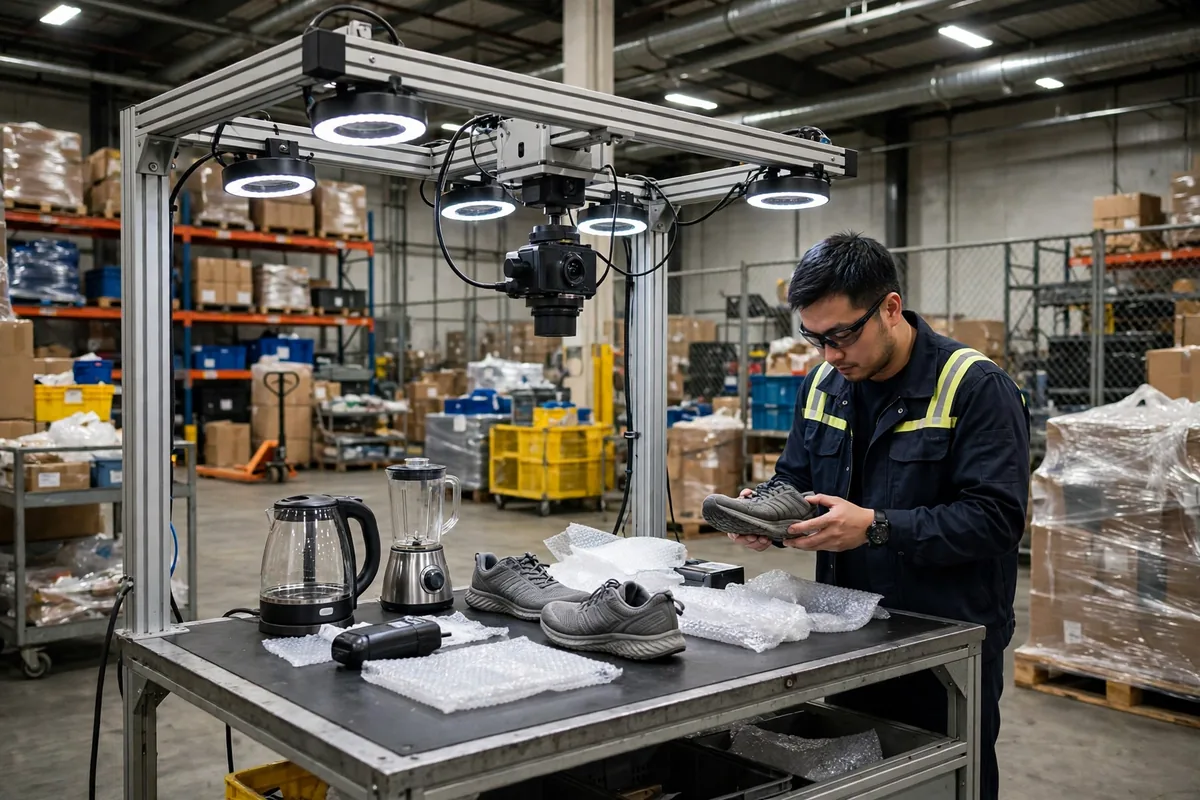
Master data sounds like consultant language, and we cannot afford consultants. But we can afford a tape measure and a bench scale, and that turns out to be enough. Never trust the spreadsheet as truth. Treat it as a draft. Take twenty SKUs at random, measure them, weigh them, scan every barcode, photograph each item from several sides, and compare all of it against the file. Mismatches are not a scandal; they are normal. Finding them during onboarding is the whole point.
Then ask three questions no spreadsheet ever answers. Are there duplicate barcodes across different products? Are there bundles, kits, and free gifts, and how are they built? When a seasonal item is discontinued, will its barcode be reused for something new? Force a named person on the client side to answer in writing. Our low-tech fix after that first disaster was a handwritten card on each new bin location, noting nicknames and lookalike warnings. It looked amateur. Wrong picks dropped noticeably in the second week anyway. Here is the counterintuitive part: during onboarding, your job is to be mildly annoying. Ask, measure, and confirm while everyone still likes each other. Once volume ramps up, nobody has time to answer, and every error lands on the warehouse.
Returns and peak forecasts: the two lines everyone skips
In March 2025 we onboarded a beauty samples client. Returns were covered in the contract with one phrase: handled per industry practice. My practice and their practice were not the same practice. I assumed opened items stayed out of sellable stock. They assumed every return would be inspected and resealed. Within a month, returns filled two pallet positions and tied up two of my people, in a team of barely a dozen, doing work nobody had agreed to pay for. We now split returns into four written buckets during onboarding: unopened goes straight back to stock, opened but unused goes to inspection, used items are held for client instructions, and damaged items are photographed and batched for a scheduled decision. Who approves each bucket, how fast it moves, and how it is charged all get settled before the first return arrives.
Peak forecasting failed us with the same client. Normal volume was about 400 orders a day, and we were assured a promotion might double it. On the first day of their June 2025 promotion, volume came in at more than four times normal, with over a thousand orders still unprinted near the carrier cutoff. I dismantled the office sofa to make packing space. A forecast does not need to be perfect, but it does need to be daily, not a single vague total. Which days spike? Which SKUs carry the promotion? Will gifts or packaging change mid-campaign? With daily numbers we can schedule temporary labor and move hero SKUs next to the packing benches. Without them, the warehouse absorbs all the risk, so we now write one sentence into onboarding: surprise volume is welcome, but the shipping promise moves with it.
Scope the systems work, and agree the exit while you still like each other
Small warehouses should not try to impress anyone with integrations. The minimum loop is four things: how orders arrive, how inventory goes back, how tracking numbers go back, and who decides when an order looks wrong. Get those four running reliably first, even if part of the flow is manual for two weeks. We once let a client insist on a full integration in week one. Order statuses stopped matching, their storefront showed orders as unshipped after the carrier already had them, and their support team chased us while we chased the data. We stabilized it by going back to manual checks. This little framework now decides our sequencing:
| Integration item | Must work at go-live | Can wait until month two |
|---|---|---|
| Order intake and cancellations | Yes, a lost order is an incident | Complex split and merge rules |
| Inventory feedback | Yes, with a rule for count differences | Second-by-second live sync |
| Tracking feedback | Yes, buyers judge you on it | Smart carrier selection |
| Exceptions | Yes, name the decision maker | Automated ticket workflows |
The last item on our 3pl client onboarding warehouse checklist is the exit clause, and it is the most counterintuitive one. The best time to discuss leaving is when nobody wants to leave. I avoided it for years because it felt unlucky, until a client announced a move with a month to spare and no agreed handover at all. Their truck blocked our door, my crew got pulled into loading it, and every other client shipped late that day. Now we agree four basics at onboarding: notice period, how stock and supplies are counted and handed over, how long goods may stay after termination, and what format data is exported in. Serious clients do not run from this conversation. They read it as a sign you plan to do the work properly.
Week one: run the client onboarding warehouse checklist as a daily routine, not a document
A checklist in a drawer does nothing. Our first week now runs on a fixed rhythm. Day one, only part of the stock comes in, and we prove receiving and putaway. Day two, we ship a small batch with a senior picker shadowing every order and logging problems on the spot. From day three, we hold a fifteen-minute call covering only three things: what went wrong, whether it is fixed, and how much volume is coming tomorrow. The log is not software. It is a whiteboard by the packing bench, problems on the left, resolved items wiped off the right. Clients trust that whiteboard more than any equipment list.
Our other proudly low-tech rule is ask before you act. If the paperwork does not say where the gift sticker goes or whether a thank-you card goes in the box, the picker photographs the item and asks in the chat instead of guessing. Confirmed answers get added to the work notes. It costs minutes in week one. Run a simple assumed example for your own site: if guessing causes twenty reworked orders a day, and each rework takes a few minutes of repacking plus possible reshipment cost, a week of that quietly eats most of a shift. Your labor rate and volume differ, so plug in your own numbers, but the direction rarely changes. Asking first is cheaper than redoing.
Small warehouses do not lose anchor clients because the building is small. We lose them when we treat the client as a rescue rope and say yes to everything. A checklist is really a way to say, while things are still friendly, what we can do, how we will do it, and what happens when we cannot. The warehouses that say it early tend to still be around next peak season. Small warehouse, small rules, said out loud. That is the whole trick.
By Xiao Ma, Small Warehouse Owner