One July morning last year, I walked into our warehouse at 6:50 AM. Southern California was already baking, and every dock door stood wide open with heat and dust rolling in. This is the story of why we finally built a vestibule. Our QA guy Lao Wang came up to me holding a sticky fly trap. "Take a look yourself," he said. "Forty-some fruit flies, just last night."
I wasn't mad at him. I was mad at us — the doors were wide open; that's where the flies came from. Fruit flies don't bite, but in a food warehouse they're a death sentence: when the auditor sees that trap, you get a non-conformance on the spot.
So here's the truth about that little room at your warehouse entrance — the vestibule. A lot of people treat it as a nice-to-have, something to build when there's spare money. Today I'm going to walk you through three lines of accounting: dust, pests, and temperature. When you're done reading, you'll see that little room isn't an expense. It's insurance.
How the Problem Found Us
Let's start with pests.
Ours is a food warehouse, and we go through an SQF audit every year. In 2023, the auditor — a veteran of twenty-plus years, impossible to bluff — walked the dock, pointed at our 20-foot-wide overhead door, and asked: "When this door is open, how do you keep insects out?"
I pointed at the air curtain above the door. "We have an air curtain."
She shook her head. "I need to see physical separation."
I went back and looked up the clause that night. SQF 11.2.7.3 spells it out: external doors in food handling areas must be insect-proofed by at least one of five methods — a self-closing device, an effective air curtain, an insect-proof screen, an insect-proof annex, or adequate sealing around trucks. The air curtain? It's also on the list, but whether the auditor believes yours is "effective" is entirely up to her mood that day.
That year we got hit with a minor non-conformance: "inadequate pest exclusion measures." A minor goes on the record — and next year's auditor will dig it up again.
Then there's temperature. Our neighbors run a cold storage facility at minus 10°F. Their manager once ran the numbers with me, using the Rite-Hite door-loss formula: one 8-by-14-foot door, 720 cycles a day, on a slow-speed door (20 to 30 inches per second), bleeds off $5,000 to $20,000 a year in refrigeration energy. That works out to about 9 cents every time the door opens, $65 a day, just gone into the air. Industry research puts warm-air infiltration through doors at up to 32% of a cold store's total heat load — nearly a third of the electric bill.
And dust? Don't laugh — dust is no joke. We had a customer packing small appliances. During peak season they sent back over 200 cartons for "surface dust exceeding spec." Root cause: dock doors standing open all day, with outdoor dust settling on freshly sealed cartons. Two hundred cartons, three people, two days of rework.
What We Tried Before Building the Vestibule
When the problem is that clear, you fix it. We went cheapest to most expensive, and I'm going to tell you about every wrong turn.
First: PVC strip curtains.
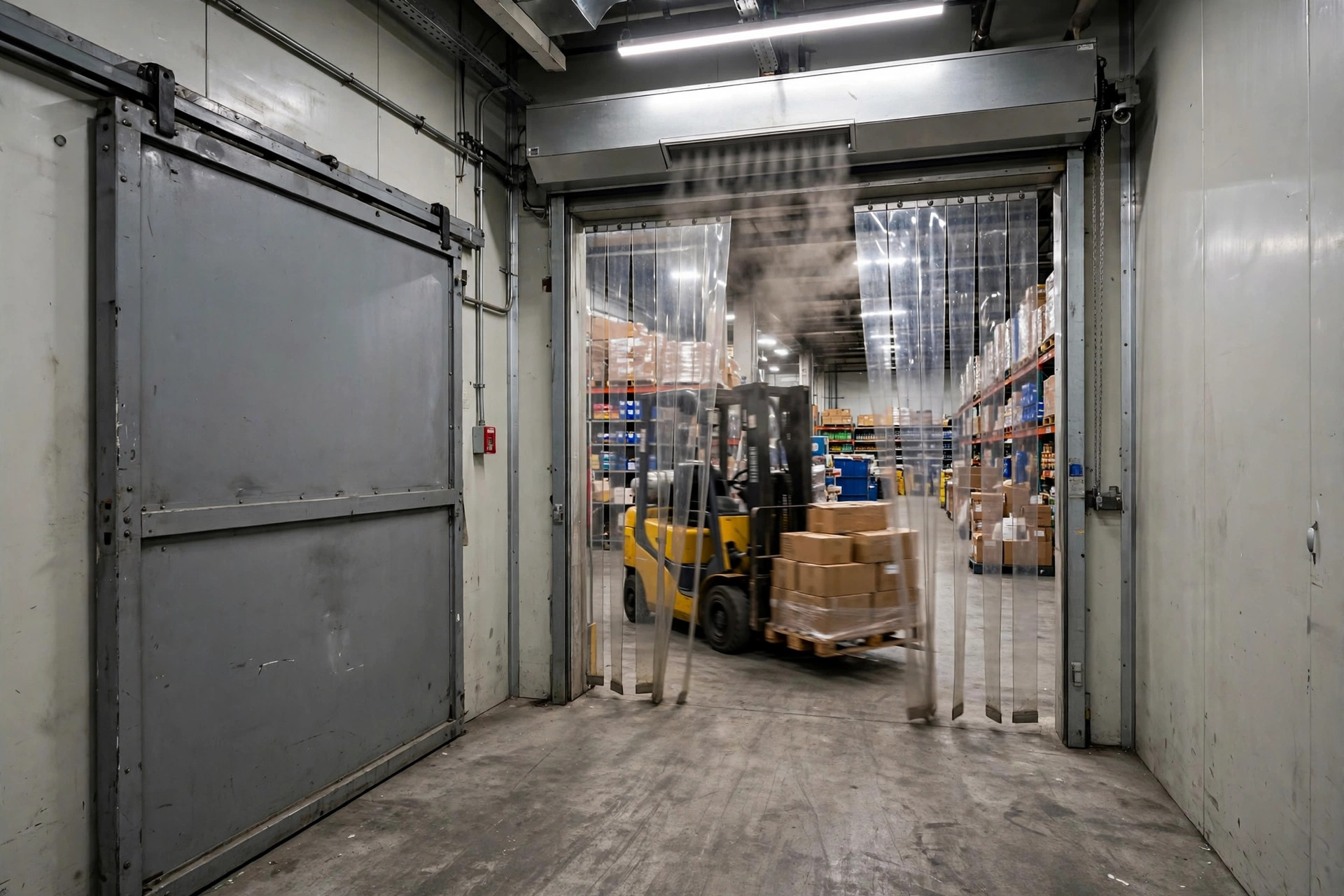
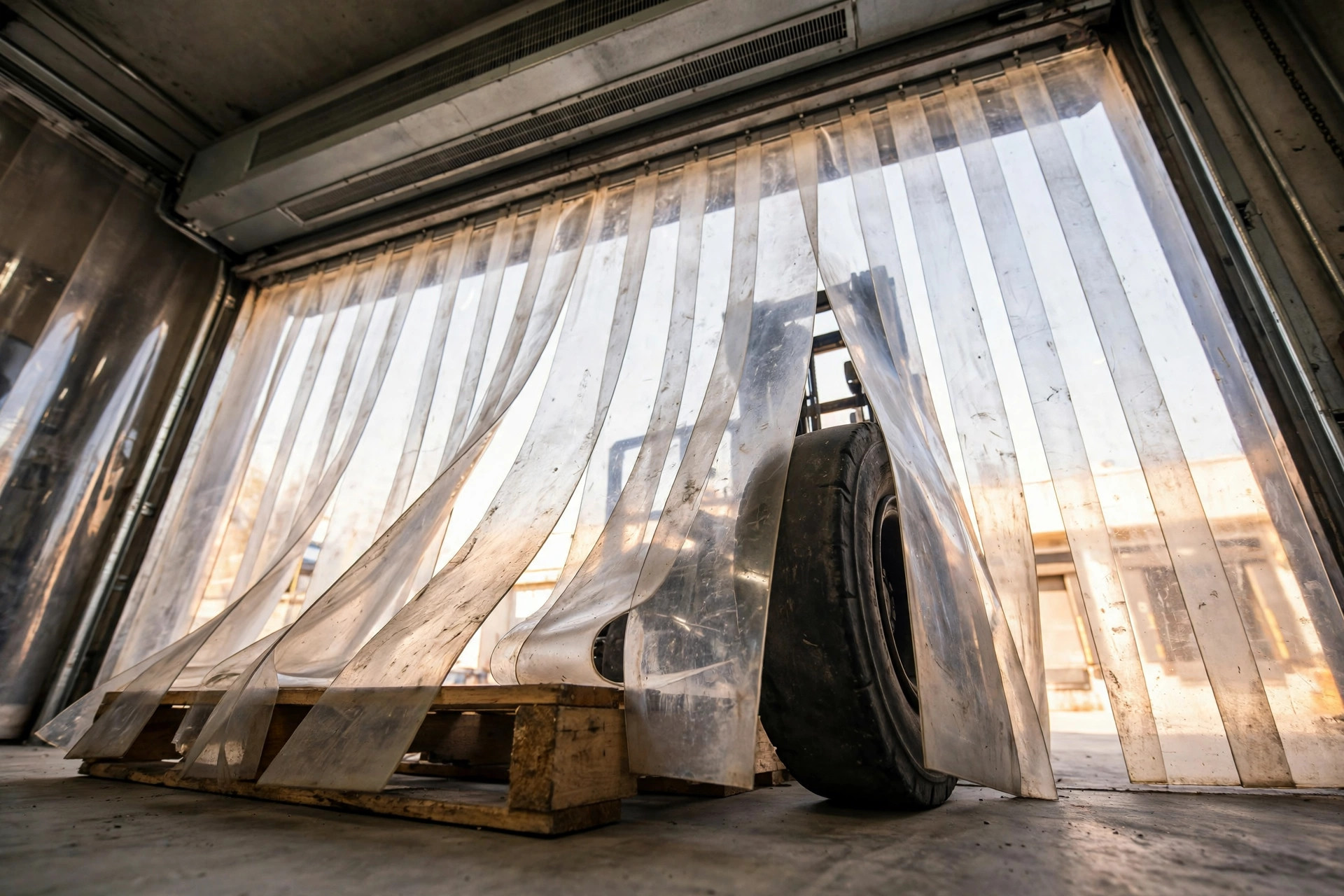
Those clear plastic strips a forklift just pushes through. Cheap — a few hundred bucks per door. We did all six doors in under a week.
The first months felt fine. Then everything went wrong at once: forklifts beating through them daily turned the strips yellow and cracked, visibility got worse and worse; drivers complained they couldn't see around corners and had to honk before every turn; and worst of all, the gaps between strips let fruit flies right through. Strip curtains are decent against dust. Against insects, they're barely better than nothing.
Second: air curtains.
We bit the bullet and put air curtains over our four main traffic doors. For an 8-by-8-foot door, the unit runs about $3,600 and up; a 12-by-14-foot door is around $8,000; a 16-by-16-foot goes to $13,300 — that's from the Illinois Statewide Technical Reference Manual, and installation costs roughly as much as the unit itself. Four doors, tens of thousands of dollars.
They worked: with the air on, dust and bugs mostly stayed out, and the summer heat was cut way down. But two problems. One: electricity and noise — do you run them 24/7 or on sensors? Sensors have a delay; 24/7 hurts the power bill. Two, and this was the dealbreaker: the auditor doesn't count an air curtain as physical separation. When the air stops or the velocity drops, insects walk right in. But auditors don't run on energy codes. They run on "I watched insects not get in."
Third: the vestibule, with interlocked double doors.
Early in 2024, we converted two main doors: a small room at each entrance, about 5 meters deep and 3.5 wide, outer and inner doors interlocked — the inner door won't open until the outer one is closed. An air curtain inside as a helper. Civil work plus two high-speed doors ran on the order of ten thousand dollars per vestibule.
That year's audit, the same auditor walked through the vestibule, nodded, and passed the pest item on the spot. "This is what I want to see," she said.
The Three Lines of Accounting
| Strip Curtains | Air Curtain | Vestibule (Interlocked) | |
|---|---|---|---|
| Equipment + install | A few hundred dollars per door | $3,600–$13,300 per unit, installation roughly equal to unit cost | Civil work + two doors, on the order of $10K+ |
| Pest exclusion | Mediocre — gaps let insects through | Good, but fails when air stops; auditors don't accept air alone | Best — physical separation, explicitly recognized by SQF |
| Temperature | Weak | Good; with a high-speed door, one door can save thousands per year in cooling loss | Best — two doors plus an air buffer |
| Maintenance | Replace strips about every 6 months | Electricity + motor upkeep | Almost zero |
| Right for | Plain dry warehouses as a stopgap | Freezer doors, tight budgets as a first step | Food, cold storage, pharma — the long-term answer |
Here's the counterintuitive part: you can't justify a vestibule on energy savings.
ASHRAE research says air curtains match vestibules on energy — even slightly better. On kilowatt-hours alone, the vestibule never wins. The real value is certainty: the audit passes the first time; pest complaints drop to zero, so nobody wakes you at midnight over a customer claim; less frost at the freezer door means forklifts stop sliding. None of that shows up on the power bill. Every line of it is real money.
And one hard truth: the biggest enemy of a vestibule isn't the insects or the dust outside. It's your own people. During peak season, drivers trying to save ten seconds will prop both doors open — wedge a pallet under the sensor and the interlock is decoration. We learned that one the hard way. So now: interlock plus an alarm. Both doors open more than 30 seconds, the alarm sounds, and the shift lead goes to find someone. Equipment plus rules.
What Our Vestibule Looks Like Today
Here's our standard practice now. Copy it if you want:
First, size. At least 5 meters deep, 3 meters wide or more. A forklift with a pallet must drive all the way in so the outer door can close before the inner one opens. If the tail is still hanging outside, the vestibule is pointless.
Second, interlocked double doors are the baseline; the air curtain is the bonus. The interlock guarantees at most one door open at a time — that's the soul of physical separation. The air curtain covers the few seconds the inner door is open. Together, they're the best combination.
Third, nothing gets stored in the vestibule. We tried using it as temporary staging at first — pallets everywhere, doors propped open again. Now the rule: nothing in the vestibule except a fire extinguisher. The shift lead's daily walk starts there.
Fourth, maintenance is almost laughably simple: wipe the interlock sensors once a month, check the door seals twice a year. Way less hassle than air curtains.
One last reminder for fellow operators: if you run a food warehouse, cold storage, or pharma, a vestibule isn't "whether" — it's "when." Standards only get stricter, and pest and temperature bills only get bigger. Build it early and sleep well. Build it late, and you'll be the one explaining things to the auditor. I've done enough explaining.
By Chen Feng, Warehouse Operations Manager