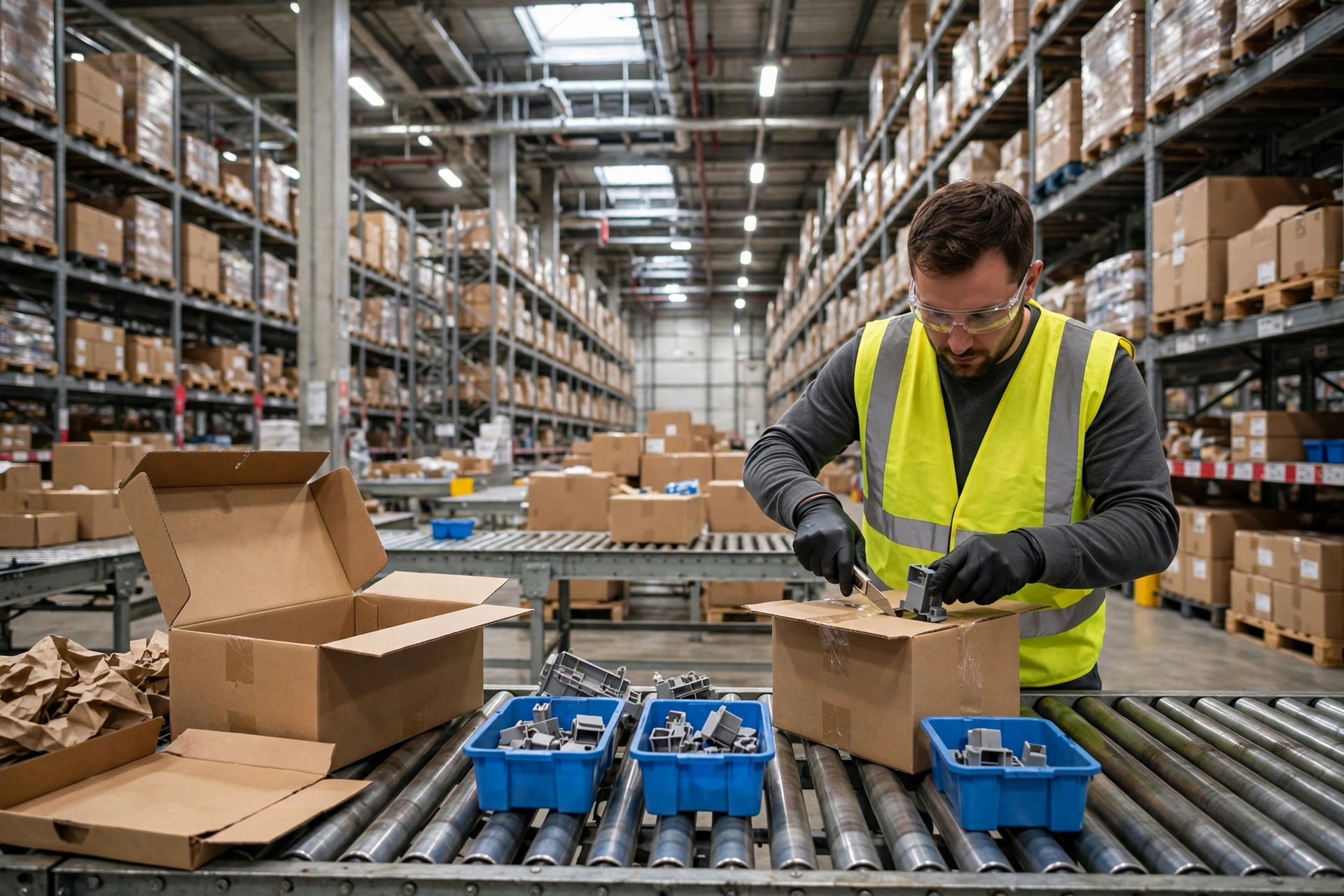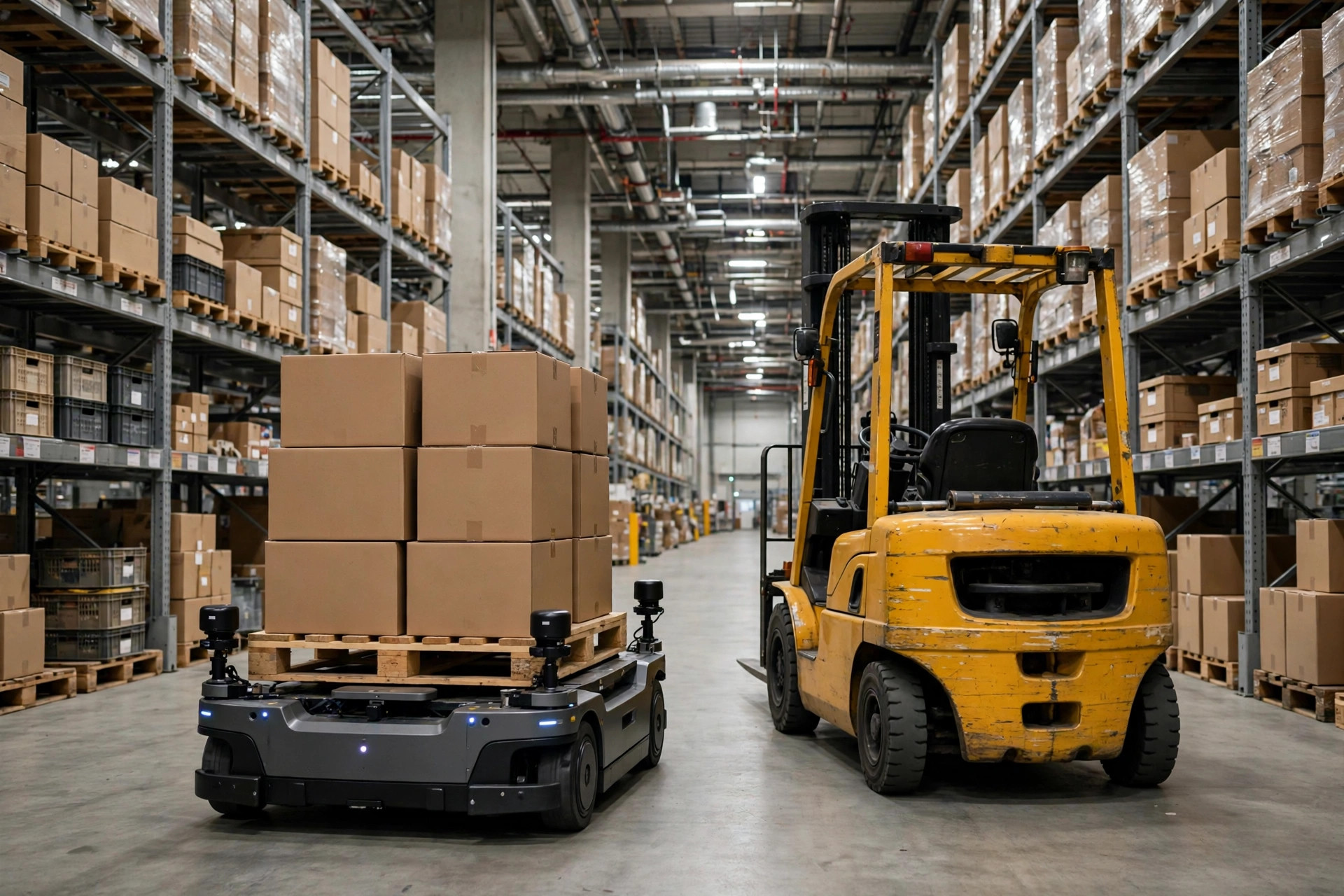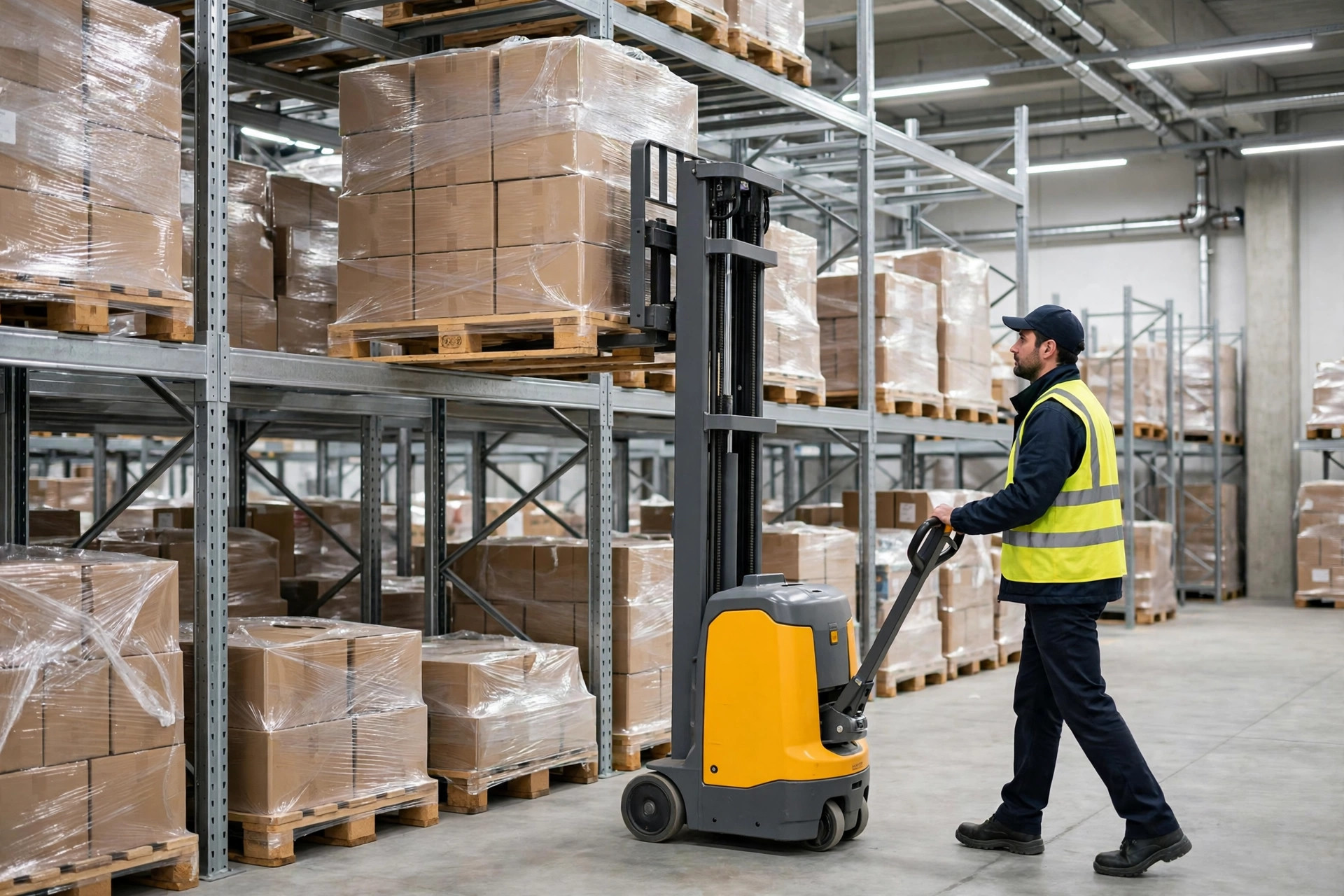
Walk into a typical regional distribution warehouse and you will see this: in front of racking with beam heights of 2.7 meters, a $40,000 sit-down counterbalance forklift lifts a pallet of paper towels to the second beam level. Total lift height: under 2.5 meters. The same motion repeats hundreds of times a day in that building. That is the phenomenon I want to examine: a huge share of low-level stacking work — everything under 3 meters — is being done by seriously over-specified equipment.
First, a boundary needs to be drawn. We previously discussed whether electric pallet jacks can replace forklifts; that piece was about pure ground-level horizontal transport — moving a pallet from point A to point B, never lifting it onto racking. This article is about stacking work only: jobs where the pallet must leave the ground and land on a beam. The selection logic for the two tasks is entirely different, and the math has to be done separately.
The numbers: how far apart are walkie stackers and forklifts, really
According to IMARC's U.S. stacker market report, mainstream electric walkie stackers transact in the U.S. market in a band of roughly $5,000–$15,000; industry buying guides put entry-level models at $4,500–$9,000. A new electric counterbalance forklift (Class I), according to pricing research published by climbtheladder, sells for $20,000–$45,000 in standard capacities — and that excludes the battery and charger, with a lead-acid battery plus charger adding another $2,500–$5,000. On purchase price alone, the medians differ by roughly a factor of three.
On capability, the data is equally clear. Per industrysearch's selection guide, standard electric walkie stackers cover lift heights of 2.5–3.5 meters, with high-spec models reaching 5.5 meters, and throughput of roughly 30–60 pallets per hour. In other words, beam levels under 3 meters are a standard walkie stacker's comfort zone, not a stretch.
Then there is the cost of keeping the machines running. The same buying-guide data puts annual servicing for an electric walkie stacker at roughly $150–$500; for a counterbalance forklift, $500–$2,500 per year, with electric-model battery replacement every 5–7 years costing $2,000–$6,000. Training is a wash — OSHA 29 CFR 1910.178 requires certified training for all powered industrial truck operators before they touch the controls, stackers and forklifts alike. That cost cannot be avoided either way.
| Factor | Electric walkie stacker | Electric counterbalance forklift | | Purchase price (USD) | 5,000–15,000 | 20,000–45,000 (excl. battery & charger) | | Typical lift height | 2.5–3.5 m | ~4.5 m | | Annual servicing (USD) | ~150–500 | ~500–2,500 | | Aisle requirement | Narrow, fits tight layouts | Wide, needs turning radius | | Operator certification | Required per OSHA 1910.178 | Same |
Case: the 3PL warehouse in the Inland Empire
In early 2024, a roughly 80,000-square-foot 3PL warehouse in California's Inland Empire asked us to audit its equipment. Beam height across the building was a uniform 2.7 meters, yet the fleet was eight sit-down counterbalance forklifts handling unloading, stacking, and shuttling — everything. The audit method was deliberately crude: ride along for two weeks and record the actual lift height of every pick. The result: every stacking move peaked below 2.9 meters; the only work exceeding 3 meters was the occasional high-cube trailer unload.
The revised plan: keep four forklifts dedicated to unloading and high-level exceptions, and hand the rest of the stacking work to six electric walkie stackers. Using public market prices, the original eight-forklift fleet represented roughly $280,000 in acquisition spend; the new mix came to about 4 × $35,000 + 6 × $10,000 = $200,000 — around $80,000 saved at purchase. More importantly, the smaller stackers eliminated the waiting for aisle clearance, and peak-season stacking pace actually improved. (Investment figures are my estimates from public price ranges; the warehouse did not authorize disclosure of actual purchase prices.)
A second case comes from an e-commerce returns processing warehouse in the Midwest. Returns racking stood only 2.4 meters tall, and off-season daily stacking stayed under 100 pallets — yet a $40,000-plus forklift sat there as a dedicated machine. After switching to a walkie stacker, the forklift driver was freed up to support the unloading line, and the returns-stacking backlog went from a two-day average to same-day clearance. No new equipment was added; the bottleneck simply moved elsewhere.
Attribution: why warehouses keep buying one size too big
With the data this clear, why do most warehouses still run all-forklift fleets? My attribution has three parts. First is procurement psychology: "what if we raise the racking someday" — paying today for a future that may never arrive. Second is sales incentives: the margin and aftermarket value of one forklift dwarf those of one walkie stacker, so dealers have no reason to talk you down. Third is management inertia: one truck type, one training program, one spare-parts list is the easiest thing to manage. And the easiest thing to manage is often the most expensive.
Four dimensions to draw the walkie stacker selection line
Taken together, selection can be decided along four dimensions:
First, lift height. At 3 meters and below, you are in walkie-stacker territory; above 3 meters — especially above 4.5 meters — hand the job to a reach truck or a counterbalance forklift. Second, load weight. The 1–1.5 ton band is the mainstream walkie stacker's sweet spot; routine 2-ton-plus pallets still belong to forklifts. Third, aisle width. In narrow aisles with frequent passing, the stacker's small footprint is a hard advantage. Fourth, task purity. If stacking is a standalone, repetitive, fixed task, the walkie stacker wins on economics; if one truck must also unload trailers, shuttle pallets, and reach high bays, the forklift's versatility earns its price.
The counterintuitive judgment is this: many managers believe "one forklift does everything" is the cheapest option, when in fact it is the highest total-cost-of-ownership option — you pay multiples of the purchase price and servicing cost, for years, to insure against a "what if" that never happens. Flexibility that is never used is not an asset. It is inventory.
On trends, lithium batteries are erasing the walkie stacker's last weakness: fast charging and opportunity charging, with no battery-swap infrastructure needed. The stacker's comfort zone will only widen in the coming years, not shrink.
At your next equipment procurement review, try writing "what is the maximum lift height this truck actually needs?" on the whiteboard first. If the answer stays under 3 meters for the long run, the question is no longer "should we buy a walkie stacker" — it is "why are we still using a forklift for this work?"
By Dr. Chen, Supply Chain Researcher