Start with the math. A US e-commerce seller shipping 50,000 parcels a month pays an average of $14.80 per parcel at list rates. With a negotiated agreement at a 32% discount, that drops to $10.06. The difference, $4.74 per parcel, is $237,000 a month and $2.84 million a year. That money is not saved. It is negotiated. (Figures in this article are illustrative; always check the carriers' official sites for current rates.)
Here is the uglier version of the same math. Two sellers, each shipping roughly 50,000 parcels a month with nearly identical weight profiles. One spends $6.1 million a year on parcel. The other spends $4.8 million. The $1.3 million gap between them is the price of negotiation skill. Parcel negotiation is not haggling. It is accounting. These are the six levers, one at a time.
1. Take the bill apart: the discount is the tip of the iceberg
Break a single parcel shipment into its parts. Typical cost structure for an e-commerce parcel (order-of-magnitude illustration):
| Cost component | Share of total bill (illustrative) |
|---|---|
| Base rate (after discount) | About 60 to 65% |
| Fuel surcharge | About 8 to 12%, adjusted weekly |
| Residential delivery surcharge | About 6 to 9% |
| Remote area, oversize, overweight surcharges | About 8 to 12% |
| Address correction, rerouting, returns, misc. | About 5 to 8% |
The "how many points off" number your sales rep loves to discuss applies only to the first row, under two-thirds of the bill. The surcharges below it default to full standard price. Nobody negotiates them for you automatically.
Then there is the quieter problem: the base itself. Both carriers announce their annual price adjustments each fall, and the increase applies to the list rates your discount multiplies. Your discount percentage stays the same while the number it multiplies keeps climbing. That is why a "good discount from last year" still produces a bigger bill this year. The discount is the multiplier. The base is what gets multiplied.
2. The six levers
Lever one: volume commitments, trading certainty for price
Discount tiers are wholesale pricing in disguise: the more volume you commit, the lower the unit price. A useful way to think about the ladder (illustrative):
| Annual committed volume | Discount tier (illustrative) |
|---|---|
| Under 50K parcels | Standard agreement pricing |
| 50K to 150K parcels | One tier up |
| 150K to 400K parcels | Two tiers up |
| Above 400K parcels | Custom negotiation |
But a commitment in a contract comes with a true-up. Miss the volume and the carrier can claw the discount back, in writing, no sentiment involved. My rule: commit at 80% of your trailing twelve-month actuals, keep the headroom to earn overage incentives, and negotiate peak-season overflow separately. Inflating your forecast to reach a tier is the most expensive mistake in parcel negotiation.
Lever two: zone mix, where your warehouse sits matters more than your discount
The same 5-pound ground parcel costs dramatically different amounts by destination zone (illustrative):
| Destination zone | Effective per-parcel cost (illustrative) |
|---|---|
| Zone 2 (same state and neighbors) | About $8 |
| Zone 5 (halfway across the country) | About $11 |
| Zone 8 (coast to coast) | About $14 |
A Zone 8 parcel costs nearly 1.7 times a Zone 2 parcel. Three days of grinding your rep for two more discount points is worth less than shipping East Coast orders from an East Coast warehouse. I have watched sellers consolidate everything into one warehouse to save on rent, then lose two to three times those savings to long-zone freight. Penny-wise math with dollar-scale consequences.
Lever three: surcharges, where the real margin lives
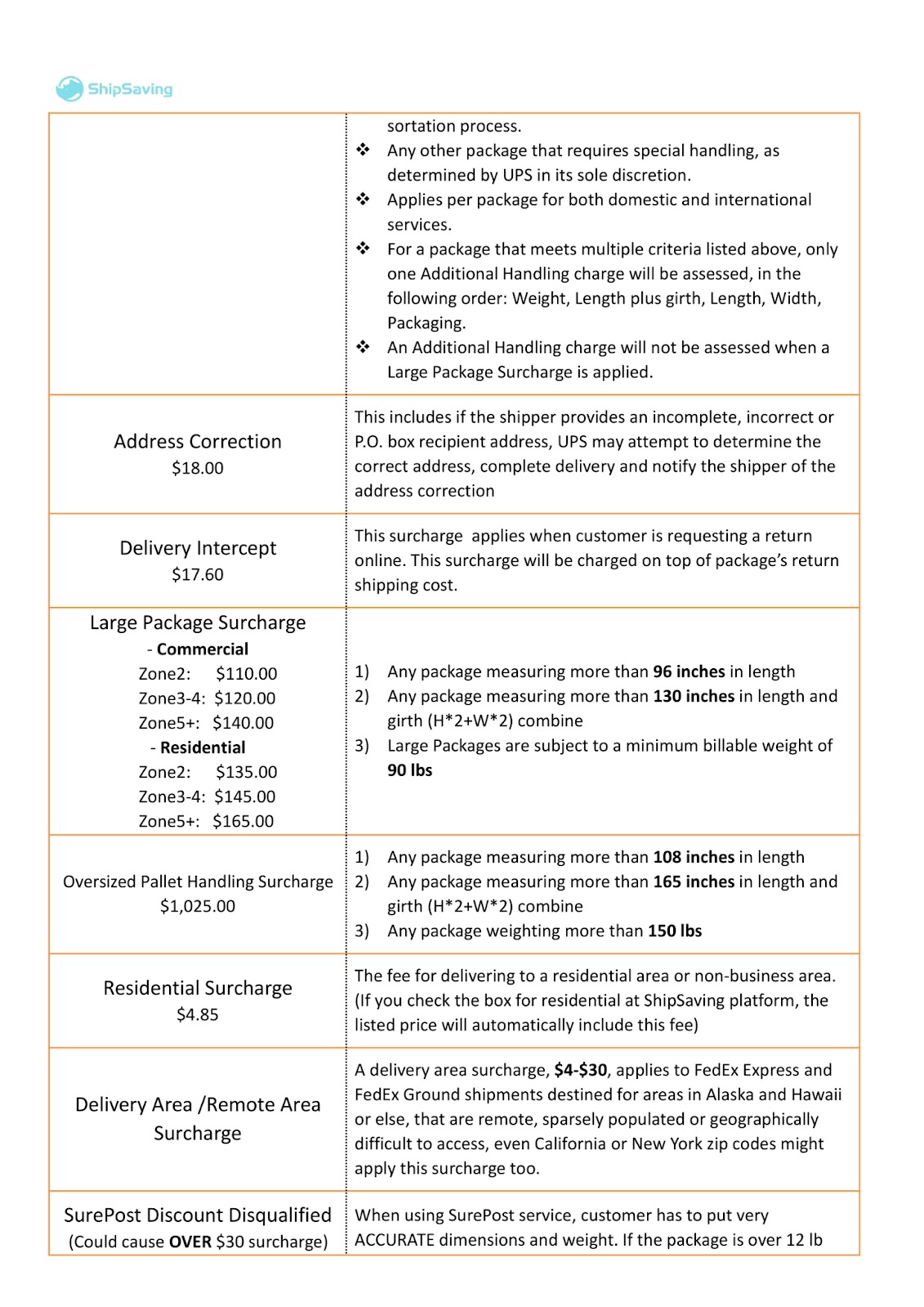
In March 2025, a home-goods e-commerce seller in Ontario, California, shipping about 2,000 parcels a day on a single carrier, had what looked like a healthy base discount. Then we pulled three months of invoices and broke them down line by line: surcharges were 31% of total freight spend. Residential delivery, delivery area surcharges, and oversize fees were the big three, and every one of them was billed at standard price. None had ever been negotiated.
We walked into the renegotiation carrying that breakdown, and the conversation changed completely. All three surcharges were brought under the discount schedule, and the monthly bill dropped about 12% (illustrative estimate). The rep had started out willing to move only on the base rate. Itemized data moved the table.
Your surcharge negotiation checklist: residential surcharge reduction percentage, delivery area surcharge relief, oversize and overweight thresholds, and address-correction fee treatment. One principle to remember: every dollar negotiated off a surcharge is pure margin, because it was 100% cost to begin with.
Lever four: competitive bidding, always keep a second option
In November 2024, a consumer-electronics accessories seller in Dallas, Texas, at roughly $4 million in annual parcel spend and a single-carrier history, moved 40% of its volume to a second carrier for a three-month trial ahead of renewal. At the renewal table, the incumbent voluntarily cut its overall effective rate by about 9% (illustrative estimate).
The second carrier does not have to be cheaper. Its existence is the discount. A single-carrier setup is a voluntary surrender of pricing power. The extra reconciliation work of running two carriers is the cheapest insurance you will ever buy.
Lever five: the annual review, start 90 days before renewal
The annual price adjustments land every fall, and the announcement is your cue to rebuild the math. Bring three things to the review: twelve months of itemized invoices, how your zone mix shifted, and your volume growth data. Never let a contract auto-renew; auto-renewal terms are written for the carrier, not for you. Run a formal review at least once a year. Even if only the surcharge terms move, the hours pay for themselves.
Lever six: payment terms and invoice auditing, the overlooked cash
Terms are about cash flow: Net 15 versus Net 30, for a seller spending hundreds of thousands a month on freight, is hundreds of thousands of dollars sitting in your account half a month longer.
The more tangible win is the monthly audit. Duplicate billing, mis-keyed weights, wrong zones, these errors show up in parcel invoices more often than most finance teams expect. Half a day a month with a spreadsheet and the carrier's online invoice detail, and the recovered refunds drop straight to profit. No software required.

3. The counterintuitive part: a bigger discount number does not mean a cheaper bill
Look at this comparison (illustrative figures):
| Carrier A | Carrier B | |
|---|---|---|
| List rate | $15.00 | $13.50 |
| Agreement discount | 70% | 62% |
| Discounted base | $4.50 | $5.13 |
| Average surcharges per parcel | $3.20 | $2.10 |
| Total cost per parcel | $7.70 | $7.23 |
Carrier A with its 70% discount looks like the winner, but lands $0.47 more expensive per parcel. A discount percentage multiplies each carrier's own list rate, and the two list rates were never equal to begin with. The only number that matters in a negotiation is the effective rate per parcel, not the discount figure. The rep shows you the discount. You do the total math yourself. The table does not lie about whose money was wasted.
4. A conclusion you can calculate
Before you negotiate, work through this checklist in order:
| Action | Decision rule | Which lever to pull first |
|---|---|---|
| Pull three months of invoices, isolate surcharge share | Above 25% | Lever three: surcharges |
| Map your zone distribution | Zones 7 to 8 above 30% | Lever two: fix the warehouse network |
| Compute your effective per-parcel rate | Above your gut benchmark | Lever four: introduce competition |
A rough formula for annual negotiable room: annual freight spend x (surcharge share x 30% + zone optimization room x 20% + competitive bidding pressure x 10%), where the percentages in parentheses are experience-based magnitudes, not promises. For a seller spending $5 million a year on parcel, working those three levers routinely unlocks $500K to $1M in annual profit. Negotiation is not haggling. It is accounting. Get the math right and the discount follows.
By Lao Zhou, Logistics Cost Analyst