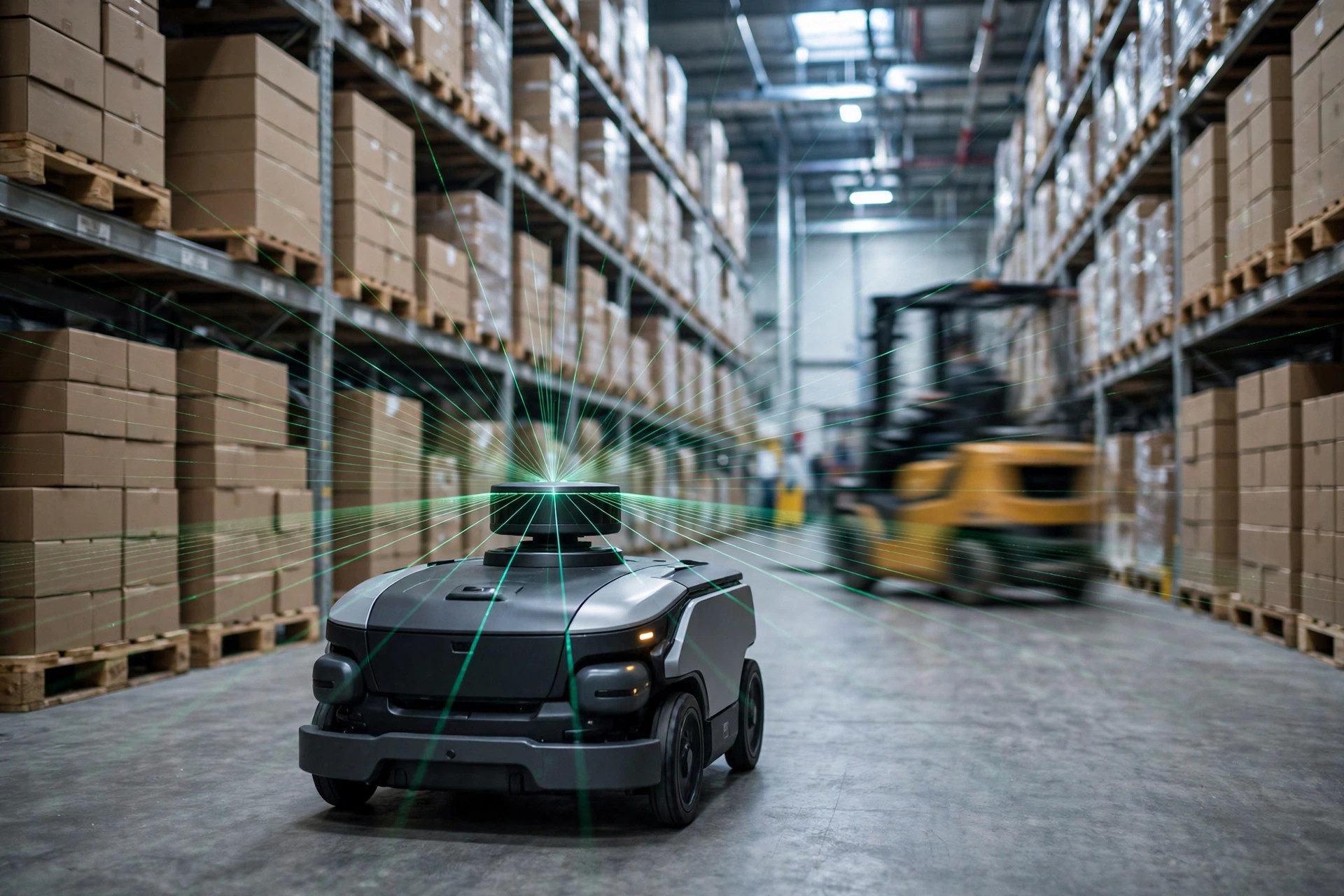
It was a night shift in the fall of 2023, at a 3PL warehouse in eastern China. The shift lead called me: one AMR in aisle 4 had "gone crazy" — spinning in circles at the aisle entrance, pausing, spinning again, while six robots queued up behind it and the whole picking line ground to a halt. I asked him to send a photo of the floor. One look and I laughed: a forklift pallet corner had ripped a chunk off the QR navigation sticker. The robot wasn't crazy. It was blind.
That's the cheapest and most fragile link in QR-code navigation: a sticker worth a few cents decides whether a six-figure robot can see. Today I'm going through the whole thing in one shot — how it works, the four ways floor codes die, how to inspect and repair them, and when to just switch to laser SLAM.
How QR navigation actually works
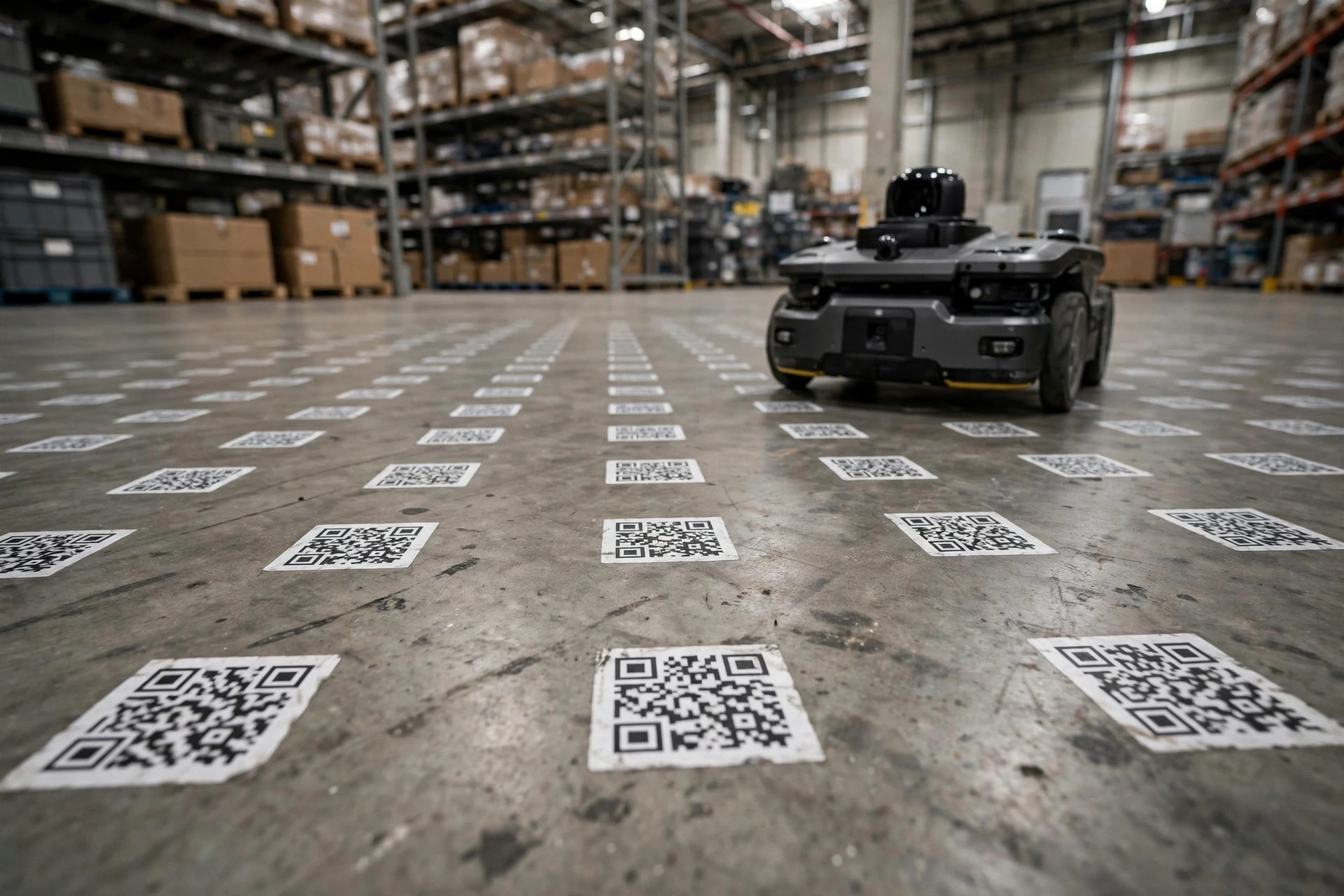
The principle is dead simple. The AMR carries a downward-facing industrial camera on its chassis, snapping pictures of the floor as it drives. The floor is tiled with QR code stickers on a fixed grid, each one encoding a global coordinate. Think of it as scattering a handful of stars across the floor — the robot can't look up at the sky, so it looks down and counts stars to figure out where it is and how far its heading has drifted. You can think of it this way: laser SLAM navigates by looking up at the ceiling and walls; QR navigation navigates by looking down at the floor.
The upside is accuracy at low cost. From my project experience, QR navigation delivers repeat positioning accuracy within plus-or-minus one centimeter, each sticker costs next to nothing, and tiling a whole site costs an order of magnitude less than putting a lidar on every robot. That's why most e-commerce and 3PL warehouses rolling out AMRs a few years back went with QR codes.
But the tradeoff is written all over it: the robot's eyes are on the floor, so whatever the floor looks like is whatever the robot sees. The moment the floor has a problem, the robot goes blind first.
The four ways floor codes die
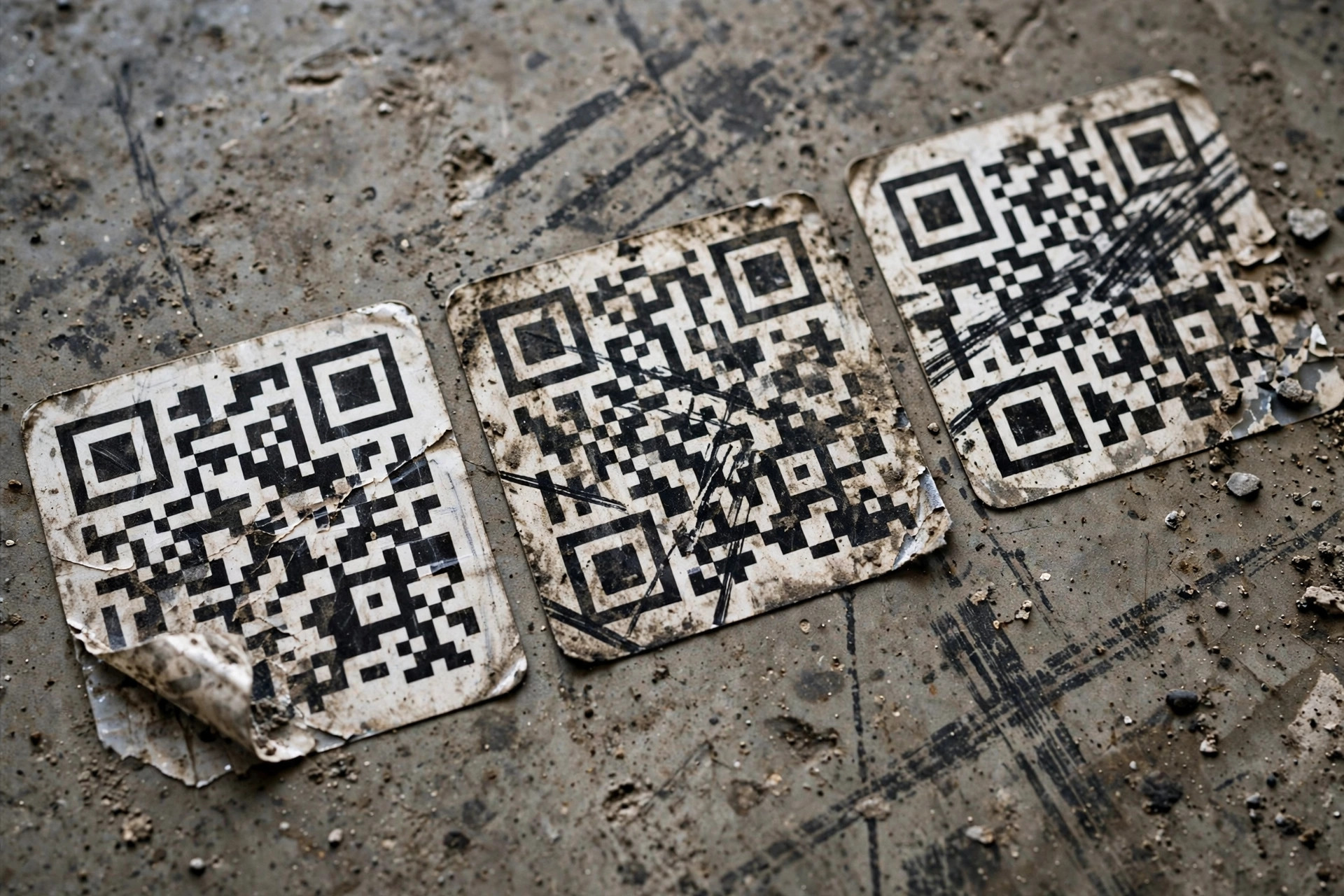
Death number one: peeling. The most common one. Stickers are glued to epoxy flooring, forklifts roll over them all day, temperature swings and ground moisture creep in, corners lift first, and once a corner lifts, a pallet corner or a forklift wheel catches it and rips the whole thing off. From my project experience, a 20,000-square-meter site with medium forklift traffic loses roughly 5% to 10% of its stickers a year. Sounds small — until you multiply by several thousand stickers site-wide and realize you're replacing hundreds a year.
Death number two: glare. Fresh epoxy flooring shines like a mirror. Around midday the skylights turn sticker surfaces into mirrors, the downward camera blows out its exposure, and the code becomes unreadable. Think of it as trying to read your phone screen while facing the sun — the camera has exactly the same problem. This one is infuriating: the sticker is perfectly fine, nothing is broken, but from 11 a.m. to 2 p.m. the robots keep losing codes at the exact same spots.
Death number three: oil and dust. QR codes carry built-in error correction — the public coding standard tolerates roughly 30% of the code area being obscured before decoding fails. Warehouse floors are never clean: hydraulic oil, tire dust, cardboard debris, layer after layer. The worst I ever saw was an auto-parts warehouse where the oil sludge on the codes was 2 millimeters thick. The camera was photographing a black pancake.
Death number four: crushing and deformation. Stickers are flat. After repeated passes by loaded forklifts, the surface wrinkles and scratches, the code's geometry distorts, and the decoder can't recognize it. Note this is physical deformation — wiping doesn't fix it. Replace only.
In early 2024, an apparel e-commerce warehouse in southern China called me in for a rescue. The symptom was pure voodoo: every day around 3 p.m., two or three robots would throw lost-code alarms at the entrance of Zone B. Reboot, fine. They'd chased it for a month. I spent an afternoon on site and found it: a row of skylights on the west side of Zone B, and at 3 p.m. the sun angle was exactly right to throw a band of glare across those stickers. The fix was embarrassingly low-tech: swap those six stickers for matte-laminated ones. Problem gone. A month of labor, over six stickers worth a few cents each.
Inspection, repair, spares: turning folk wisdom into a routine
QR codes aren't a technology problem. They're a management problem. Here's a field-tested routine:
Inspection cadence: high-traffic lanes (shared by forklifts and AMRs) get a full sweep monthly; low-traffic zones quarterly. The tool doesn't need to be fancy — a phone works. Open any scanner app, scan each code; instant reads are healthy, failures get logged. From experience, two people can sweep a 20,000-square-meter site in a day.
Replacement rule: three triggers, any one means swap it — ① a corner lifting more than 1 cm; ② visible contamination covering more than a third of the code face (don't live on the 30% error-correction edge); ③ surface scratches that push scan time past 2 seconds. Don't cry over a sticker worth pennies; one line stoppage costs thousands. Even a schoolkid can do that math.
Spares: keep 10% of the site's total sticker count in stock. Adhesive has a shelf life — glue goes bad after about a year, so don't hoard two years' worth. Photograph every sticker at install time, match position numbers to the coordinates in the WMS, and replacements become a ten-minute job: find the photo, peel, stick.
And here's the counter-intuitive one: the biggest enemy of QR codes isn't technology — it's the cleaning crew's mop. I've seen more than one warehouse where janitors mopped with strong-acid cleaner, soaking the stickers, and the adhesive was dead across the whole site in three months. One sentence to the cleaning crew — "don't soak the stickers" — beats any technical solution.
When to switch to laser SLAM: the dividing line
Someone always asks: this is such a hassle, why not just switch everything to laser SLAM? Do the math first, then I'll start ranting.
| QR navigation (annual upkeep) | Laser SLAM (one-time retrofit) | |
|---|---|---|
| Hardware cost | Stickers cost pennies; a full 20,000 sqm site runs to tens of thousands (project-experience figure) | Lidar plus retrofit adds tens of thousands per robot |
| Annual upkeep | Inspection labor plus replacement stickers: thousands to low tens of thousands a year | Near zero (no floor consumables) |
| Environment needs | Clean, non-glaring, low-oil floors | No floor requirements, but struggles with mirrored glass walls and wide-open featureless areas |
| Accuracy | Within ±1 cm | Typically ±2–3 cm |
| Route changes | Re-stick plus re-survey, half a day minimum | Edit the map in software, minutes |
The dividing line is clear: filthy floors (heavy oil, brutal forklift traffic, uncontrollable cleaning), annual sticker replacement above 15% of the site total, or routes that change every other week — hit two of three, and stop fighting QR codes; switch to SLAM. Flip side: brand-new epoxy floor, routes that sit still for half a year, and someone willing to inspect monthly — QR's accuracy and cost advantage will beat SLAM senseless.
One last rant, aimed squarely at pseudo-requirements. Every time I give this talk someone asks: "Can we just stick the codes denser?" "Can we put little metal cages over them?" Stop. Denser codes mean the robot looks down and sees nothing but codes — decode compute doubles and the robot runs slower. A metal cage glares worse than the sticker itself; that's pants-off-to-fart engineering. In navigation, less is more. Good enough is good enough.
Whether the money is worth it comes down to one number: what one AMR costs you per year for QR codes (stickers plus its share of inspection labor). If that's more than 5% of the robot's annual depreciation, your floor was never suited to QR in the first place — switch to SLAM sooner rather than later. If it's under 2%, follow the routine above, and this humble approach will serve you another five years.
By Da Liu, Automation Engineer