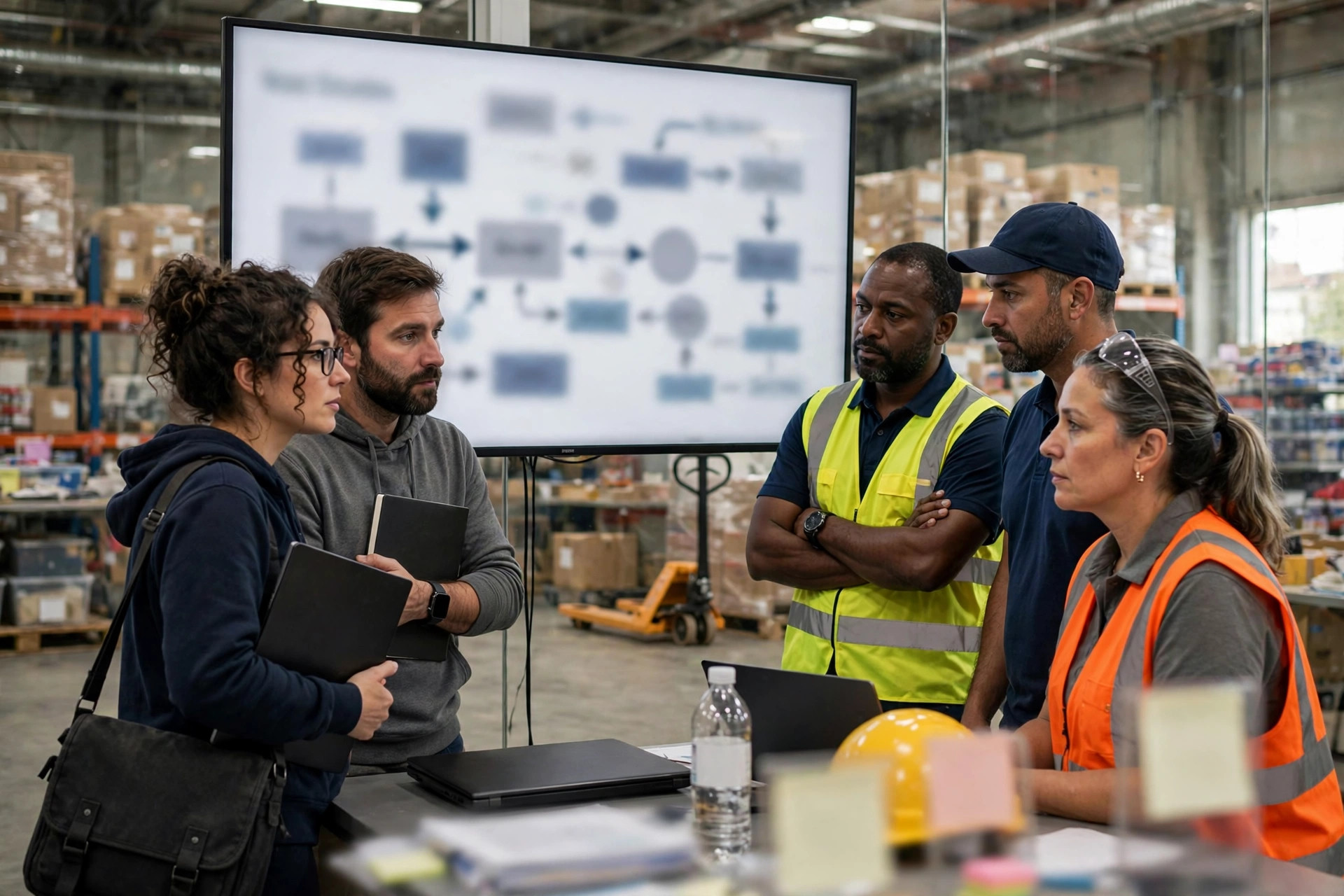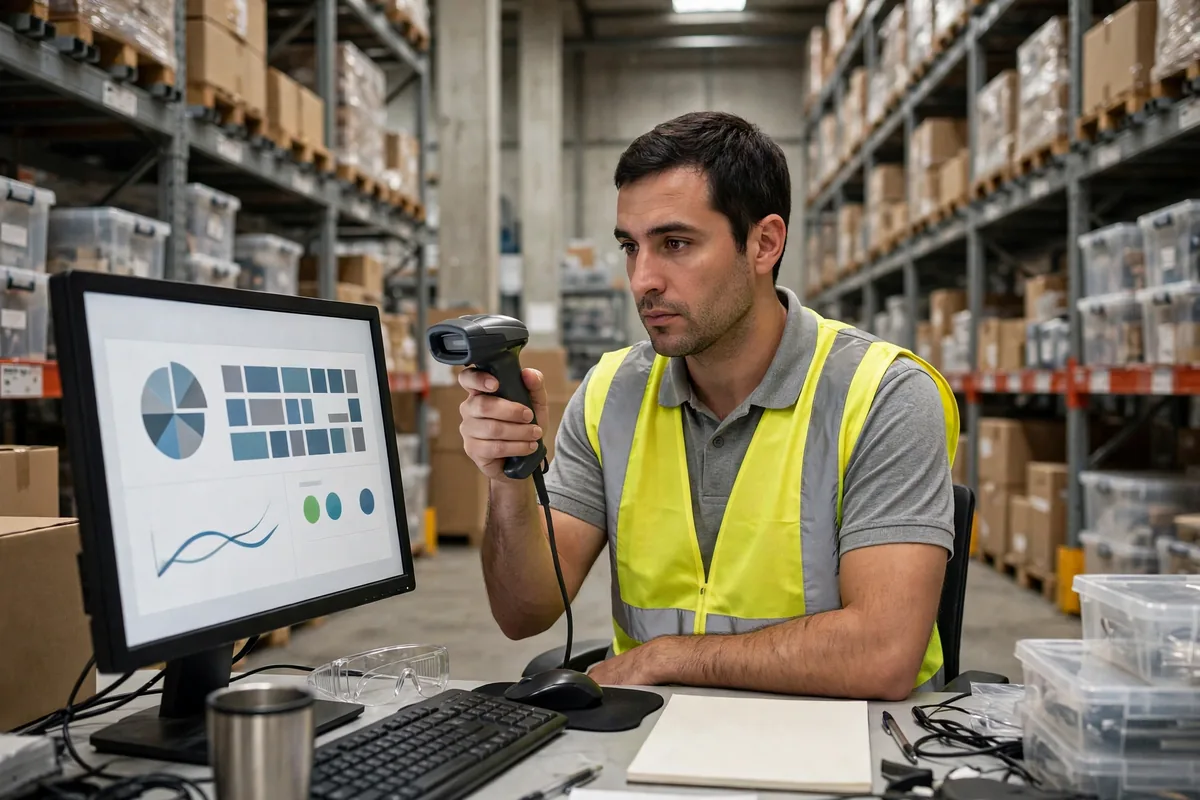
Warehouse Wi-Fi coverage is never uniform, and that is exactly the problem offline picking has to solve. The gaps between high-bay racking, the far side of thick cold-storage walls, and the depths of dense metal shelving are precisely where signals weaken, and they are precisely where picking happens. This produces a paradox that has grown sharper as mobile picking has spread: handheld terminals now carry tasks, location guidance, and barcode validation, so the deeper the dependence on connectivity, the higher the cost of the moment it drops. Offline picking grew out of this contradiction. It lets a handheld keep working while disconnected and syncs the data back when the network returns. But its real difficulty is not whether scanning works offline. It is whether the data reconciles after reconnection.
How Offline Picking Works: Local Cache and Conflict Resolution
The architecture breaks into three layers. The first is local caching: while connected, the terminal downloads the shift's tasks, location data, and product master data, so that during an outage the picker still sees task lists, location suggestions, and validation rules from local storage. The second is local recording: every scan, confirmation, and exception report during the outage is written to a local database with timestamps and device identifiers. The third is conflict merging: when connectivity returns, local records upload to the server, which merges them against data created in the meantime by other terminals and other parts of the operation, resolving conflicts under preset rules.
The key point is that conflicts are not edge cases in offline mode; they are the normal state. Two examples illustrate why. In the first, a task is claimed twice: picker A claims a task while offline, while picker B, on a connected terminal, claims the same task at the same time. On sync, the system must decide whose work stands and how the duplicate is voided or merged. In the second, inventory counts race: picker A picks 20 units from a location while offline, and in the same window a stock counter adjusts that location's book quantity from a connected device. A naive overwrite on sync erases one side's real work.
Two Field Scenarios: What Happens During an Outage
The first scenario comes from a third-party warehouse in eastern China. During peak season in 2024, a wireless access point serving the high-bay area failed, leaving about 12 of 40 handheld terminals disconnected for nearly two hours. The shift already running offline picking kept working and completed roughly 300 order lines during the outage. After reconnection, the system flagged 17 conflicts, most of them duplicate task claims resolved automatically under a "first finisher wins" rule, with 3 inventory discrepancies routed to manual review. The shift supervisor's retrospective put it plainly: production did not stop, but reconciliation added about an hour. That hour is part of the true cost of offline capability.
The second scenario is a failure, and it is the more instructive one. Another warehouse launched offline picking without a conflict plan. During an outage, two shifts each picked part of the same wave's orders. On sync, the system applied a last-write-wins rule by timestamp, marking some order lines as picked when the goods had never left the shelf. The discrepancy surfaced only at verification, and the rework took half a shift. The lesson is not about vendor selection. It is that conflict policy must be written into the operating procedure before go-live: where automatic merging stops, which conflicts go to manual review, and within what time limit. These decisions belong in the rollout plan, not in the post-incident review.
The Rollout Path: From Pilot to Full Deployment
The first step is to scope what goes offline. Not every task suits it. The prudent starting point is picking and verification, which are read-heavy and write-light. Wave release, inventory adjustment, and cross-dock shipping, which touch global state, should stay online at first. The narrower the initial scope, the lower the rollout risk.
The second step is to choose a conflict policy and document it. Three common policies are timestamp priority, server-state priority, and manual-review priority. What I observe in practice is that most warehouses land on a hybrid: task-claim conflicts resolve automatically by timestamp, quantity conflicts go to manual review, and any discrepancy touching money or a customer promise always goes to a person. Once chosen, the policy should be configurable and auditable in the system, not hard-coded where nobody can find it.
The third step is an outage drill. A real drill is not unplugging a switch to see whether scanning still works. It simulates a genuine shift: one hour offline, two shifts working in parallel, reconciliation afterward. Record three metrics: order lines completed during the outage, conflicts flagged after sync, and manual review time. These three numbers are the ones management should keep tracking after go-live.
The fourth step is full deployment, paired with a fallback plan: how the terminal warns when sync fails, how long stale data triggers an alert, and under what extreme conditions manual data entry is permitted. A fallback plan looks useless on quiet days and decides recovery speed on bad ones.
A Decision Framework: Does Your Warehouse Need Offline Picking?
Four dimensions determine whether the investment pays. The first is outage frequency: if your warehouse has recorded weak or lost connectivity every month over the past half year, the return is clear; if the network has been stable, the priority can wait. The second is work density: the more order lines per hour at peak, the more expensive a stoppage. The third is concurrency: multi-shift, multi-terminal operations face a larger conflict surface and higher policy-design cost, but also greater need. The fourth is the current system: whether the existing WMS supports local caching and incremental sync. Feature boundaries vary by vendor and version, so confirm them against the vendor's latest official documentation before assuming an older system can be retrofitted cheaply.
| Dimension | Deploy offline first | Can wait |
|---|---|---|
| Outage frequency | Monthly weak or lost connectivity | Network stable long-term |
| Work density | Dense peak order lines | Low volume, can pause for network |
| Concurrency | Multi-shift, multi-terminal | Single shift |
| System base | WMS already supports incremental sync | Old system needs major rework |
The Counterintuitive Judgment: Stronger Offline Capability Demands Stronger Management
A common misunderstanding is that offline picking lowers management requirements because it lowers network dependence. The reality runs the other way: offline mode shifts consistency guarantees that the network used to provide in real time onto post-hoc merge rules and manual review. The system absorbs the continuity problem during the outage, but reconciliation, exception handling, and permission auditing do not shrink; they gain a layer. Warehouses that treat offline picking as "buy it and work through outages" typically discover the gap at their first large-scale conflict, when the procedure was never written.
At a deeper level, the direction of travel matches the broader trend in warehouse digitization: compute and storage move toward the terminal, and the network retreats from a real-time dependency to an eventual-sync channel. Over the next few years, faster terminal hardware, mature local databases, and standardized merge algorithms will likely turn offline capability from a differentiator into a default. But default does not mean free: its cost migrates from network infrastructure to process design and training. For a manager, the real decision is not whether to adopt offline picking, but at what level of process readiness to adopt it.
A Checklist of Failure Modes
First, stale local data: a cached task cancelled or reassigned in the background during the outage gets executed anyway, and the wasted work surfaces only after sync. The countermeasure is a validity window on cached tasks, with expired unsynced tasks frozen pending review. Second, clock drift: inconsistent terminal clocks distort conflict resolution, so unified time synchronization is a pre-launch requirement. Third, lost exception reports: damage, shortage, or discrepancy reports recorded only locally and lost on a failed sync are silently swallowed, which is why stale-data alerts are mandatory. Fourth, permission gaps: offline overrides must remain auditable back to person, terminal, and timestamp.
Stepping back, offline picking raises a question more interesting than the one it answers: once the system no longer demands real-time connectivity, should management granularity, performance measurement, and exception response change with it? Technically, picking can continue through an outage. Organizationally, the question is whether the warehouse is ready to reconcile afterward rather than control beforehand. The answer differs for every warehouse, and it determines whether offline capability becomes a productivity gain or a new source of trouble.
By Dr. Chen, Supply Chain Researcher