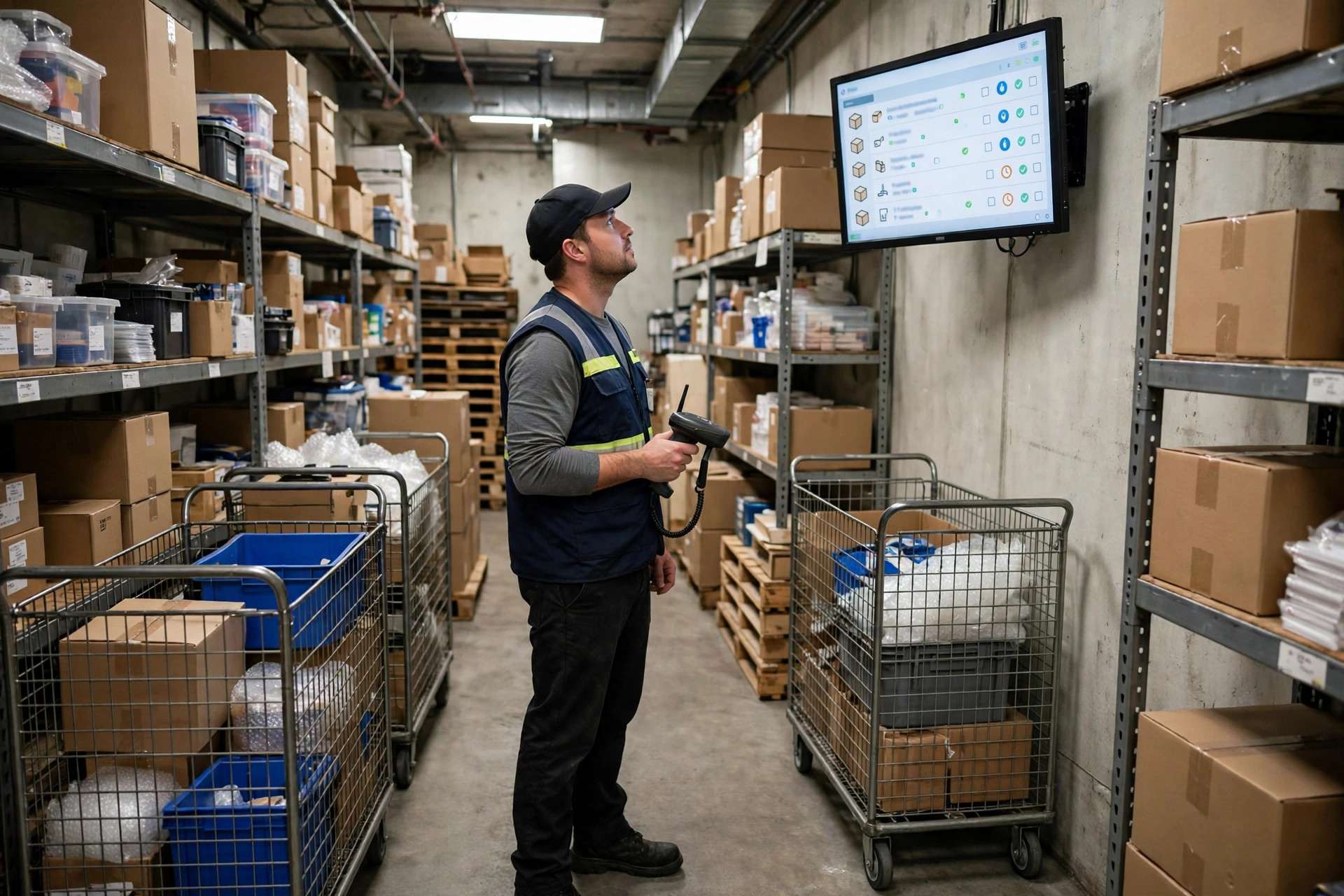
WMS inventory discrepancy after go-live is not, in most warehouses I have costed, a sign that the system is doing the math wrong. It is a sign that three old leaks are finally visible. One warehouse I worked with saw the dollar value of its monthly discrepancies rise by roughly a third in the first month after go-live, and the warehouse manager wanted the system rolled back. We split the discrepancy tickets by cause before touching anything, and the pattern was plain: master data that had always been wrong, barcodes that had always failed, and adjustment habits that had always hidden the gap. The manual workarounds that used to cover all three did not survive go-live, so the leaks showed up on the books. That money was being lost before, too. It just was not being counted.
Let me put the cost framing first, because it changes what you fix. The most expensive part of a discrepancy is rarely the item itself. A single miscounted case might be worth a few dozen dollars on paper, but finding it can cost half a day of recount labor, a stalled picking line, and, in the worst case, a wrong shipment. Add those up and the true cost is often ten times the value of the goods. This article prices the leak, names its three sources, and gives a 30-day order for plugging them.
First, price the leak: what inventory discrepancy really costs each month
Start with a cost table, not with a recount. I recommend tracking four cost lines for one full month before deciding anything. Warehouses that do this usually discover that the book value of the discrepancy is the smallest line on the page.
| Cost line | How to calculate it | Typical monthly scale |
|---|---|---|
| Book value of discrepancies | Net overages and shortages after offsetting | A few thousand dollars for a mid-size consumer goods warehouse, varying widely by category |
| Recount and investigation labor | Discrepancy tickets × average hours per ticket × hourly labor cost | Often larger than the book value itself when tickets are frequent |
| Line stoppage and waiting | Picking hours lost while locations are frozen, plus late-shipment penalties | One delayed shipment in peak season can erase a week of margin |
| Wrong shipments and complaints | Wrong-shipment orders × returns, reshipping, and goodwill cost | Low in volume, high in cost per incident |
Take a mid-size consumer goods warehouse as a working model: roughly 20,000 outbound orders a month, around 120 discrepancy tickets, and about an hour of investigation per ticket. At an hourly labor cost of roughly $18 to $30, recount labor alone runs about $2,200 to $3,600 a month. Add two or three wrong shipments and a few delayed orders, and the total discrepancy-related cost easily passes $10,000 a month in a bad month. At least half of that, in my experience, traces back to the three leaks below.
The first case is a unit-of-measure error. A third-party warehouse handling household goods kept showing discrepancies on a handful of personal-care SKUs, small amounts, every single day. The cause was in master data: the supplier shipped in cases of 24 bottles, but the system had been set up with 12 bottles per case. Receiving booked cases, picking booked bottles, and the book stock never reconciled. Staff had covered it with manual notes for two months before go-live. Once the system enforced the data, the notes disappeared and the discrepancies appeared. Nobody was careless. One wrong conversion factor corrupted every document downstream.
The second case is a barcode that fails in real conditions. Another warehouse saw discrepancies concentrated on the night shift, always on the same product family, always off by one unit. Following the shift for one evening showed the cause: the barcode was printed on reflective film, and handheld scanners under warehouse lighting frequently failed to read it. Workers keyed the code by hand, and a single mistyped digit sent the stock to the wrong SKU. Daytime lighting masked the problem, so it looked like a night-shift discipline issue. It was a label and lighting issue. Switching to matte labels and writing the scan angle into the work instruction cut that cluster of discrepancies sharply within a week.
Three sources of inventory discrepancy that survive go-live
WMS inventory discrepancy after go-live comes from three sources, and each has a same-day check you can run without a consultant.
The first source is master data. The three most common errors are wrong unit conversions, one barcode mapped to several items (or several barcodes to one item), and product codes that do not match the physical goods. The check is simple: pull the 20 SKUs with the largest discrepancies and verify, one by one, the purchase unit, the stock unit, and the sales unit, plus every barcode attached to each SKU. Those top 20 SKUs often account for half the discrepancy value. Fixing them beats a warehouse-wide cleanup for speed of impact.
The second source is barcodes and scanning. The danger is not only a barcode that will not scan. It is a barcode that scans as the wrong item. Promotional packs, bundle packs, and repackaged goods with old barcodes never voided in the system are the usual suspects. The check: measure the manual-entry rate by product family. Any family above roughly 10% manual entry deserves a label or process review, and any SKU that changed packaging or ran a promotion needs its old barcode voided in one pass. A high manual-entry rate is not evidence that workers are sloppy. It is evidence that the process is pushing them toward hand entry.
The third source is permissions and workaround habits. This is the most overlooked and the most expensive. After go-live, some warehouses, under shipping pressure, give floor staff inventory-adjustment rights so discrepancies can be cleared on the spot. The month-end discrepancy report then reads zero, but the gap was not fixed. It was written away in adjustment tickets. A related habit is shipping first and booking later, which leaves system stock and physical stock permanently half a step apart. The check: pull one month of adjustment records and look for three fields on each ticket — who adjusted, how much, and who approved. If more than about one in five adjustments has no approval, the discrepancy number is not trustworthy. The discrepancy did not go away. It was hidden.
Here is the counter-intuitive part: a rise in discrepancies after go-live can mean the system is working. Before go-live, informal adjustments hid the gap. After go-live, every movement leaves a trace, and the gap can no longer hide. The cheaper response is to treat the newly visible discrepancies as a work list and close them one by one. What you get is a real accuracy rate, not a reported one.
A 30-day plan, in the right order
WMS inventory discrepancy after go-live should be attacked in order, not all at once. Cheap and fast first, process change last.
Week one is a master-data triage. Verify conversions and barcodes for the top 20 discrepancy SKUs, fix conversion errors and one-code-many-item mappings, and freeze new SKU creation until conversion factors have been checked. The goal for week one is not zero discrepancies. It is removing systematic errors so the remaining discrepancies can be traced to a specific step.
Week two is barcodes and scanning. Rank product families by manual-entry rate, fix labels or scanning steps for anything above roughly 10%, void old barcodes for repackaged and promotional SKUs, and write scanning guidance for hard environments such as night shifts, cold storage, and reflective packaging. Do not ask workers to guess their way through a bad scan.
Weeks three and four are permissions and review. Restrict inventory adjustments to team leads and above, require a reason code and an approver on every adjustment ticket, and hold a weekly discrepancy review that covers only three items: the five SKUs with the largest discrepancies that week, the three largest adjustment tickets, and any cause that has repeated twice or more. A cause that repeats for two straight weeks means the fix missed the mark. Change the fix instead of recounting more often.
The conclusion is computable. If a warehouse is carrying roughly $10,000 a month in discrepancy-related cost, the three fixes above typically cost a few people for a few days plus a batch of labels. Done in this order over 30 days, a 30% to 50% cut in discrepancy tickets is a reasonable expectation. If you do not see it, check the adjustment tickets first. The discrepancy may not have failed to fall. It may have been adjusted away again. Price the leak, plug it in order, and only then debate whether you need a different system or more frequent counts.
By Lao Zhou, Logistics Cost Analyst