Let me lay out the conclusion first: my warehouse has 7 people and 3,000 square meters. After switching from assigning tasks to individuals to a WMS task pool — grab-and-go dispatch — our peak-season picking got about 20% faster. But there are some orders I would never, ever throw into the pool.
I know what you're thinking: Xiao Ma, you're a small-warehouse owner, what are you doing writing about WMS dispatch logic? Fair point. We can't afford the fancy dispatch engines the big players run. But the underlying question is the same whether you're 3,000 or 30,000 square meters: every morning, how do today's jobs get into people's hands?
How "Assign to a Person" Burned Us
A few years back we copied the big warehouses. Every morning I spent 40 minutes with a spreadsheet assigning the day's orders to names: Lao Chen gets 30, Ah Fang gets 28. Looked professional. Felt like management.
Then reality started slapping us in the face.
First, Lao Chen took a day off, and the 30-plus orders under his name froze — nobody dared touch them. "That's Lao Chen's work." Ah Fang is fast; she'd finish hers by noon and scroll her phone all afternoon. When I asked her to take extra orders she looked genuinely hurt: why should I do more just because he's slow?
Worse, the plan never survived contact with reality: returns came in, rush orders jumped the queue, goods hadn't arrived yet. My beautiful spreadsheet needed rebuilding daily. Forty minutes of dispatching every morning — an hour in peak season — and it was still wrong by 10 a.m. That's not management; that's an unpaid second job as a full-time scheduler.
What a WMS Task Pool Actually Looks Like
Then we moved to a lightweight WMS with a task pool, and the whole thing is almost embarrassingly simple:
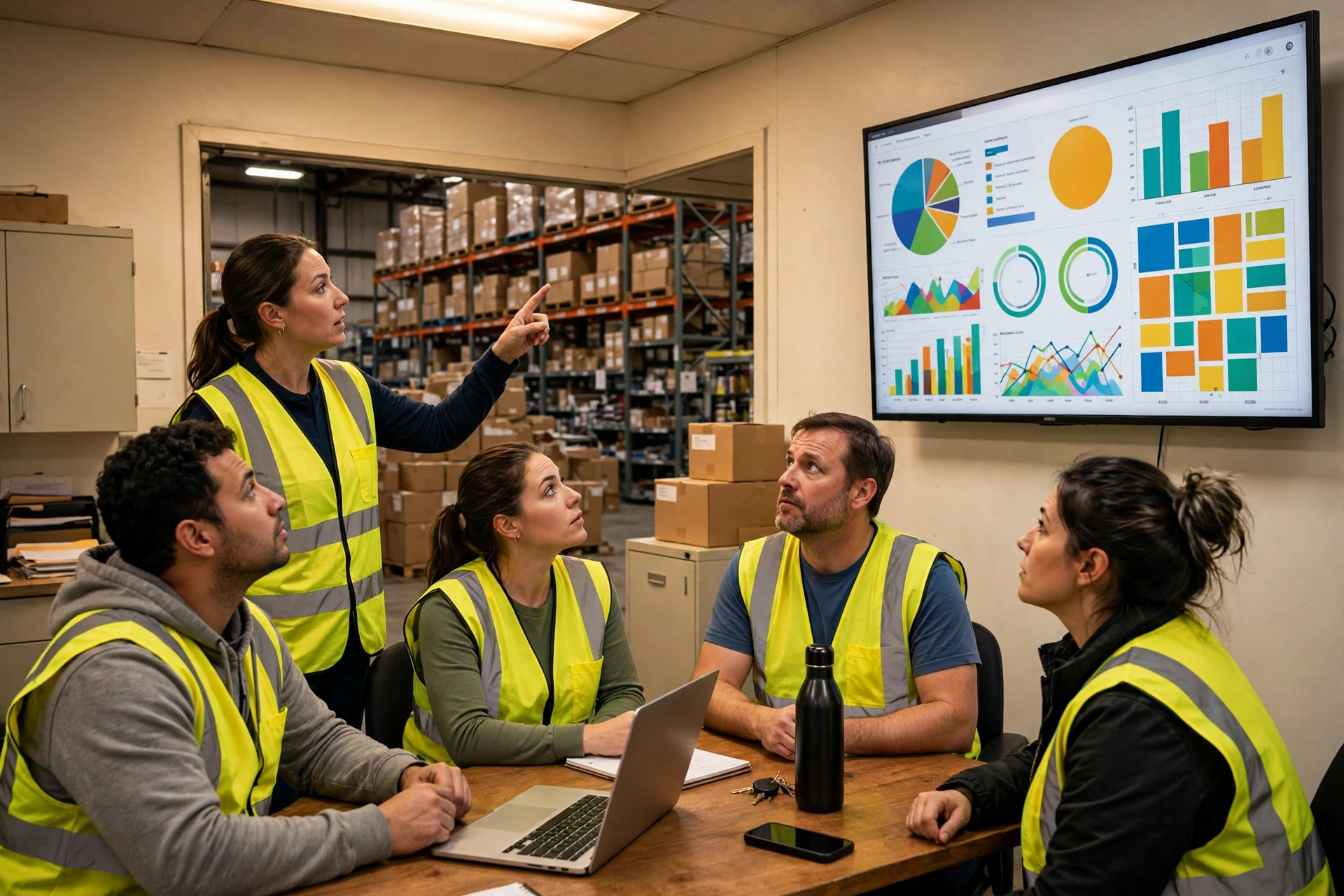
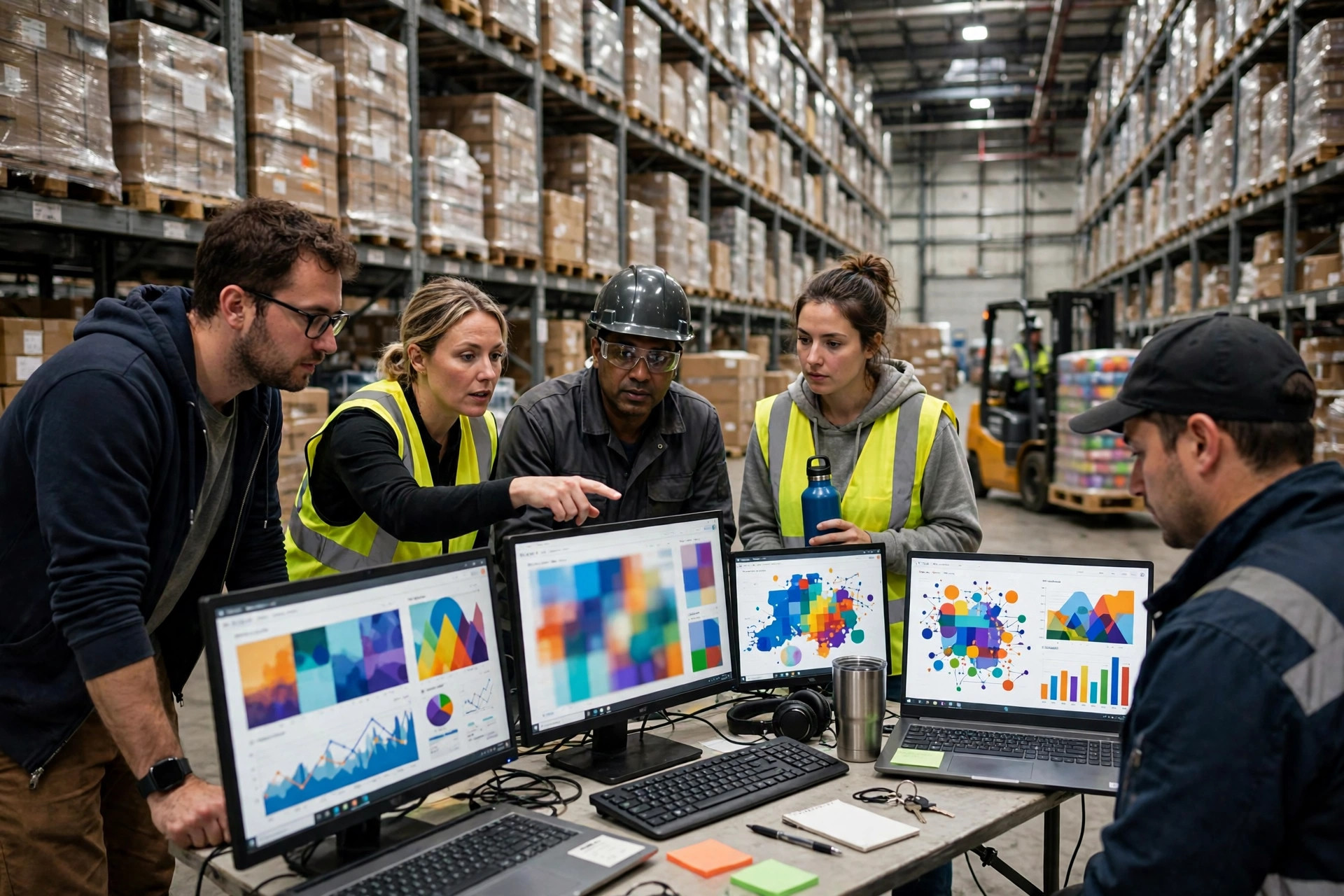
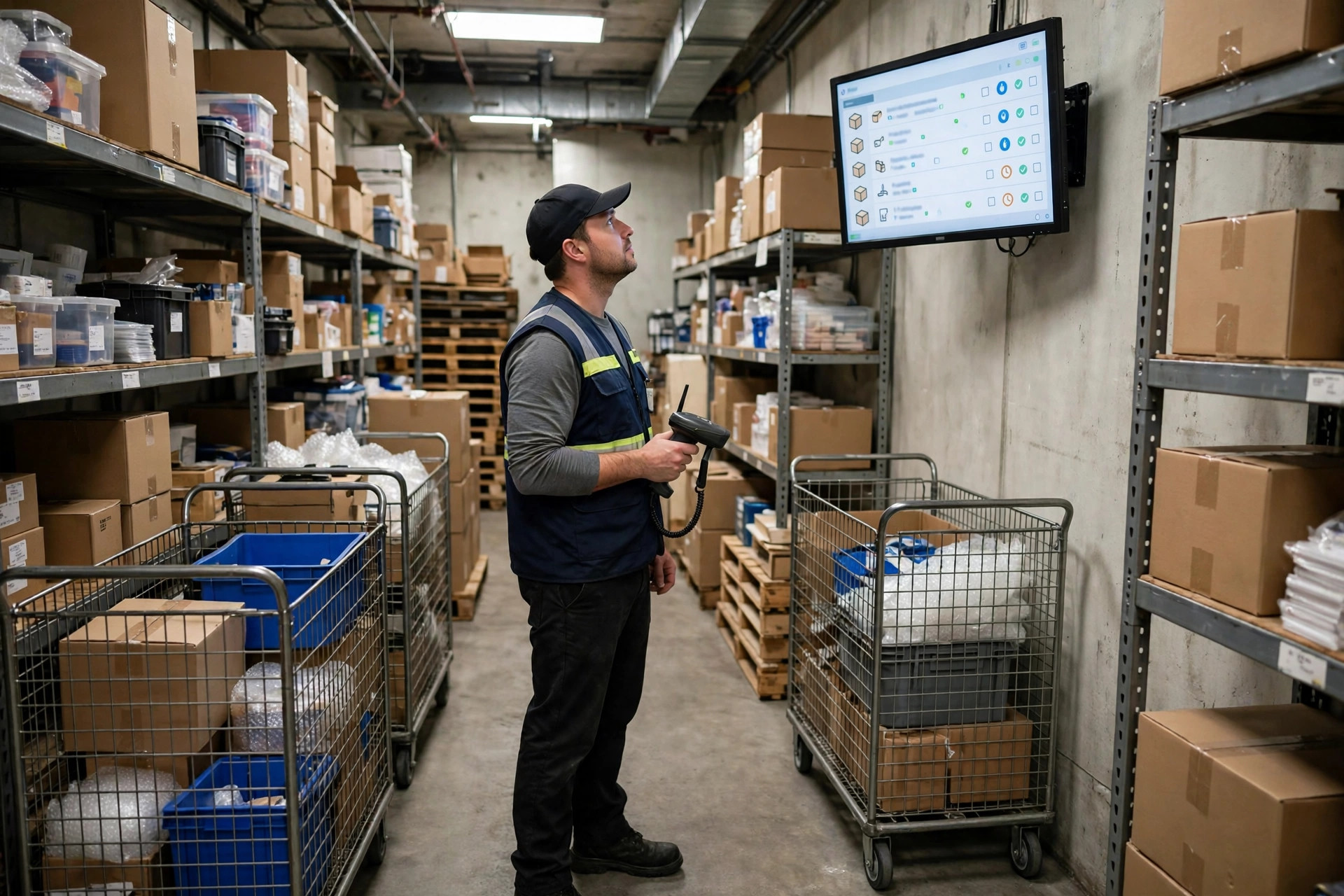
All picking and putaway tasks go into one pool instead of being assigned to people, ranked by priority, shown on a secondhand monitor bolted to the wall. Whoever finishes their current job walks up, taps one, scans to claim it, and goes. When they're done, they come back for the next one. Same logic as ride-hailing drivers grabbing orders — except we're grabbing pick tickets.
I'll admit I was nervous at first: won't this be chaos? After the first month, I shut up.
Peak season, same 7 people: before, 210 orders a day with overtime until 9 p.m., 30 orders per person. Now, 260 orders a day, done by 7 p.m., 37 per person. Twenty percent faster — and I got my 40 morning minutes back. That time is much better spent reconciling accounts, trust me.
Why is it faster? I've boiled it down to three things:
First, it kills uneven workloads. Fast people do more, slower people do less, and nobody complains — you grabbed the orders yourself, who are you going to blame?
Second, it kills waiting. Under assigned dispatch, people stood idle waiting for upstream work or QC. Now the pool always has something in it; people always have something to do.
Third, it kills me as the bottleneck. Whoever does the dispatching is usually the ceiling on efficiency. No matter how well I plan, I can't react to floor changes faster than the floor itself.
When WMS Tasks Must Be Assigned to a Person
But grab-and-go isn't magic. A friend runs a 20,000-square-meter 3PL with tens of thousands of SKUs. He wanted to copy my pool setup and I talked him out of it. Why? He has three kinds of tasks that must never enter a pool:
High-value goods. A single 3C product worth thousands — one mispick, one drop, and the day's margin is gone. Those go to veteran pickers only, and when something goes wrong you need a name.
Traceability-required orders. Pharma, food — batch control is strict, and auditors will ask "who picked this unit?" A pool with scan records can technically trace, but an assigned record is much harder to argue with.
Skill-gated tasks. High-bay picking, hazmat — if a rookie grabs one of those, it's an accident waiting to happen. His warehouse learned this the hard way last year when a new hire took a high-bay pick, misaligned the forks, and dropped a full pallet. Nobody was hurt, thankfully. Since then, special tasks only go to certified people.
See the pattern? Assigned dispatch isn't really about dividing work — it's about dividing responsibility. When responsibility outweighs efficiency, you assign.
The Hybrid: How We Run It Now
So we run a hybrid now, with two task types configured in the WMS:
Routine picking, putaway, and replenishment all go into the pool — about 80% of our daily tasks.
The other 20% gets assigned to named people: goods worth over 500 yuan a unit, customer-specified batches, complaint rework orders. The WMS auto-detects them by rule and routes them to designated staff, bypassing the pool entirely.
One more trick: the classic failure of grab-and-go is "good tasks get snatched instantly, ugly tasks rot." We added timeout escalation — a task sitting in the pool for over 2 hours auto-bumps in priority and turns red; if still unclaimed, it pings my phone. Ugly tasks still get done; the system just makes sure the tough ones get chewed through first.
| Dimension | WMS Task Pool (grab-and-go) | Assigned to Person | | Dispatch overhead | Near zero | Manager spends 30-60 min daily | | Responsiveness | Whoever's free jumps in | One sick day jams everything | | Traceability | Weak, patched with scan logs | Strong, down to the name | | Skill gating | Tasks must be uniform | Can tier by skill level | | Morale | You grabbed it, you own it | "That's his job, not mine" |
The Counterintuitive Bit: a Task Pool's "Mess" Is a Small Warehouse's Discipline
Here's the contrarian take: people think grab-and-go looks "messy" and assigned dispatch looks "professional." After years running a small warehouse, I've concluded it's the other way around — the messiness of a task pool is skin-deep; it replaces office politics with rules. The professionalism of assigned dispatch is often fake; it buys a tidy-looking inefficiency with the manager's time.
Why do big warehouses overwhelmingly assign? Not because it's more efficient — because they can afford the efficiency tax: they can staff a dedicated dispatcher, absorb uneven workloads, all in exchange for "when something breaks I can find the person." That's a fine trade for them. For us it's pure overhead — we don't have a dispatch headcount. The dispatcher is me, and my time belongs with customers, not in Excel.
So here's my advice to fellow small-warehouse owners: under 3,000 square meters, fewer than 10 people — start with the task pool and save yourself a dispatcher's salary. When you start losing sleep over "who exactly mispicked this order," then bring in assigned dispatch. Don't reverse the order; reversing it means paying for pain.
Small warehouses have their own way of surviving. Grabbing orders is a skill too.
By Xiao Ma, Small Warehouse Owner