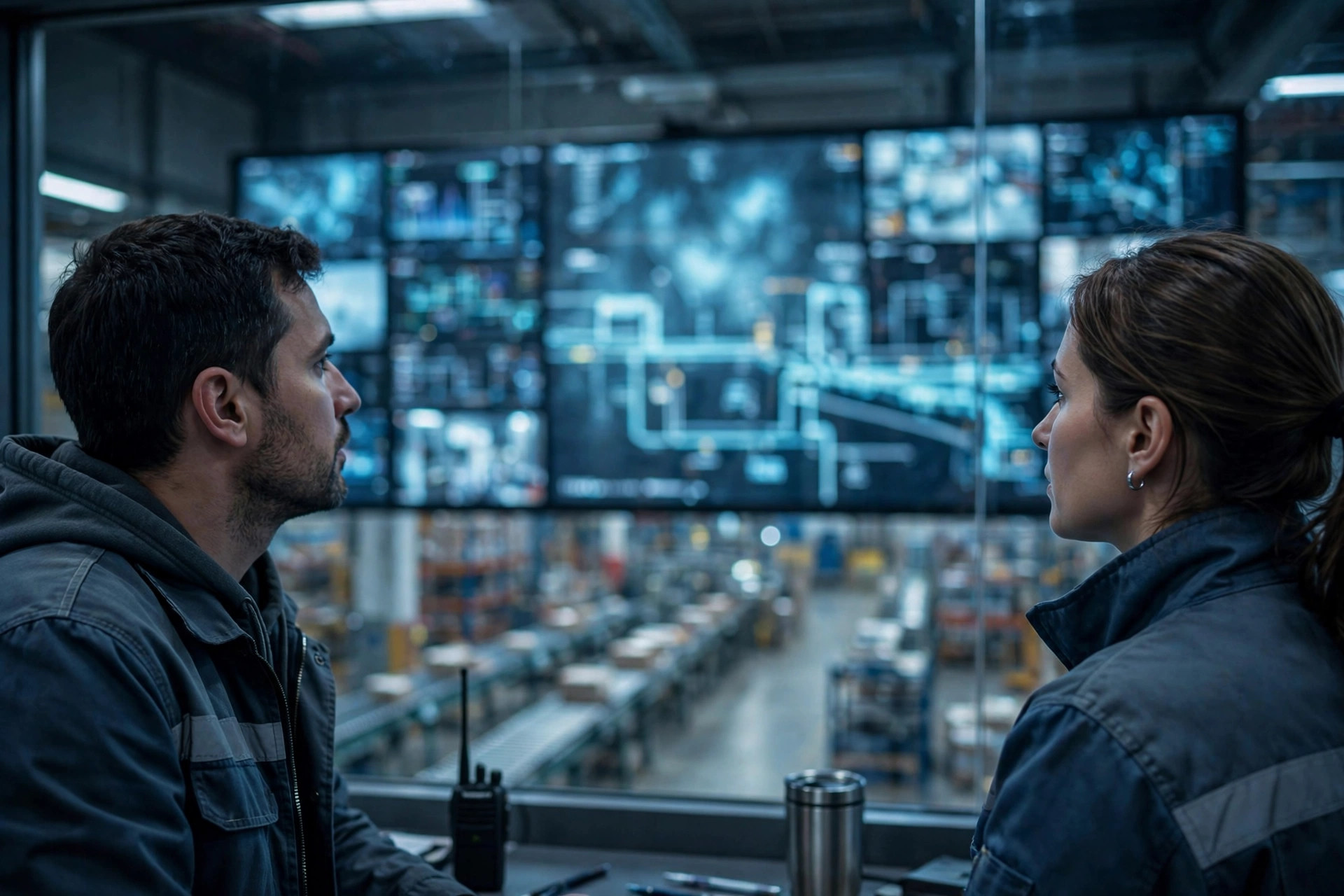
Every peak season ends with a round of post-mortems about warehouses that "broke." What I have observed over the years is that volume itself rarely breaks a warehouse. What breaks it are the cracks in the scheduling logic — the kind that stay invisible until volume suddenly multiplies. Running last year's orders through your WES in a simulation stress test is how you find those cracks early.
Why the stress test has to happen two months early
An automation trade publication, Conveyco, put it well: peak season does not create operational problems; it exposes the ones already there. The logic is simple. On a normal day, outbound tasks are released in sequence and the system has enough slack to absorb mismatches. Multiply volume severalfold, and every link runs at full capacity — the first to fail is the link that was merely "good enough" on a normal Tuesday.
Over the last few years I have noticed a shift: more fulfillment centers now run a simulation stress test on their WES six to eight weeks before peak, feeding it last year's order data. Industry coverage from Robotics & Automation News confirms this window — testing six to eight weeks ahead leaves time to optimize and re-test. The standard move is to take last year's peak order profile, layer on this year's expected growth, and run it through the WES simulation environment to see how the system responds under real pressure.
Digital twins in warehousing are well past the concept stage. According to industry analysis published on ManufacturingTomorrow, warehouse digital twins typically unlock 10 to 25 percent labor productivity improvements, with overtime and temporary labor costs falling as a result. GEODIS has published harder numbers from a pilot with a large consumer electronics client: daily throughput rose 18 percent, from 85,000 to 100,000 units, with no additional capital investment; pack operations improved 12 percent and pick operations 6 percent. These numbers tell one story: optimizations found in a virtual environment can land on the real floor.
Two warehouses: one rehearsed, one broke on the day
The first story is a composite drawn from several projects, anonymized, set in the run-up to the 2025 peak season. An e-commerce fulfillment warehouse in eastern China, decently automated, with cross-belt sorters. In early September the operations lead did one thing: they loaded the complete order flow from the previous year's Singles' Day into the WES simulation environment, scaled it to this year's growth forecast, and ran it for a full day. The result was clear: after the afternoon wave releases, between roughly 2 and 4 p.m., the sorter's upstream buffer kept accumulating. The cause was not equipment capacity — it was a mismatch between the wave-release rhythm and the sorter's divert timing. Tasks released too fast for the diverters to keep up, parcels queued in the buffer, and the queue slowed downstream packing.
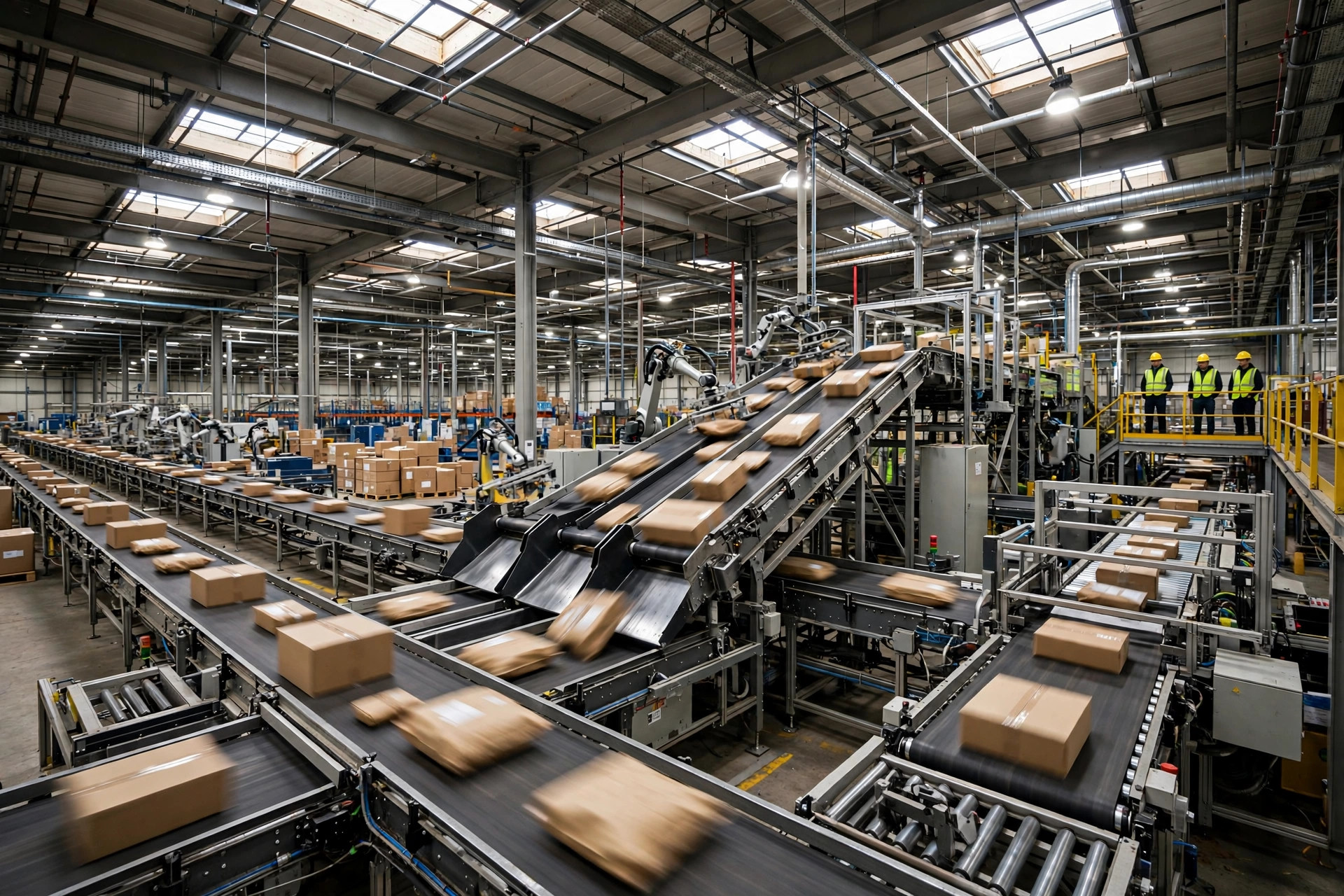
What made this discovery valuable was how cheap the fix was. The team simply retuned wave release to align with sorter cadence and added buffer-threshold alerts. The afternoon backlog never appeared during peak. Found on the day, the same fix would have carried far more risk and labor cost.
The second warehouse is the mirror image. Similar size, and before peak the team decided that since "the system ran fine last year, and this year's volume looks about the same," no simulation was needed. On peak day, during the evening rush, the exception-handling area jammed with returns and problem parcels. This was not a main-flow bottleneck — it was an exception process nobody had rehearsed. People were pulled off the main flow to clear exceptions, the main flow went short-handed, the evening carrier cutoff passed, and some orders shipped late. Overtime and chargebacks were tallied together. The attribution here is worth thinking about: the bottleneck was not capacity. It was "we never imagined this happening."
What a proper simulation stress test looks like
| Step | What you do | Deliverable | Common pitfall |
|---|---|---|---|
| Data prep | Assemble last year's peak order detail: SKU mix, wave distribution, exception and return rates | A "baseline order flow" | Capturing only totals, so the test becomes an enlarged normal day |
| Model calibration | Calibrate equipment parameters, labor rates, and travel distances in the WES to match reality | Simulation output that tracks history within tolerance | Using nameplate specs instead of actuals — the sim looks rosier than the floor |
| Scenario design | Baseline plus two to three stress scenarios (higher volume, equipment failure, labor shortfall) | A scenario pack | Testing only the baseline; peak fails on the scenario you skipped |
| Bottleneck reading | Watch queue lengths, equipment utilization, and task wait times; locate bottlenecks | Bottleneck list with fix priorities | Reading averages instead of peaks; bottlenecks hide in the peaks |
Two points deserve emphasis. First, scenario design must include stress cases. WES simulation tools — MMH's reporting on WES vendors describes "emulator" tools built to stress-test at double or triple volume — exist precisely for this. Second, when reading bottlenecks, look at peaks, not averages. Bottlenecks never live in the average; they hide in two bad hours.
The math: simulation costs little, a broken peak costs a lot
A simulation stress test costs mostly people and time: data cleansing, calibration, running scenarios, reading results. For a mid-size automated warehouse, the first round takes roughly one to two focused weeks. It is a one-time investment, and the model gets reused every peak season, so marginal cost declines each year.
A broken peak, by contrast, compounds: chargebacks on missed cutoffs, overtime for emergency labor, the next day's normal capacity consumed clearing yesterday's backlog, and the quieter damage of customer complaints and marketplace ratings. They are not in the same league.
So the decision is not "how accurate is the simulation." It is "is a cheap rehearsal worth it." Given the industry numbers above, the answer is clear.
The contrarian take: the best part of a simulation is not the forecast
Here is the contrarian judgment I want to offer: the most valuable output of a simulation stress test is not the forecast report. It is that the exercise forces the entire operations team to walk through the exception processes, properly, in advance.
Most warehouses have smooth main flows. Bottlenecks hide in exceptions: how returns get diverted, where problem parcels go, how tasks get re-planned when a sorter faults, how temp workers ramp up quickly. These processes are touched a few times a year in normal times — and all at once on peak day. Running a simulation is rehearsing the "what-ifs" in advance. If the warehouse in the second story had rehearsed, the evening rush would not have gone sideways.
In other words, a simulation stress test is a low-cost, high-fidelity fire drill. The forecast report is just the drill's byproduct.
Where this is headed
My trend call: simulation built into the WES will move from "big-project standard" to "routine pre-peak practice" within the next two to three years. Three reasons. First, the technology is ready: MMH's coverage of WES vendors shows simulation and orchestration engines are already key evaluation criteria, and vendors such as Roboteon already use simulation to size AMR fleets for peak and estimate picking costs under different parameters. Second, demand is forcing it: volume swings keep getting bigger, and the cost of scheduling by gut feel keeps rising. Third, the cost is falling: build the model once, reuse it every year — the marginal cost drops, and it is no longer just the big warehouses that can afford it.
On the timeline, I see 2026–2028 as the adoption window: leading fulfillment networks write simulation stress tests into their peak-season SOPs first, mid-size automated warehouses follow, and eventually it becomes a default WES feature.
An open question
If simulation can expose bottlenecks early, should the fixes on that list happen before the simulation, or after? It sounds like a riddle, but it is a real pattern: many warehouses know the sorter cadence and wave release are misaligned, yet fixing it means touching several departments' processes, so they wait "until the simulation results are in" — and then the same bottleneck shows up on the list, year after year. Simulation exposes problems. It cannot supply the will to fix them. I will leave that one with you.
By Dr. Chen, Supply Chain Researcher