Here is my verdict up front: a WMS keeps the books, a WCS runs the machines. One answers "what inventory, where, and what needs to happen"; the other answers "is the equipment moving right now, and where to". Two sides to this. On one side, the two systems are built for fundamentally different jobs, and neither can replace the other. On the other side, every vendor wants to do the other guy's job too — which is how you end up paying for the same functionality twice.
I have seen this movie too many times. A 3PL in California was replacing its WMS when the vendor threw in an "automation module," promising no further software would be needed once conveyors arrived. Two years later the sortation line showed up, and the equipment vendor's engineer just shook his head: millisecond-level equipment control and real-time photo-eye response were simply beyond a WMS that thinks in minute-level tasks. They bought a WCS anyway. The money spent on that "automation module" was wasted, and the project slipped by months. That is the tuition you pay for not understanding the WCS vs WMS difference before you sign.
WMS, WES, WCS in One Line Each
People get lost in the three acronyms, so let me line up the three siblings, one line each:
| WMS | WES | WCS | |
|---|---|---|---|
| Owns | Inventory records, orders, slotting, labor planning | Task sequencing, workload balancing, exception handling | Equipment-level control, material flow, device synchronization |
| Time horizon | Days, weeks | Minutes to hours | Milliseconds |
| Talks to | Warehouse managers, planners | Operations managers | Automation engineers, PLC technicians |
This division of labor is consistent across the industry breakdowns I have read (o3sigma's three-layer model, for example). Remember the time-horizon row: the WMS thinks about "what happens today," the WES thinks about "which order goes first in the next half hour," and the WCS thinks about "which way the conveyor turns this millisecond." Different time horizons mean they cannot do each other's jobs.
The Difference Is Not the Name — It Is Planning vs. Execution
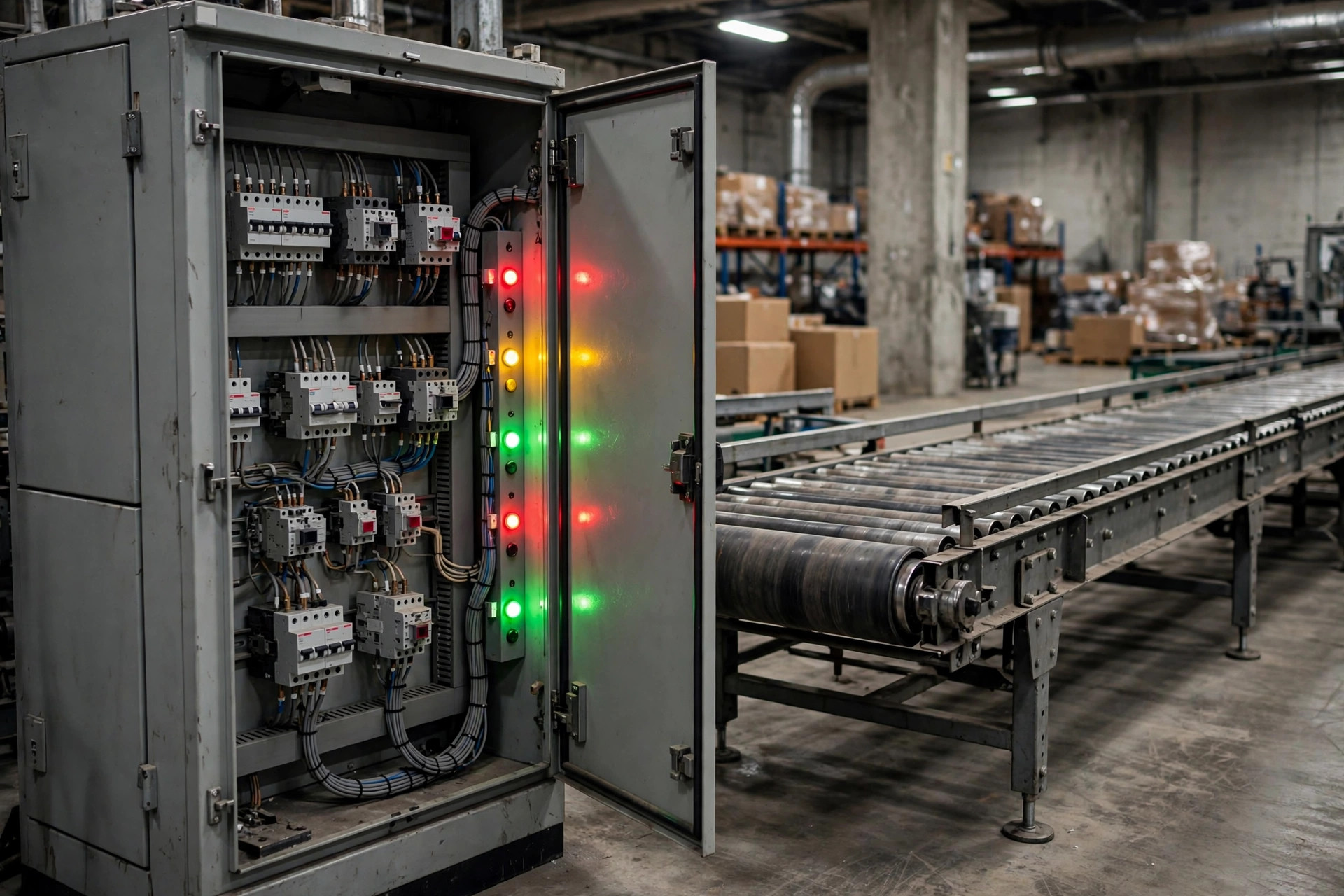
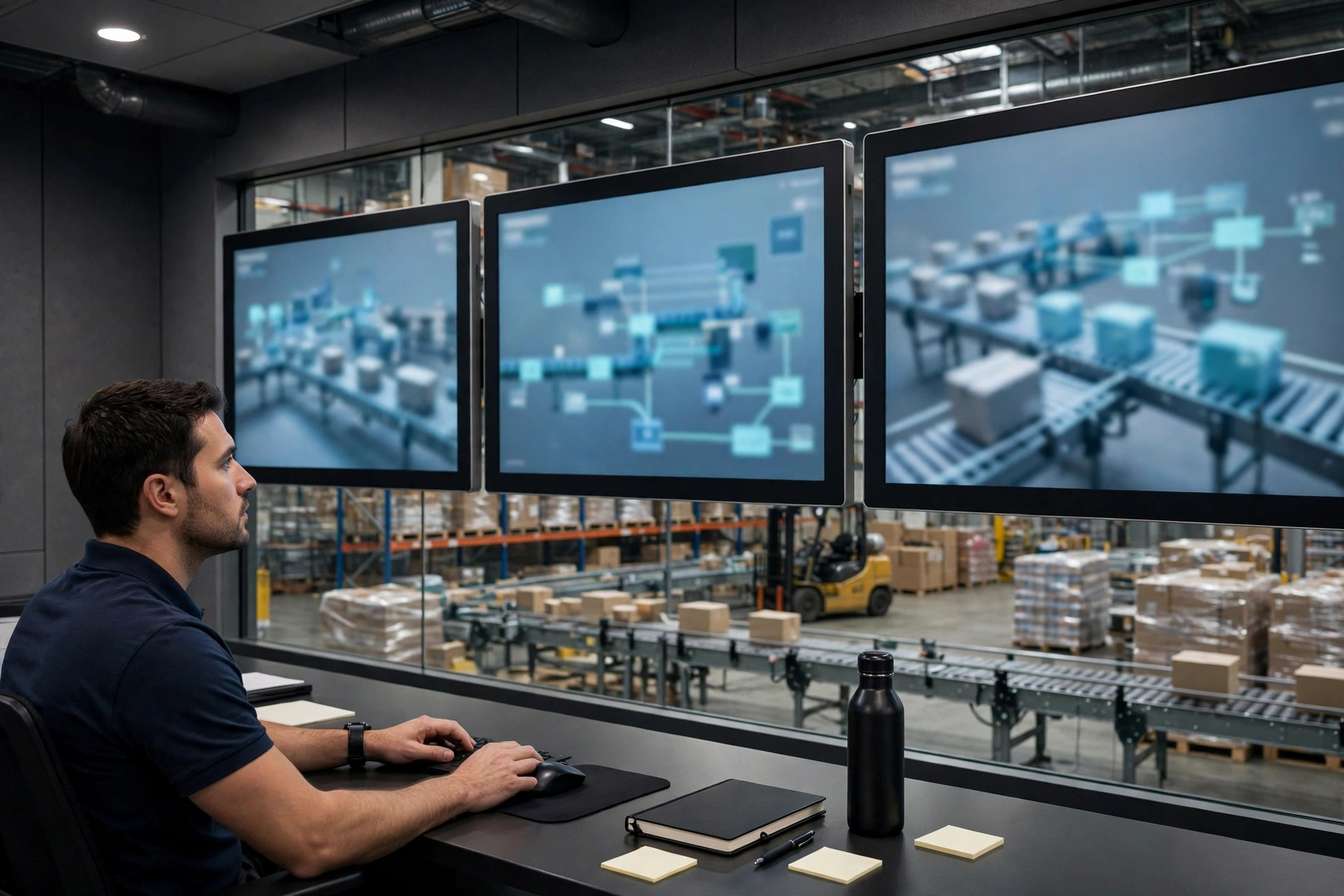
Put simply, a WMS is a planning system and a WCS is an execution system. The WMS takes orders, sets policy, and keeps the inventory books on non-real-time logic. The WCS takes the WMS's instructions and drives the conveyors, sorters, AS/RS cranes, and AGVs, reacting in real time to actual events on the floor — a sorter jams, and the WCS reroutes on the spot instead of waiting for the WMS to finish its meeting.
Systems integrator List and QC Software used an analogy in a white paper that I will borrow: the WMS is the composer writing the score; the WCS is the conductor keeping every "instrument" (conveyors, sorters, pick-to-light) in time. A great score with no conductor is just noise — which is why, wherever there is equipment, even the strongest WMS still needs a WCS.
When a WMS Alone Is Enough: Three Dividing Lines
This is the question buyers actually care about. Draw three lines by automation level:
| Your warehouse | Buy | Why |
|---|---|---|
| Fully manual, forklift operation | WMS is enough | Nothing to control — a WCS has no job |
| Semi-automated: a conveyor line, sorter, pick-to-light, standalone AS/RS | WMS + WCS (usually bundled by the equipment vendor) | A WMS cannot command millisecond-level equipment |
| Fully automated, multi-equipment orchestration | All three: WMS + WES + WCS | Both task sequencing and equipment control need a dedicated owner |
o3sigma reaches the same conclusion: manual warehouses need only a WMS, semi-automated ones can add a WCS, fully automated ones need all three layers. That List and QC Software white paper also listed telltale signs you may need a WCS: over $50M in sales, a warehouse larger than 100,000 square feet, a conveyor system with multiple sortation points, and more than 3–4 SKUs per order. Treat it as a reference — if two or three of those describe you, then start talking WCS.
One more example from my own experience, a positive one this time: an e-commerce warehouse doing about 20,000 orders a day, semi-automated with a cross-belt sorter and pick-to-light. The owner skipped WES entirely — the WMS talked straight to the equipment vendor's WCS, the PLC integration was tuned once, and it ran fine for years. The point? Three layers are not a standard package; they are configured by need. Forcing a WES into a semi-automated warehouse is mostly a donation to the vendor.
The Overlap Trap: Three Questions Before You Sign
The real trap is the overlap zone. WES and WCS functionality overlaps in pack sorter management, shipping sorter management, automated pick management, and pick-to-light management (Logiwa has mapped this overlap). A WMS vendor's "orchestration module" overlaps with the equipment vendor's WCS too. That overlap is not a bug — it is business. Both sides want the middle layer, and you are the one paying twice for it.
Take these three questions to the vendor before signing:
First: does this module you are selling manage planning or equipment? Can it do millisecond-level equipment control? If they cannot answer, it is probably a WMS plug-in wearing a WCS name tag.
Second: which features overlap with my existing WMS and with the WCS bundled by my equipment vendor? Can the overlapping parts come out of the quote? A vendor willing to list the overlap is a vendor actually trying to sell you something.
Third: who builds the interface, who does the integration testing, and who shows up on site first when something breaks? Put it in the contract. Ninety percent of WMS–WCS trouble dies at the interface: data that does not reconcile, statuses that do not sync, and two vendors pointing fingers when it breaks.
One more counterintuitive call: what you should buy is not the "most feature-complete" suite, but the one with the clearest boundaries. The most expensive part was never the software license — it is the interface. Who writes it, how many rounds of integration testing, who pays for delays: getting those three lines into the contract is worth ten times more than buying one more module.
So back to the opening question: what is the relationship between WCS and WMS? One keeps the books, one runs the equipment, and who owns the orchestration layer in between depends on your automation level and how your contracts are written. Next time a vendor tells you "our suite covers everything," try asking back: covers everything, huh — so when the equipment jams at 2 a.m., are your people the ones showing up on site?
By Lao Mi, Supply Chain Veteran (20 yrs)