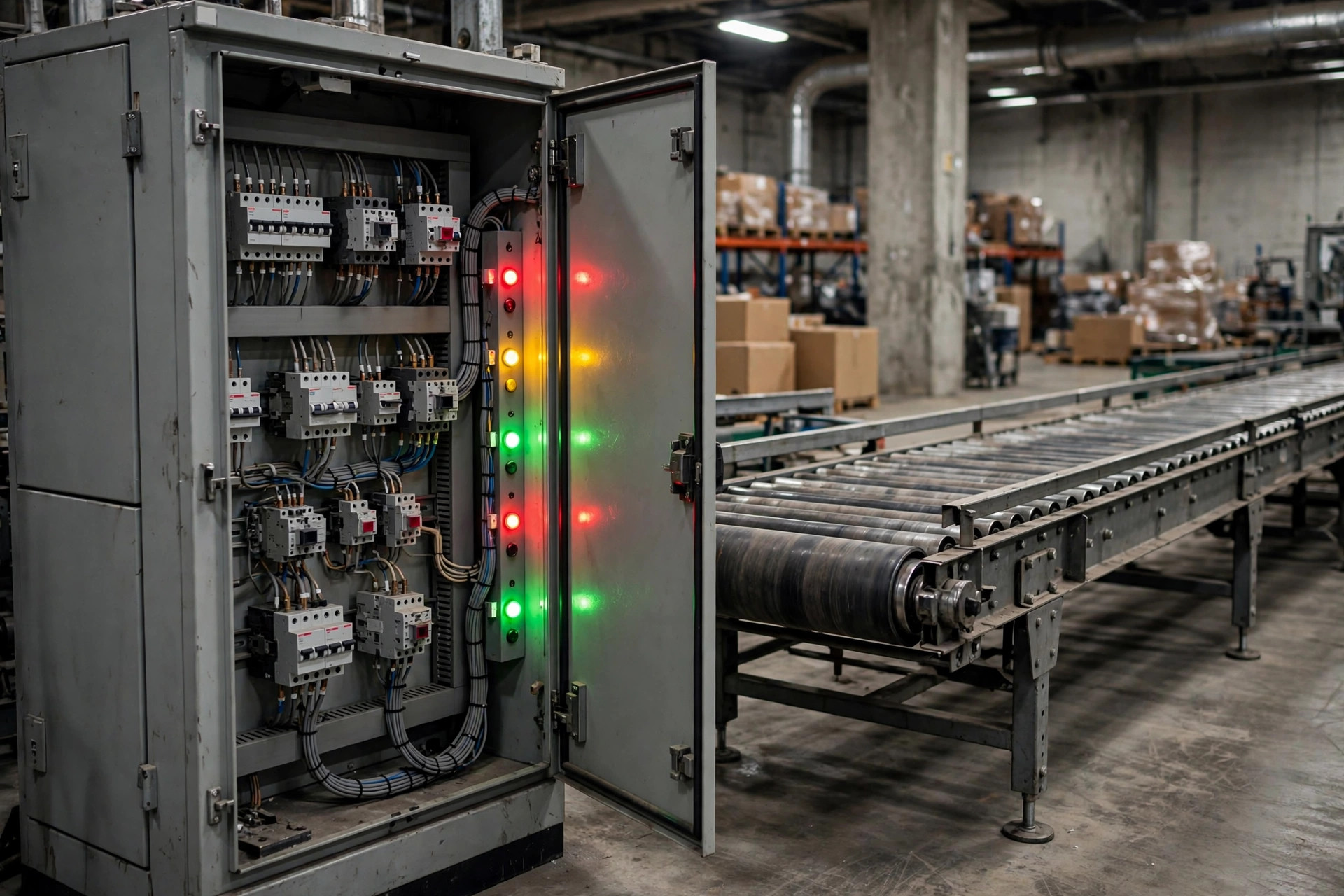
In warehouse automation there is a recurring scene: the ribbon-cutting for new equipment. The AS/RS cranes are up, the conveyors are powered, an AMR makes its first autonomous run — and the owner breathes a sigh of relief, assuming the hardest part is over. Project post-mortems suggest the opposite is usually true. After mechanical installation completes, a facility is typically still months away from real go-live, and during that stretch the dominant consumer of labor hours is no longer the equipment vendor but the software and commissioning teams. The WCS implementation timeline remains the most chronically underestimated segment of any automation project.
Consider the industry's own published benchmarks. According to automation integrator DNC Automation's public WCS implementation FAQ, timelines fall into three bands: a basic WCS for a simple conveyor system deploys in 6 to 12 weeks; a moderate-complexity facility with multiple equipment types needs 3 to 5 months; and a large-scale implementation with extensive automation takes 6 to 12 months, including design, configuration, integration, testing, and commissioning. Note what these bands actually measure: the software and integration work itself, on the assumption that equipment is already in place and mechanical installation is done. Even under that assumption, the top band consumes a full year. The elasticity is enormous — and what determines which band a project lands in is rarely the volume of code.
The Five Phases: An Account of Where the Time Goes
Synthesizing post-mortems from several integrators, WCS implementation effort distributes roughly as follows. Phase one, requirements and interface freeze, takes about 15 to 20 percent of total effort: documenting every WMS-to-WCS message, every PLC telegram format, and every exception code table between the WCS and each piece of equipment, then getting both sides to sign. Phase two, configuration and development, takes 20 to 25 percent: configuring process logic on the WCS platform, writing device drivers, running offline emulation. Phase three, on-site integration and commissioning, is usually the largest block at 30 to 40 percent: equipment powers up unit by unit, and the WCS is connected and exercised section by section. Phase four, trial operation and ramp-up, takes 15 to 20 percent: running with real volume, tuning takt time, fixing corner cases. Finally, acceptance and handover take about 5 percent: documentation, training, warranty transfer.
The structural point of interest is phase three. Why is on-site commissioning always the black hole? One reason is that PLCs and the WCS inhabit two fundamentally different conceptions of time. A PLC thinks in millisecond scan cycles — a photo-eye signal arriving 50 milliseconds late is an incident. A WCS thinks in transactions — a pallet's complete journey from point A to point B. When these two time-conceptions meet on-site for the first time, problems emerge that no office emulation could have surfaced: sensor jitter, pallet posture deviations, network latency spikes. Each looks small in isolation, yet each requires both sides to sit down together, reproduce it, localize it, and establish whose fault it is. That is how time gets consumed: not in one collapse, but in hundreds of small withdrawals.
Two Scenes From the Field: How Time Gets Argued Away
In 2024, a third-party logistics provider in the American Midwest commissioned a cross-belt sorter line, with the WCS handling sortation scheduling between the sorter and the WMS. In week three of commissioning, a problem surfaced: sortation misroutes hovering around 0.3 percent. The equipment vendor insisted the WCS was issuing faulty sort plans; the integrator produced logs proving the plans were correct and that telegrams were being dropped on the PLC execution side. The standoff lasted two full weeks before the root cause emerged: a PLC program version mismatch. The vendor had flashed version 3.2 on-site, while the integrator had developed against interface documentation for version 3.1 — and between the two versions, the byte offset of the sort-confirmation telegram differed by one position. The project went live five weeks late. The actual code fix took two days. Everything else went to proving the problem wasn't on one's own side.
The second case is from Europe in 2022. An e-commerce fulfillment center installed an AS/RS, and the owner — chasing a peak-season deadline — insisted the WCS enter trial operation on the original schedule even though crane mechanical installation was running six weeks behind. The control logic was therefore tuned for two months against half-installed equipment; entire branches of logic couldn't be tested at all because the hardware wasn't there. When mechanical installation finally completed, nearly all previously tuned parameters had to be redone, because the real cranes' acceleration profiles differed from the simulated ones. The lesson was later written into that owner's contract template for all greenfield projects: the WCS team does not mobilize on-site until mechanical installation and standalone equipment testing are complete. That seemingly schedule-slowing rule cut commissioning duration by nearly a third on subsequent projects.
The Three Delay Traps
The first trap is starting work before the interface documentation is frozen. Once WMS-WCS and WCS-PLC interfaces start changing mid-project, every change creates rework on both sides. Worse, interfaces are a gray zone — they belong to neither party's deliverables list — so the cost of changes is never cleanly negotiable. The mature practice is to make the interface freeze a contractual milestone: after the freeze date, any interface change goes through a formal change process, with schedule and cost handled separately.
The second trap is leaving the definition of "running smoothly" out of the contract. What constitutes passing trial operation — 72 hours of continuous fault-free running, or 90 percent of design takt? Real orders or test data? If these criteria aren't defined at signing, acceptance becomes endless negotiation. I have seen a six-week argument over the literal definition of trial-operation acceptance — while both sides privately agreed the system was already usable. The fix is to quantify acceptance criteria into the contract appendix: continuous run duration, takt achievement rate, mis-sort ceiling.
The third trap is tying WCS acceptance to mechanical acceptance on the same date. Every day the machinery is late, the software team burns another day of on-site cost — and the morale damage of idle waiting exceeds the financial cost. The decoupled approach is staged acceptance: the WCS first passes "emulation acceptance" against virtual equipment, then "on-site acceptance." Once emulation acceptance passes, the software team can demobilize, leaving only a skeleton support crew on-site.
A Counterintuitive Finding: Writing Code Is the Cheapest Part
Studying WCS project overruns, one counterintuitive conclusion recurs: in total cost, actually writing WCS logic accounts for the smallest share. The bulk goes to three items — waiting, rework, and dispute. Waiting: software teams idling on-site for equipment, interfaces, or the other party's schedule. Rework: tearing things down because requirements were never frozen. Dispute: establishing responsibility in the gray zones. None of the three produces a single line of code, yet together they consume the most budget and schedule.
A second counterintuitive finding cuts the other way: freezing requirements too early causes more rework, not less. Freezing control logic before the hardware is finished merely freezes assumptions about a hypothetical machine. The genuinely time-saving approach is the reverse — bring the interface test bench (emulation) forward: before equipment even arrives on-site, run every branch of WCS logic thousands of times against virtual PLCs. When the real equipment lands, commissioning becomes verification rather than debugging. The more thoroughly virtual commissioning is done, the smaller the on-site black hole becomes.
The Trend: Virtual Commissioning Is Rewriting the Timeline
The boundary between WCS and WES (warehouse execution systems) is blurring, with more WCS platforms absorbing orchestration capabilities; meanwhile, virtual commissioning tooling is moving work that once had to happen on-site back into the office. If 60 percent or more of integration work can be completed before equipment arrives, the three published bands — 6 to 12 weeks, 3 to 5 months, 6 to 12 months — may each shift down a tier in the coming years.
But that raises a question worth sitting with: when commissioning no longer requires large engineering teams stationed on-site for months, what happens to the integrator's business model? Will the per-diem billing model collapse first, or will owners first demand the saved schedule be converted into price cuts? A WCS implementation timeline was never purely an engineering question — underneath it sits the profit distribution of the entire automation value chain. The next time you hear "the software part is quick, just a few weeks," consider asking three questions: are the interfaces frozen, are the acceptance criteria in the contract, and is the emulation environment built? The answers predict the real go-live date better than any Gantt chart.
By Dr. Chen, Supply Chain Researcher