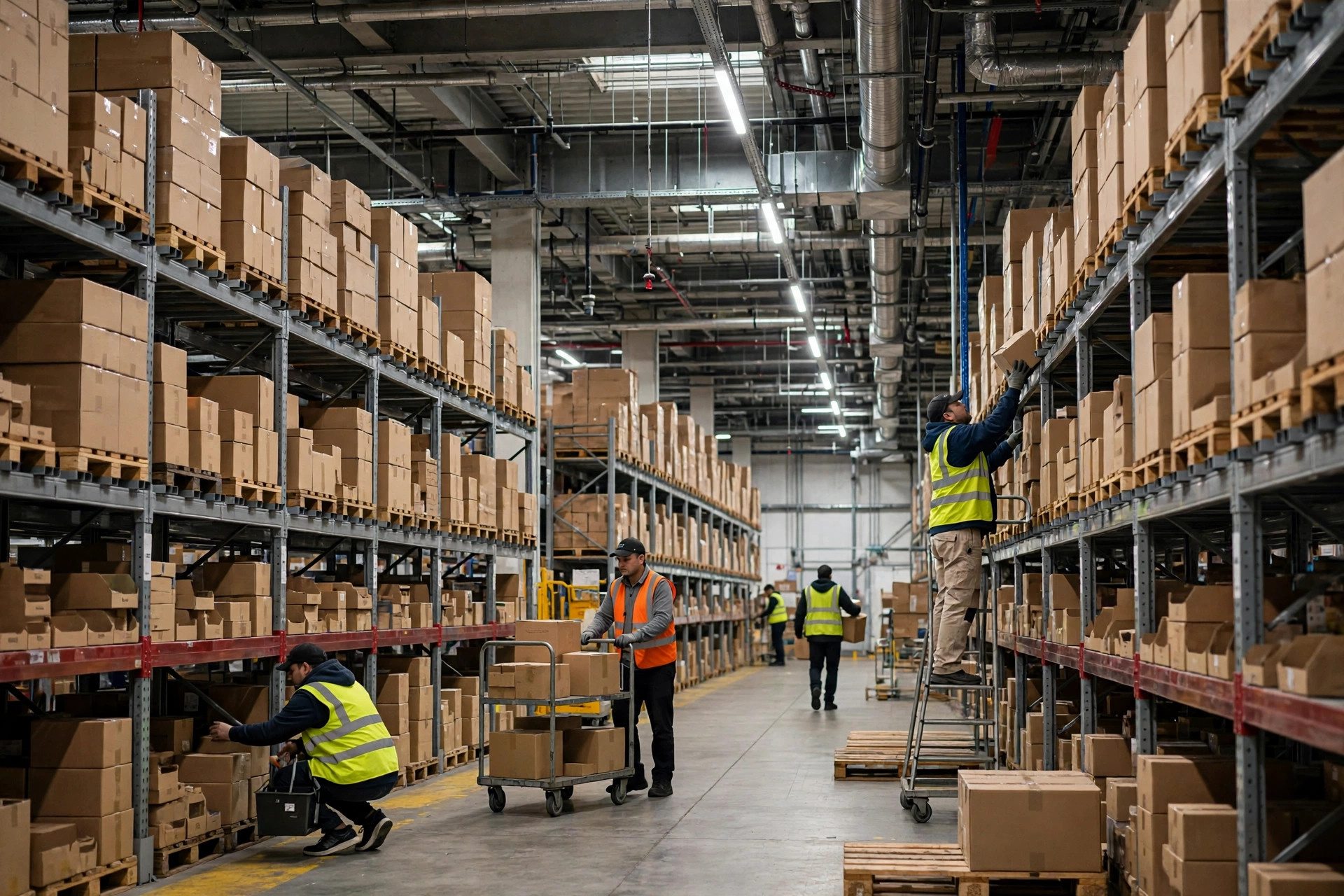
We have a client in home goods e-commerce, warehouse in Southern California, a little over 400 SKUs — not a big operation. Last October, a month before peak season, their pick lead Dave — a nine-year veteran — sprained his ankle skiing and was out for three weeks.
Three weeks. Doesn't sound like much. But on a 12-person pick team where Dave picked at 130 units per hour against a team average of 105, his absence dragged the team average down to 78 — a drop of more than 25%. Daily orders surged past 9,000 during peak, orders weren't cleared before cutoff, and the UPS truck waited at the dock twice for nothing. The client called us, furious: where's your 3PL management? The contract SLA says 98% on-time shipping, you're at 92% — should we trigger the penalty clause?
My honest thought at the time: this one isn't entirely on us. Every warehouse has a Dave. When he's out sick, the warehouse catches a cold; if he actually retires, it goes straight to the ICU. Every 3PL knows this in their bones, but nobody brings it up during contract talks — because the moment you do, the client's first reaction isn't "I see," it's "so you're held together by a few guys — are we overpaying for management?"
Where exactly does that 25% go?
Nothing in Dave's head exists in the WMS. After all these years, I've boiled picking tribal knowledge down to three things:
First, route intuition. The pick path the WMS calculates is theoretically the shortest — correct on paper. But Dave knows the B-zone aisle gets jammed with replenishment forklifts after 3 p.m., so walking through it means standing in line. He knows the rack at the far end of C-zone leans a little and costs a few extra seconds per pick. So his route always beats the system's recommendation. The system isn't dumb; it's blind to the floor.
Second, location memory. Four hundred-plus SKUs, and Dave knows which odd corner each one lives in without looking at the order. A new hire? Waving an RF gun, hunting location by location, backtracking when wrong. The WMS tells you where to go. It doesn't tell you what the product looks like, which shelf level, left side or right.
Third, the feel for exceptions. This is the spooky one. Torn packaging, smudged barcodes, two items that look nearly identical — Dave can tell with a squeeze or a heft. This client has two throw pillows whose SKUs differ by one digit, with near-identical packaging. They scan fine, but new hires mis-ship them at ten times Dave's rate. Every return rate the client sees on a report traces back to this.
So when the veteran calls in sick, you don't just lose one person's output — the whole team's rhythm breaks. Like a band losing its drummer: everyone else can still play, but nobody's in sync.
We have another client, a food distributor in Texas, with the extreme version: the veteran didn't take leave, he retired, and the knowledge walked out the door with him. His replacement followed the WMS step by step, and it took three full months to reach 70% of the old hand's rate. I helped them tally the overtime and temp labor for those three months. The number stung.
What does a three-week absence actually cost?
Using the first client's internal numbers (magnitudes for reference):
| Cost item | Where it comes from | Scale | | Overtime | 12 people x 1.5 extra hours/day x 15 days | Several thousand dollars in extra overtime pay | | Temp labor | 4 temps at about 60% of regular productivity, still needing supervision | about 20% higher labor cost for three weeks | | SLA penalties | On-time shipping 98% -> 92%, triggering the penalty clause | Fines plus customer claims | | Mis-ships and returns | Mis-ship rate 0.3% -> 1.1%; handling a return costs multiples of shipping it | Return processing costs doubled |
Add it up: Dave's three weeks out cost the client enough to cover nearly half a year of his wages. That's why I say the veteran isn't a cost — he's an asset. An uninsured asset.
Three ways to capture tribal knowledge — which one pays off?

Option one: master-apprentice pairing. The oldest method, and still the most common. The problem: the apprentice learns "follow the master" — when the master leaves, the apprentice tops out around 70%. And while mentoring, the master's own output takes a hit. It works best for small warehouses, because it's cheap.
Option two: film it. Strap an action camera on Dave for a day and have him narrate: why this route, how to tell this item apart, which locations are traps. Video's biggest advantage is capturing the "feel" stuff that can't be written — no written SOP will ever say "you just know by the squeeze." Cost is near zero. The catch: footage nobody edits and nobody watches equals zero.
Option three: route maps plus an exceptions cheat sheet. Draw Dave's actual routes on a map and post them at the aisle entrances; make a one-page "look-alike SKU comparison" and stick it at the audit station. Half a day of work, fastest payoff — but it only covers the parts that can be put into words.
| Method | Investment | What gets captured | Biggest risk | | Mentorship | Master's output discounted for 2-3 months | about 70% | Knowledge walks out again when the apprentice leaves | | Video | Near zero | Feel, route-choice logic | Unwatched footage = wasted effort | | Route maps + cheat sheets | Half a day | Whatever can be articulated | Incomplete coverage |
Here's the contrarian take: most people assume master-apprentice pairing is the safest bet. It's actually the most expensive — and it just moves the eggs from one basket to another. The combination that really pays is "video plus one-pagers": knowledge only belongs to the organization once it lives outside any single person.
And a trade-off nobody likes to mention: the better the veteran, the lazier the organization gets about capturing his knowledge. Everything runs fine while Dave's around — who bothers? Everyone scrambles only after he calls in sick. That's why this has to be settled at contract signing, not after something breaks. After the fact, the client just hears excuses.
Put it on the negotiating table
Insider moment. When a 3PL quotes you, the labor productivity assumes a "mature team." In reality, temps often hit 30% of headcount during peak, productivity drops to 70% — a gap invisible on the quote. So the smart client asks about people in the contract; and the smart 3PL volunteers to write "workforce stability" into the SLA — because once it's in writing, the 3PL can fairly charge a peak-season staffing assurance fee and push back on unreasonable volume swings. Genuinely win-win.
Next time you negotiate a contract, ask these three questions:
One: "What share of your pick team has three-plus years on the job? Which zones does each of them cover?" You're probing single-point dependency. Under 20% veterans, or a zone only one person can pick — now you know where the risk sits.
Two: "If a key picker is out for more than two weeks — leave or resignation — what's the contingency plan? Does the SLA have a matching grace period?" Awkward questions now beat ugly fights later, by a mile.
Three: "For tribal-knowledge capture — mentoring videos, route maps, exception guides — is that investment inside the management fee or a separate line item?" A separate line means they take it seriously; vague hand-waving inside the management fee usually means it doesn't exist.
One last thing: in this business, what 3PLs fear most isn't the client squeezing price — it's the client treating the 3PL as an interchangeable commodity. The veteran's value is living proof that a good 3PL is not a commodity. Next time the client waves the SLA at you, don't rush to accept the penalty. Put these three questions on the table — you're not negotiating fines, you're negotiating how to keep the warehouse steady, together.
By Susan, 3PL Sales Director