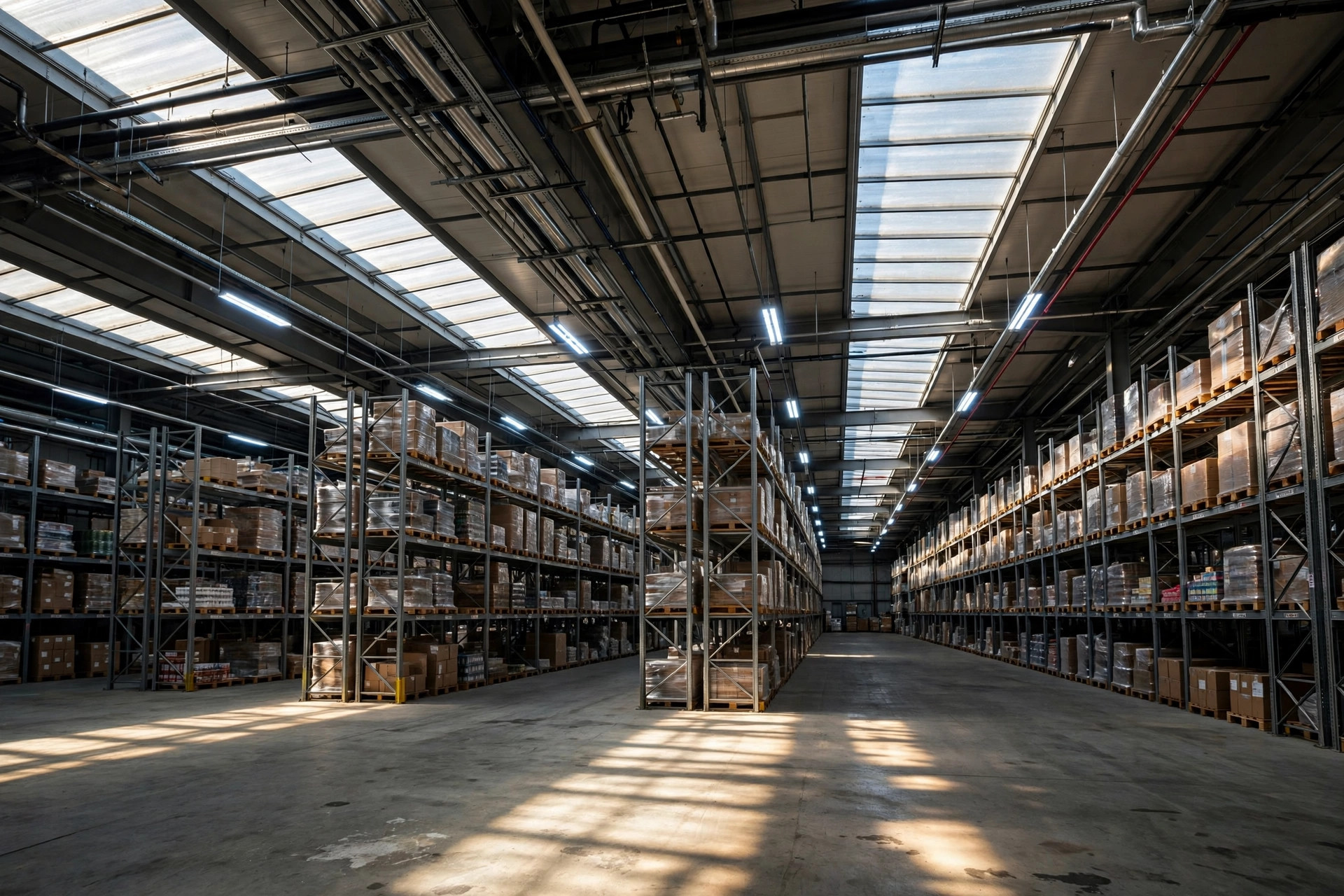
A lighting vendor told me last month: "skylights cut lighting energy 30%." I asked to see the meter. In the daylit zones, the sub-meter went from 42,500 kWh to 29,750 kWh — yes, a 30% drop. The whole facility's electric bill? Down 8.4%. And that was with skylights, daylight-responsive dimming, and LEDs all installed together.
That gap is the entire subject of this article. Warehouse skylight daylighting saves real money — but it saves a slice of the lighting bill, while buying 15 years of roof leak risk and extra cooling load. If you cannot put all three numbers on one page, "30% savings" is a sales sentence, not a financial fact.
Warehouse Skylight Energy Savings: Know Which Bill You're Cutting
The U.S. DOE's Federal Energy Management Program (FEMP) is the source vendors quote most: pairing LED luminaires with daylight harvesting can cut lighting energy use by 20–60%. It's on the DOE daylighting page. But it comes with two conditions vendors rarely volunteer: first, that is lighting energy, not the total electric bill; second, 20–60% is the ideal-application ceiling.
Translated to operator language: in a 50,000 sq ft warehouse, lighting is typically 20–30% of the electric bill (lower in cold storage, where refrigeration dominates). And only the skylit zones dim. So a "30% cut in daylit-zone lighting" × "lighting is 25% of the bill" × "daylit zones are 60% of lighting" works out to roughly 4.5% off the total bill. The vendor's measured 8.4% was already a good result.
The vendor in question — Hyperlite, and note this is vendor-published M&V data, not independent measurement — studied a Midwest logistics center of 50,000 sq ft over 12 months of post-occupancy sub-metering: daylit-zone lighting energy fell 30% (42,500 → 29,750 kWh), summer afternoon peak demand fell 31% (14.2 → 9.8 kW), and the average facility bill fell 8.4%. To their credit, the same article states a conservative design target of 15–30% for budgeting purposes.
Rule one for any skylight proposal: ask whether the percentage refers to lighting energy or the total bill. If the answer is fuzzy, close the deck.
The Four Costs the Savings Pitch Leaves Out
In 2023 I looked at a 3PL site in California's Inland Empire — 120,000 sq ft, 40 skylights with photocell dimming. The ops director's exact words: "forty skylights, curbs and install, under two hundred thousand dollars — cheaper than I budgeted." Then he showed me year two's utility and repair invoices. I wrote down four missing lines.
First, the racks eat the light. This warehouse ran 32-foot racks under a 36-foot deck. Under California Title 24 Section 130.1, the skylit zone extends horizontally 0.7× the ceiling height from the skylight edge — but light travels down, not sideways. Thirty-two feet of rack splits the skylit zone in half; the natural light reaching the pick aisles was maybe a third of the modeled value. The lighting designer had drawn the daylit zones for an empty building. Put in the racks and the model is fiction. For high-bay warehouses: insist the lighting model is recalculated with racks in place before you sign anything.
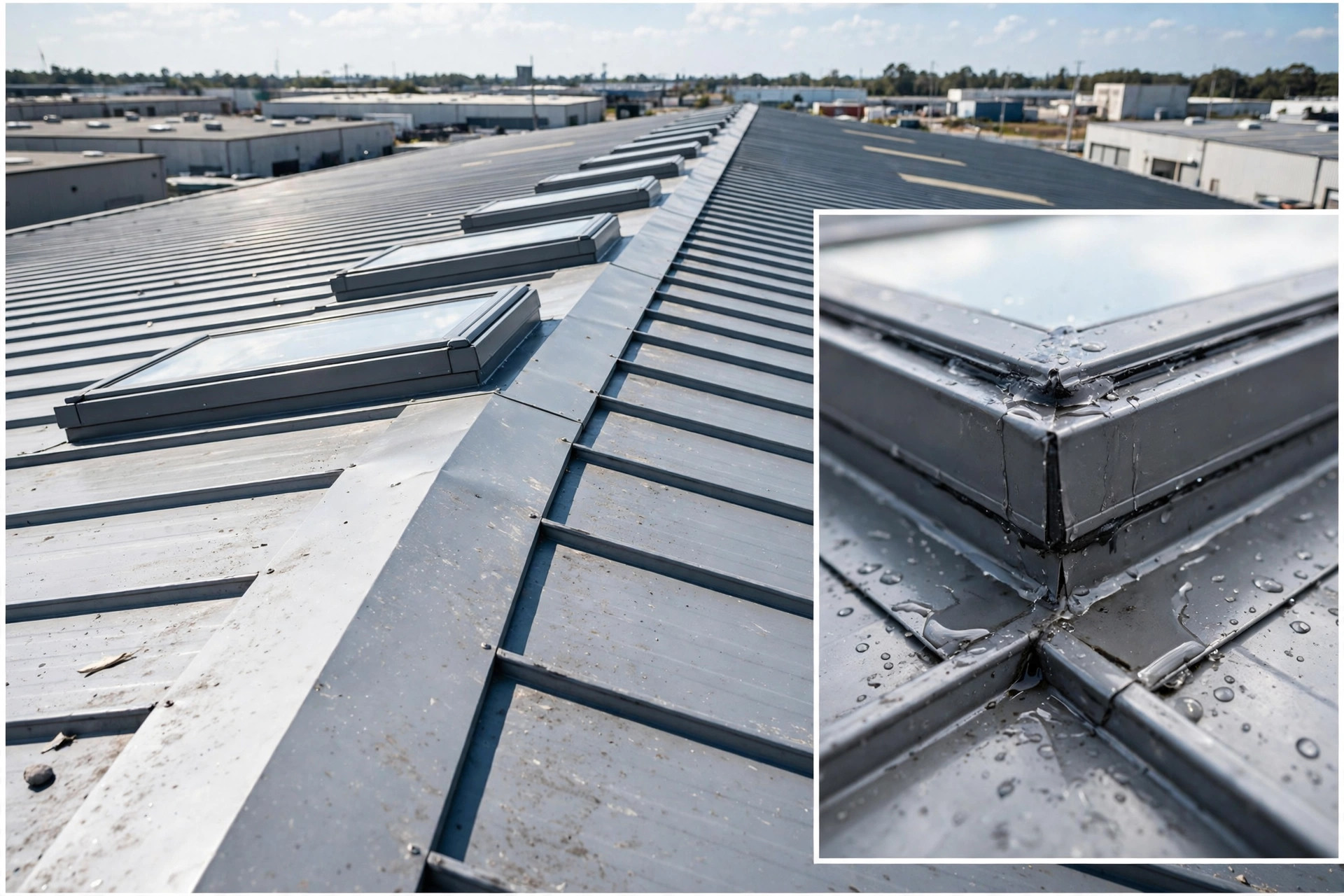
Second, every roof penetration is a 15-year leak subscription. Curb flashing sealant ages, thermal cycling loosens joints, a hard storm pushes water uphill. A roofing contractor once told me: "the parts of a roof that never leak are the parts with no holes in them." In year two, 3 of the 40 skylights seeped during rain season — a few thousand dollars in repair and damaged-goods claims. The question is never "will it leak," it's "in which year, and how many." A proper TCO carries $200–$400 per skylight per year for inspection and sealant work over the life of the roof.
Third, in summer you're importing heat, not just light. Even low-SHGC skylights admit an order of magnitude more solar heat than an insulated deck. That Inland Empire site paid roughly $9,000 more in June–September cooling than the prior year — about 40% of the lighting savings went straight back into air conditioning. Ambient warehouses barely notice; temperature-controlled ones (food, pharma) must model this separately.
Fourth, code compliance costs. In California, skylights alone don't pass — Title 24 Section 130.1 requires automatic daylighting controls (dimming or switching) on luminaires in the skylit zone, and the fixtures themselves must be dimmable. IECC C405.2.4.2 has similar daylight-zone definitions and control mandates. Translation: the skylight is half the project; photocells, dimming drivers, and commissioning are the other half. Any proposal that quotes the skylights without the controls is incomplete by definition — it can't pass inspection.
The 10-Year TCO: Skylights vs. No Skylights
Here's the full-cost comparison for a 50,000 sq ft ambient warehouse, 6,000 operating hours a year, $0.12/kWh (swap in your local rate — the formula doesn't change). Skylight scenario uses the conservative target: 20% lighting savings in daylit zones.
| Cost item (10 years) | No skylights | Skylights (40 units + daylight controls) |
|---|---|---|
| Initial investment | $0 | ~$180k–$220k (curbs, install, controls, commissioning) |
| 10-yr lighting electricity | ~$510k | ~$440k (20% daylit-zone savings, conservative) |
| 10-yr added cooling electricity | $0 | ~$30k–$50k (summer solar gain, climate-dependent) |
| 10-yr skylight maintenance (inspection, sealant, flashing) | $0 | ~$80k–$120k |
| Leak reserve (10-yr expected value) | $0 | ~$20k–$40k |
| 10-year total cost of ownership | ~$510k | ~$750k–$870k |
| Net electricity saved over 10 yrs | — | ~$70k |
Read that bottom line carefully: $70k of electricity savings does not buy back $240k–$360k of total cost. An industry figure often cited (via buildings.com) puts skylight payback at 36–60 months — but that's simple payback: initial investment divided by annual electricity savings, with cooling, maintenance, and leaks conveniently excluded. On a full-cost TCO, this example's payback stretches to 8–10 years — roughly the skylight's own service life.
When do skylights actually pay? All three conditions must hold at once: (1) new construction, where the skylight is an incremental cost rather than a retrofit cut-and-repair (retrofit curb work runs 30–50% more); (2) ceiling height under ~28 ft with racks under ~20 ft, so daylight actually reaches the floor; (3) electricity above ~$0.15/kWh or a local daylighting incentive (check current utility programs). Miss one, and the money is wasted.
Already Installed? Budget These Three Lines Every Year
If the skylights are already in, don't panic — disciplined maintenance contains the damage.
One: pre-rain-season inspection, every year. Walk all 40 units with a roofer: cracked sealant, loose flashing, half a day to a full day of labor. That's the basis for the $200–$400/unit/year budget. Skip it and one leak's cargo claim buys ten years of inspections.
Two: replace the glazing on a 5–8 year cycle. Polycarbonate yellows, and visibly so — transmittance drops year after year, and your savings numbers decay with it. When you re-glaze, specify double-wall with low-E coating; the heat gain drops noticeably.
Three: recalibrate the photocells annually. Dirty or drifting sensors fail to dim, and the lights run 100% all day — the skylight's savings, undone by a sensor nobody touched. I've walked a site where uncalibrated sensors had run three years with the daylit zone at full output. The skylights were decorative.
The Conclusion You Can Compute
One sentence: warehouse skylight daylighting saves a slice of the lighting bill while buying 15 years of roof-maintenance and leak risk; it works for new low-rack buildings with high electricity rates, and it usually loses money for retrofits, high-bay, or temperature-controlled warehouses.
Use this formula directly:
Full-cost payback (months) = total initial investment ÷ (annual lighting savings − annual added cooling − annual maintenance budget)
Plug in your four numbers: total initial investment (including controls and commissioning), annual lighting savings (use the conservative 15%, not the vendor's 30%), annual added cooling (ask your HVAC contractor), annual maintenance budget (skylight count × $300). Over 72 months: don't build it. Under 48 months: negotiate. Between 48 and 72: wait for incentives and rate trends.
Money you can't calculate is money you shouldn't spend. That's the whole article.
By Lao Zhou, Logistics Cost Analyst