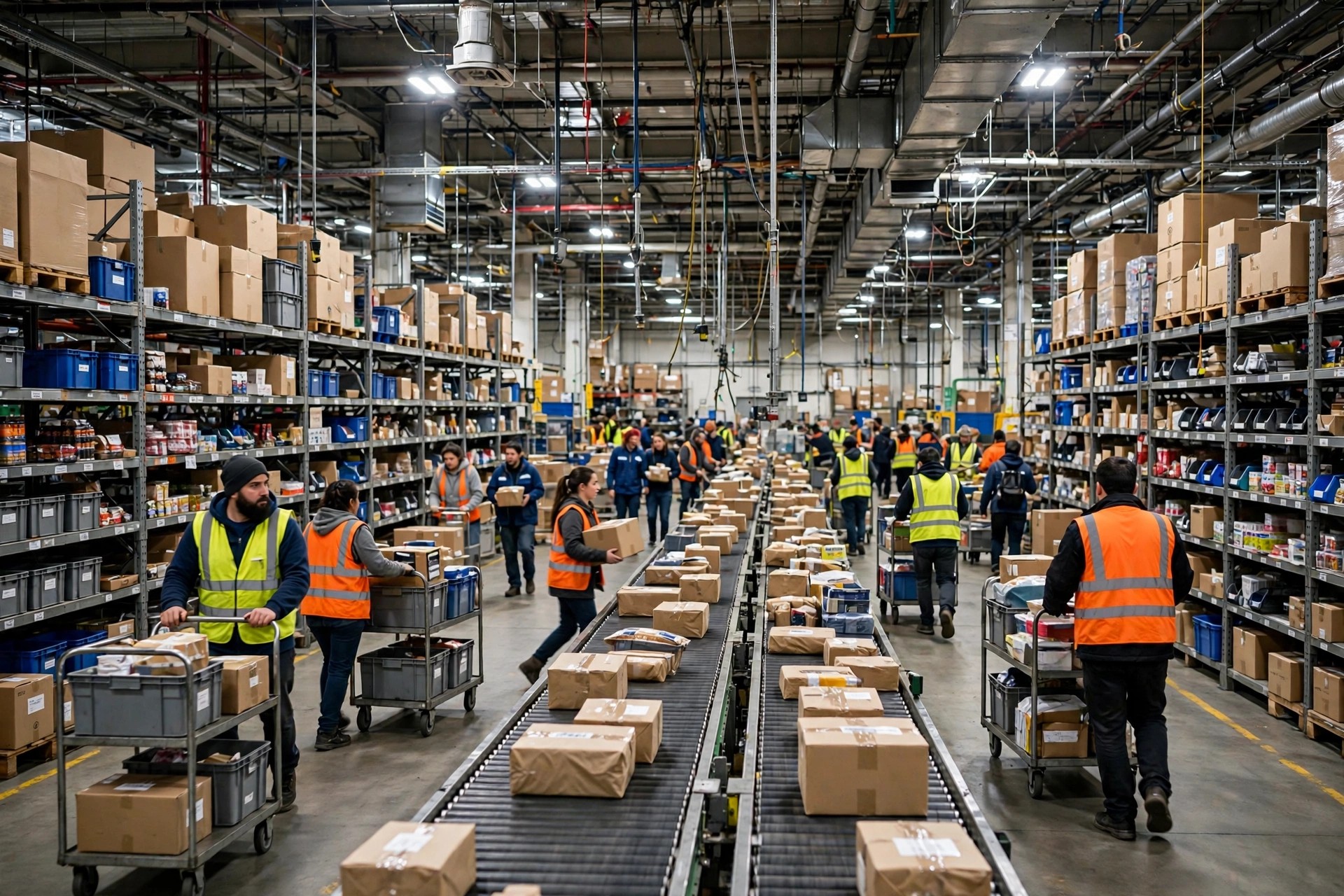
Monday before Thanksgiving, peak season, 5:40 in the morning.
I pulled into the warehouse and the parking lot was still half empty. Walked through the big door and my night-shift lead, Lao Liang, met me with the first words of the day: "Boss, four more walked off night shift."
Black Friday volume was already triple our normal. Pick carts were stacked up past the aisle entrance. The pack stations? The girls were flying, hands a blur, and still couldn't keep up with inbound shoving freight at us wave after wave. The crew had been pulling overtime for two straight weeks. You could see it in their eyes.
One of my veterans pulled me aside: "Chen, if we don't get more hands by this weekend, I'm calling in sick too. My back is done."
Real talk: in this business, peak season temporary staffing is the whole game. Every November, nobody has enough hands.
At the 6 AM pre-shift huddle I looked at forty-something faces and had exactly one thought: this year, I am doing the math on peak season temp staffing properly. Staffing agency versus direct hire. We tried both. Both burned us. Here's both sets of books.
Temp Agency: Fast Is Real. So Is the Turnover.
Black Friday 2024, our first big run with a staffing agency.
Ordered on a Wednesday, sixty people showed up Friday morning. The speed was unreal. No job ads to write. No interviews. Work authorization paperwork already done. They walked through the door and started picking.
Finance ran the numbers: the agency billed us $27.50 an hour, the temp took home about $18.50. Nine bucks in the middle, roughly a fifty percent markup. Expensive, sure. But zero hassle.
Then week two happened.
A new warehouse opened in the next logistics park over. They offered $19.50 an hour for temps. One dollar more. Twenty-two of our sixty agency workers just stopped showing up within three days. Not a two-weeks notice. Gone.
The agency scrambled. Backfill takes three days. In those three days, our backlog went from 3,000 orders to over 8,000. Customer complaints hit sales. Sales hit me.
Real talk: you can't blame the agency, and you can't blame the temps. A temp worker has no loyalty to anyone. Money talks. A dollar talks. That's the game.
But here's the part people don't put in the spreadsheet: those twenty-two who left? Every one of them cost us two days of a veteran's time to train. Lao Zhang's three rookies had just hit 90 units per hour picking — just getting independent — and then poof, gone.
That's the real cost of a temp agency: when the worker walks, you don't lose his wages. You lose the trainer's time.
We renegotiated the contract after that. Added a clause: if the same cohort stays four weeks, the agency rebates part of the markup. And they got smart on their end — bumped the pay rate they offer our people by fifty cents. Attrition dropped by half overnight. Money, spent in the open, works. Funny how that is.
Direct Hire: You Keep the People, You Lose HR's Sanity
Peak season 2025, we flipped the playbook: direct seasonal hires.
Forty seasonal spots. Posted on job boards, plus a referral bonus — $300 for any veteran whose referral completes 60 days. Worked better than expected. Half the hires were friends and family of our crew. When you know the person next to you, morale is different. End of season: 78% retention. Way above the agency year.
But the price tag? Our three HR folks didn't get a weekend off for two months. Nine hundred-plus resumes screened. Two hundred interviews. Job board ads ran us close to ten grand, plus background checks, onboarding, uniforms. About $400 per head all-in.
The real punch came after. End of January, season over, thirty-two people had to go. Then the unemployment insurance bill showed up the following year — our state's UI tax rate bumped up a tier. Finance told me it was nearly twenty thousand extra a year. Real talk: I never saw that one coming.
And overtime. During those peak weeks, plenty of people worked 58 to 60 hours. Under the FLSA, everything past forty is time-and-a-half. No exceptions. Agency or direct, that money gets paid either way — but with direct hires, you're the one cutting the checks. Mess up the math, the penalty letter comes to your company. With an agency, at least payroll is their headache.
The Two Ledgers, Side by Side
Here's our actual book from 2025. Per temp worker, ten-week season, fifty hours a week. This is Inland Empire, California numbers. Your market will differ — don't copy-paste.
| Cost item | Staffing agency | Direct hire |
|---|---|---|
| Worker's take-home hourly | ~$18.50 | ~$18.50 |
| Our real hourly cost | ~$27.50 (with markup) | ~$21 (wage + payroll tax / workers' comp / UI share) |
| Recruiting cost per head | $0 (agency's problem) | ~$400 (ads + interviews + onboarding) |
| Training cost | High (churn = constant retraining) | Medium (they stay, training sticks) |
| End-of-season separation | $0 (one phone call) | UI rate hike + separation conversations |
| Flexibility | High (scale up/down fast) | Low (easy in, hard out) |
| 10-week total per worker | ~$13,750 | ~$11,300 (with recruiting amortized) |
On paper, direct hire wins by nearly twenty percent. But hold on. Don't decide yet. The next section is the whole point.
The Counterintuitive Truth: "Quits on Day Three" Is the Expensive Part
After all these years, here's the thing nobody tells you: hourly rate is not the key variable in temp staffing.
The key variable is which day they quit.
A new picker is net-negative for the first three days. A veteran babysits them. Two people doing one person's work. Around day four they start paying back. Around day eight they hit seventy, eighty percent of a veteran's speed. If your average temp quits on day twelve, you're perpetually paying for those first three days. Forever.
Our agency temps averaged nineteen days. Our direct seasonals averaged sixty-eight. That single difference flips the math. The agency's hourly rate is fifty percent higher on paper — but once you factor in churn and training, direct hire comes out nearly twenty percent cheaper per productive hour.
But — and this matters — that conclusion only holds if your peak is long enough. Ten weeks or more, direct hire wins. Six weeks or less, the agency's flexibility earns its markup. Our break-even sits around eight weeks. Do your own math with your own season length.
One more trade-off people miss: joint employer risk. The NLRB's rules on whether agency temps count as your employees have been swinging back and forth for years. If the day comes when temps working in your building make you jointly liable — their injuries, their unpaid overtime — the agency's biggest selling point ("it's not our payroll") gets a lot weaker. I'm a warehouse manager, not a lawyer: get your contract's liability split in writing, and don't sign the template.
What We Do Now: The 70/30 Split
Starting this year, our standing playbook is a seventy-thirty split.
Skill positions — core picking, packing, anything that needs trained hands — go to direct seasonal hires. We start recruiting ten weeks out, employee referrals first. Pure muscle, high-volatility roles — unloading, palletizing, the stuff that swings with the daily volume — go to the agency. Scale up or down with a phone call. About thirty percent agency.

And we use exactly one agency partner, long-term. No rotating three vendors. When you've worked with the same agency for three years, they know what kind of worker you need. The quality difference is night and day. Our partner started reserving people for us two months before peak. Last Black Friday: zero no-shows. I wouldn't have believed it two years ago.
Three reminders for fellow warehouse folks:
First, don't wait until October to recruit for peak. Start in September. The good temps are all taken by mid-October.
Second, put attrition terms and backfill timelines in the agency contract. Verbal promises don't count.
Third, with direct seasonals, tell them the end date on day one, and have the conversation again two weeks before it ends. People who leave on good terms come back next peak. Eleven of the thirty-two who left us last year reapplied this year on their own. That's half our training cost gone, for free.
Peak season comes down to people in the end, not equipment. Get the temp staffing math right and triple volume doesn't scare you anymore.
By Chen Feng, Warehouse Operations Manager