Let me say it straight: in five years of selling cross-border e-commerce, the most expensive lessons I have learned were not about ads. They were about shipping. When I started in 2023, I ran everything through one account. Light little boxes and heavy gym equipment all went down the same lane. By year end, shipping was eating 18 percent of my revenue. Sellers I knew were running at 11 to 12 percent. That gap was the price of not knowing how to split accounts. Warehouse parcel multi account routing is the fix I wish I had known then.
Warehouse parcel multi account routing boils down to one rule: never let light freight pay for heavy freight, and never let heavy freight drag light freight down the wrong lane. Light parcels go Ground. Heavy freight goes LTL. Oversized items get their own quote. It sounds simple. The details are where the money leaks out.
Today I keep four accounts active: one main Ground account for light parcels, one LTL account for heavy freight, one backup account for oversized and remote deliveries, and one cheap third-party channel for packages under one pound. Each account has a job, and none of them cross over.
Warehouse Parcel Multi Account Routing Starts With the Hard Limits
The first cut in warehouse parcel multi account routing is not price. It is the carrier's hard limits. UPS and FedEx Ground both cap a single parcel at 150 pounds, 108 inches on the longest side, and 165 inches in length plus girth. Cross any one of those and the shipment stops being a parcel. It becomes freight. Force it through and the carrier either refuses it or bills it at freight rates, and the invoice that arrives can be double what you quoted.
The postal channel is stricter: USPS Ground Advantage tops out at 70 pounds and 130 inches in length plus girth. Postal is genuinely cheap for small packages, but past 70 pounds it is out of the game entirely.
Then there is the quieter trap: dimensional weight. UPS and FedEx Ground bill on length times width times height divided by 139, and charge whichever is higher, actual weight or dimensional weight. I once sold a batch of lampshades that weighed 8 pounds in a 30 by 30 by 30 inch box. Dimensional weight came out at 194 pounds. Eight pounds of product billed at 194 pounds. That is how dimensional weight eats your margin. My rule now: if dimensional weight runs more than 1.5 times actual weight, the parcel leaves the Ground account and goes LTL, or gets repacked into a smaller box.
| Shipment type | Test | Which account |
|---|---|---|
| Light parcel | Under 70 lb, dim weight close to actual | Postal or Ground account |
| Mid-size parcel | 70 to 150 lb, inside size limits | Ground account |
| Heavy / palletized | Over 150 lb, or multiple boxes on a pallet | LTL account |
| Oversized | Longest side over 96 in, or length plus girth over 130 in | Separate quote account |
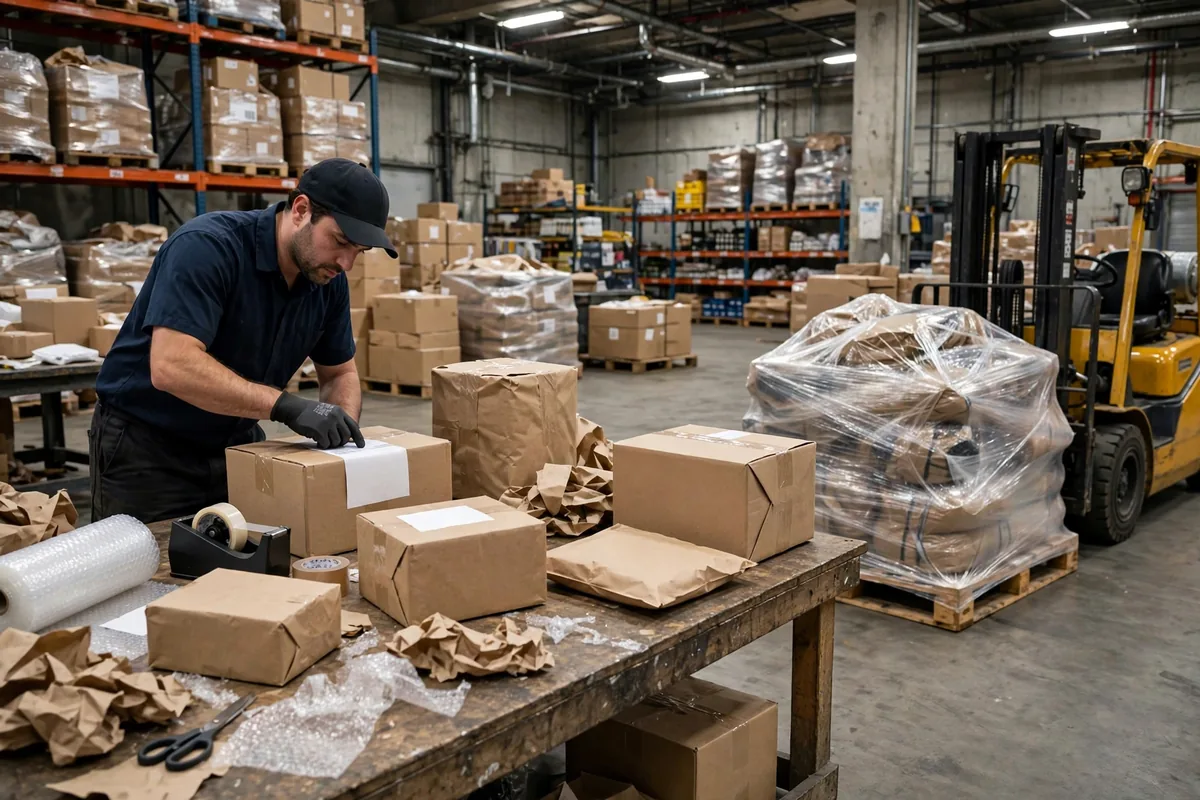
That table is taped to the packing bench in my warehouse. The packers do not have to think. They read the table and pick the lane.
I Compare Rates Every Week
A lot of sellers think warehouse parcel multi account routing means comparing rates once when you open the account. Wrong. Rates change every year, surcharge rules change every year, and the cheapest account last year can be the most expensive this year. Every Friday afternoon I spend half an hour running the next week's 20 typical shipments through all three accounts and writing the results in a table.
In October 2024 I caught a mistake that had been costing me for months. A 120-pound piece of gym equipment had always gone Ground, because 120 pounds is under the 150-pound cap and I assumed that meant it was fine. That week's comparison showed the same shipment going LTL for nearly 40 percent less. Why? Ground charges oversize surcharges per piece, and a 120-pound box had already triggered them. LTL prices on total shipment weight and density, so once the freight was palletized the per-pound cost dropped below parcel. Since then my rule is simple: anything over 100 pounds gets priced both ways, Ground and LTL, and the cheaper lane wins. Industry guides put the parcel-to-LTL crossover somewhere in the 100 to 200 pound range, depending on dimensions, density, and accessorials. That matches what I see in my own quotes.
Never compare base rates alone. Surcharges are where the real money hides. Residential delivery, extended-area delivery, oversize and overweight fees, Saturday delivery. Stacked together they can double the base rate. I keep an accessorial list next to the rate table for each account, and every comparison includes the surcharges that shipment is likely to trigger.
Surcharges and Claims Are Where Sellers Bleed
First, surcharges. In early 2025 I shipped to a remote part of California and the delivery address was flagged as an extended area. The surcharge added more than 30 dollars and wiped out the margin on the order. Now my flow has one extra step: check the address before booking, tag residential, commercial, and remote addresses separately, and route residential deliveries through the account with the friendliest residential surcharge.
Second, claims. Every platform handles lost and damaged parcels differently, and the payout timelines are not the same. My lesson: for high-value shipments, use the account with the clearest claims process and the highest payout cap, even if the base rate costs more. Cheap channels can take 30 days or more to settle a claim and ask for a pile of documentation. In June 2024 I lost an 800-dollar shipment through the cheapest third-party channel. The claim dragged on for six weeks and paid out 200 dollars. Since then, anything over 500 dollars goes through the main account. I do not chase the cheapest rate on expensive freight.
One more trap: account suspension. Third-party rate-shopping platforms watch for sudden volume spikes and frequent returns. A new account that jumps from zero to hundreds of parcels in a week can get flagged. My approach is to grow each account gradually. A new account runs small volumes for two weeks, and only scales up once it proves stable.
Multi Account Routing Is Never Set-and-Forget: Split First, Then Optimize
Warehouse parcel multi account routing is not a one-time setup. It is a weekly habit. Step one: split shipments by the hard limits in the table above and assign each class its account. Step two: compare rates weekly, and price anything over 100 pounds through both Ground and LTL. Step three: review surcharges and claims monthly, and change the rules when one account's accessorials start running hot.
Here is a hypothetical example to show the scale: assume monthly sales of 100,000 dollars, with shipping falling from 18 percent of revenue to around 12 percent after the split. That is roughly 6,000 dollars a month saved, enough to hire another packer. Those are my own numbers from my own books, but your freight is different, so do not copy my percentages. Copy the method: split first, compare, then review.
One last warning: do not open a dozen accounts because each one looks cheap. An account you cannot manage is a liability, not a saving. Four accounts are enough.
By Ah K, E-commerce Seller (5 yrs)