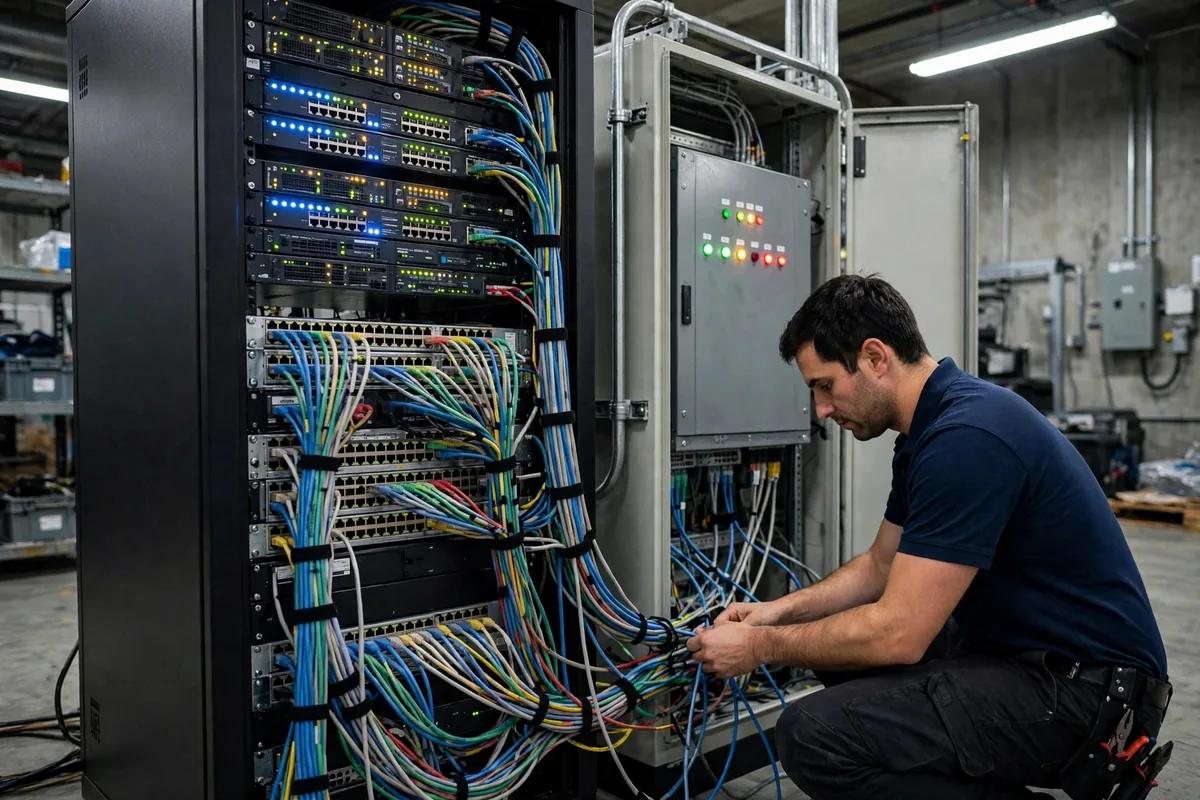
In May 2021, Colonial Pipeline suffered a ransomware attack — a textbook failure of OT network segmentation — that shut down one of America's largest fuel pipelines for roughly six days, triggering fuel shortages along the East Coast. The incident became a landmark case in supply chain security — not because of the ransom figure, but because of the attack path. The intruders entered through the corporate IT network and the impact eventually reached operational technology systems. The lesson travels well beyond energy. In a warehouse, when the WMS, PLCs, and the office network all share the same flat network, a compromise on one side can travel to the other.
Warehouse OT network segmentation has been raised more often in recent years for two converging reasons. On one side, the population of OT devices keeps growing: PLC-controlled conveyors, stacker cranes, and automated sorting systems are all networked. On the other, integration keeps deepening — the WMS connects to office systems and cloud platforms, remote maintenance and vendor access have become routine. As the connectivity surface expands, the case for segmentation grows with it. According to published industry security reports, attacks targeting industrial control systems have risen steadily over the past several years, and warehouses, as critical nodes in the logistics chain, carry an exposure surface that is not obviously smaller than a factory's.
One Network, Three Worlds: Why OT Segmentation Matters
Consider the typical warehouse network today. The office area has dozens of PCs, printers, and guest Wi-Fi. The warehouse floor has WMS servers, wireless access points, and handheld terminals. The equipment layer has PLCs, sensors, and conveyor controllers. In many facilities, these three layers share a single subnet, or sit behind one ordinary switch with only a nominal separation. An employee clicks a phishing link on an office PC, the malware moves laterally, and the next hop may be the WMS server. In the extreme case, PLC control traffic itself can be interfered with.
This flat architecture is rarely the result of anyone choosing it. Warehouse IT grew incrementally: first the office network, then the WMS, then automation — each time by adding one more cable to the existing network. Adding a cable costs almost nothing. Retrofitting segmentation costs real money all at once, so the problem gets passed from one generation of infrastructure to the next. A parts warehouse in eastern China that we interviewed in 2024 illustrated the pattern: three layers sharing a single gateway, with equipment vendors maintaining PLCs through a generic account created years ago, with no access logging at all. Management was not unaware of the risk. What it lacked was a clear modernization roadmap.
It is worth noting that the difficulty of segmentation is not primarily technical. VLANs, firewall policies, and access controls are mature technologies. The hard part is mapping who needs to talk to whom: the WMS needs the PLCs' data interfaces, the PLCs report status to the monitoring system, the office reporting tool reads the WMS database, and vendors need remote access to tune parameters. Once that communication map is drawn, most of the segmentation design is done. Without it, segmentation either leaves backdoors open or blocks legitimate operations.
OT Network Segmentation in Practice: VLANs, Firewalls, and Remote Access
In practice, warehouse OT network segmentation usually proceeds in four steps. The first is an asset inventory: list every connected device and assign it to one of three zones — office IT, warehouse IT, or OT. WMS servers, handhelds, and printers belong to warehouse IT; PLCs, sensors, and conveyor controllers belong to OT; office PCs, email, and office automation belong to office IT. The inventory almost always turns up surprises: an old label printer still running its default password, a switch in a corner that nobody remembers installing.
The second step is network zoning. Each zone gets its own VLAN, with no traffic between zones by default — only allow-listed communication passes. The WMS talks to PLCs only on designated data ports, the office network queries the WMS only through the reporting interface, and the OT zone never initiates connections to the office network. There is a counterintuitive point worth stating plainly: tighter is not always better. Seal the OT zone completely and the vendor who needs to troubleshoot remotely cannot get in; a minor fault then waits for an engineer to fly out, and the downtime costs more than the security risk it replaced. The sensible goal is "deny by default, allow by exception," not a total cutoff.
The third step is firewall and boundary control. Firewalls sit between zones, and all cross-zone traffic passes through policy checks. Firewall rules need periodic review — we have seen warehouses running rules written three years earlier at implementation time, while the business has moved on. That is like guarding a new door with an old key.
The fourth step is closing the remote access path. Vendor maintenance on PLCs must go through a jump host or VPN, with one account per person, revoked after use, and fully logged. No direct vendor connections to the internal equipment network, and no long-lived generic accounts. This step is the easiest to overlook and the most likely to cause an incident, because the tension between remote access convenience and security never goes away.
Patch cadence is a separate decision that deserves its own judgment. Office IT can patch monthly. OT devices cannot follow the same rhythm: a PLC firmware update can affect line speed, so it must be validated in a test environment first and scheduled into a maintenance window. The pragmatic approach is tiered: office IT on a normal cadence, warehouse IT a week behind for observation, OT devices evaluated quarterly with only validated critical patches applied. Patching slowly is not laziness. It is a trade-off — one unvalidated patch that stops a conveyor line can cost more than the vulnerability it was meant to fix.
Why OT Network Segmentation Matters Now, and What Comes Next
Zoom out, and the pace of OT network segmentation comes down to two variables: regulatory pressure and the cost of incidents. On the regulatory side, cybersecurity requirements for critical infrastructure keep tightening. Warehousing and logistics are not named as directly as energy, but as a critical link in the supply chain, compliance pressure will arrive sooner or later. On the cost side, the direct loss from a single OT security incident may look contained, but the chain reaction — downtime, lost orders, damaged customer trust — usually exceeds the initial estimate.
Three trends are worth watching. First, IT-OT convergence will not reverse. The goal of segmentation is not to tear two networks apart again, but to make sure convergence happens through controlled channels. Second, zero-trust thinking is moving from office IT into OT: trust no device and no account by default, verify every access. That fits a warehouse environment — many devices, many people — particularly well. Third, the boundary of security responsibility is shifting. Who is responsible for OT network security — the equipment vendor, the integrator, or the warehouse operator — needs to be written into contracts, not argued about after an incident.
There is one more point worth adding: the cost structure of segmentation is changing. Five years ago, a full OT network segmentation project was a major investment for a mid-sized warehouse. Today, VLANs, firewalls, and jump hosts are mostly capabilities already present in existing network equipment and management tools. The cost now sits mainly in the human work of mapping communication flows and writing policy, not in hardware. In other words, the barrier is lower than it was five years ago, and the reasons to delay are fewer. The cost curve is moving down while the threat curve moves up, and where those two lines cross is the moment to act.
So back to the original question: is separating the WMS, PLCs, and the office network worth it? The investment is real, but the cost of a single OT security incident is typically several times the cost of the project. More importantly, segmentation is not a project with an end date. It is a continuing operating state: assets change, operations change, threats change, and the segmentation policy has to change with them. Is your WMS still running on the same network as your PLCs today? And if the answer is yes, when is the next network upgrade on the calendar?
By Dr. Chen, Supply Chain Researcher