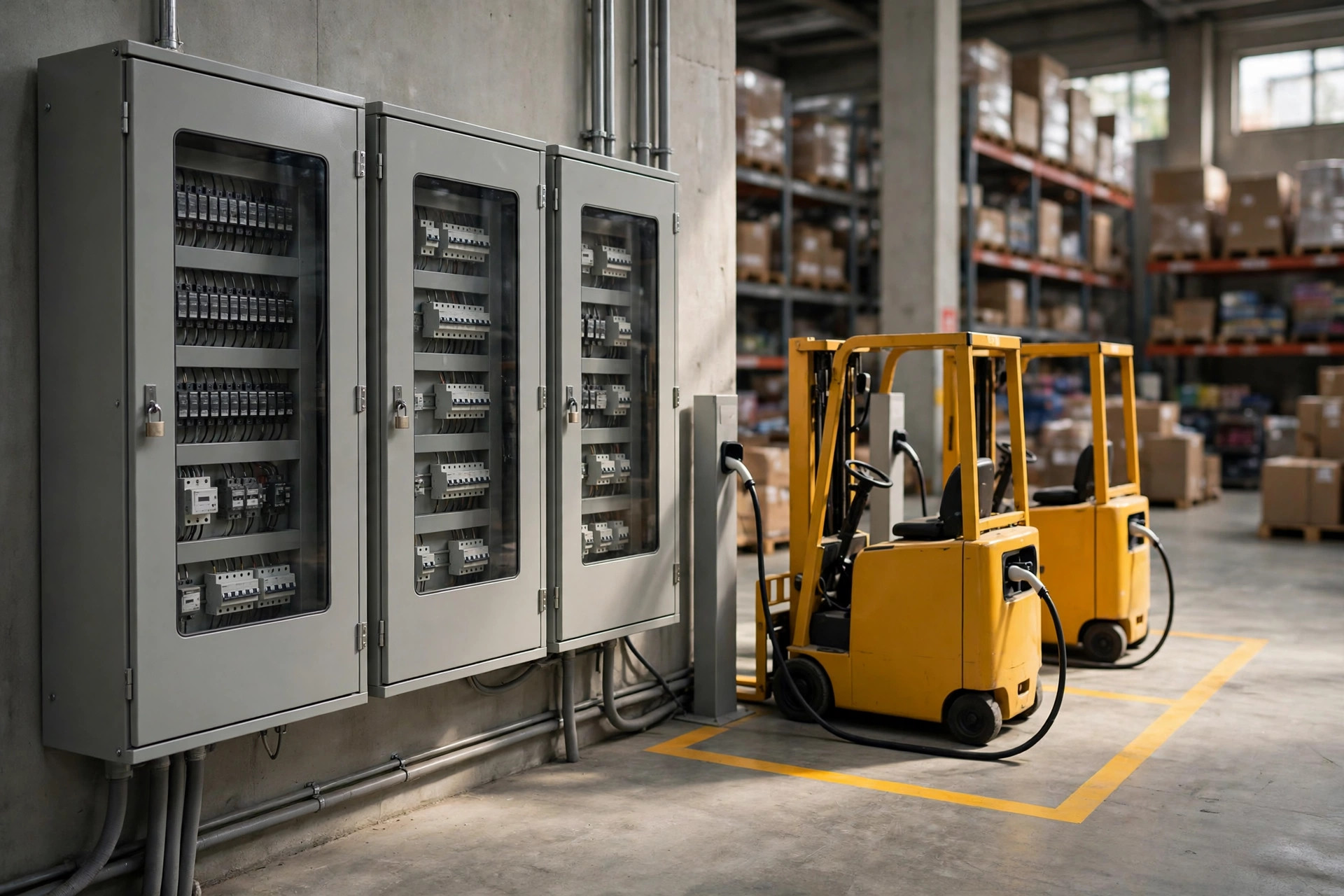
The day I signed my warehouse lease, I was too busy haggling over rent to look at anything else. I talked the landlord down from 1.1 to 0.95 yuan per square meter per day — saving myself close to 100,000 yuan a year — and walked out feeling like a genius. I never once thought to peek inside the electrical room. Six months later I added four electric forklifts, plugged them all in on the first night, and the lights across the whole warehouse started flickering like a nightclub. My only thought: we're out of power.
That's the trap most small warehouse owners walk into: we negotiate rent and forget about electricity. This piece is about warehouse power capacity upgrades — how to check a building's electrical capacity before signing, how much juice chargers, refrigeration units, and automation actually draw, who pays for a capacity upgrade, and the three clauses that must go into your lease.
The Upgrade Bill Gets Decided the Day You Sign
Let me start with my own bruise. At the end of 2023, my 3,000-square-meter warehouse in Jiaxing switched from diesel to electric forklifts — four of them, all at once. The logic seemed airtight: electric forklifts save fuel money, they're cleaner, and you just plug them in.
That first night, with all four trucks charging, the lights started "breathing" — dimming and brightening in waves. The electrician took one look at the transformer and said: "This transformer was already small. Add this load, and tripping the breaker is just a matter of time."
I asked the industrial park about a capacity upgrade. The answer: yes, there's a process, but the cost and timeline depend on the local power utility (upgrade fees, application procedures, and tariff rules vary a lot by region — always go by your local utility's latest published policy). And the kicker: the park said the upgrade was on me, the tenant. My lease said nothing about it. The landlord shrugged: "You never asked."
We never did the upgrade — we survived on a workaround (more on that below). But those six months taught me something: at the leasing table, electricity is the second-biggest variable after rent. A small warehouse can't just burn money on this stuff. A capacity upgrade can easily cost several months' rent, and if you don't sort it out before signing, you've signed a time bomb.
First, Figure Out How Much Power You Actually Need
Don't start by asking "is it enough?" — start by knowing your own numbers. Here's a rough power-draw table for the equipment you'll find in a typical small warehouse. These are magnitudes, not specs — for your exact equipment, check the nameplate:
| Equipment | Rough draw per unit | Usage pattern |
|---|---|---|
| Lighting + office | A few kW | On daily, baseline load |
| Forklift chargers | A few kW each | Shiftable, but 4–5 charging at once adds up |
| Cold storage / refrigeration units | Tens of kW | Running 24/7, the real power hogs |
| Packing / carton sealing machines | A few kW | Intermittent, usually fine |
| Conveyors / small sortation gear | A few to ~10+ kW | Depends how automated you are |
My 3,000-square-meter site, fully kitted out: a few kW for lighting and office, ten-plus kW for four chargers, a few kW for two packing lines — all running at once, and you've eaten most of a small transformer's headroom. Small warehouses typically sit on transformers in the tens to low-hundreds of kVA, and the landlord sized that transformer for "a building that stores boxes," not "an operating warehouse with chargers." You're renting their past, not your future — that's for every small operator planning to add electric forklifts, refrigeration, or automation.
Here's another story. My friend Lao Chen rented 2,000 square meters in the neighboring park in early 2024 for cold-chain storage and installed two refrigeration units. When the first power bill arrived, he nearly lost it: the "demand charge" line on the bill was far bigger than he'd expected. One phone call later, he learned how two-part tariffs work — the demand charge is billed monthly against your contracted capacity (or peak demand) whether you use it or not, and the exact rates and calculation method follow your local utility's latest published policy. Refrigeration runs around the clock: contract too little capacity and you can't run, contract too much and you pay for air every month. Lao Chen's verdict: "I didn't rent a cold warehouse, I adopted an electricity ancestor."
So the right order is: add up your equipment's rough draw, check how much transformer headroom is left, then look at how much of your bill is demand charges. And here's the counterintuitive one: for a small warehouse, the biggest part of the power bill is often not the per-kWh energy charge — it's the demand charge tied to contracted capacity. Oversize the transformer and you pay every month even when the machines are idle. A building with "plenty of spare power" isn't necessarily a good deal — you're paying monthly for that spare capacity.
Who Pays for the Upgrade: Three Clauses for the Lease
Paid for in bruises, this conclusion: a capacity upgrade has to be negotiated before you sign, in writing. After signing, you have zero leverage. Three clauses. Don't sign without all three.
First, the landlord must guarantee the available capacity at handover — as a number, in the contract. Don't take "the power is fine" verbally. Ask for the transformer nameplate, the capacity registration documents, or the last few months' power bills (a bill shows the demand-charge structure and usage pattern). Put the number in a supplement: available capacity at handover shall be no less than X kVA.
Second, settle upgrade cooperation and cost-sharing in advance. When you later add chargers or refrigeration and need more capacity: the landlord must cooperate with the paperwork (without the property owner, the utility application stalls), and the cost split — ratio or cap — gets agreed now. The small-operator argument: an upgrade adds value to the landlord's property, so the cost should be shared, not dumped on the tenant.
Third, spell out restoration duties at lease end. The chargers and wiring you paid for — do you rip them out and restore the space, or leave them at a depreciated value for the landlord? Unwritten, this becomes another fight at move-out.
The landlord may find you fussy. But think about it: you negotiated hundreds of thousands in annual rent — isn't the thing that determines whether you can actually operate worth three more questions?
The Small Warehouse Workaround: Off-Peak Charging
Here's how we survived without an upgrade — off-peak charging, the classic small-operator money saver.
It's embarrassingly simple, and it works: every charger gets a timer. Forklifts work by day; charging starts after 10 p.m. Two reasons. One, it dodges the daytime peak — the transformer is most stressed during working hours, and at night there's plenty of headroom for the trucks. Two, many utilities run time-of-use pricing where off-peak power is cheaper — the exact spread follows your local utility's latest published policy, but the direction is always the same: nights are cheaper.
The result? Six months in: zero trips since, and the monthly bill came in more than ten percent below what we'd projected. A timer costs a few dollars. It might be the best money this warehouse ever spent.
Of course, workarounds have a ceiling. If what you're adding is a 24/7 refrigeration unit, or you're scaling to a dozen chargers, no amount of scheduling saves you — do the upgrade properly. The boundary is simple: shifting load across time only works if your total draw still fits inside the transformer's capacity. Past that, go through the upgrade process.
Advice for Fellow Small Operators
The four-step power check before leasing:
- Read the power bill. Ask the landlord for recent bills. Look at the demand-charge vs. energy-charge split, and get a feel for the numbers.
- Look at the transformer. Go to the electrical room, read the nameplate, ask about remaining headroom. Don't accept "I think it's enough."
- Ask about upgrades. Can the park do a capacity upgrade, how long does the process take, what's the rough cost (exact figures per your local utility's latest published policy)?
- Write it into the lease. The three clauses above — capacity guarantee, upgrade cooperation and cost split, end-of-lease restoration. Every one of them.
Small warehouses have their own way of surviving. Big companies can write the upgrade check without blinking; we can't. Electricity is invisible until it isn't — one tripped breaker, one unfair bill, and you'll never forget the electrical room again. Do the math first, sign second. Don't wait until the lights start flickering.
By Xiao Ma, Small Warehouse Owner