
It was 2:30 in the morning. Two guys from the receiving team had just walked out, and my lead came to me and said the night's freight wasn't going out. I told him one thing: put Marcus and Devon on it. They're both multi-skill workers — Marcus runs the forklift and can pick, Devon handles packing and inspection. That shift got saved. That's what cross-training is really for. Not a poster on the wall. A lifeline when you're short-handed.
We used to run one person, one job. Receiving did receiving. Picking did picking. Looked clean on paper. Then people started dropping, and the whole chain seized up. The worst one was a peak season a few years back — three or four pickers on the night shift called in sick, and the receiving crew just stood there. Not because they didn't want to help. They genuinely couldn't. Picking flow, handheld scanners, slotting logic — they'd never touched any of it. Throwing them in would have made things worse.
That year we did some ugly math. To survive the "one absence kills the shift" problem, every role kept one or two extra bodies as backup. In a building with around two hundred people, we were carrying fifteen to twenty redundant heads. Still not enough in peak season. Dead weight in slow season. Let me be straight: that's not management, that's buying peace of mind with payroll.
Our first attempt at rotation was a disaster. I kept it simple: a schedule where receiving rotated into picking for a month, then back. The veterans felt demoted. The new hires got dragged around before they knew anything. Both team leads came to my office to argue about it. Three months in, productivity hadn't moved, but the complaining had doubled. Lesson learned: you can't force rotation on people.
So we changed the approach. No mandatory rotation. We built a multi-skill program instead — volunteers only. Learn a second skill, earn a "multi-skill" tag, get extra pay. Plenty of young guys signed up. A few veterans too, but I had to go recruit those myself. More on that in a minute.
The Skills Matrix: A Multi-Skill Worker Is Not a Jack-of-All-Trades
First, let's kill a myth. A multi-skill worker is not someone who can do everything. Someone who can do everything can usually do nothing well, and when something breaks, they can't carry the shift. Our rule: one primary job you do cold, plus one or two secondary jobs. And "secondary" means you can run that job alone for a full shift — not "you kind of know it."
We built a skills matrix. Rows are people, columns are jobs — receiving, QC, putaway, picking, packing, loading, forklift, system work. Each cell has four levels: none, apprentice (needs a buddy), independent (can work alone), mentor (can train others). The whole chart hangs on the break room wall. Everybody can see where they stand and what the next level takes. Here's a simplified slice:
| Worker | Primary | Secondary 1 | Secondary 2 |
|---|---|---|---|
| Marcus | Picking (mentor) | Forklift (independent) | Packing (independent) |
| Devon | Packing (mentor) | Inspection (independent) | Picking (apprentice) |
| Ray | Forklift (mentor) | Putaway (independent) | — |
Level-ups are strict. Apprentice to independent needs a mentor's sign-off. Independent to mentor requires you to bring one apprentice up to independent first. A guy once argued with me — "I've been picking for two years, why am I still independent?" I told him: train one apprentice to independent and I'll promote you tomorrow. A month later he came back and said, "I get it now. Training people is hard." Attitude fixed itself.
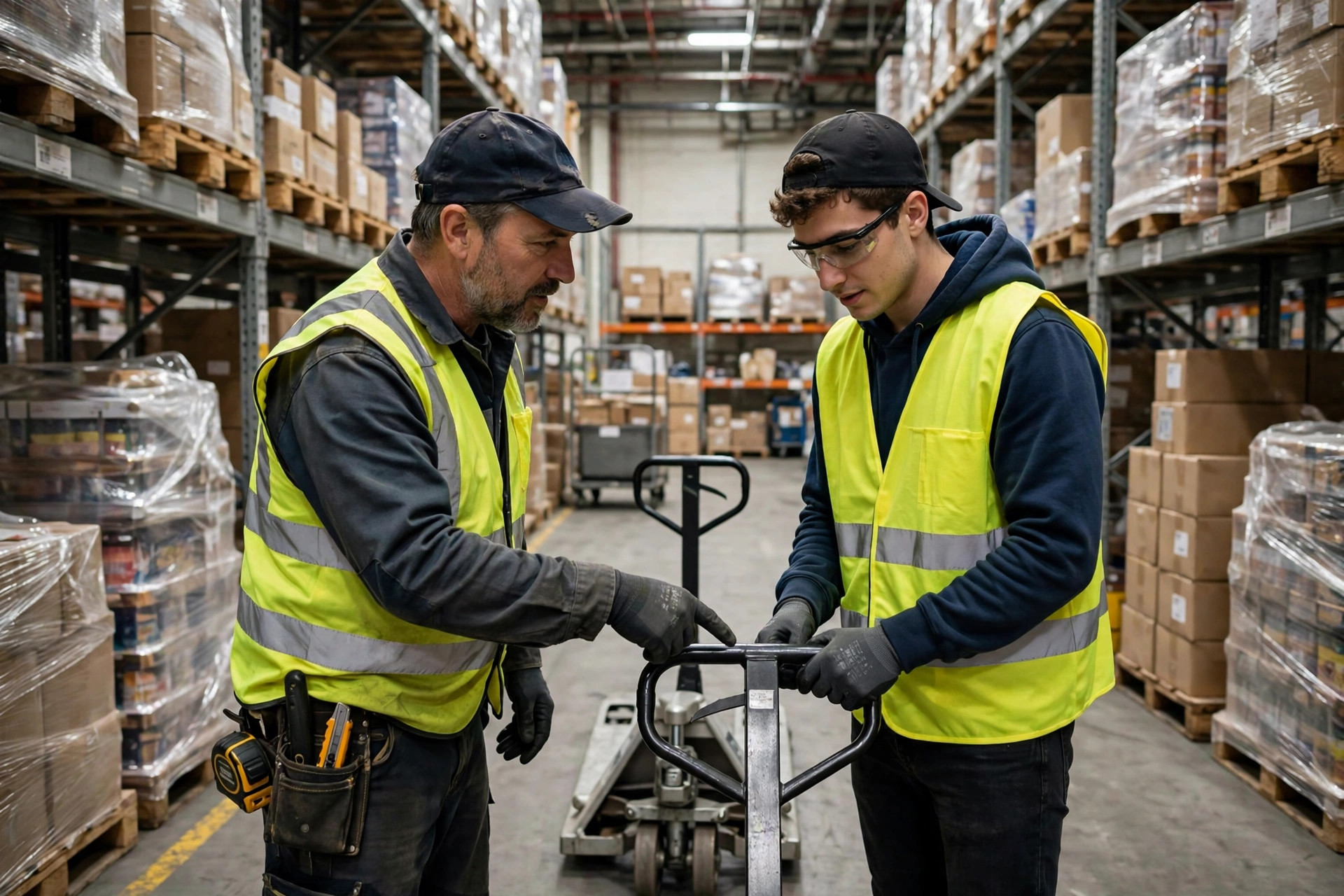
The training happens on the floor, always. A veteran showing a new hire how to run a pallet jack, how to read a slot location, how to talk to a driver — you can write that in a manual and nobody will read it, or you can walk it once and they'll remember it forever. Our standing rule now: every apprentice shadows a mentor for a full month before the sign-off counts.
Cross-Training Pay: Doing the Math Out Loud
This is the question everyone asks: who pays for the extra skills? We tried two models. First was "learn a secondary skill, get a bump." People signed up for the bump, learned halfway, and quit the program. Now it's "you get paid when you can cover a shift." Hit independent on a secondary job, you get a monthly premium. Hit mentor, the premium goes up again. It grows with tenure — one more step each year you stay. Walk out the door and it's gone. It's in the pay stub, not a promise.
Here's how the math works. Before, we carried a dozen-plus backup heads across every role, and that payroll added up fast. Now, the total multi-skill premiums come to a fraction of what those redundant positions cost — and we don't run short in peak season anymore. I won't quote our exact numbers because every market pays differently, but run it yourself: take the annual cost of one backup head you no longer need, and compare it against the annual premiums for four or five cross-trained workers. The answer is obvious.
There's a hidden line item too: overtime. When we were short, we paid overtime, and overtime bleeds money. Now the crew covers gaps internally, and overtime dropped hard. Scheduling got easier as well. It used to be a jigsaw puzzle — one missing piece and the whole thing fell apart. Now I've got a bench full of utility players, and every schedule has an answer. The hours my leads used to spend fighting over the roster alone paid for the program.
"Won't They Just Take the Skills and Leave?"
I'll be honest: this is the first question every peer asks me. You train someone into a multi-skill worker, and they take those skills to the warehouse down the road. Didn't you just train your competitor's employee?
Here's the truth: yes, some leave. But we've done the counting, and the value created by the ones who stay has long since covered the ones who left. And here's the part I didn't expect — our cross-trained people quit less than the single-skill ones. Think about it: doing the same task for three years straight grinds people down until they want out. When you can pick today, load tomorrow, and train a new hire the day after, the job keeps changing shape, and people don't burn out as fast. I didn't plan for that. It was a bonus.
We added two small retention moves. First, the premium grows with tenure, like I said — leave and it resets to zero. Second, when we promote leads and supervisors, workers with multiple skills go first. The young guys figured out fast: more skills means a faster path up, so sign-ups went up. That's a virtuous cycle.
One last thing for my fellow managers. Don't rush this. From our failed first attempt to the system we run today took nearly two years. Don't start with mandatory rotation for everyone. Start with the volunteers, the young ones, and the respected veterans you personally recruit as mentors. Build a few success stories, and the rest will follow on their own. If there's one secret to keeping a rotation system from turning into chaos, it's this: make it voluntary, make it pay, and make it lead somewhere.
By Chen Feng, Warehouse Operations Manager