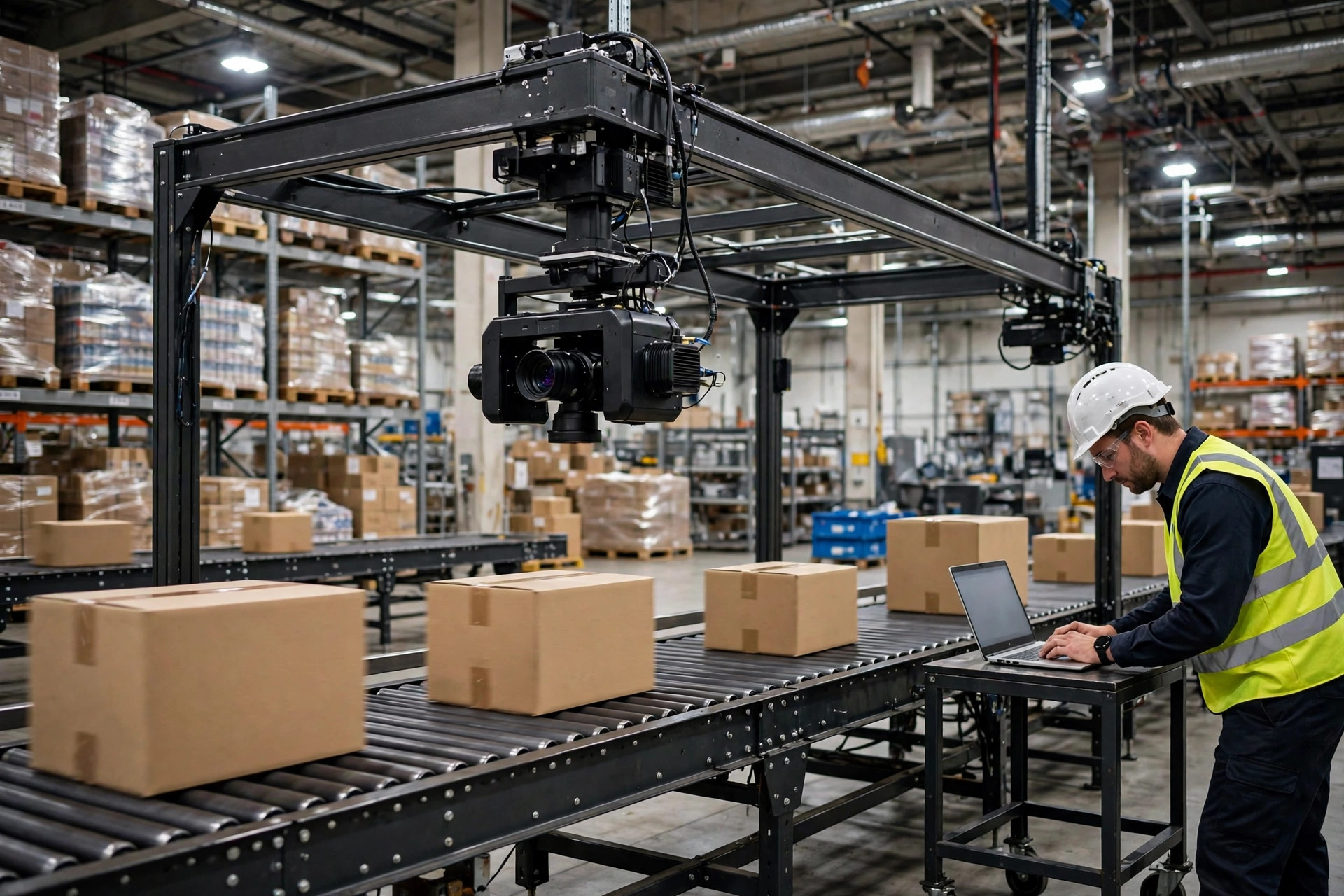
We had a client, the general manager of a third-party logistics firm in southern China, who came to talk about his warehouse AI project budget and wanted to add vision checking to his sortation line in the second half of 2024 to catch mis-shipments before they left the building. He brought me a supplier quotation with a single total on one page. The number did not look unreasonable, and he was ready to sign. I asked him to hold off and to split that total with three questions: which locations does the pilot cover, will full rollout require new hardware, and is maintenance charged separately for the following year. After those questions, the supplier revised the explanation without changing the total: the pilot covered only two locations, full rollout required a hardware supplement, and maintenance was billed annually on top. The total had not moved, but its meaning had changed completely. That is the first lesson of splitting a budget: a blended number cannot be approved with confidence, and it cannot be negotiated with precision.
Why a Warehouse AI Project Budget Must Be Split Into Three Budgets
Such a budget needs to be split into pilot, rollout, and maintenance because the three sums buy different things. Pilot money buys an answer: does this solution work on your goods, under your lighting, at your pace. Rollout money buys replication: turning a result at one location into stable capability across the whole warehouse, which often exposes hardware, network, and process changes the pilot never touched. Maintenance money buys continued accuracy: keeping the system correct after goods change, volumes shift, and seasons turn, with someone responsible for retraining models and adjusting rules.
A second client, an e-commerce warehouse in eastern China in early 2025, learned this by skipping the split. Its pilot looked excellent, with checking accuracy strong at the pilot locations, and the boss approved a full-warehouse budget by multiplying the pilot unit price by the number of locations. During rollout, the team discovered that the pilot locations had the best lighting and the most regular cartons, while nearly a third of the remaining locations needed added lighting, changed camera angles, or adjustments to conveyor timing. The rollout budget grew by roughly forty percent over the original estimate, the project stalled midway, and both sides felt the other had changed the deal. Nobody had changed the deal. The pilot number had simply never been a valid unit price for the whole warehouse.
Warehouse AI Project Budget by Stage: How to Price Pilot, Rollout, and Maintenance
Splitting a warehouse AI project budget works best when each stage states what it includes, what it excludes, and what would change the price. A simple table does more work in a budget meeting than a long narrative, because a decision maker can see at a glance where the money sits.
| Stage | What this money buys | Most commonly missed item | One line to lock down in writing |
|---|---|---|---|
| Pilot | Small-scale proof that the solution works in your conditions | Data cleanup, site preparation, manual checking for comparison | Pilot scope: locations, product types, and time period |
| Rollout | Replication and stable go-live across the warehouse | Added lighting and hardware, network work, training and parallel running | Whether hardware, site work, and training are itemised separately |
| Maintenance | Continued accuracy and availability after go-live | Model retraining, rule tuning, spares, and response times | Annual package or per-incident billing, with response time stated |
The pilot stage carries a counterintuitive point: the cheaper the pilot, the more expensive rollout can become. A pilot that only tests the easiest locations and the most regular products produces attractive numbers and a weak conclusion. A pilot worth its money deliberately includes one or two difficult cases, such as poor lighting, irregular shapes, or peak-season pace, to test whether the system holds up when conditions are unfavourable. Spending a little more on honest validation during the pilot often prevents a much larger surprise during rollout, and that comparison is one a boss can understand, provided it is shown rather than asserted.
Maintenance is the budget line suppliers are least eager to explain and buyers are most likely to forget. A model does not stay accurate by itself. Product mix changes, packaging changes, and a surge in peak volume can all pull accuracy downward. Before signing, the buyer should know who retunes the system when data changes, whether each tuning round is charged separately, how quickly someone responds at night, and whether spare parts are held locally or ordered on demand. Promises made verbally before a contract are not costs. The same promises written into the contract become manageable costs. The fear that keeps many operations leaders awake is not the first-year price, but the discovery in year two that the system has no owner and needs a rescue budget.
How to Present the Budget to a Boss or a Client
When presenting the budget, do not lead with the total. Lead with the structure, in one sentence: pilot money buys a conclusion, rollout money replicates that conclusion across the warehouse, and maintenance money protects the result year after year. Put the total last and the structure first. A boss rarely approves a number alone. A boss approves a logic that can be defended upward: money released in stages, each stage producing a visible result, with the next funding request arriving only after the previous stage has proved itself.
In negotiation with a supplier, three questions do most of the work. Can the pilot scope be written into the contract, and does a change in product mix count as an extra charge. Are hardware, site work, and training itemised separately in the rollout price, or hidden inside a blended unit rate. Is maintenance billed as an annual package or per incident, and are response time and tuning rounds capped. If a supplier hesitates on those questions, it does not necessarily mean bad intent. It often means the supplier has not separated the three budgets either, and a supplier who has not separated them is the one most likely to add charges during rollout.
There is also an insider pattern worth naming. Many low headline prices achieve their look by hiding first-year maintenance inside rollout, or by leaving rollout site work outside the pilot quotation. Judged on the first-year total alone, the cheaper offer wins. Judged over three years, the same offer can turn out more expensive. A useful negotiating move is to ask every supplier for a three-year total: pilot plus rollout in year one, maintenance in years two and three, and the three-year sum. Once the horizon is stretched to three years, any front-loaded discount followed by back-loaded charges becomes visible, and the comparison becomes honest.
On amounts, this article speaks in example magnitudes and structure only, and it does not promise any specific vendor price. A pilot is typically a small-scale investment in the tens of thousands of dollars range in order-of-magnitude terms, rollout scales with warehouse size, and maintenance is an annual figure. Those magnitudes are examples to help a decision maker calibrate expectations, and actual prices depend on the real quotation. Using an example magnitude to force down a supplier's real price will stall a negotiation rather than advance it.
Next time you negotiate a warehouse AI project budget, remember to ask these three questions: which difficult cases does the pilot actually prove, are rollout hardware and site work itemised separately, and is maintenance an annual package or billed per incident. Once those three questions are answered in writing, the budget stands up to scrutiny, and the person approving it can do so with a clear picture of what each stage buys and what it does not.
By Susan, 3PL Sales Director