Full disclosure: I'm out of my lane here. I run a 3,000-square-meter warehouse — the kind of operation where "enterprise technology" means a second label printer. Writing about voice picking, the fancy headset system the big 3PLs brag about, is like a food-truck owner reviewing a Michelin kitchen. But because every dollar comes out of my own pocket, my nose for "is this actually worth it" might beat any sales rep's. When it's your money, you do the math.
Black Friday 2025. We handle fulfillment for three small e-commerce clients. Normal days: 400 orders. That Friday: 1,100. My four pickers are veterans who could find any SKU blindfolded — and we still mispicked 11 orders.
Not 11 items. 11 orders. A large shipped instead of a medium. A promo gift left out. One customer's product packed into another customer's box. The client sent a "😊" in the group chat, and we ate the return shipping plus reshipping. Nearly two grand, gone in a day. I sat in my office, did the math, and felt sick: one mispick costs me three days of a picker's wages.
For ten minutes I dreamed the big-warehouse dream: strap on a headset, the system tells you what to grab, mispick rate drops to "practically zero." I almost called the vendor. Then I saw the quote — several thousand dollars per headset kit, tens of thousands for a full deployment, plus WMS integration. I put the phone down. We can't burn money like that.
Once I calmed down, I asked the better question: what problem does this actually solve for the big guys? Not "the warehouse is too loud" — "we have 200 pickers and nobody can read the lists." Our mispicks had a different root cause: overconfidence. Veterans grabbing from memory, look-alike SKUs side by side. Boom — wrong item.
Voice Picking in the Noise: Can the Headset Actually Hear You?
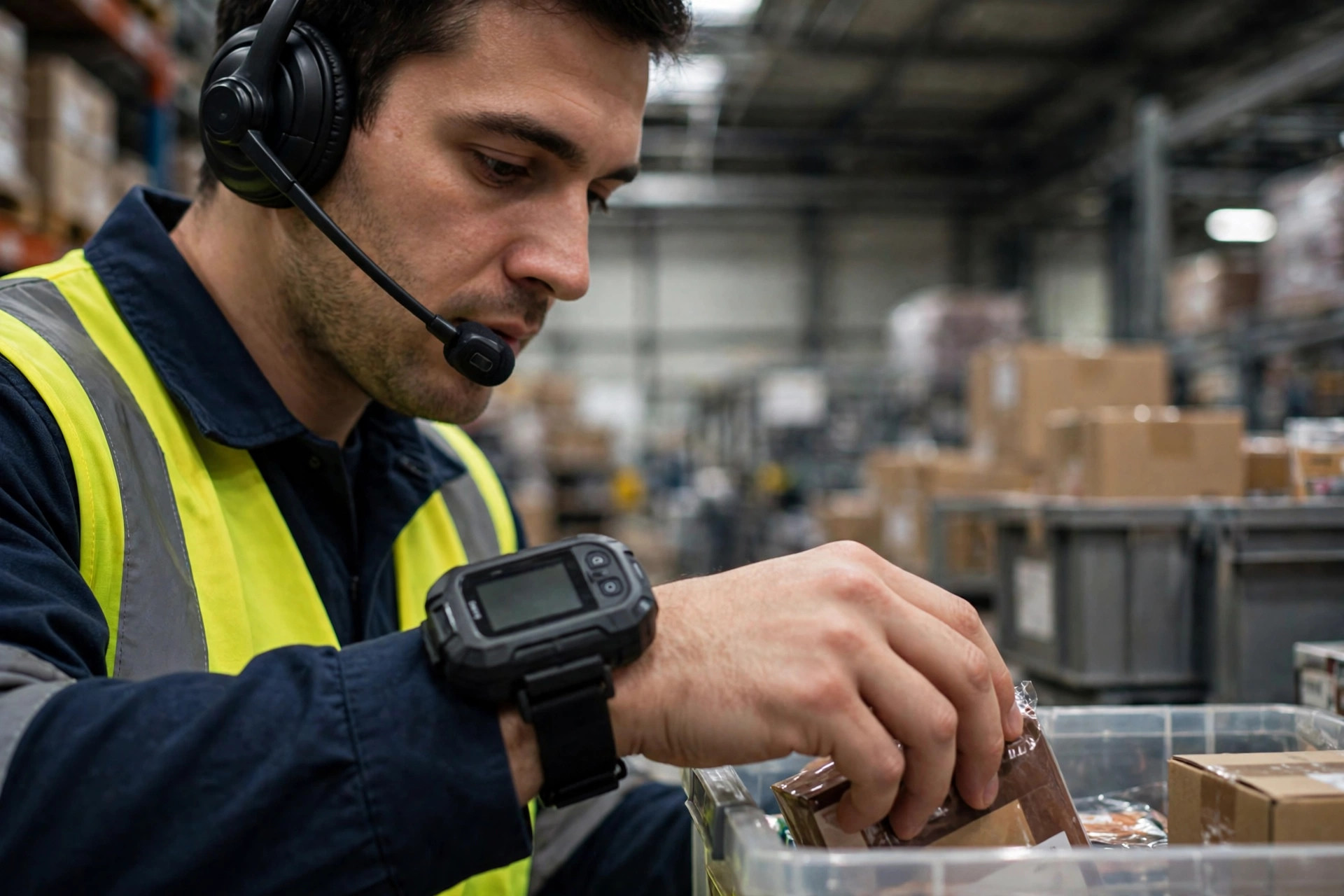
This was my first real question. Our little warehouse gets loud too during peak season — the case sealer hammering away, forklifts beeping in reverse, someone smashing pallets in the next bay. The whole thing runs on speech recognition. If it keeps mishearing, you've just bought yourself a very expensive deaf supervisor.
I asked a friend who actually runs the stuff. The answer surprised me: vendors solved the noise problem years ago.
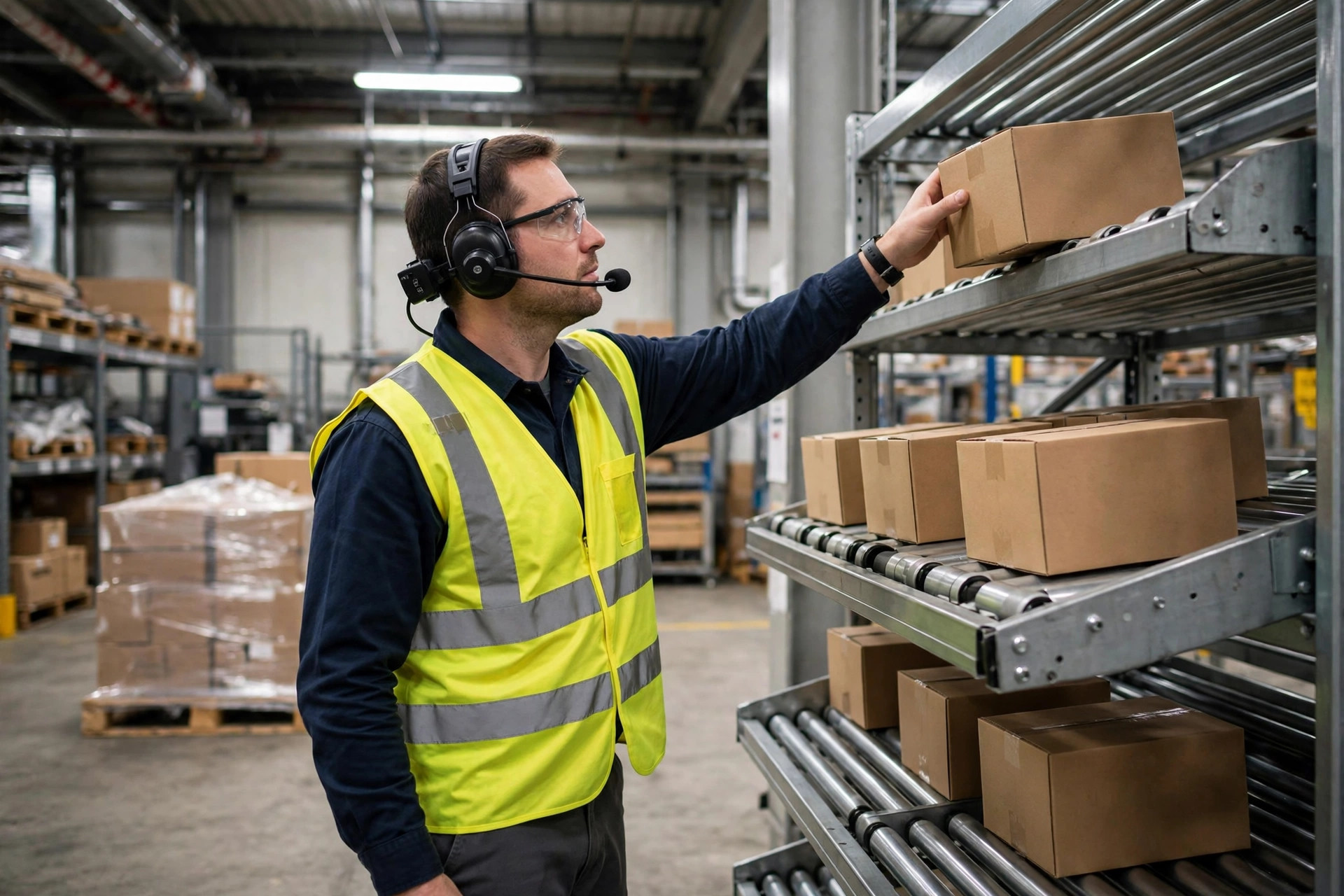
Modern industrial headsets use directional noise-canceling mics that only pick up the voice at your mouth, plus a check-digit mechanism — after each pick you speak the last two digits of the location to confirm, and it corrects you on the spot. At around 85 decibels, recognition holds up fine. Technically, voice picking in a noisy warehouse works. What it actually struggles with:
First, accents. Recognition is best with standard pronunciation. One of my friend's guys pronounces "seven" like "seben" — the system took three days of training to learn him.
Second, network. Recognition runs in real time against a server — hit a wireless dead zone and the headset becomes a fashion accessory. Big warehouses pay for seamless roaming. Our Wi-Fi can't reach the bathroom door.
So the accuracy verdict: the system genuinely holds up in noise. The vendor hype isn't about noise — it's about the ramp-up period. The first three months will make you question your life choices. Month six is when the magic starts. Funny how the sales rep forgets to mention that part.
Three Ledgers: Paper vs. PDA vs. Voice
Since accuracy isn't the blocker, only money is. Here's my comparison from a 3,000-square-meter shop doing a few hundred orders a day (figures are industry ballparks — get fresh vendor quotes):
| Paper lists | PDA scanning | Voice picking | |
|---|---|---|---|
| Startup cost | Basically zero — printer and paper | A few hundred dollars per device, a dozen to start | A few thousand per kit, tens of thousands for the full rollout |
| Pick speed | Baseline | 20–30% faster than paper (no flipping pages) | 30–50% faster than paper (hands and eyes free) |
| Mispick rate | Depends entirely on the human; peak season is a gamble | Scanning verification cuts it clearly | Check digits plus voice confirmation — among the lowest in the industry |
| Training a new hire | Three days shadowing a veteran | Half a day to learn scanning | Two to three days of following voice prompts |
| Biggest weakness | Errors, slowness, zero traceability | Ties up one hand; winter gloves make you want to cry | Expensive, needs WMS integration and rock-solid network |
| Best for | A few hundred orders a day | Growing operations past a thousand a day | Several thousand orders a day and up — big DCs and 3PLs |
Every advantage of the voice approach is real — and every one has a prerequisite: volume. A big DC saves enough labor to pay for the hardware; at a few hundred orders a day, the savings won't cover the annual software fees. That's the real reason small warehouses aren't buying voice picking. It's not that the tech is bad. The math doesn't close.
Here's the counterintuitive part: you're not buying accuracy for tens of thousands of dollars — you're buying discipline. The true value of voice-directed picking: a three-day new hire performs at 80% of a veteran, with every action logged. Big warehouses need "anyone can do this job." Small warehouses need "don't let the veteran quit." Copying the big guys' homework just gets you their invoice.
Big Warehouses Buy Discipline; We Go Low-Tech
My buddy A-Dong runs a 20,000-square-meter 3PL. In 2024 he deployed voice picking — 30 kits, software, implementation, training, several hundred thousand dollars all in.
The first three months were chaos: headsets fogged at the cooler entrance, recognition dipped in the noisiest corner, and veterans hated "talking to thin air like an idiot." A-Dong spent those months wondering if he'd lit the money on fire.
By month four, the system had learned everyone's accents, they'd filled the wireless dead zones, and the veterans stopped hating it. Six months in: productivity up roughly 40%, new-hire training compressed from two weeks to three or four days, mispick rate down to a third of their PDA days. At 6,000+ orders a day, the savings paid back the investment in about eighteen months.
But he said something I'll never forget: "Xiao Ma, you can't copy this. It's not that you don't get it — your volume can't support the payback period. My 6,000 orders a day is the entry ticket. At 500 a day, this thing is a luxury good."
Fair enough. Same technology: in a big warehouse it's productivity, in a small one it's performance art.
Back to our 11 mispicks. We couldn't afford the headset route, but the errors still had to stop. Our low-tech fix cost under $2,000 total, and it has two moves:
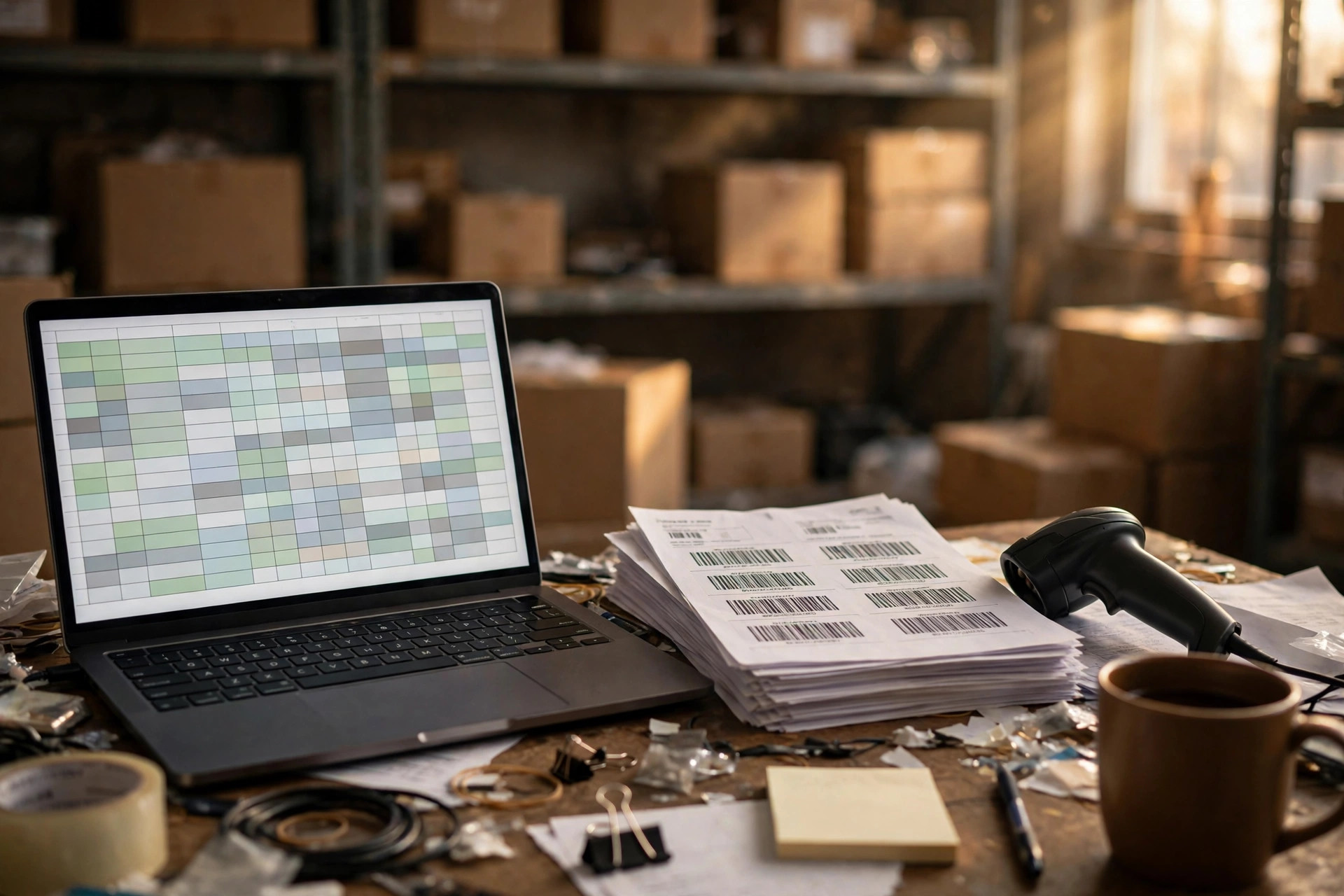
Move one: weigh everything at pack-out. A scale on the pack table, every SKU's standard weight in a spreadsheet. Weigh before sealing — weight's off, open the box. A large versus a medium differs by 80 grams; the scale catches it instantly. This alone stopped about 70% of our mispicks.
Move two: photograph every box. One phone photo of the open box before sealing, auto-saved to the client's folder. Customer claims something's missing? Send the photo — 90% of disputes die on the spot.
The result: from a dozen-plus mispicks a day that Black Friday week to one or two a month now. Two grand invested, several thousand a month in avoided losses. Scrappy, sure — no voice guidance, no fancy dashboards — but the ROI embarrasses voice picking.
Three Notes for Fellow Small Warehouses
One: fix your slotting before you talk tech. Chaotic locations, smeared labels, look-alike SKUs stored together — spend a weekend re-slotting and printing clear labels. It beats any device, and it's free.
Two: the enemy of accuracy is confidence, not noise. Veterans picking from memory are the hidden landmine — one cheap verification step (weighing, photos, a second scan) outperforms any picking-method upgrade.
Three: put voice picking on the "when we grow up" list. When daily volume is steadily above 3,000 orders and new hires cycle every few months — then call the vendor. Call now and the rep's enthusiasm will make you feel like a big DC. Wake up. We're small warehouses.
So: does voice picking work in a noisy warehouse? Yes, it genuinely does. But between "it works" and "we can afford it" stands a wall called volume.
Small warehouses have their own way of surviving. I tell myself that every Black Friday. This year is no different.
By Xiao Ma, Small Warehouse Owner