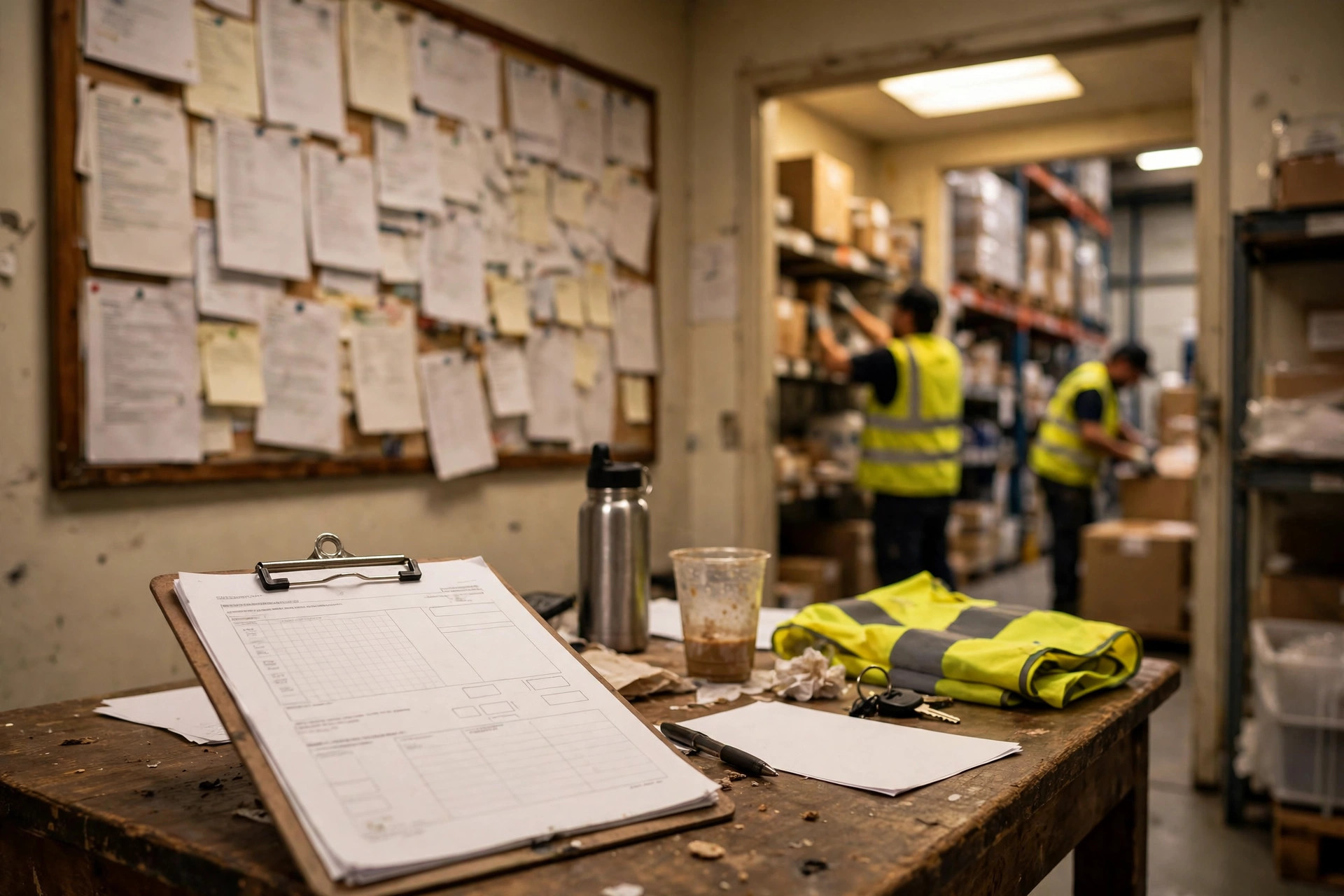
Every Q4, my little warehouse does the same dance: volume triples, my crew of six can't keep up, so I bring in a few 1099 temps to pick and pack. Hourly pay, no payroll taxes, no benefits, done and dusted when peak ends. Three years of this. Then this spring, a letter from the state: independent contractor misclassification. Back taxes owed. Plus penalties. Plus interest.
Turns out "easy" has a billing cycle.
Warehouse temps are misclassification's favorite target
The IRS and state agencies have spent the last few years hunting exactly this pattern: people who look like employees but sign 1099 contracts. Warehouse pickers are the worst possible case — fixed hours, fixed location, taking orders from a supervisor, using the warehouse's equipment. Stack those four facts up and 99% of "independent contractor" defenses collapse.
As of October 1, 2026, New Jersey's ABC test is in full effect, tightening the standard further. Federally, the Department of Labor's new independent-contractor rule went to White House review on September 28, 2026. The direction is unmistakable: more audits coming, not fewer.
The ABC test: fail one prong, lose everything
New Jersey's ABC test says a worker is an independent contractor only if the employer proves all three:
- A – Free from control: the worker isn't directed or controlled
- B – Outside the business: the work is outside your usual course of business
- C – Independent trade: the worker runs their own independent business doing this work
Warehouse pickers die on prong B. Picking, packing, shipping — that IS the warehouse business. They usually fail A too: start time, aisle assignments, pick targets, all set by a supervisor. Prong C? The temp goes home after shift. There is no "independent picking business."
The harsh truth: 1099-ing people to do your core warehouse work fails the ABC test almost every time.
The real math: what misclassification costs
Here's my actual lesson, with numbers rounded but ratios real. One 1099 temp, eight months, $18/hour, roughly $25,000 total paid. After reclassification:
- Back employer FICA: ~$1,900
- State unemployment insurance back payments + late fees: ~$800
- Penalties (scaled by willfulness): $1,500–$5,000
- Workers' comp exposure if anyone got hurt uninsured: uncapped — the medical bill is yours
One worker, eight months, easily over $5,000. I had six temps that peak. Do the multiplication. That excludes legal fees and the operational chaos of an audit.
The contrarian takeaway: 1099s don't save money. They defer the cost and add interest. Real savings come from structuring labor correctly, not disguising employees as contractors.
The federal picture is shifting in the same direction. The Department of Labor's new independent-contractor rule went to White House review on September 28, 2026, and whatever final form it takes, the "economic reality" test it refines has always been brutal for warehouse temps: when one client provides all your work, all your hours, and all your tools, you are economically dependent on that client. That's the whole test in one sentence.
A second story, from a 3PL friend in Ohio: he used 1099 "owner-operators" for forklift work — guys who owned their own pallet jacks, he argued, so they were independent. The state didn't care about the pallet jacks. It cared that they worked his shifts, in his building, moving his customers' freight, under his dispatcher's radio. $40,000 in back assessments. His comment to me afterward: "I thought the equipment made them contractors. Turns out the schedule made them employees."
One more trap small operators miss: workers' comp. In most states, if a 1099 temp gets hurt on your floor and you carry no workers' comp for them, you don't just owe the medical bill — you can lose the exclusive-remedy protection that caps employer liability. An uninsured temp injury can become an uncapped lawsuit. One ankle fracture in a racking aisle can cost more than a year of that worker's wages.
The 5-minute self-audit
Run your 1099 roster through this before the state does:
- Do you set their daily schedule? (Yes = red flag)
- Is their work your warehouse's everyday business? (Yes = red flag)
- Do they use your equipment, systems, and supplies? (Yes = red flag)
- Do they work for other clients at the same time? (No = red flag)
- If they mess up, who eats the loss — and have you ever sent them a "corrective notice"? (You / yes = red flag)
Three or more red flags: stop kidding yourself. They're employees. Convert them to W-2.
Three compliance plays a small warehouse can actually afford
One: use a legit staffing agency for peaks. They charge 20–30% markup, which stings — but payroll taxes, workers' comp, and audit risk are theirs. My math: about 15% more than 1099s, ten times cheaper than getting caught.
Two: W-2 your core roles, 1099 only the truly one-off work. Picking and packing every day? Part-time W-2. Rack installation, a one-week systems project? That's what 1099s are actually for.
Three: the hours bank. Let full-timers bank overtime as time-off credits in slow months, then burn those credits to cover ~30% of peak staffing before calling the agency. We measured it: 12% lower peak labor cost.
Big companies have legal departments. We don't. But small warehouses have their own way of surviving: don't get clever about "saving on payroll taxes." You save pennies and gamble dollars. Get the labor structure clean, and you sleep at night.
We definitely can't afford a second penalty notice.
By Xiao Ma, Small Warehouse Owner