Amazon changed the rules again, and my Europe stock plan had to change with it. That is the story of my last year as a seller: every time I think the routine is settled, something moves. Valencia, Spain port warehouse logistics is where I landed after all that moving, because Spain kept showing up in my numbers as the cheaper, faster door into Southern Europe, and Valencia is the port that carries it.
Here is the complaint first, because sellers deserve honesty: a lot of guides talk about Valencia as if it were just a dot on the map. They never tell you how cargo actually splits once it lands, or what to do when half your shipment is meant for Madrid and the other half is meant for a buyer in Italy. I learned that by getting it wrong first.
Valencia Port Warehouse Logistics: Big Growth, Real Splits
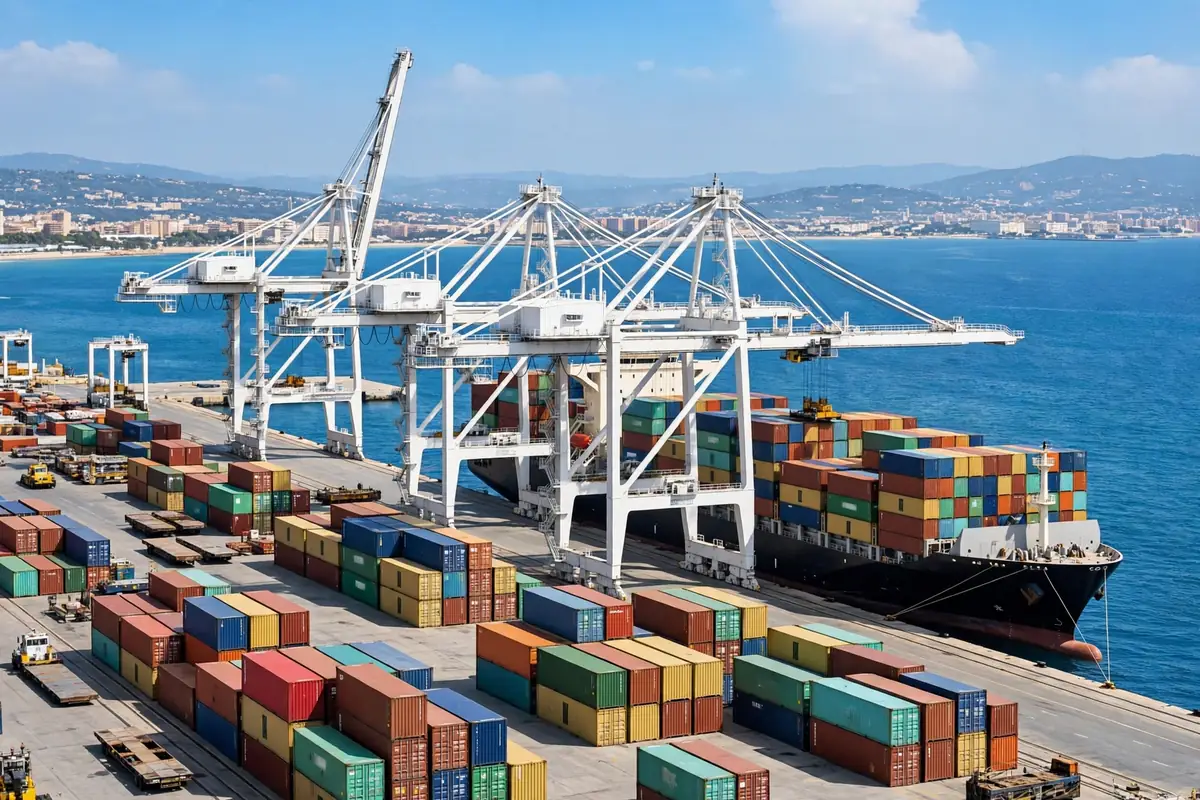
Valencia handled about 5.48 million TEU in 2024, up about 14.15% year on year. It is the largest container port in Spain and the fourth largest in the European Union. Total cargo in 2024 was about 80.67 million tonnes. China is its largest trading partner, at about 0.7 million TEU in 2024. The port handles about 40% of Spain's total import and export volume. That growth rate is the number that made me pay attention, because a port growing that fast is a port where capacity, warehouse space, and trucking all get tight at the same time. That, in one sentence, is Valencia Spain port warehouse logistics: big volume through one door, and the winners are the sellers who decide the split before the ship arrives.
The split is the part nobody warns you about. About 40% of Spain's import and export volume passes through this one port, and a big share of what arrives is not staying in Valencia. Some of it goes north to Madrid, some of it rides onward to other Mediterranean markets, and some of it is transshipment that never touches a Spanish warehouse at all. If you book warehouse space as if every box were Valencia-local, you pay for space your cargo never uses.
Then there is the total cargo figure: about 80.67 million tonnes in 2024. Containers are only part of it. Bulk and breakbulk move through the same port, so the mix of cargo passing through every day is wide. When a warehouse takes your boxes, it has to think about which kind of cargo yours is, and whether it is competing for the same crews and the same lanes as everyone else's. A seller only sees their own shipment. A warehouse sees the whole port. That gap in perspective is where many delays begin.
About 40% of Spain's import and export volume is another way of saying that roughly four in every ten Spanish shipments pass through Valencia. For a seller, that means the warehouses, the trucks, and the handling crews around the port are all sized to that scale, and in peak season it is first come, first served. If you arrive late, you wait. What I do now is lock warehouse space and book trucks ahead of peak season, instead of looking for people when the vessel is nearly here.
Valencia Port Splits: What I Did With One Shipment, Two Destinations
The case below is an illustrative scenario, and its day counts are a hypothetical worked example, not real lead times. I once had a single shipment that needed to split two ways: one part for the Spanish market, one part onward to a buyer further along the Mediterranean. My first instinct was to send everything to one warehouse near the port and sort it there. That felt tidy. It was also slow, because every onward box had to be received, stored, picked, and reloaded before it could leave again.
What I do now is split the decision before the vessel arrives. Cargo with a firm Spanish delivery address gets warehouse space near the port. Cargo that is only passing through gets as little handling as possible: keep it in the port flow, do the paperwork early, and move it on. The rule I use is simple. If a box needs to be touched more than twice after discharge, I have planned the split wrong.
Setting the split early has one precondition: the paperwork and the delivery addresses for both destinations must be complete before the vessel arrives. If an address is vague or one document is missing, an early split still falls apart, and the cargo ends up being checked and queued all over again at the port. I have paid for that mistake. Now I check the recipient details for both destinations before the goods ship. I would rather spend half an hour before dispatch than half a day waiting at the port.
Valencia Port Warehouse Logistics: The Numbers I Actually Watch
The table below is a hypothetical worked example, for comparing approaches only. The day counts are assumptions, not quoted lead times.
| Approach | Handling steps after discharge | What it suits |
|---|---|---|
| Split before arrival | One touch, then onward | Cargo with a confirmed onward destination |
| One warehouse, sort inside | Two or more touches | Mixed cargo with undecided destinations |
| Hold everything at the port | No warehouse touch | Cargo waiting on a connecting vessel |
This table looks simple, but the math behind it is yours to work out. The difference between one touch and two touches is not one extra step. It is one extra queue, one extra wait for the goods, and one extra chance for something to go wrong. My stocking logic now is this: the more certain the destination, the fewer the touches; the less certain the destination, the sooner I pin the destination down, instead of leaving the uncertainty to be solved at the port.
Here is the counterintuitive part. Most sellers think that when a port grows 14.15% in a year, the smart move is to grab warehouse space as close to the quay as possible, at any price. I think the opposite: at a fast-growing port, the scarcest thing is not space, it is handling capacity. Every extra touch costs you a slot in a queue that is already getting longer. The cheapest warehouse can become the most expensive one if your cargo waits three extra touches to leave it.
Pitfalls to Dodge
First, do not treat the 0.7 million TEU of China trade as a promise that your boxes move first. A big trade lane means big volume and big queues, not priority for a small seller. Second, confirm the onward leg before the vessel berths, not after discharge, because trucking and feeder space out of a growing port gets booked ahead. Third, check the paperwork for each destination separately. A split shipment is two customs and delivery stories, not one, and one missing document can hold the half that was ready to go.
One more pitfall is watching only the ocean freight and forgetting the warehouse and split costs. Cheap ocean freight means nothing if your cargo gets handled three extra times and sits for days at the port. The saving disappears straight back into storage and handling. I cost the whole journey now: ocean, warehouse, split, and last mile, added together. Whichever option is cheapest in total, and steadiest on time, is the one I take. An option that is cheap on one leg alone is usually a trap.
Valencia port warehouse logistics comes down to this: it is not about whose warehouse sits closest to the quay. It is about who sets the split early, touches each box least, and costs the whole journey. Set the split early and the cargo never waits at the port. Touch it less and fewer things go wrong. Cost it all and cheap stops turning into a trap.
My advice is boring and it works: decide the split before the ship arrives, touch each box as few times as possible, and keep the onward booking confirmed while the cargo is still at sea. This trick works — I have tested it myself.
By Ah K, E-commerce Seller (5 yrs)