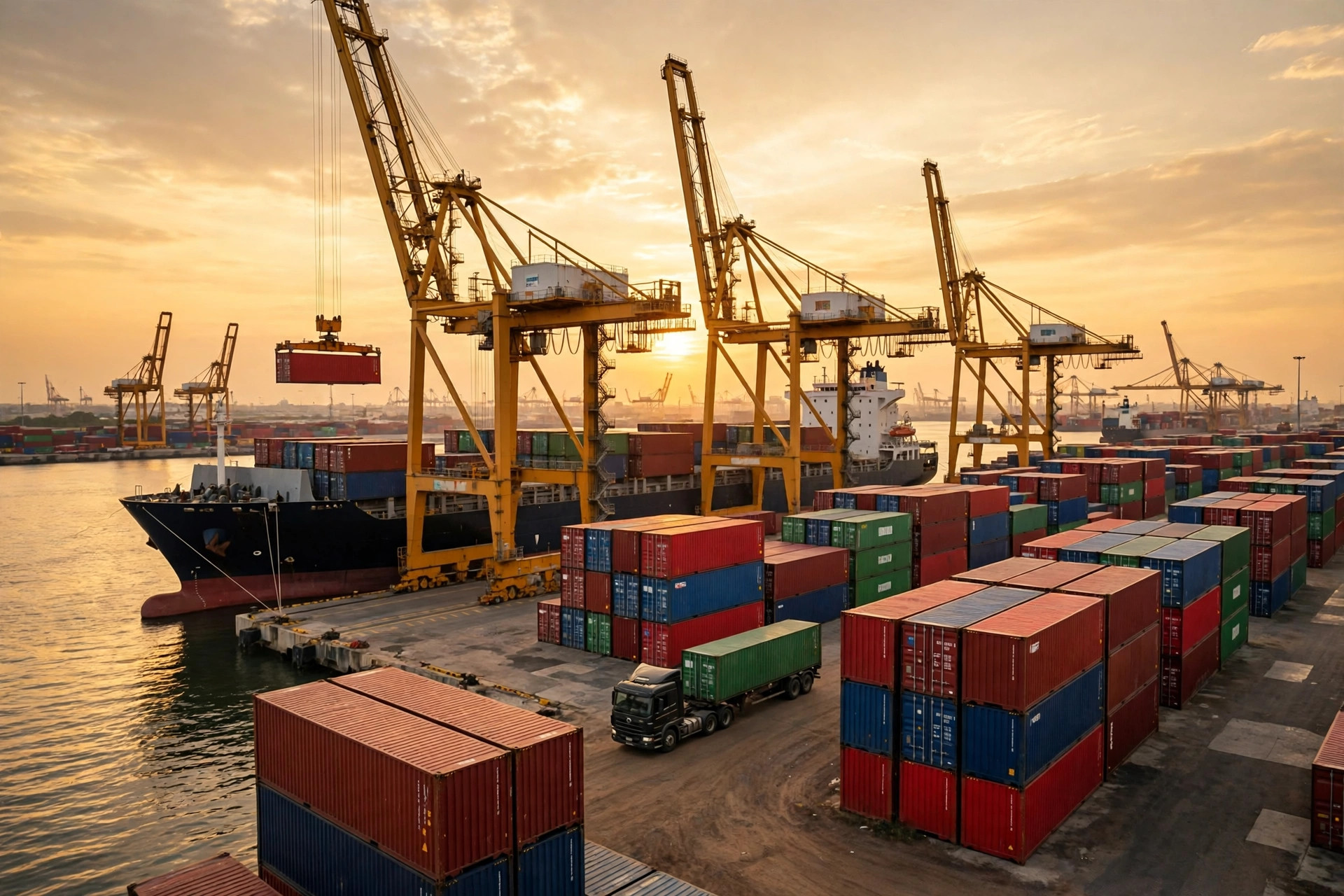
Let's start with the bill. A 40-foot container of outdoor lighting fixtures, shipped from Shenzhen to Los Angeles in March 2026, FOB value $96,000. HTS 9405: MFN rate 6%, plus 25% from the 2018 Section 301 lists, plus another 12.5% from the new Section 301 round that took effect July 24, 2026. Stacked together: 43.5%. The duty on that single container is $41,760 — 43.5% of the cargo value, paid before the goods leave the port.
That is the reality of importing into the US in 2026: tariff cost is no longer a line item — it is the largest one. Complaining about the rate is wasted breath — you cannot change the rate. What you can change is whose P&L absorbs it and what value it gets calculated on. There are exactly three legal paths: pass it downstream through pricing, move the supply chain, or restructure the declaration. Let me run the numbers on each.
First, Break Down the Rate Stack — Otherwise You're Flying Blind
Most importers stare at a duty bill and only know "it's a lot." For China-origin goods as of October 2026, the stack is generally additive (exact rates depend on your HTS code — verify against the latest USTR and CBP publications):
| Duty layer | Typical level for China | Notes |
|---|---|---|
| MFN rate | 0–25% by code | Look up your code in the USITC HTS |
| Section 301, original lists (2018) | 7.5%–25% | Varies by product list |
| Section 301, new round (effective 2026-07-24) | 12.5% | China tier; 60 economies placed in tiers |
| Section 232 (steel, aluminum, derivatives) | 50% | Only for covered products |
Two background facts. The Supreme Court struck down the IEEPA fentanyl tariffs on February 20, 2026 — money paid under that layer is now a refund question (CBP's CAPE portal opened Phase 3 on October 6, 2026), not a cost question. And while 25 states are suing over the new Section 301 round, duties are being collected during the litigation. Price against the current rate.
Path 1: Tariff Cost Pass-Through Downstream — Do the Pricing Math
This is the fastest path, and the one that punishes sloppy arithmetic the most. Raising prices is not "let's add 10% and hope." Two numbers decide whether it works: price elasticity, and your competitors' duty burden.
Back to the lighting example. Duty per container: $41,760. Per unit, that's $8.70 (4,800 units to a container). The distributor's psychological price ceiling sits at $49.99; your sell-in price is $32, and your margin was $12 a unit. After the duty eats $8.70, you're left with $3.30. That business is dead on arrival.
The pass-through formula is simple:
Amount to recover ÷ (1 − expected volume decline) = nominal price increase
If a $8.70 increase is expected to cost you 15% of volume, you need to raise prices by roughly $8.70 ÷ 0.85 ≈ $10.20 to recover the total. Then check the competition: if rivals import from China under the same 43.5% stack, everyone raises together. But if a competitor already moved production to Mexico (10% under the new Section 301 tier, likely outside the old lists), your $10 increase is a gift to them.
A counterintuitive take: the hardest part of pass-through isn't the math, it's the timing. After the IEEPA tariffs fell in early 2026, importers cut prices to grab share — then the July 24 Section 301 round landed and the burden came right back. Two price swings in six months destroyed channel confidence. In a rising-rate cycle, raise once, raise enough, and leave 3 points of buffer. Channels can live with "expensive." They cannot live with "different every month."
Path 2: Move the Supply Chain — Don't Look at the Rate, Look at the TCO
"Move the factory to Vietnam" is the most repeated advice of the last two years. Check the rates: Vietnam sits in the same 12.5% tier under the new Section 301, so the move only sheds the old-list 25% — the new 12.5% follows you there. The rate math:
- Stay in China: MFN + 25% (old list) + 12.5% (new)
- Move to Vietnam: MFN + 0% + 12.5% (new) → saves 25 points
- Move to Mexico: MFN + 0% + 10% (new, lower tier) → saves 27.5 points
But the rate is one row in a TCO spreadsheet. Late 2025, I ran the numbers for a hardware importer: the Vietnam factory quoted 8% higher than Shenzhen, transit added 5–7 days, and moving tooling plus trials cost $400,000. On $3 million in annual cargo value, duty savings ran about $750,000 a year — static payback 8 months after the quote premium and working-capital drag. Worth doing. At $800,000 a year in volume, another client faced a payback beyond three years — I told him not to bother. The breakeven for supply-chain relocation isn't the rate differential — it's your shipment volume.
The red line: shipping Chinese goods through a third country for a label swap and re-export to the US is transshipment fraud — back duties, penalties, and criminal exposure in serious cases. This path only covers genuine substantial transformation: real manufacturing steps performed in the third country.
Path 3: Restructure the Declaration — If You Can't Lower the Rate, Lower the Base
This is the finance person's favorite path: it touches neither the supply chain nor the price. Duty = rate × dutiable value — and the value base is usually more elastic than the rate:
- The first-sale rule. If your goods pass through a middleman (say, a Hong Kong trading company) before entering the US, the dutiable value can be the first sale price — what the factory charged the middleman — rather than what you paid. A 20% middleman markup is normal, so the duty base drops to 80%. The 43.5% rate doesn't move, but it's multiplied by 0.8 — the equivalent of shaving 8.7 points off the rate. This is a recognized CBP rule, provided the transaction chain is genuine and documented.
- Classification review. The same product can plausibly sit under several HTS codes, and the rate gap between them is routinely 10 points. Have a competent broker or trade attorney re-run your top SKUs. The direction is "classify correctly," not "classify low" — get it wrong and CBP claws it back with interest.
- Drawback. Import into the US and re-export (to a Canadian DC, for example), and the duties paid can be refunded. With the IEEPA refund channel opening in 2026, processing has gotten smoother.
The cost of this path is professional fees: a trade attorney bills by the hour, and a classification review plus a first-sale structure for one SKU runs from a few thousand to around twenty thousand dollars. But it's a one-time investment that pays every year — often the highest ROI of the three paths, provided your volume justifies it. Under $500,000 a year in cargo value, the fees don't amortize; stick with Path 1.
The Three Tariff Cost Pass-Through Paths, Side by Side
| Path 1: Raise prices | Path 2: Move the supply chain | Path 3: Restructure the declaration | |
|---|---|---|---|
| What changes | Selling price | Country of origin | Dutiable value / classification |
| Speed | Immediate (next quote) | 6–18 months | 2–4 months |
| Upfront investment | Near zero | High (tooling, trials, ramp-up) | Medium (attorney/broker fees) |
| How it saves | Pushes the burden out | Lowers the applicable rate | Lowers the base, fixes classification, recovers refunds |
| Biggest risk | Lost orders, lost channels | Quality swings, long payback | Classification disputes, retroactive assessments |
| Best for | Sellers with pricing power and equally-taxed rivals | Annual volume above $2M | Middleman in the chain, concentrated SKUs |
The paths are not mutually exclusive. The most common combo is 1 + 3: raise prices to stabilize cash flow now, restructure the declaration to shrink the base, then decide whether the savings fund a price cut or drop to the bottom line. Below roughly $2 million in annual volume, leave Path 2 alone.
Here's the calculable conclusion. When you set the annual budget, run this formula for each path:
Annual duty saved − annual added cost, per path. Execute the largest positive one. If all three are negative, the category has no legal margin left at current rates — kill the SKU. That's more dignified than bleeding.
Nobody gets to not pay the tariff. The only questions are who pays, and on what base. Whether that money was well spent comes down to one thing: did you do the math before you paid it.
By Lao Zhou, Logistics Cost Analyst