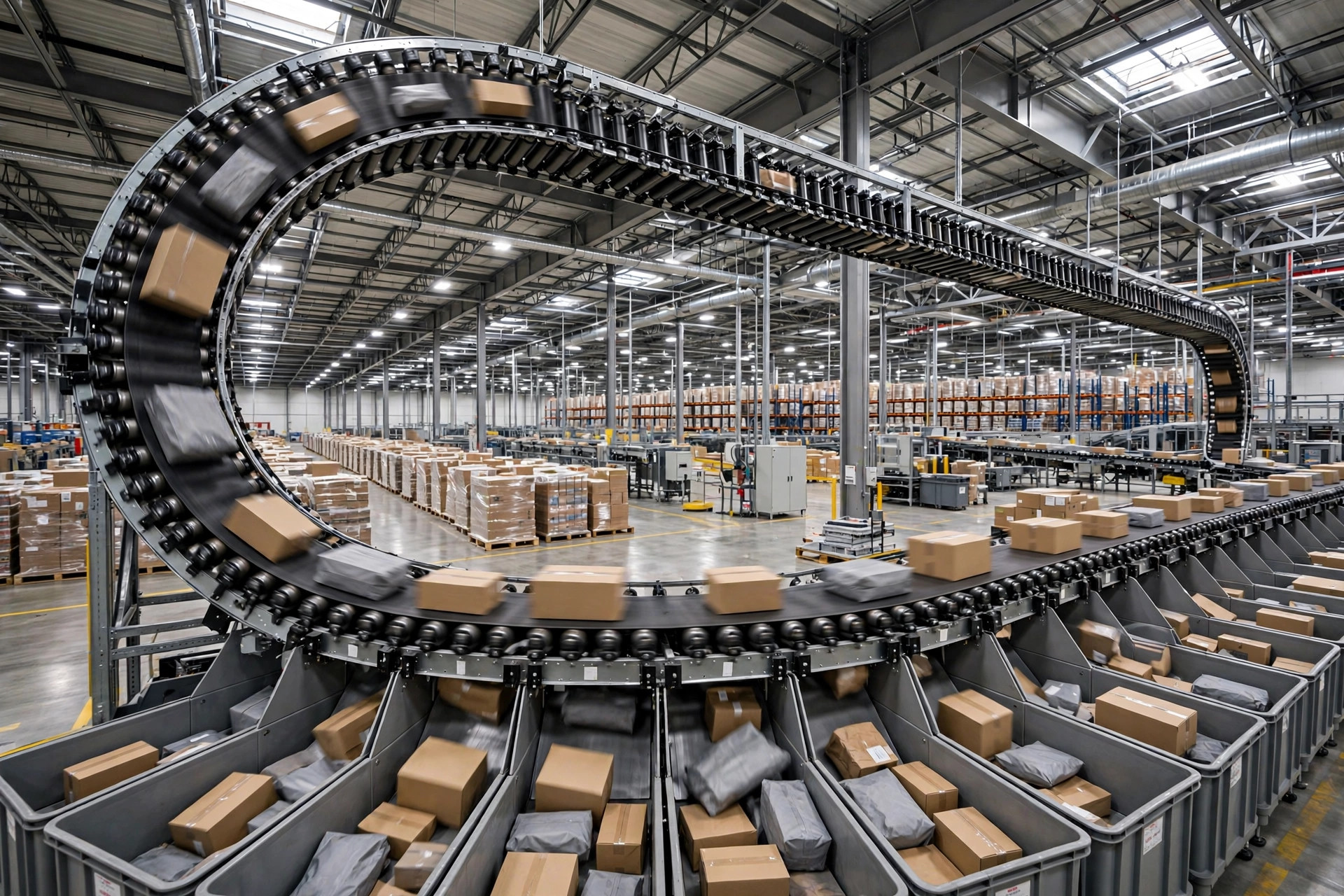
Let's start with the math. A cross-belt sorter rated at 10,000 items per hour goes down for 60 minutes, and on paper you've lost 10,000 items of throughput. That's only the first line on the ledger. The real money burns on the next two lines — combined, they're routinely 3 to 5 times the first. Don't believe it? Let's work through it line by line. Numbers only.
The three lines of sorter downtime cost, laid out first
| Cost line | How to calculate | Scale (mid-size sort center example) | |
|---|---|---|---|
| Line 1 | Lost throughput | Downtime hours × actual throughput × margin per item | 1 hour ≈ 8,000–10,000 items not sorted |
| Line 2 | Idle labor | Affected headcount × hourly wage × downtime hours | 30–40 people upstream and downstream burning a few thousand dollars an hour |
| Line 3 | Hidden costs | Missed carrier pickups, overtime catch-up, SLA penalties | Luck-dependent — can be multiples of the first two lines combined |
Breaking each one down below. The example figures use real-world magnitudes from a Midwest US 3PL sort center, and every assumption is stated — running cost math without stated assumptions is just storytelling.
Line 1: one hour down, how many items lost
First, correct a common calculation error: use actual throughput, not nameplate throughput. The plate says 12,000 items per hour; in real life 8,000 is a good day — induction can't keep up, chutes fill, the system hiccups. Nameplate numbers make the math look pretty. Finance won't accept them.
At an actual 8,000 items per hour, one hour down means 8,000 items unsorted. Where do they go? Two places: overtime catch-up, or late delivery. In peak season "we'll get to it tomorrow" doesn't exist, so it almost always becomes overtime. The overtime labor, plus any expedited shipping upgrades — that's the second half of line 1. Plenty of people stop the math at "8,000 items lost." Wrong. The expensive part comes after.
Line 2: the machine stopped, the people didn't
When the sorter stops, the people can't stop. Induction, audit, packing, loading — thirty to forty people upstream and downstream, all standing around. Conservative math: 35 people at $22 an hour (a reasonable US warehouse frontline wage band; varies by state, use your local actuals). 35 × 22 = $770 per hour. That $770 buys exactly zero output.
Money down the drain. And you can't avoid it — send everyone home and call them back when the machine's fixed an hour later? Not realistic. So line 2 is rigid: the moment the machine stops, it starts burning, and it doesn't wait for you.
Line 3: the most expensive downtime cost is the one you can't see
November 2024, the week before Thanksgiving — the busiest days of the year. A Midwest 3PL burned out its main drive motor, and the sorter sat dead for 6 hours. In those 6 hours, they missed two carriers' pickup windows — and I mean pickup windows, not "running a little late." Miss the window, and that batch of 40,000-plus items ships a full day late.
What followed was expensive: SLA penalties, forced shipping upgrades on some orders, a full weekend of overtime to catch the next wave. Their finance team did a post-mortem: the extra cost of that one incident was six figures. Six hours, six figures. Per hour, that's enough to fund two years of preventive maintenance on that sorter.
There's an even more hidden line: once the order cutoff slips, the linehaul plan for the whole trailer slips with it, and the downstream warehouse's receiving plan slips after that. This cascading cost is hard for finance to allocate precisely, but it's real. My estimation rule: value line 3 at no less than the sum of lines 1 and 2, and double it in peak season. Think I'm guessing? Ask your customer service team what a one-day peak delay costs in credits and lost orders. Numbers don't lie.
The leverage points: where this money is best spent
Math done, now find the leverage. Downtime is this expensive, so the savings levers are three, ordered by how fast they pay off:
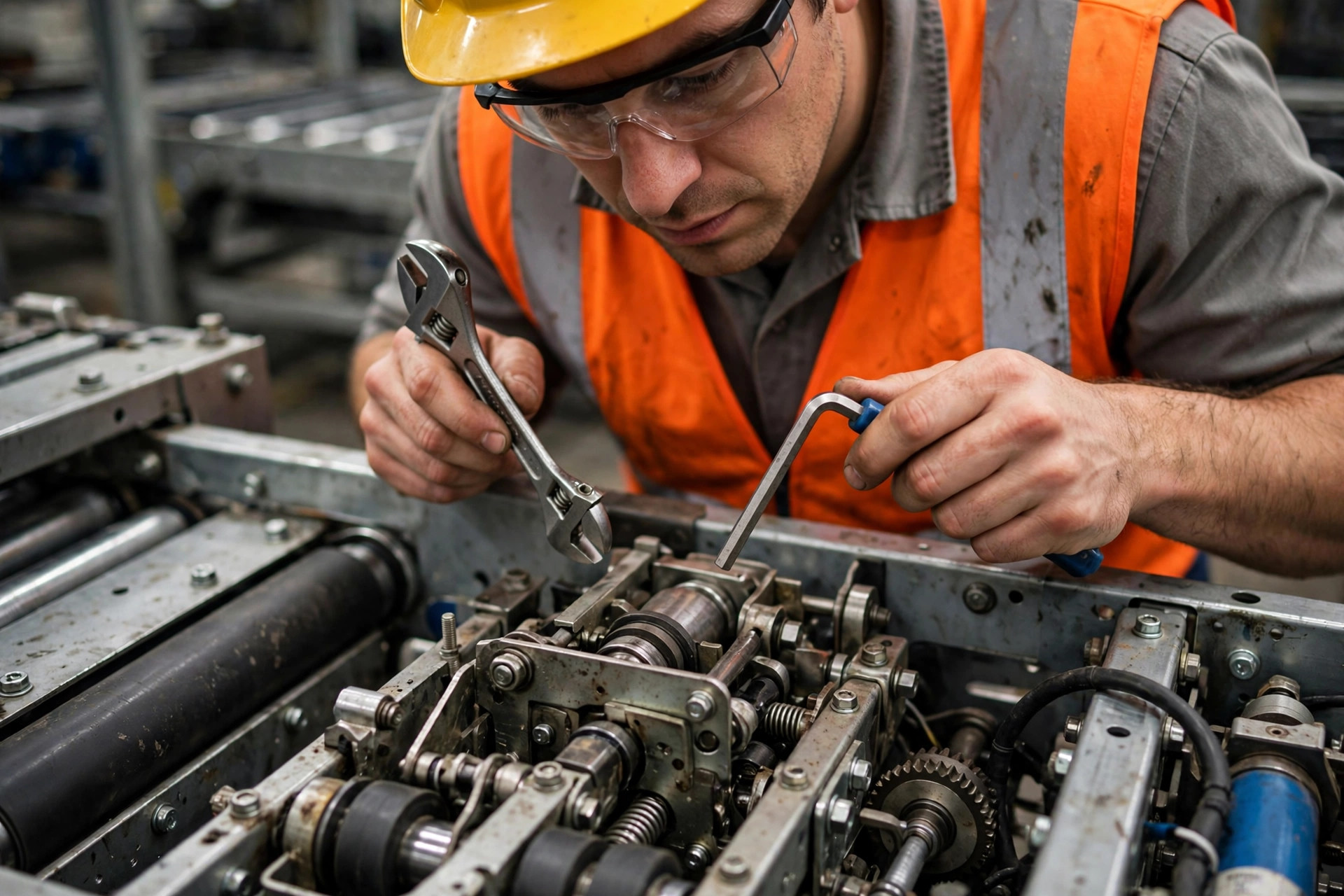
First, keep one set of critical spares on site. Main drive motor, belts, photoelectric sensors — these three account for the vast majority of unplanned sorter downtime. Spares in stock: back up in 2 hours. Spares ordered from the manufacturer: down for 2 days minimum. Waiting on parts is the most expensive downtime there is. A critical spares kit costs tens of thousands of dollars — that 3PL's single incident burned enough to buy several kits.
Second, look at OEE every day. Don't tell me "it feels okay lately" — I'm allergic to the word "feels." Pull OEE (overall equipment effectiveness) daily: availability, performance, quality — whichever one dips shows up immediately. Small stoppages (15 minutes of daily jam clearing, a half-hour weekly walkthrough) often add up to more than one big failure, just invisibly. You won't find it without the numbers.
Third, trade small planned stops for big unplanned ones. Two hours of planned maintenance a month: tension the belts, clean the sensors, check motor temperatures. Twenty-four hours a year buys you unplanned downtime dropping from 50–80 hours a year to under 10. Here's the comparison table I ran for a client:
| Approach | Annual spend | Annual unplanned downtime | Annual downtime loss (est.) |
|---|---|---|---|
| 2 hrs/month maintenance + spares on site | Tens of thousands of dollars | Under 10 hours | Tens of thousands of dollars |
| Bet it won't break, fix it when it does | $0 | 50–80 hours | Hundreds of thousands of dollars |
Here's the counterintuitive call: a sorter is at its most expensive not when it's running, but when it's stopped. Every dollar of maintenance buys probability of "not stopping." That ROI beats most equipment investments your company makes.
Closing: one formula
Remember this formula: one hour of downtime cost ≈ actual throughput × margin per item + idle headcount × hourly wage + expected hidden penalties. Plug in your own three numbers, and whatever comes out is your ammunition for the maintenance budget conversation with your boss. If the budget doesn't get approved, forward them this article.
By Lao Zhou, Logistics Cost Analyst