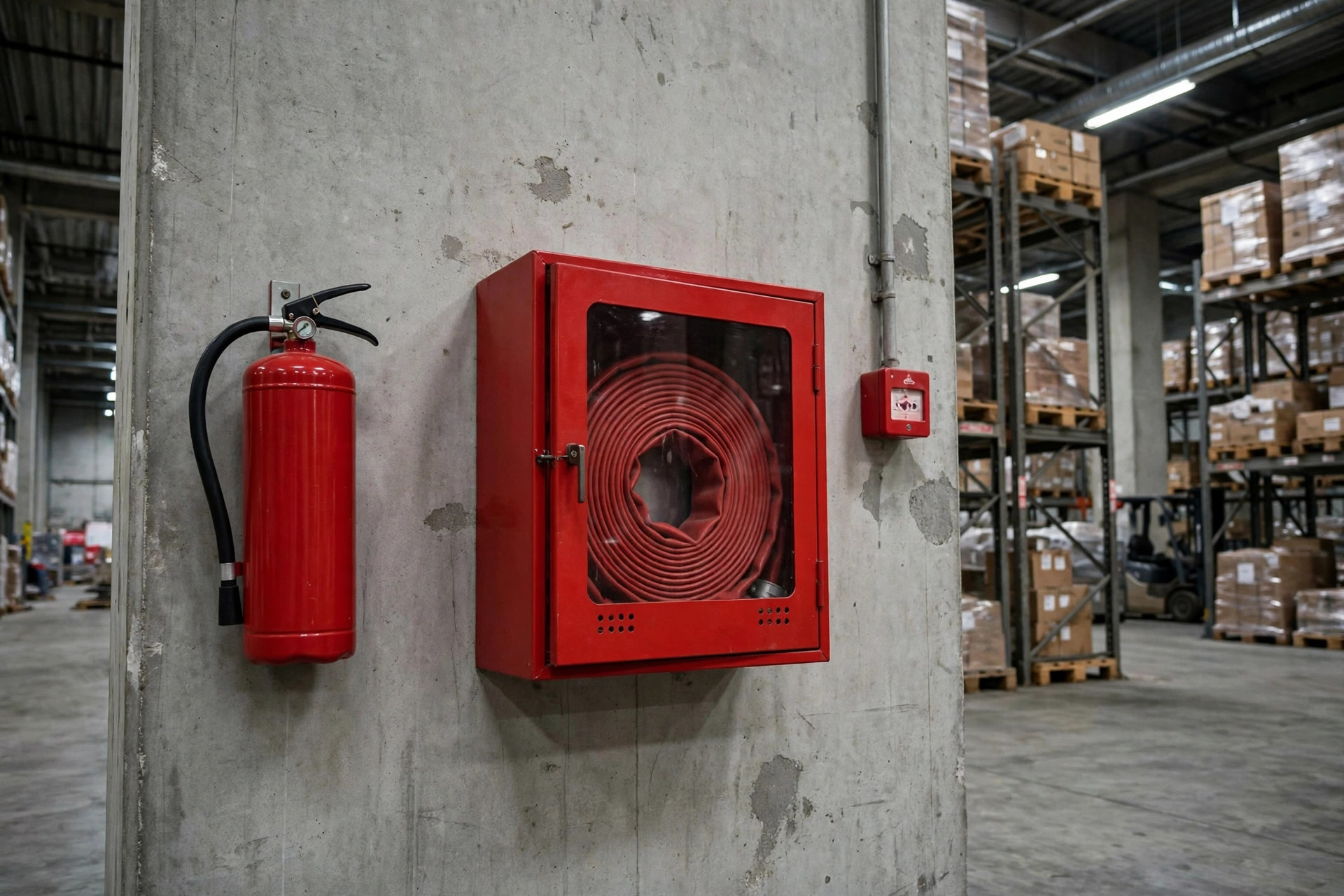
This past July I got a call from a friend who runs a pet-food distribution warehouse in Fontana, California — about 120,000 square feet, pushing over twenty thousand cases a day in peak season. He sounded exhausted. His smoke detectors went off every single afternoon. The fire department had rolled out four times in a month, and on the last visit the battalion chief warned him, face to face, that they were one step away from treating it as nuisance alarms. He was losing his mind, and he wanted me to recommend a "more sensitive, more reliable" detector so he could rip out the old ones.
I told him not to spend a dime yet — pull the security footage from around 3 p.m. first. After watching it, the picture was clear: this had nothing to do with sensitivity. The detectors weren't broken. They were being fooled by dust.
Why does it always happen in the afternoon?
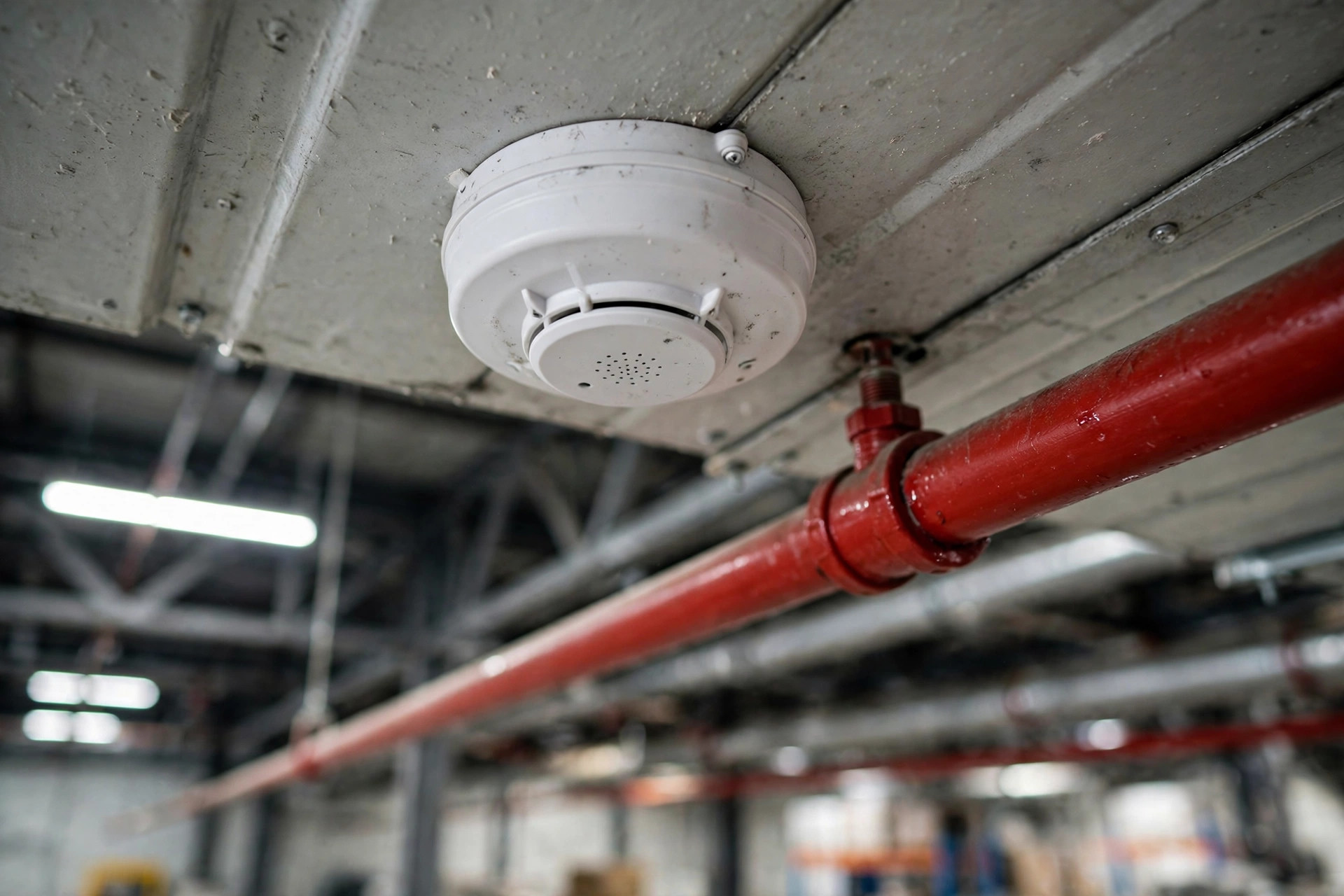
Here's how a photoelectric smoke detector does its job. Inside there's a little labyrinth chamber: an infrared LED fires on one side, a receiver waits on the other. Normally the light never reaches the receiver. When smoke particles drift in, they scatter the light, the receiver catches the scatter, and the detector calls it smoke and sounds the alarm.
The problem: it can't tell a smoke particle from a dust particle. Cardboard fiber, kibble powder, pallet debris — they're roughly the same size as smoke particles, and they scatter light in almost exactly the same way. To the detector, the 3 p.m. dust cloud and a small fire look like twins.
In a dusty warehouse, false alarms usually come down to four culprits. First, dust itself — every break-bulk, restack, and sort kicks it up. Second, moisture — cold-storage doorways and rainy-season docks, where condensation forms droplets that scatter light just as well. Third, forklift exhaust — one hard throttle on a diesel lift sends particulates straight up. Fourth, sudden temperature and humidity swings — dock doors cycling open and shut, stirring up everything settled on top of the racks.
So why the afternoon? Because that's when all four pile up. Outbound peaks in the afternoon, forklifts running hardest; temperatures peak too, and the warm air carries dust up to the ceiling; dock doors keep cycling, and the turbulence pushes concentrations over the alarm threshold. Mornings kick up dust as well, but not enough to trip anything — so the mornings stay quiet and the afternoons put on a show, right on schedule.
That warehouse later hired an environmental firm to test particulate levels. I saw the report myself: afternoon readings in the bulk zone were more than triple the morning numbers. I won't quote the figures — every warehouse's product mix is different, so get your own test done. It's far cheaper than replacing every detector in the building.
Four detector types — which one survives a dusty warehouse?
There are four mainstream types. Let me walk through them, conclusion first: in a dusty warehouse, the plain spot photoelectric is a landmine you planted yourself.
Ionization detectors were the standard decades ago, extremely sensitive to small particles. They're mostly phased out now, for two reasons: they contain a tiny radioactive source, so you can't toss them in the dumpster at end of life — disposal goes through a special channel; and in dusty air they're far too "diligent," crying wolf every day until even the shift staff stop reacting. Verdict: out, don't consider it.
Spot photoelectric — those little white discs on most warehouse ceilings today. One advantage: cheap, a few dozen dollars a head, and the most common thing on approved plans. The disadvantage is fatal in dusty environments: it's the false-alarm champion. The worst case I ever saw was a hardware warehouse — eleven false alarms in six months, until the manager snapped and pulled the power on the detectors. When the fire marshal found out, the penalty cost far more than the false alarms ever did, and nearly jeopardized their operating permit. Don't do it — disconnecting detectors is handing over your own lifeline.
Aspirating systems — the VESDA family and its peers. Instead of passively waiting for smoke to drift in, they actively draw air through a pipe network, filter out the large dust particles, then analyze what's left. They can tell dust from real smoke, and their false-alarm rate is the lowest of the four. Fire protection engineers love them for tall, dusty spaces. The price is real, though: tens of thousands of dollars per zone — dozens of times the cost of spot photoelectrics. That's the trade-off, stated plainly: pay big for peace of mind, or save small and live with the alarms. There's no having it both ways.
Beam detectors — a transmitter on one end, a receiver on the other, shooting across the whole space. Built for very tall warehouses. But their Achilles' heel is the lens: dust films over the optics and the signal slowly degrades. If lens cleaning doesn't make it into your maintenance program, you've paid good money for decoration. In a dusty warehouse, don't touch beam detection unless the maintenance plan is written into policy.
Here's my plain-spoken selection cheat sheet, by scenario. Heavy dust, high-value goods, tall ceilings — bite the bullet and go aspirating; the money is well spent. Moderate dust and a tight budget — photoelectric can stay, but only with dust covers, scheduled blow-outs, and mounted well away from dust sources. Very tall spaces — don't count on spot photoelectrics; they're sluggish up high by nature. Beam or aspirating is the right answer. Ionization — we've covered that; it's out.
And here's a mistake of mine, so you don't repeat it. Once, trying to save a client money, I suggested dialing down the sensitivity on their photoelectrics two notches. False alarms dropped — and then at acceptance testing, the inspector's canned-smoke test timed out past the limit and the system failed on the spot. Three more weeks of rework. I learned my lesson that day: sensitivity settings belong to the fire code and your local authority having jurisdiction, not to you. When in doubt, NFPA 72 and your local fire department have the final word.
So once it's installed right, are we done?
Picking the right type is only step one. Mount it in the wrong spot and it'll scream just the same.
A few placement rules. Not directly above forklift aisles — exhaust rises. Not beside dock doors — every cycle blows a fresh load of dust into the chamber. Not at the cold-storage entrance — condensation false alarms love that spot. Find your dust sources, then mount upwind of them: break-bulk areas, bulk hoppers, keep your distance. And in a tall space, a single layer at the ceiling is decoration — smoke gets scattered by air currents before it ever reaches the top. Layered coverage is what works; have your fire protection engineer calculate the layers for your ceiling height and airflow.
Don't cheap out on maintenance either. Dust cakes the sensing chamber and the sensitivity drifts. Pull them down and blow them out with compressed air every six to twelve months. I've seen too many warehouses that never touched a detector in five years — you could write your name in the dust inside. Whether those things alarm or not is pure luck at that point.
When a false alarm happens, have a standard response instead of scrambling every time. Control room identifies the zone and sends someone to look. No fire confirmed — reset per procedure, and log the time, the zone, and what operations were running. Same zone twice in a month — stop just resetting and start a root-cause review: is it the location, or is it time for a different detector type? Keep those logs. When the fire department comes asking, they're your evidence that the system is actually managed.
One last thing — the acceptance angle. Acceptance testing checks whether the system alarms on a real fire; nobody grades you on false alarms. But too many of them and the fire department starts paying attention — sit-downs, re-inspections, fines. My advice: bring up the dusty environment early, at the design stage, and put a low-false-alarm option like aspirating detection on the table. Don't wait until you're summoned to explain that "our place is just dusty" — by then you're playing defense.
This week, take ten minutes — ladder or as-built drawings, your pick — and check what model of detector is on your ceiling. If it's the plain vanilla spot photoelectric and your warehouse is a dusty one, now you know: the next false alarm probably isn't a broken device. It was the wrong choice on day one. Whether you replace it is a budget question. But at least you know where the problem lives, and you won't spend good money chasing the wrong fix.