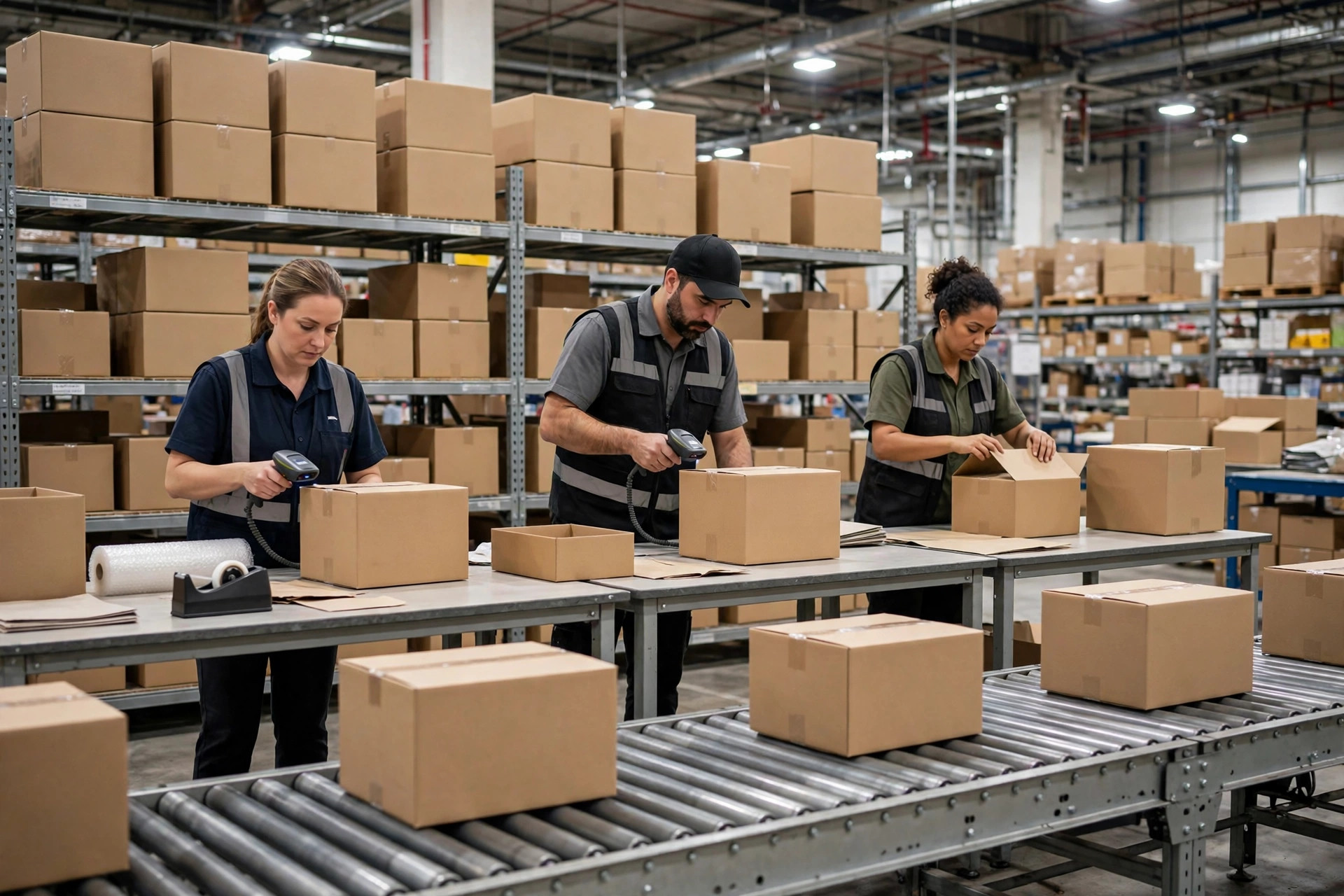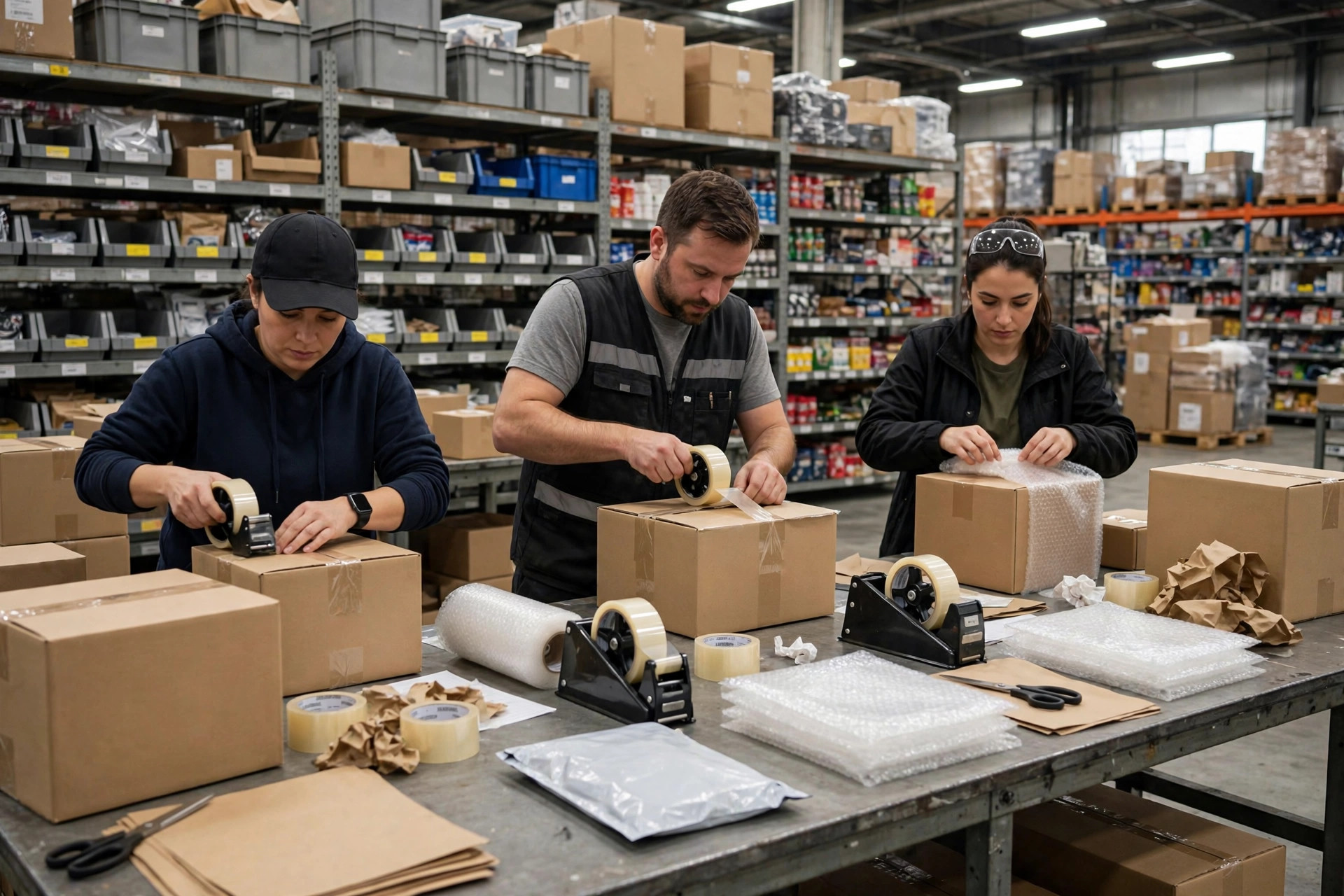
Here is the verdict up front: when one order ships as three parcels, eight times out of ten it is not a system bug. It is your OMS order splitting rules doing their job. The real problem is never the split itself — it is misconfigured rules. Fail to split when you must, and your SLA blows up. Split when you shouldn't, and your freight bill doubles. I have seen this exact failure three times, and every single time it surfaced on go-live night, when fixing it meant stopping the line.
What Order Splitting Actually Splits
Strip away the jargon and OMS order splitting is one sentence: when the items in an order are not in the same place, or do not fit in the same box, the system breaks the order into multiple parcels. There are five legitimate triggers, each tied to a real scenario:
- Inventory is not in one place. Stock sits in two warehouses, or in two zones of the same building — say, bulk storage and a climate-controlled cage. Consolidating means waiting on a transfer.
- It does not fit in one box. A six-foot tent pole and a sleeping bag are never sharing a carton, no matter how hard you pack.
- Product categories must be isolated. Adhesives and aerosols with hazmat properties cannot ride in the same box as regular goods.
- Carrier routing differs. Only one carrier serves that remote ZIP code, while everything else in the order ships cheaper with another.
- Delivery promises differ. The customer paid for next-day on part of the order. Holding everything until it is all picked means breaking that promise.
The first three are physical constraints — splitting is mandatory. The last two are policy choices — whether to split depends on how you write the rules. Most disasters come from treating a policy choice like a physical constraint, or the other way around.
Two War Stories: One Self-Inflicted, One Rescue
Q3 2025. An outdoor-gear client, 3PL warehouse in Ontario, California, going live on a new OMS right before peak season. The owner made the call: "One order, one parcel. Best customer experience." Every split rule switched off. I told their project manager I had seen this exact mistake three times and he was about to be number four. He didn't believe me.
Week one of peak season, it blew up. Their adhesives and repair kits lived in a separate climate-controlled cage; tents and sleeping bags lived in bulk storage. Any order containing both a tent and a repair kit sat in the warehouse waiting on an internal transfer — two extra days on average. The 48-hour ship promise went straight out the window. Three weeks in, "where is my order" tickets had more than doubled. They turned the split rules back on overnight and added one more: small items ship first, bulky items follow. Remember this iron rule: physically separated inventory cannot be wished away by an OMS setting. What you turned off was not the split — it was your SLA.

Now the opposite story. Late 2024, a pet-supplies client doing thousands of orders a day, with split rules configured way too aggressively: split by pick zone, split by carrier region, split by dimensions. Some orders went out as five parcels. Split rate above 40%. One look at the freight invoices told the story. The rescue took three steps. Step one: pull the data and find every "same recipient, same day" order that the rules had torn apart. Step two: add a consolidation window — parcels to the same recipient, within four hours, on the same carrier, merge into one shipment. Step three: oversized items ship alone, everything ordinary gets combined. One month later, the split rate was down to around 15%, and parcels per order dropped from 1.6 to 1.2. The lesson runs in reverse: rules written too fine-grained turn every split into pure freight cost.
Do the Math: When Order Splitting Pays and When It Burns
Don't go by gut feel. Put it in a table (figures are illustrative — validate against your own history and your carriers' current published rates):
| Don't split: wait for everything | Split: ship in waves | |
|---|---|---|
| Parcels per order | 1.0 | 1.3-1.5 |
| Freight cost | Baseline | Roughly 30% higher |
| Ship speed | Set by the slowest item | In-stock items move first |
| CS pressure | "Where is my order" tickets | "Why three parcels" tickets |
| Best for | High-AOV orders, unboxing experience | Multi-warehouse, strict delivery promises |
The biggest misconception about order splitting is counting only the freight. The real ledger has three lines: freight, late-delivery cost, and customer-service cost. Blown SLAs cost you repeat buyers. Ticket spikes cost you staffing. Both routinely dwarf the freight delta.
The Go-Live-Night Checklist for Split Rules
How to configure the rules. Here is my go-live-night checklist — go down it line by line:
- Define "must split" first: inventory in different warehouses or zones; oversized or overweight single items; hazmat, temperature-controlled, and regular goods mixed in one order; remote addresses with restricted carrier options.
- Then define "never split": same zone and fits in one box — splitting is prohibited. High-AOV orders (more than 3x your average order value) ship whole by default.
- Set a consolidation window: same recipient, same day, same carrier — parcels within four hours merge into one shipment. Four hours is the starting point; run it a week, then tune.
- Carrier routing comes before splitting. Decide which carrier takes each parcel before you split. Picking the carrier after the split is aiming after you shoot.
- Test five orders before sign-off: a cross-warehouse order, an oversized order, a mixed-hazmat order, a high-AOV order, and two orders from the same recipient on the same day. No signature until all five pass.
- Stamp every parcel with its split reason: the rule ID goes into the parcel notes so CS can see it and the customer gets a straight answer. A split with no audit trail becomes a customer-service disaster sooner or later.
Common Failure Modes
- Making split rate a warehouse KPI. The warehouse games the number, stops splitting when it should, and your SLA pays for it. Split rate is an observation metric, not a performance target.
- Zones changed, rules didn't. Last year's zone-based split logic is still running against this year's merged zones.
- Three parcels, three carriers. Splitting and carrier routing are two separate rule sets — configure them separately and you get three tracking numbers and a CS team explaining itself into exhaustion.
- No "primary parcel" concept. Two of three parcels come back as returns, the system can't reconcile, and finance discovers it at month-end close.
One counterintuitive call to close: a "zero split rate" target may be the most expensive KPI in the company. Holding a parcel two extra days to consolidate saves pennies in freight and costs you repeat buyers and CS hours. Order splitting is, at its core, a trade-off — freight, speed, and service cost cannot all be optimal at once. My verdict is unambiguous: protect the SLA first, optimize freight second. The first job of a split rule is "don't make the customer wait." Saving money is job two.
Something you can do tomorrow: open your OMS rule list and count how many split rules were "configured at go-live and never touched since." If it's more than half, this article was written for you. Start with one consolidation-window rule — four hours, same recipient — run it a week, then look at the data.
By Lin Xiao, WMS Implementation Consultant