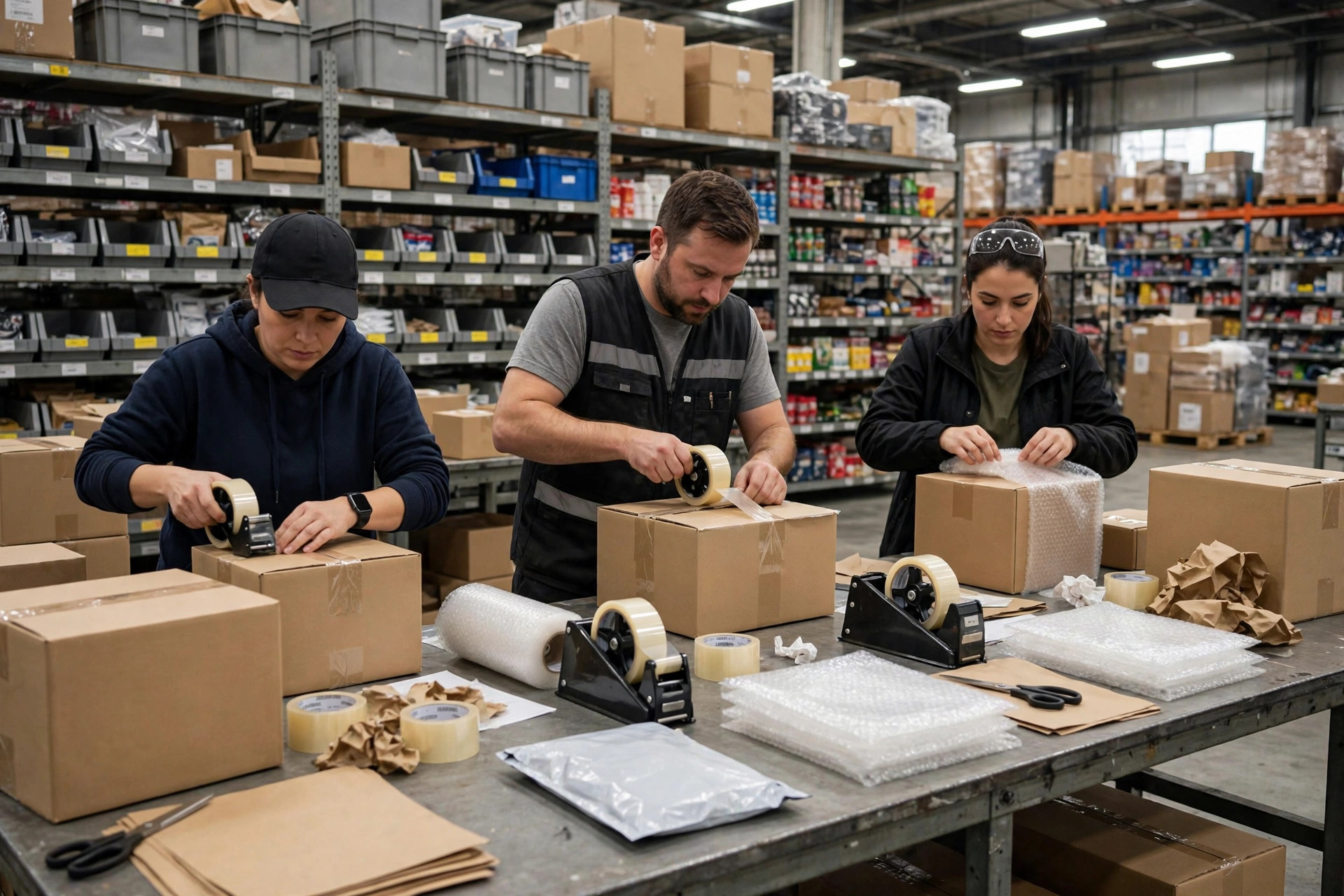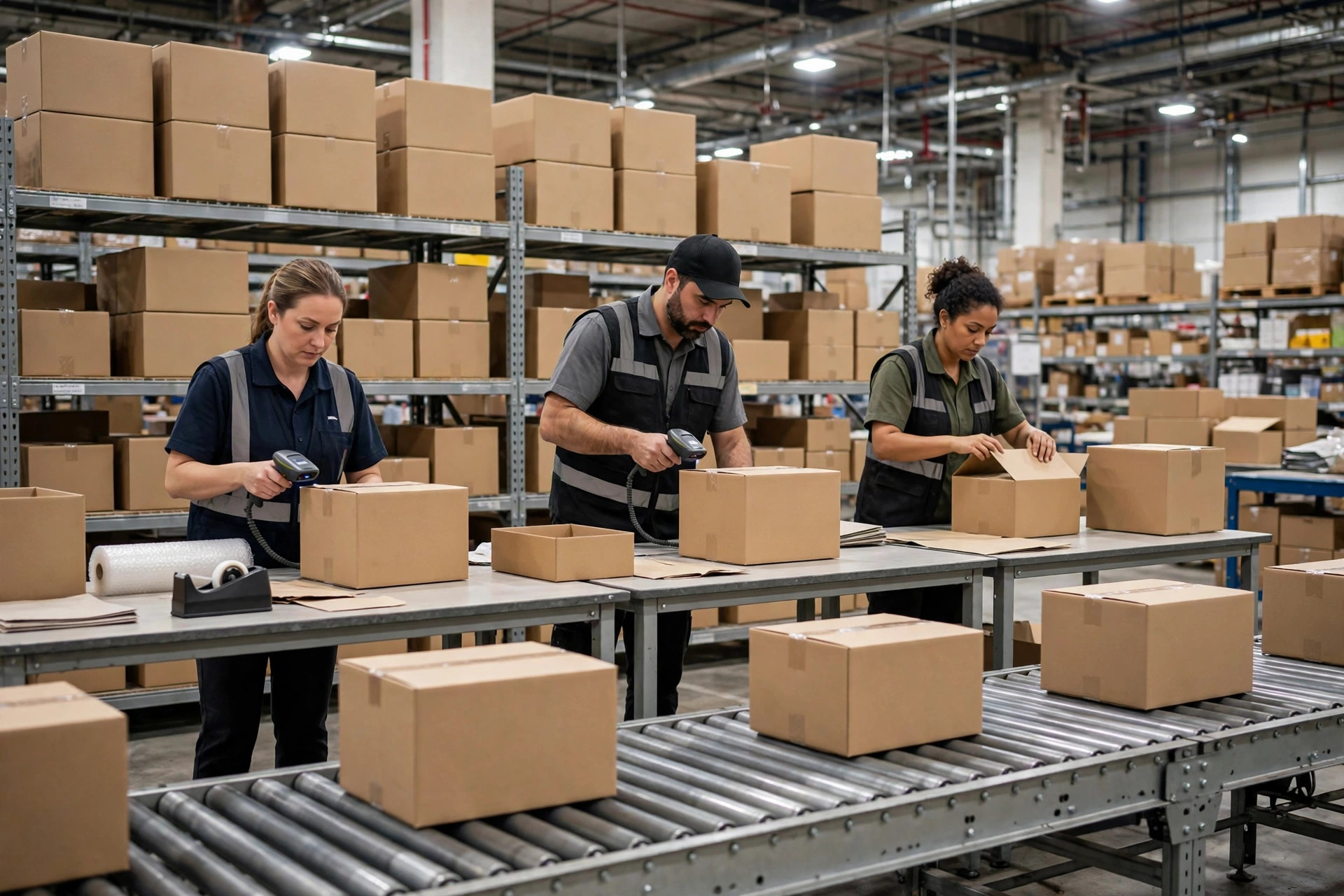
Let me start with a rant: everybody in this business is obsessed with same-day shipping. Sellers post videos of parcels flying down the conveyor belt like it's a flex. Nobody posts their freight bill.
A guy in my seller group bragged yesterday that his "fulfillment efficiency is up 30%." I looked at his screenshot: 1.8 parcels per order on average. Sure, parcels fly out fast — and money flies out faster. One buyer places 3 orders in a day, you ship 3 separate parcels, and you just paid for two extra shipments for nothing. Tell me that's not burning cash.
I learned this the hard way during Black Friday week last November (2025), at my LA warehouse. I sell phone accessories — small, light SKUs, 0.2 to 0.8 lbs each. One buyer ordered a screen protector, a phone case, and a charging cable in three separate orders on the same day. The system split them into 3 parcels automatically. The buyer got 3 boxes and left a 3-star review: "excessive packaging, wasteful." But the real gut punch was the math: 3 UPS Ground labels at a bit over $8 each — $26 total. Consolidated into one parcel, it would've been a bit over $11. That single order cost me an extra $15 for literally nothing. And that week I had 400+ of these multi-order buyers. My hands were shaking when I reconciled the freight bill.
So I built consolidation rules into my OMS. My consolidation rate now sits at around 35%. The rules aren't complicated — here's the copy-paste version:
First, orders from the same person within 48 hours — full match on name, address, and ZIP — get auto-merged into one parcel. I tested that 48-hour window myself: shorter and you barely consolidate anything; longer and buyers start getting impatient.
Second, the hold window is tied to your delivery promise. Orders with a 2-day delivery promise get a maximum 4-hour hold; standard Ground orders can wait 12 hours. Don't blow up your delivery commitment just to merge one more order.
Third, re-weigh after merging. Anything over 70 lbs total or with one side over 48 inches doesn't get merged. One oversize surcharge wipes out a week of consolidation savings — that red line is non-negotiable (check your carrier's current policy for exact thresholds).
Fourth, FBA orders are excluded. Amazon decides how inventory splits across warehouses, not you. Don't waste time trying to consolidate what you can't control.
The math: consolidation rate from 0 to 35%, what it saves per month
Straight from my OMS and freight bills:
| Split (before) | Consolidated (now) | |
|---|---|---|
| Monthly orders | 8,000 | 8,000 |
| Total parcels | about 9,500 | about 8,000 |
| Orders participating in consolidation | 0 | 2,800 (35%) |
| Those 2,800 merged into | — | about 1,300 parcels |
| Parcels eliminated | — | about 1,500 |
Each eliminated parcel saves me about $6.50 on average — that's the marginal cost of the second label onward, based on what my account actually paid (discounts vary by account, so run your own numbers). 1,500 × $6.50 = $9,750. Nearly ten grand a month, over $110K a year. That's two extra packers on payroll with money left over.
Here's the smallest unit of the math, so you can feel it: one buyer, 3 orders. Split: 3 labels at $8.20 each = $24.60. Consolidated: one label at $11.50. Savings: $13.10, or 53%. These multi-order buyers are a real share of my order mix — it adds up terrifyingly fast.

The counterintuitive part: faster shipping isn't always better
Every seller group is racing to ship same-day, like a 2-hour delay is a crime. But think: a 2-lb parcel going Ground across the country takes 3–5 days anyway. Shipping it 2 hours earlier? The buyer can't tell. Shipping it 2 hours later, merged into one parcel? Half the freight cost.
So what are those 2 hours actually worth? Near-zero impact on buyer experience, 50% off your freight bill. My policy now: for anything within the promised delivery window, hold as long as the window allows; only SKUs with an explicit same-day promise go through the express lane. Ship speed is a cost line, not a religion. Don't let the platform's ship-time score guilt-trip you — protect the score, but do it the cheapest way possible.
Here's my decision framework for the hold window:
| Hold window | Consolidation rate (my numbers) | Late-shipment risk |
|---|---|---|
| 0 hrs (ship immediately) | 0% | None |
| 4 hrs | about 15% | Low, safe for 2-day promise |
| 12 hrs | about 30% | Medium, Ground orders only |
| 24 hrs | about 38% | High, blows up in peak season |
See the problem? Going from 12 to 24 hours gains you 8 points of consolidation but doubles the risk. I cap everything at 12 hours now. Don't get greedy.
Three pitfalls — don't step in them
Pitfall one: holding too long earns you bad reviews. When I first launched consolidation, I set a 24-hour window. Christmas season, total disaster: a California buyer ordered on Monday, the system sat on it waiting for a "possible second order" until Tuesday, delivery slipped a day, 1-star review: "slow shipping." Lesson: the hold window must follow the delivery promise. I now run tiered windows — 4 hours same-metro, 12 hours cross-country — and that type of review hasn't happened since.
Pitfall two: forget consolidation for FBA split shipments. Amazon splits your inbound across warehouses however it wants; your OMS rules can't touch that. Consolidation only works for merchant-fulfilled orders.
Pitfall three: returns. When a buyer returns just one item from a consolidated parcel, have your CS script ready in advance: how freight is handled, how much gets refunded. Don't improvise when the buyer is already annoyed.
That's the method, the numbers, and the landmines. Consolidation costs zero dollars — it's an OMS rule change plus two extra hours of patience, and it saves you a car's worth of freight every month. This one I tested myself, and it works.
By Ah K, E-commerce Seller (5 yrs)