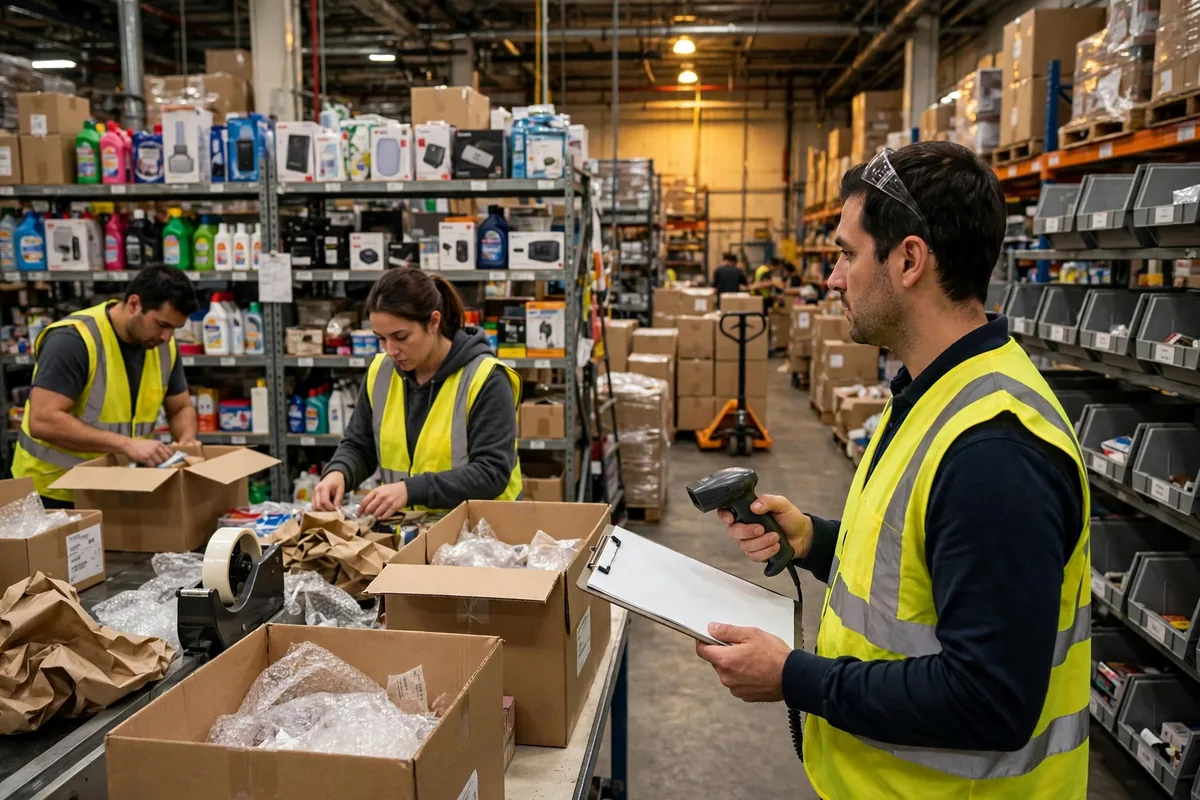
It was a Tuesday morning last November, 6:40 a.m., and the day's OMS backorder allocation problem was already waiting at the door. I had just walked into the warehouse when Lao Wang, our night-shift lead, blocked the doorway.
"Boss, we're done. Four hundred jackets left of the hot style, and more than nine hundred units sitting in orders waiting to ship."
That's what oms backorder allocation looks like in real life. Not numbers in a table. A person blocking your doorway, half-empty pick bins, and a customer service phone queue about to explode. It took us forty minutes to sort the orders that morning, and two packing lines stood still while pickers waited for work.
Let me be straight with you: when you're short, the problem is never "we don't have enough stock." The problem is "who gets it first." Get that order wrong and everything downstream falls apart. Cut a key account and you don't lose one order, you lose next quarter's contract. Cut small orders and customer service spends the whole day making apology calls. Allocation isn't about boxes. It's about relationships, and whether this warehouse still gets orders next month.
OMS Backorder Allocation Starts With One Table
Our rule now is simple: the moment a shortage shows up, we rank orders against one priority table before anyone touches a pick list. I built that table with our customer service lead and our sales rep, arguing for two days before last year's peak season. Then we taped it to the office wall so nobody can quietly change it.
| Priority | Who gets stock first | Why |
|---|---|---|
| 1 | Orders with a same-day delivery promise | The promise is in the contract, and missing it costs money |
| 2 | Key accounts and long-term channel orders | Lose one order and you may lose a quarter |
| 3 | Regular orders, in the order they came in | First in line, first served |
| 4 | Low-margin orders that can wait | Hold them until the replenishment arrives |
The table alone isn't enough. The system has to leave room for a human override, and that override can only come from two people: me and the customer service lead. Every override has to carry one sentence in the system: why we changed it, and whose order moved. Without that opening, a sales rep calls at midnight and the night shift has no idea whose call to follow. Open it too wide and everyone edits the table until it's worthless.
Most order systems default to first-come-first-served: whichever order arrived first gets the stock. That default isn't malicious, it's just lazy. Oracle's own documentation says it plainly: with no allocation rule, the system promises stock in the order requests arrive, so a low-priority order that came in early can eat everything and leave nothing for a high-priority order that came in later. Their example splits supply 60% to a high-priority demand class and 40% to a low-priority one. That is what an allocation rule does: it cuts the stock into blocks first, then queues inside each block. Our wall table is the same idea done by hand, with the blocks defined by promised times, key accounts, and margins.
Here's the counterintuitive part: first-come-first-served sounds like the fairest rule, and it's the most dangerous one. An early order time says nothing about how important the customer is or how urgent the order is. It hands the decision to the clock. Whoever clicked fastest gets the stock, and the big customer gets squeezed out by a pile of small orders. We ran first-come-first-served for years, and one peak season we lost a three-year customer because his order sat behind a stack of one-off orders. He didn't complain. He just switched suppliers the next quarter.
The Real Cost of OMS Backorder Allocation Shows Up on the Phones
Two summers ago, on a Friday afternoon, we ran out of a popular water bottle. The system ran its default rule, nobody on the night shift looked twice, and by Monday morning we found out a chain supermarket's order had been cut. That supermarket was a new key account that year, and the first order was a test of whether we could deliver. The test result was a stockout with no phone call at all. Our customer service lead sat in her office all afternoon without saying a word.
After that we made a rule: once allocation runs, the system has to produce a cut list with exactly three things on it — who got cut, how many units, and when the replenishment arrives. That list lands in my inbox and the customer service lead's inbox before 9 a.m. every day. If it doesn't arrive, something is wrong with the system, and we fix the system before we start work.
The numbers below are a hypothetical example — I made the figures up, but the math is real, and you can plug in your own numbers. Say 400 units are left and orders are waiting for 900. Rank them by the table: same-day orders take 300, key accounts take 80, and 20 units are left for regular orders. Regular orders wanted 520 units, so 500 units go unfilled. At an average of 4 units per order, that's 130 regular orders, and 20 units covers 5 of them, leaving 125 orders waiting for replenishment. Customer service now has 125 phone calls to make. At 3 minutes a call, that's 375 minutes — more than 6 hours, or over 3 hours with two people on the phones.
That math tells you where the real cost of a stockout sits: not in the warehouse, but at the customer service desks. Sorting orders takes forty minutes. Cleaning up takes a full day. So before you cut anything, ask one question: how many calls can customer service handle today? If the answer is "not that many," push the orders that can wait instead of cutting everything at once. And one more rule that belongs in the system, not on paper: cut orders jump to the front of the queue the moment replenishment arrives, and no new order cuts in front of them.
After the Cut: Backorders and Apologies Have a Fixed Routine
Cutting the order is only half the job. Our fixed routine has three moves. One, customer service calls the customer the same day the order is cut — shortage first, replenishment date second — and if the call doesn't connect, a text message goes out so there's a record. Nobody waits for the customer to find out on their own. Two, when replenishment lands, the cut orders ship first, automatically, with no new orders jumping the line. Three, every Monday morning I sit down with the customer service lead and go through last week's cut list: who got cut, why, did we cut the wrong one. When we got one wrong, we say so out loud and change the rule.
We also learned the phone calls the hard way, and now our veterans coach the rookies. Lao Zhang on the customer service team has eight years in, and his first lesson for a new hire isn't a script — it's listening to three real cut calls. Once a rookie named Xiao Li opened a call with "the system shows a stockout," and the customer blew up on the spot. Lao Zhang took the phone, apologized first, gave the replenishment date, then asked if the customer wanted a different color shipped as a partial — the customer chose to wait for the full order and added two extra cartons of something else. After he hung up, Lao Zhang told Xiao Li: a cut call isn't a notification, it's a negotiation. You need a replenishment date and an alternative in your hand, or you have nothing to negotiate with.
One more lesson, paid for in blood: never split a backorder shipment. Ship one order in two parcels and the customer pays freight twice while the warehouse picks and packs twice. Better to wait two days and ship it whole. Those two days mean nothing to the customer, but the freight and labor you save are real.
Shortages never go away. Peak season comes every year. What you can do is set the priority table before the season starts, leave the override opening in the right hands, and write the apology script before you need it. Then, on the morning the stock runs out, you'll have time for the real surprises instead of standing in a doorway arguing with your own team.
By Chen Feng, Warehouse Operations Manager