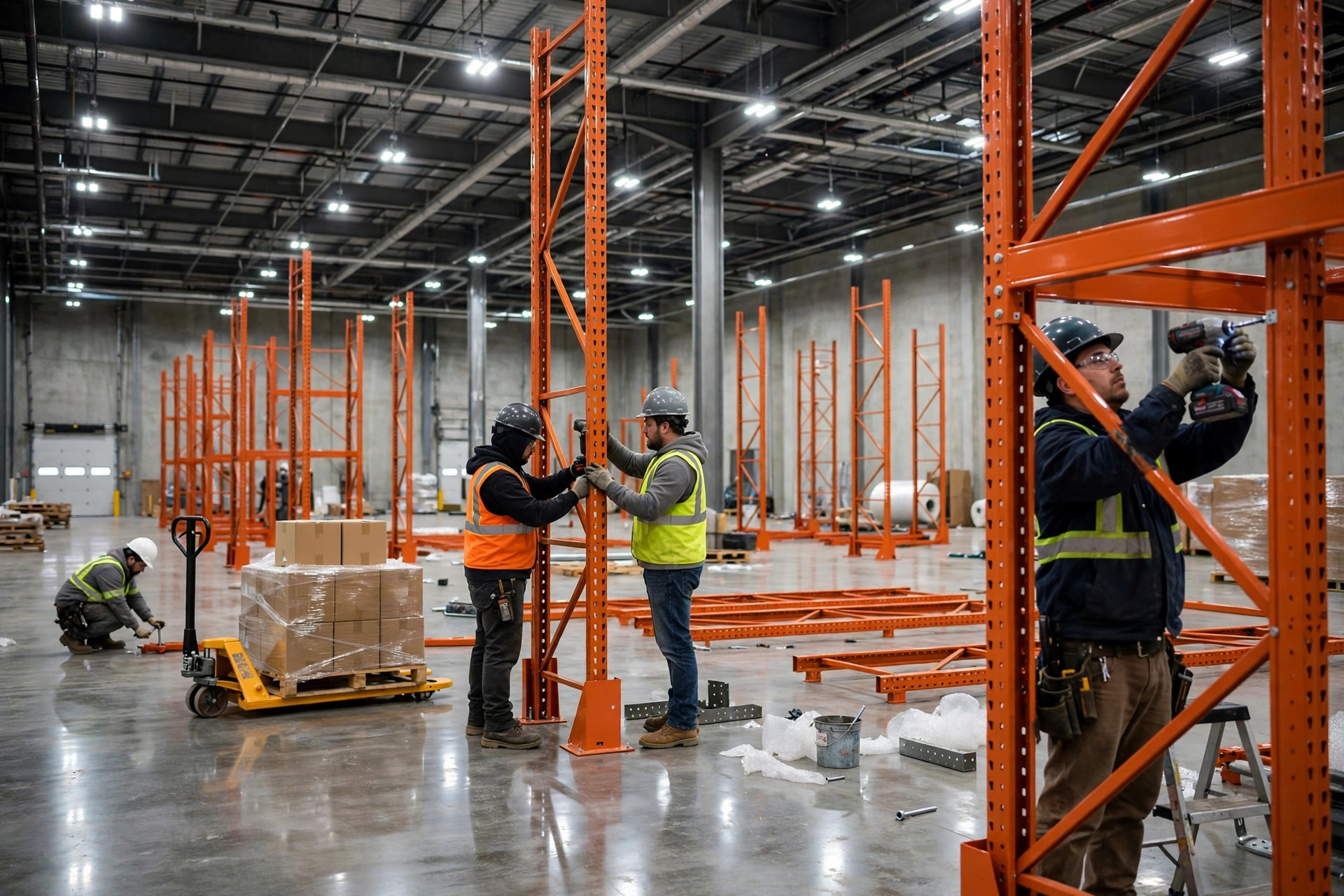
Folks, I've opened a new warehouse three times now. The latest was spring 2023: we moved our entire operation to a new building east of Ontario — 60,000-plus square feet, racking still going up, and the first trucks already lined up at the dock. At 6:30 that morning I stood in an empty warehouse watching the install crew bolt crossbeams, with 400 pallets already stacked in receiving. One thought in my head: if this 90-day ramp-up plan isn't tight, peak season will break us.
Let me be straight with you: opening a warehouse isn't hard. The ramp-up is. Ninety days from empty floor to full capacity, and every wrong step gets paid for in money and time. What follows is the version we bled for — not universal law, but it's our playbook now for every new site, and it hasn't blown up on us since.
Phase 1 of the 90-Day Ramp-Up Plan: Days 1–30 — Don't Let Freight In Yet
The first big trap of any warehouse ramp-up, and nine out of ten operations fall into it: the system isn't ready, but freight comes in anyway.
On day 9 of our 2023 opening, our WMS location master wasn't built yet — the racking vendor had sent three versions of the drawings, each with a different numbering scheme, and IT had imported the wrong one twice. Meanwhile the first 400-plus pallets got unloaded straight into receiving and sat there for three days. Receivers worked off paper slips while the system showed nothing. On the third evening the customer called asking where their freight was, and we couldn't even prove it had arrived. We just sent photos.
Here's what we do now, locked in: during the first 30 days, racking, systems, and staffing run in parallel — but no inbound freight until the system is proven. The cadence:
Days 1–10: racking installation plus location-code freeze. The coding scheme must be locked by day 10, and whoever changes it after that buys coffee for the whole team. Change a code and every printed label, every WMS location, every position your people memorized has to change with it.
Days 10–20: build locations in the WMS, configure putaway strategies, test print templates — run everything three times in the test environment. With real data, three times, not fake "TEST-SKU-001" nonsense. We ran real customer SKUs, and on the second pass we caught a logic bug in the putaway strategy: all A-movers were being directed to high bays, but at the time only two of our forklifts could reach that high. The third was still in transit.
Days 20–30: veteran staff come in first and practice on test data. Freight comes after day 30. No exceptions for anyone — I said that to our sales director's face across a table, and I'd do it again.
And here's a counterintuitive one: when a ramp-up is slow, adding people doesn't help. On our first opening we stuffed sixty-plus people into the building in the first two weeks, and everyone tripped over everyone else — the racking crew complained receiving was in the way, IT couldn't hear themselves think, forklifts couldn't turn in the aisles. We learned: keep it to a core crew of about twenty for the first 30 days and get the sequence right. At this stage you need "smooth," not "many."
One more thing from day 22. A truck driver delivering racking parts nearly got into a shouting match with our receiving lead over unload sequence — the driver wanted to dump and go, the lead said the install crew needed the crossbeams first. Neither was wrong; nobody had synced the delivery schedule. Ever since, during every opening we do a 15-minute standup at 4 PM: install crew, IT, receiving, aligned on tomorrow's work. Fifteen minutes that saves endless arguments later.
Phase 2 of the 90-Day Ramp-Up Plan: Days 30–60 — Pilot With Small Volume
Freight starts arriving on day 30. Don't rush to full volume. Our lesson: pilot with one or two long-time customers for two weeks.
In 2023, day 37, we took our first full container — a five-year customer, 300-plus pallets. Then putaway started and we discovered the WMS was directing everything to high-bay locations the forklifts could technically reach — but with two forklifts meeting in one aisle at peak, the aisle jammed solid. For two days, putaway operators stood under the racks staring up while pallets queued in the aisles and receiving filled up again.
How did that surface? Because our pilot testing had only run "ideal data." Nobody fed in the reality of two forklifts in one aisle. Since then, our pilot rule is ironclad: run real orders, real equipment, real people. Write down what's missing; don't work around it. Work around it once and you'll pay for it ten times over.
The other trap in this phase is veteran-to-rookie ratios. We had about twenty veterans and forty-plus new hires — roughly one to two, which is honestly the limit. In week seven, six of the eight people on night shift were rookies, and our mispick rate spiked to nearly 5%, versus our normal 1% or so.
We changed the rhythm: rookies shadow day shift for three days first, and only go to nights once they actually know the work. Night-shift rookies never exceed half the crew. It's slower, sure — but do the math: one mispick means the claim, the rework, the apology. That costs more than three days of patience. Everyone on the floor understands that math.
Phase 3 of the 90-Day Ramp-Up Plan: Days 60–90 — Climb to Full Capacity
By day 60, the system is smooth and people know their jobs. Only now do we talk about "full capacity."
Our ramp line: 70% of design capacity from day 60 to 75, 90% from day 75 to 90, keeping 10% in reserve for peak-season swings. Why the reserve? Because days 45–60 are the complacency zone — everyone thinks "we're basically done," SOPs start slipping, supervisors stop watching as closely. We got burned by this in 2021: on day 55 the supervisors collectively exhaled, then a promo hit on day 70, the pick zone locked up solid, we worked until 2 AM, and three people didn't show up the next day.
So in phase three we track exactly three things. First, three numbers at the morning huddle: yesterday's pick completion rate, mispick rate, inventory accuracy. Any number drifts, we review it that same day — never overnight. Second, break "full capacity" into weekly targets, one notch up per week, so the team can adapt. You can't get fat in one bite. Third, a full wall-to-wall count on day 85. Three months in, every book-to-physical discrepancy surfaces at once — clean it up while it's still manageable. Don't fear the trouble now; you'll cry about it later.
The Math Behind the 90-Day Ramp-Up Plan: Three Slow Weeks Save Three Months
People ask me: with a pace this deliberate, won't customers walk? Compare our two openings:
| 2021 rush opening (freight on day 15) | 2023 planned opening (freight on day 30) | |
|---|---|---|
| First 30 days | Looked productive, daily overtime | Almost zero output, customers grumbling |
| System incidents | Two sets of books, inside and outside the system — took four months to reconcile | Zero system-level incidents after day 30 |
| Peak mispick rate | Nearly 8% in peak season | Topped at 5%, back under 2% in two weeks |
| Customer outcome | Lost a major account | On day 60 the customer moved their second warehouse's freight to us too |
Bottom line: in warehouse openings, slow is fast. The real value of a 90-day ramp-up plan isn't the timeline — it's that everyone knows which phase we're in and what's forbidden in it. No freight in the first 30 days. No full volume in days 30–60. No slacking in days 60–90. Draw the three red lines, then execute.
Opening a New Warehouse? Steal These Five Rules First
One: freeze location codes by day 10; every change after that gets penalized. Two: no freight in the first 30 days, no matter whose relationship is on the line. Three: pilot with real orders, not ideal data. Four: keep the veteran-to-rookie ratio at one-to-two max, and rookies never more than half of night shift. Five: full physical count on day 85, don't fear the trouble.
Folks, there are no miracles in warehouse openings — only sequence. Get the sequence right and 90 days is plenty to go from an empty floor to full capacity. Get it wrong and six months still leaves you with a mess. If your next opening gets stuck in any phase, come talk — I've got maps for every pit I've fallen into.
By Chen Feng, Warehouse Operations Manager