During the 2024 hurricane season, a friend of mine running a 3PL warehouse in Tampa took four feet of water. Cardboard turned to pulp, a whole batch of electronics was toast — $2.3 million in damage. The worse news came later: insurance paid less than $900K. He wasn't uninsured. He just never read the fine print: a flood exclusion and a percentage-based hurricane deductible. He walked into both traps.
Here's my verdict up front: you can't fully disaster-proof a warehouse, but a solid plan cuts your losses by half or more. The warehouse without a plan spends the first day after a disaster panicking. The one with a plan spends it working.
Know Your Disaster Zone
Natural disasters in the US follow regional scripts. Each type of disaster mostly picks on specific areas.
California: earthquakes plus wildfires — one sudden, one seasonal. From September through November, when the Santa Ana winds kick in, you can smell the smoke in the air. If your warehouse is in California, you need two playbooks.
Florida and the Texas Gulf Coast: hurricanes, June through November. And it's not the wind that gets you — it's the storm surge and the flooding that comes with it. That's what drowned my friend's warehouse in Tampa.
The Midwest: spring and summer floods along the Mississippi, plus the tornado corridor through Oklahoma and Kansas.
Extreme weather keeps getting more frequent. The so-called "once-in-a-century" event now shows up every few years. My advice: pin your warehouse on a hazard map. FEMA has a free risk lookup tool on its website (check the latest on their official site). Spend half an hour, type in your warehouse address, and see which hazards come back high-risk. Honestly, plenty of owners don't even know whether their building sits in a floodplain. That's lesson one.
48 Hours Before: Copy This Checklist
Hurricanes, floods, wildfires — forecasters usually give you a reliable 48-hour heads-up. That's your only window to act. Don't spend it in meetings. Just do the work.
People: confirm evacuation routes and rally points, message them to everyone; set up an emergency duty roster — who leaves last, who comes back first; check on employees with disabilities and night-shift staff individually. Don't leave anyone out.
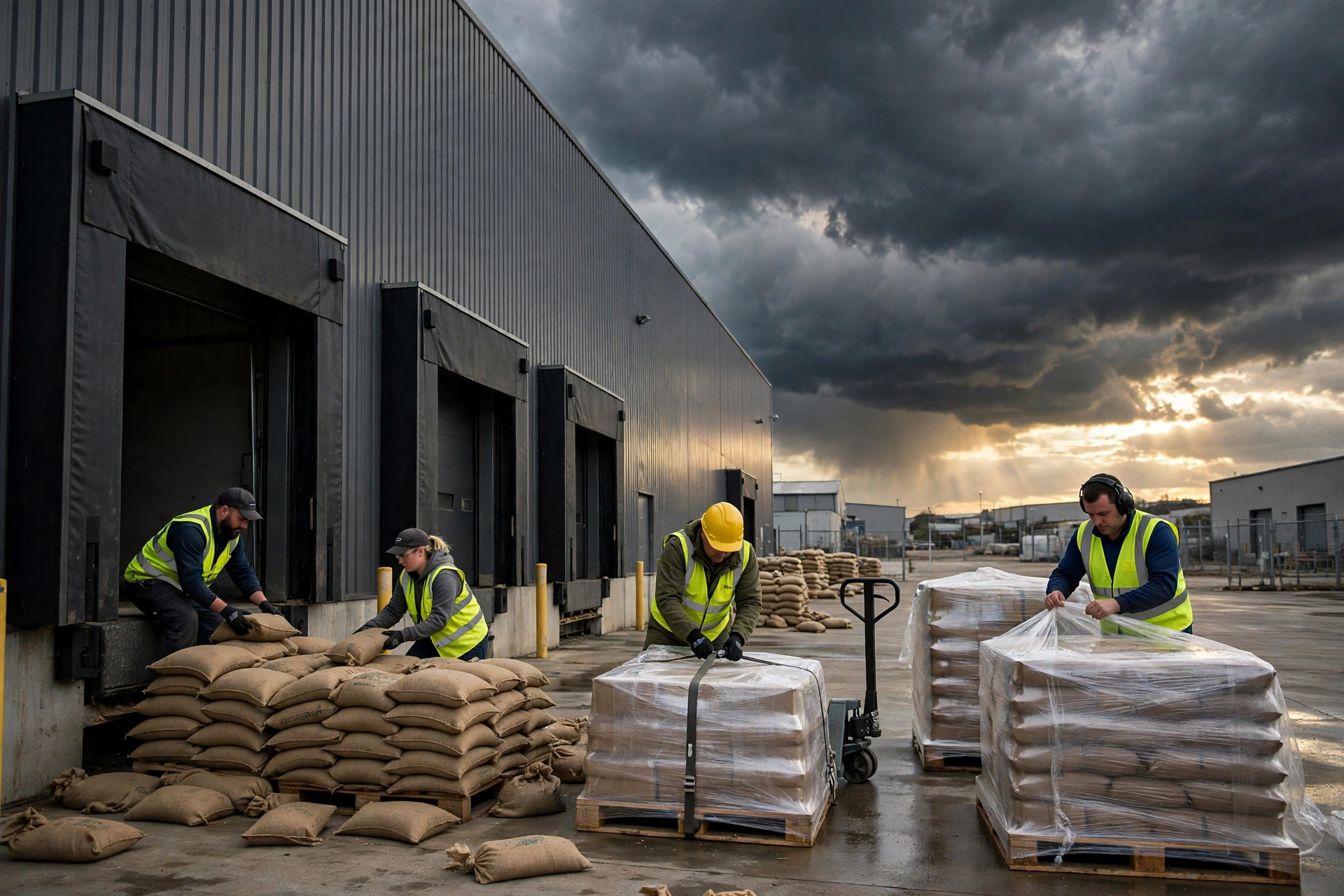
Inventory: move high-value goods from low rack positions to higher ground — clear the bottom two levels first, every forklift driver knows this; re-wrap every pallet, two extra rounds of stretch film; cover anything water-sensitive — cartons, textiles, electronics — with tarps. Don't cheap out on the tarps.
Building: seal dock doors and windows, stack sandbags at entrances; check the roof drains for blockages — plenty of flooding starts on the roof; line up a generator rental in advance. For cold-chain warehouses, backup power is non-negotiable — four hours without power and frozen goods start warming.
Data: back up your WMS data, inventory counts, insurance policies, and leases to the cloud; put critical paper documents in a waterproof case and take them with you.
And one thing most people never think of: walk the warehouse with your phone and shoot a video before the disaster hits — racks, inventory, equipment, doors and windows, as-is, with a timestamp. That video is worth hundreds of thousands of dollars at claim time. More on that in a minute.
One more thing for when the disaster is actually happening: protect people, not product. Where to shelter in a tornado, don't hide under racks in an earthquake, never drive into floodwater — all of this goes into the written plan, and it only works if you've drilled it. OSHA requires employers to have a written emergency action plan (check current requirements on their official site). It's not decoration. When something goes wrong, that's what investigators ask for.
Recovery: Get the Order Wrong and Money Goes Down the Drain
The post-disaster sequence is: safety assessment → photo documentation → file the claim → cleanup → restart. In that order.
Step one, safety assessment. A structural engineer goes in first: are the racks standing, is the roof intact, did the wiring get wet. Nobody enters until it's cleared. Every year people get electrocuted or crushed going in too early. Rushing in to salvage inventory is the dumbest move you can make.
Step two, photo documentation. Before you touch anything: water lines, soaked inventory, damaged equipment — the more, the more detailed, the better. Put it side by side with your pre-disaster video and the adjuster has nothing to argue with.
Step three, file the claim. Call your insurer immediately — missing the notification deadline can hurt your claim. Isolate damaged goods and tag them. Do not throw anything away in a hurry — the insurer needs to see it. What they can't verify, they discount.
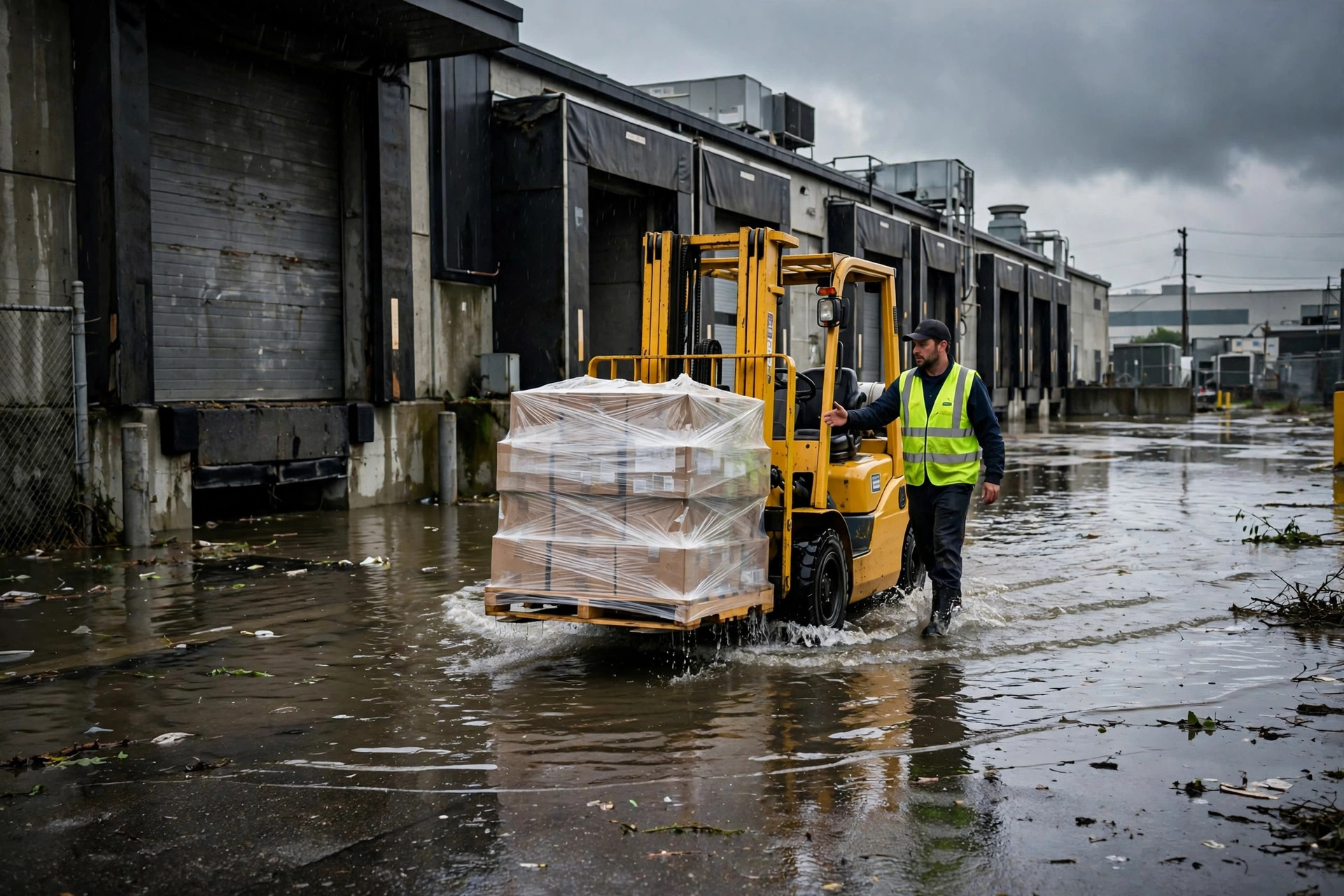
Step four, cleanup. Make it safe first, then clear the goods. Handle water-damaged inventory per the insurer's requirements — scrap what needs scrapping, salvage what has residual value.
Step five, restart. Phase it back. Ship the most urgent orders first. And this matters more than speed: reassure your customers. Proactively tell them your recovery plan. What customers fear isn't delay — it's silence.
Insurance: Bought Doesn't Mean Paid
This is the part that matters most. Three traps.
Trap one: flood is usually not in a standard property policy. Standard US commercial property insurance generally excludes flood. Want flood coverage? Buy it separately (for example through the federal flood insurance program — check the latest on their official site). I've met too many owners who assumed "property insurance covers everything" and discovered after the water came in that it covered nothing.
Trap two: hurricane deductibles are percentage-based. A normal deductible is a fixed amount, say $10,000. Hurricane deductibles in many states are a percentage of the insured value — 2% to 5% is common. On a $5 million policy, 5% is $250,000 — before the disaster even starts, you're out a quarter million. Most people never did that math when they bought the policy.
Trap three: business interruption insurance — most people don't have it. Your warehouse sits idle for two weeks, but rent and payroll don't stop, and customers may walk. Business interruption covers lost profit and fixed costs during the downtime, but the fine print sets a waiting period (usually 48–72 hours). The details decide how much you actually get.
Let's do the math: my friend in Tampa lost $2.3 million and recovered less than $900K — $1.4 million out of pocket. If he'd spent $30K–$50K on a pre-disaster plan — securing inventory, sandbags, tarps, a generator deposit, a pre-disaster video — he'd have cut losses by $600K–$800K at least, and the claim would have gone smoothly. Next to the loss, the plan costs next to nothing.
My verdict: insurance is the floor. The plan is the leverage. Buying insurance doesn't mean you'll get paid — the fine print decides everything.
Finally, three things you can do tomorrow. One: check the FEMA hazard map and confirm which disasters your warehouse actually faces. Two: pull out your policy and read three lines — is flood covered, is the hurricane deductible fixed or percentage-based, do you have business interruption coverage. Three: walk your warehouse with your phone, shoot a video, upload it to the cloud. It might be the highest-ROI thing you do all year.