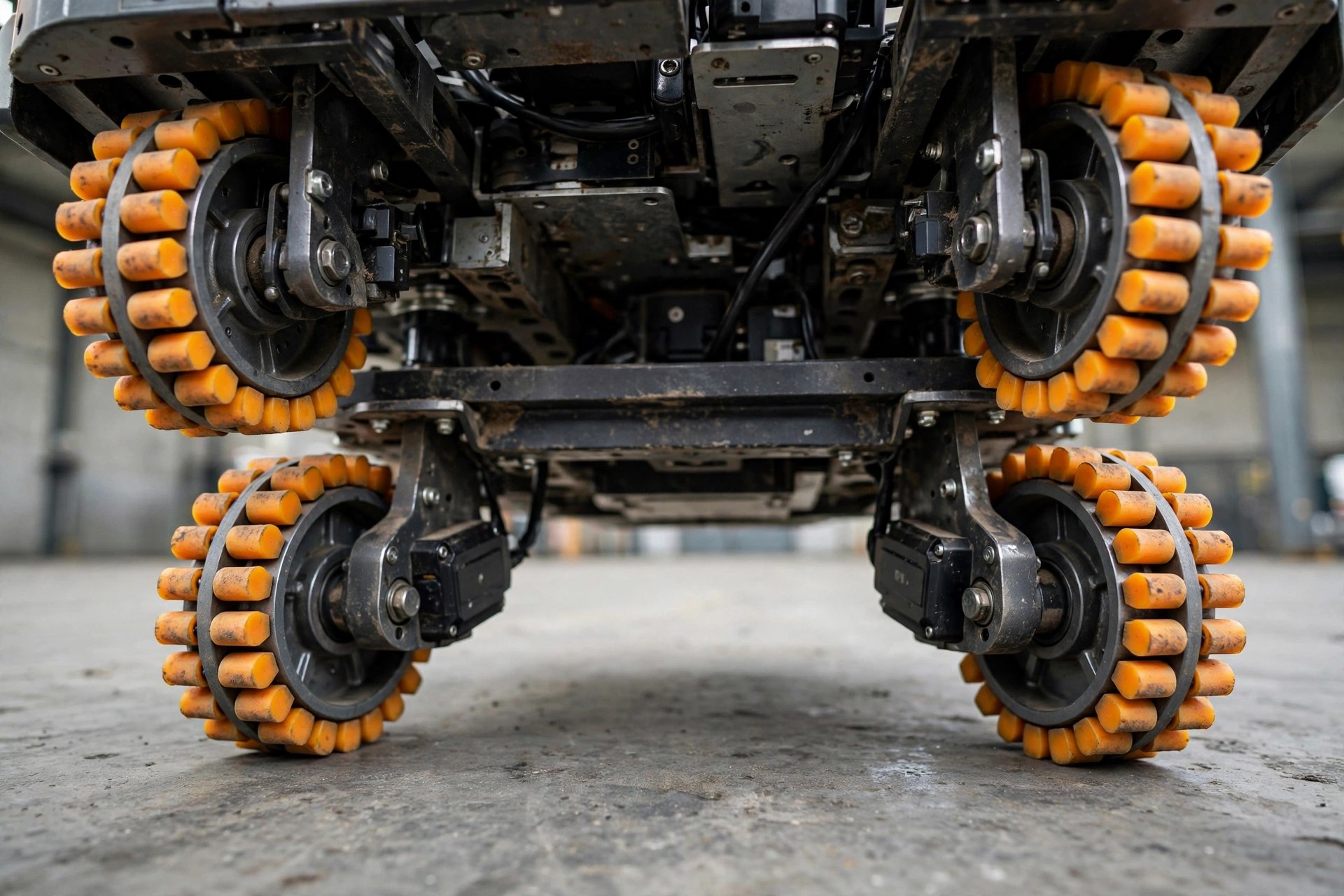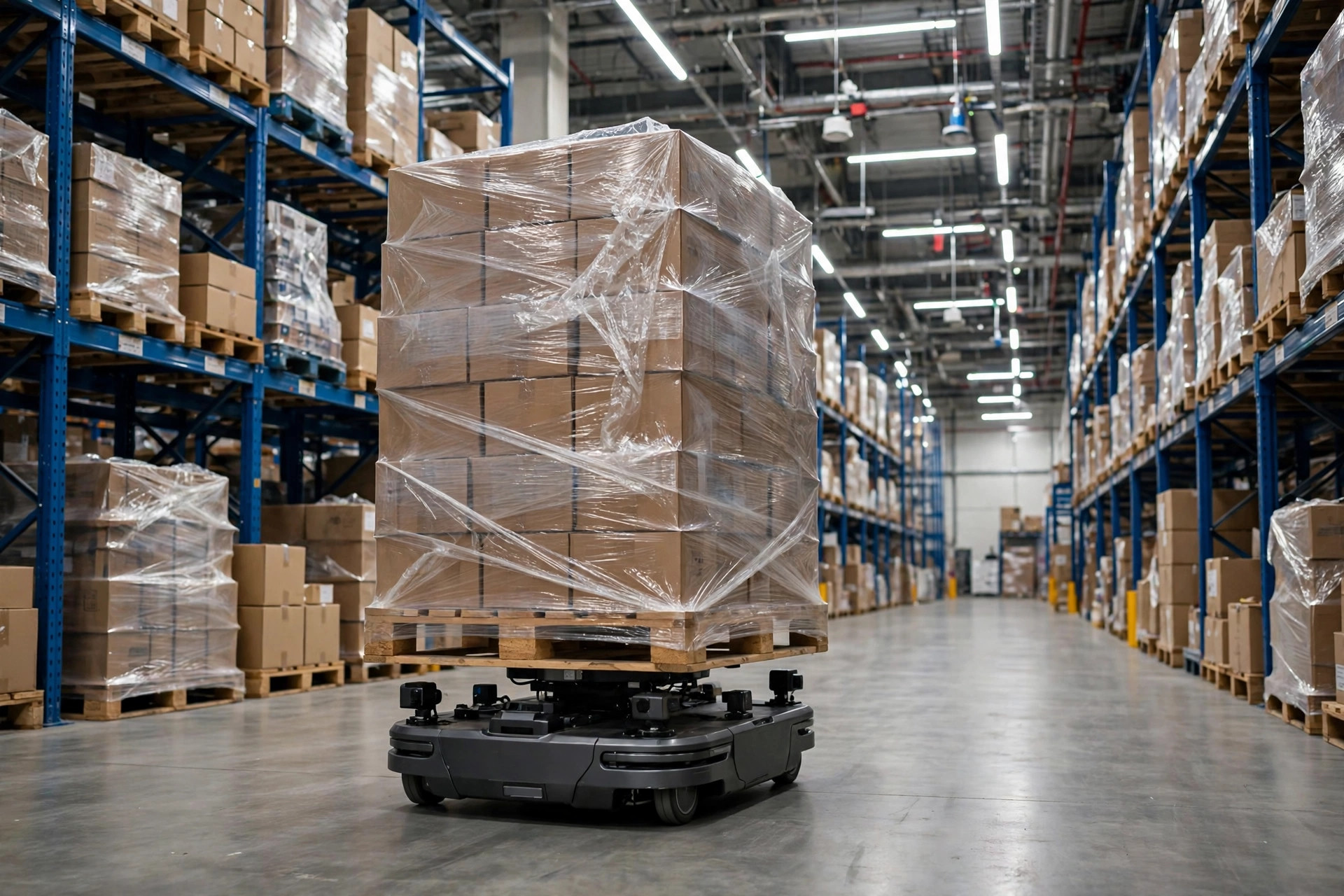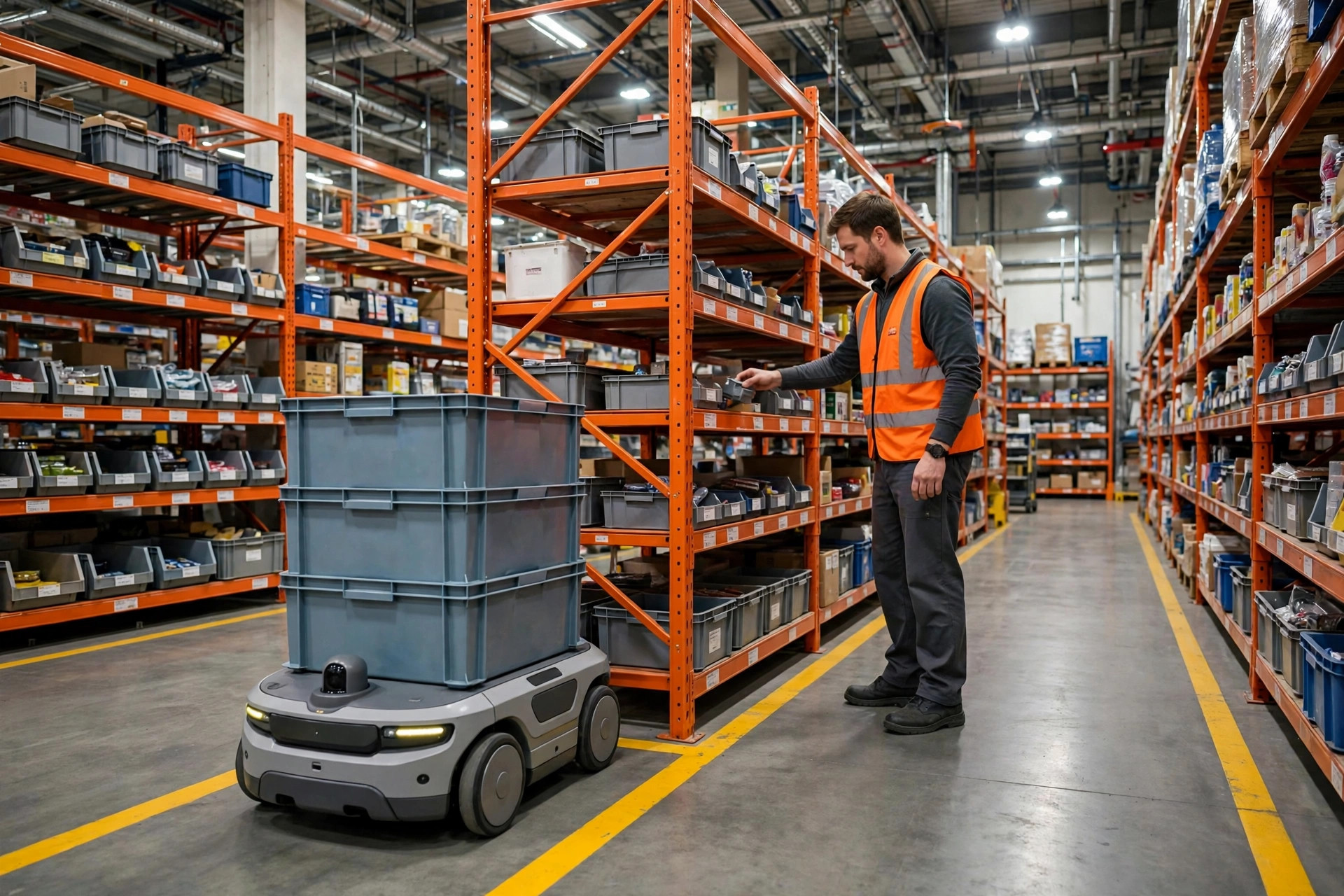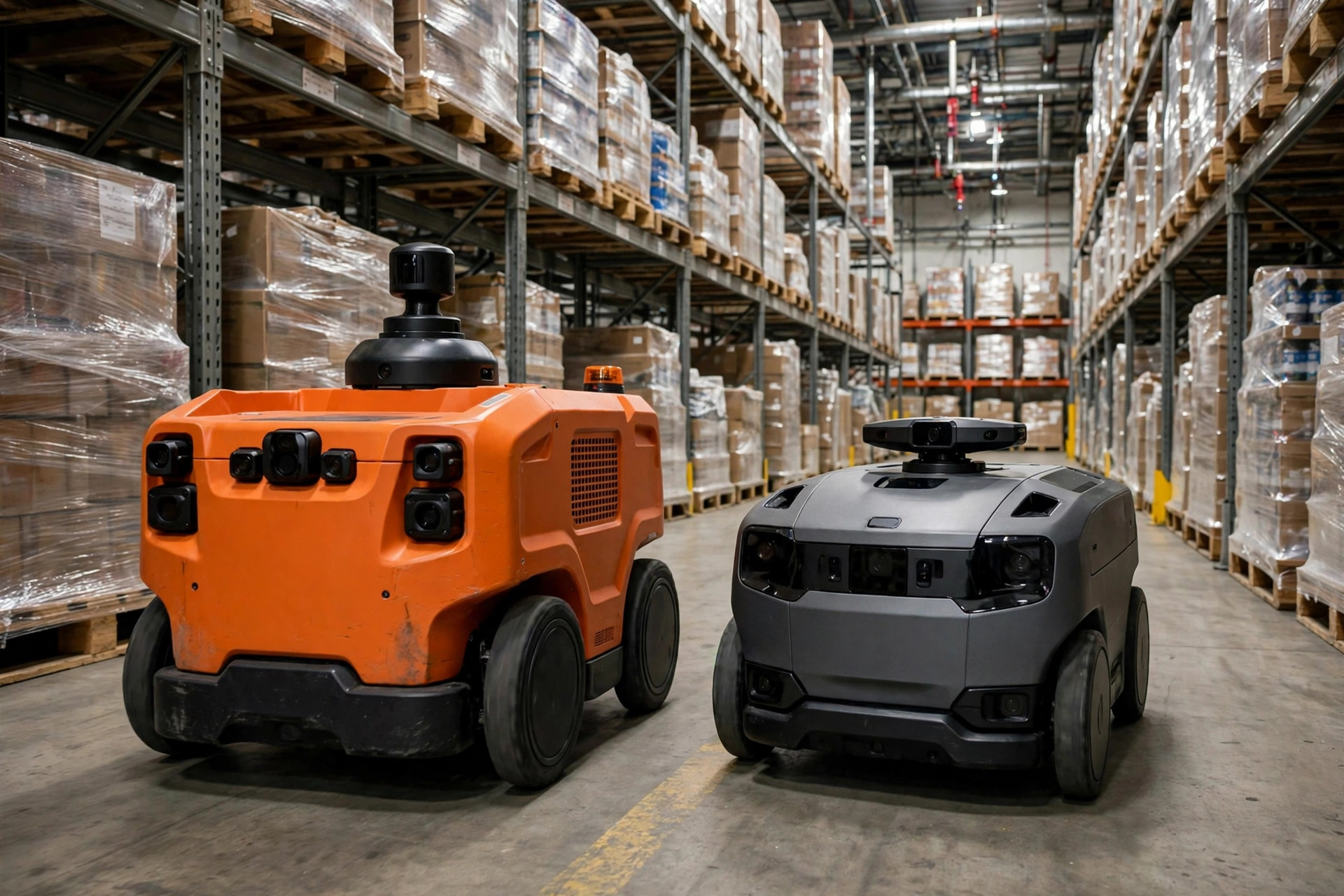
It was 2 a.m. in a beverage distribution center outside Atlanta, and I was standing on the mezzanine watching two AMRs play chicken. Brand A's bot had stopped dead at an intersection, convinced it had the right of way. Brand B's bot had backed up eighteen inches, declared "path blocked," and sat there blinking. Their two dispatch systems were each waiting for the other to move. After twenty minutes, the night supervisor killed the automation for the whole zone and sent three people with pallet jacks to clear a backlog of 60 cases by hand. Nobody's hardware was broken. The robots simply couldn't agree on who goes first — because nobody had ever made them speak the same language.
That night is the one I replay for every warehouse manager who asks, "Can we just buy the other brand too? They're cheaper." The short answer is yes. The long answer is that the hard part of a mixed fleet is never the vehicles. It's deciding who gives the orders.
What VDA 5050 covers — and what it deliberately leaves out
VDA 5050 is an open communication standard published jointly by Germany's VDA (automotive industry association) and VDMA (mechanical engineering association). It defines the interface between mobile robots and a central fleet control, sometimes called the master control. The current release is version 3.0.0, published in March 2025.
The design is deliberately narrow. Orders flow one way, state flows the other. Messages are JSON over MQTT — QoS 0 for routine traffic, QoS 1 for connection monitoring. The spec defines a small set of message types: order, instantActions (pause, resume), state (position, battery, errors), visualization, connection heartbeat, factsheet (the robot's physical characteristics), and zoneSet. If a vendor implements them correctly, any compliant master control can dispatch their vehicles.
What the standard does not do is just as important: it defines no safety functions and no traffic logic. Routing, right-of-way, congestion handling, deadlock recovery — the spec explicitly leaves all of that to the master control and the vendors. VDA 5050 makes robots understand commands. It does not teach them to share the road.
I learned this the expensive way on a project where a vendor's brochure checked the "VDA 5050 compatible" box. During integration we discovered they had implemented the state channel — the robot could report where it was — but never built the order channel. The master control couldn't send a single task. The robots were chatty and useless. Never trust the brochure. During acceptance, make the vendor demo every message channel, one by one, with your own eyes on the broker traffic.
The master control question: three architectures, no free lunch
In a mixed fleet there can only be one brain. I've seen three ways warehouses solve this.
Option one: a neutral third-party fleet manager. Purpose-built software that speaks VDA 5050 and treats every brand equally. The upside is freedom — you can swap vendors later without ripping out the control layer. The downside is a separate software license, and the reality that vendor-specific actions (Brand B's proprietary lift sequence, for example) can't be expressed in the standard, so expect custom adapters.
Option two: one robot vendor doubles as the master control. This is the most common sales pitch: "Our fleet manager runs our robots and theirs." It works, with a catch. The scheduler is inevitably tuned for the host brand — task allocation, charging priority, error recovery all favor the home team in subtle ways. And the commercial terms are where it really bites: the maintenance contract typically locks you in for two to three years, and when you try to add a third brand, "compatibility testing" becomes a convenient veto.
Option three: split the building. Brand A owns the east zone, Brand B owns the west, with a virtual fence between them. It's the lowest-effort path and, frankly, an admission of defeat. Cross-zone tasks get hand-carried by people, which is exactly the labor you were automating away.
My verdict: if the fleet will grow past ten vehicles and you plan to keep adding brands, go with the neutral third-party control. The license cost pays for itself at the second procurement round. For a pilot under five vehicles, a vendor-hosted control is acceptable — but get this in the contract: when a third-party brand is added, the incumbent has 60 days to complete VDA 5050 integration, with daily penalties against the maintenance fee for every day over. Without that clause, "we'll support it later" becomes a three-year argument.

The map problem nobody puts in the quote
Here is the famous gap in VDA 5050: it says nothing about maps. Every vendor builds its own map with its own coordinate system. Vendor A's origin is at the receiving dock; Vendor B's origin is at the charging station. When the master control says "go to (12, 30)," each robot hears a different place.
In practice, commissioning engineers align the maps by hand: pick four known points in the building, pin the two coordinate systems together, and move on. It works — until it doesn't. The alignment is a snapshot. The day you rearrange racking or drop a temporary staging lane, the maps silently drift apart, and nobody notices until a robot drives into a space that doesn't exist on its map. I watched this happen at a cold storage site: racking got re-slotted, nobody re-registered the maps, and a robot rolled into a dead-end aisle that had been closed off, LiDAR screaming, taking the whole fleet down with it.
So treat map alignment as an operating procedure, not a one-time task. Every racking move or aisle change should trigger re-registration, written into the SOP with a named owner. If your facility changes layout seasonally, budget the engineering hours for it like you budget for battery replacements.
Before you sign: the acceptance checklist
This is the checklist I built from watching mixed-fleet projects fail. Run it before final sign-off:
- Make the vendor demo every VDA 5050 message channel individually — especially order and instantActions, not just state.
- Run both (or all) brands together for at least four continuous hours. Count mutual waits and human interventions.
- Stage a head-on encounter in an aisle. The master control should resolve it in under 30 seconds — not a person with gloves.
- Kill Wi-Fi roaming for 10 seconds mid-mission. The robot should stop safely in place, not wander on its last instruction.
- Unplug one brand's charger and watch whether the low-battery task reallocation logic covers the whole fleet, not just that brand.
- Move one rack, run the map re-registration, and time it. The process should complete within two hours.
- Demand the factsheet and verify dimensions, payload, and turning radius against the contract.
And here's the one thing you can do tomorrow: don't decide interoperability in a conference room. Get two vehicles from each candidate brand into an empty staging area — or one idle corner of your own building — and run half a day of mixed missions: dispatch, charging, faults, network drops, all of it. If a vendor keeps finding reasons to avoid that smoke test, walk away from the deal. The money you save isn't the point. The 2 a.m. standoffs you never have are.