
Why Some US Sellers Warehouse in Mexico: A Nearshoring Cost and Transit-Time Breakdown
Here's something that sounds crazy until you see the math: a seller who only serves the US market keeps his inventory in Mexico. American customers order, the goods ship from south of the border, and they still arrive on time. This isn't madness — it's nearshoring, and it's been booming along the US-Mexico border. Even a small-warehouse guy like me, running a 3,000-square-meter operation, has heard the buzz.
Let me start with our predicament. Our little warehouse sits in Southern California, where rent climbs every year and labor costs make my chest hurt — peak-season temp wages are brutal. Last year, my friend Chen, who sells auto parts like brake pads and wiper blades, came to me and asked: "Ma, what if I move my parts warehouse to the Mexican border? Could that work?" My first reaction: what about delivery speed for your US customers? Then he walked me through the numbers, and I shut up.
The Border Math: Mexico Nearshoring Is Tempting, but It Burns
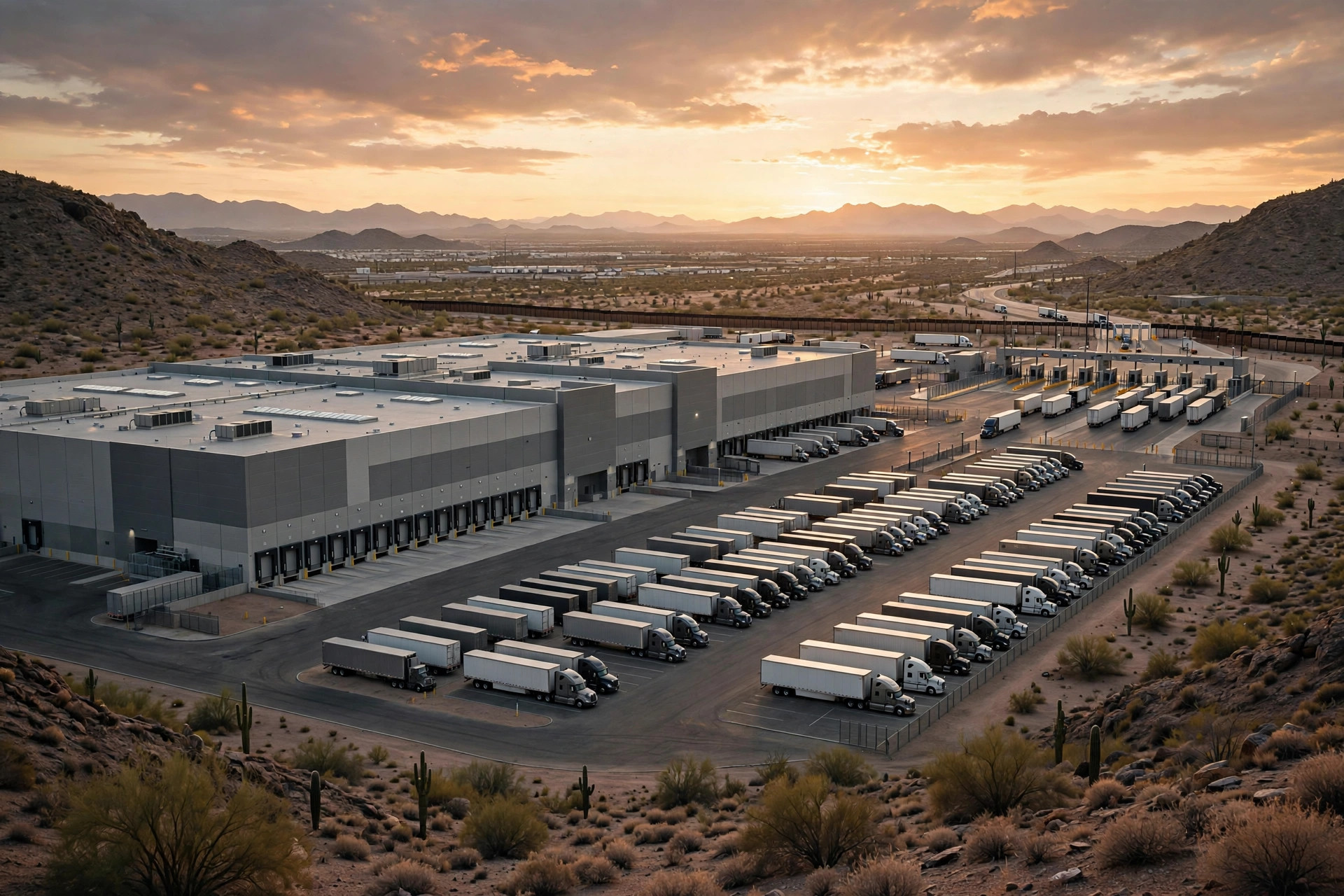
In the fall of 2024, Chen moved his warehouse to Nuevo Laredo — the Mexican city right across the border from Laredo, Texas. His setup: bulk auto parts stored in the Mexico warehouse; when US orders come in, cross-border trucks clear customs the same day, haul the goods to a Texas distribution point, and parcels go out from there. As he puts it: "Same goods, just a different place to sleep."
The results? On rent alone, he says he cut it by more than half — "what rents a tiny office in SoCal rents a whole row of racking over there." Labor is cheap too — a packer's monthly pay runs under a third of the US equivalent. On transit time, most of his customers are in Texas and the Southeast: delivery went from 2 days to about 3, and his negative review rate barely moved. Per-order fulfillment cost dropped roughly 30 percent (his own math, treat it as directional).
But don't just watch the thief eat meat without watching him take the beating. Chen paid plenty of tuition in year one: during a port inspection surge, one shipment sat at the border for four full days and his customer service line melted down. He burned through two customs brokers before finding a reliable one. Once, a wrong product description on the paperwork got an entire container held — fines plus storage losses ran close to ten grand. His words: "The rent I saved almost got eaten alive by cross-border uncertainty."
That brings me to my first counterintuitive take: the biggest cost of a Mexico warehouse isn't rent — it's uncertainty. A US warehouse is expensive, but the expense is predictable. A border warehouse is cheap, but the cheap price hides a stack of invisible bills — inspection delays, paperwork rework, broker trial-and-error, peak-season port queues. None of it shows up on a quote, but all of it comes out of your margin.
US Warehouse vs Mexico Nearshoring: A Comparison
When I helped Chen review the experiment, I built a comparison table. Treat these as directional ranges — check current local rates before acting on any of it:
| Item | US warehouse (SoCal / Texas) | Mexico border warehouse (Nuevo Laredo / Juarez area) |
|---|---|---|
| Rent | High, rising yearly | Roughly one-third to one-half of US rates |
| Frontline labor | High, worse in peak season | Roughly one-third of US levels |
| Linehaul | Domestic trucking, stable transit | Cross-border trucking + port crossing, 1–3 extra days of variance |
| Customs / compliance | Simple | Needs a solid broker; paperwork mistakes cost you tuition |
| Returns | Mature process | Cross-border returns are a nightmare — keep a US returns point |
| Best-fit freight | Anything | High-velocity, standardized goods that can wait 2 days |
The second takeaway is obvious from that table: not every product belongs in a Mexico warehouse. Chen's brake pads are standardized, high-velocity, low-return — a perfect fit. Compare that with a camping-lantern seller I ran the numbers for last year: hundreds of SKUs, double-digit return rates, customers demanding 2-day delivery. I talked him out of it: "You can't copy this homework — copying it digs your own grave." He stayed in a US warehouse and saved himself the trouble.
Is Your Freight a Fit for a Mexico Warehouse? A 4-Question Self-Test
Don't get excited yet. Ask yourself four questions first. If you can't answer one, don't move:
Question 1: Is your product a "dumb standard part"? High velocity, few SKUs, highly standardized, low return rate — you need all four before reading on. Customized, fragile, high-return goods will break you with one border crossing.
Question 2: Can your customers wait an extra day or two? Customers in the South and Midwest are fine with border-warehouse transit; East and West Coast customers, forget it. Pull your historical order data and map the ship-to addresses first.
Question 3: Do you have reliable cross-border resources? A customs broker, a cross-border trucking company, and a border warehouse operator — miss one and you're stuck. Chen's biggest year-one pitfall was an unreliable broker. No resources? Start by piggybacking on an established 3PL already operating there instead of building from zero.
Question 4: How do returns work? Cross-border returns are brutally expensive. The right setup is "ship from Mexico, return to a US point" — which means keeping a small US returns location, and that cost goes into the math too.
The Small-Warehouse Playbook: Piggyback, Don't Build
Finally, some survival philosophy from our little warehouse. Big companies go to Mexico with full builds — warehouses, teams, compliance departments. We small guys can't burn that kind of money. Our scrappy approach is one word: piggyback.
Chen didn't lease his own warehouse at first either. He started with a 3PL that already had border facilities, paid per pallet, and ran a three-month trial. Only after transit times and damage rates checked out did he sign his own lease. That "piggyback first, build later" path is made for small-budget operators: trial-and-error cost drops from hundreds of thousands to a few thousand dollars. If it doesn't work, you walk away — an affordable loss.
Another scrappy move: shared warehousing. Some operators at the border run shared facilities where small sellers split a warehouse and share one customs broker, cutting costs further. The catch: keep ownership and accounting crystal clear, and read the contract three times. Don't say I didn't warn you.
At the end of the day, Mexico nearshoring isn't magic — it's a trade of certainty for cost. If you're willing to accept a day or two of transit variance and a pile of cross-border hassle in exchange for 30–50 percent lower warehousing costs, the deal works. If you sell time-sensitive, delicate, high-return goods, the deal is a money pit dressed up as savings.
What our little warehouse has learned these past two years: don't compete with big companies on resources — compete on sharper math and bolder experiments. Nearshoring is a test worth copying, but first check whether you're taking the same exam as everyone else.
Small warehouses have their own way of surviving.
By Xiao Ma, Small Warehouse Owner


