title: "How to Start a 3PL Warehouse Business: Leases, Forklifts, Your First Customer, and the First-Year Math" excerpt: "How to start a 3PL warehouse business, from a small-warehouse owner who did it with zero customers: lease red lines, the used-equipment playbook, a first-year startup cost breakdown, breakeven math, and why your first customer should be steady — not big." tags: ["3pl", "startup", "warehouse-leasing", "cash-flow", "first-customer"]
How to Start a 3PL Warehouse Business: Leases, Forklifts, Your First Customer, and the First-Year Math
Here's the verdict up front: if you want to start a 3PL warehouse business, the most expensive thing isn't the forklift or the racking. It's your first customer's payment terms. In the fall of 2021, I signed a lease on a 32,000-square-foot warehouse in Ontario, California, with exactly zero customers lined up. Friends looked at me like I was filing for bankruptcy in advance. Five years later the little warehouse is still alive — not because of luck, but because of a handful of scrappy rules the first year beat into me.
Starting a 3PL warehouse, step one: the lease — compromise on location, never on these three
Location: don't just look at rent — look at how trucks get there.
We toured a building 25% cheaper, forty minutes off the freeway. One look and our driver shook his head: extra mileage and extra time on every run, two runs a day in peak season, and the rent savings evaporate. We took Ontario — pricier, ten minutes off the freeway, parcel carriers driving past daily, and easy hiring: warehouse workers already live nearby.
A market anchor first: NAI Capital reported average asking rent in the Inland Empire at $1.12 per square foot per month, triple net, in Q4 2024 — and we signed in 2021, when it ran hotter. Every "what our little warehouse actually paid" number below is from back then, for reference only. Don't take it as today's quote sheet.
The lease: the annual increase cap is the most valuable sentence in the contract.
First draft from the landlord: five years, 4% annual bumps, no early termination. Three rounds later: 3% cap on annual increases, and the right to exit after year three with six months' notice (plus three months' rent as penalty). Small-warehouse founders, don't stare at the starting rent line. Stare at "escalation" and "exit." A 5% win on starting rent gets eaten alive by one 8% bump in year three. Security deposits run two to three months' rent — frozen on signing day. Count it in startup cash.
Fire code: "sprinklers included," said the landlord. Half true.
Our racking went up 20 feet. The fire department took one look: above a certain storage height you need in-rack sprinklers; the ceiling system alone doesn't cut it. That retrofit cost tens of thousands and three weeks — nearly missing our first inbound. Lesson: take your racking drawings to the fire marshal before you sign. The landlord's "everything's included" was based on the last tenant's two-meter-high light goods. Yours are six-meter pallets. Different universe.
Buy used equipment. Never cheap out on software.
The first counterintuitive rule from year one: anything that can break can be bought used; the system you touch every day deserves full price.
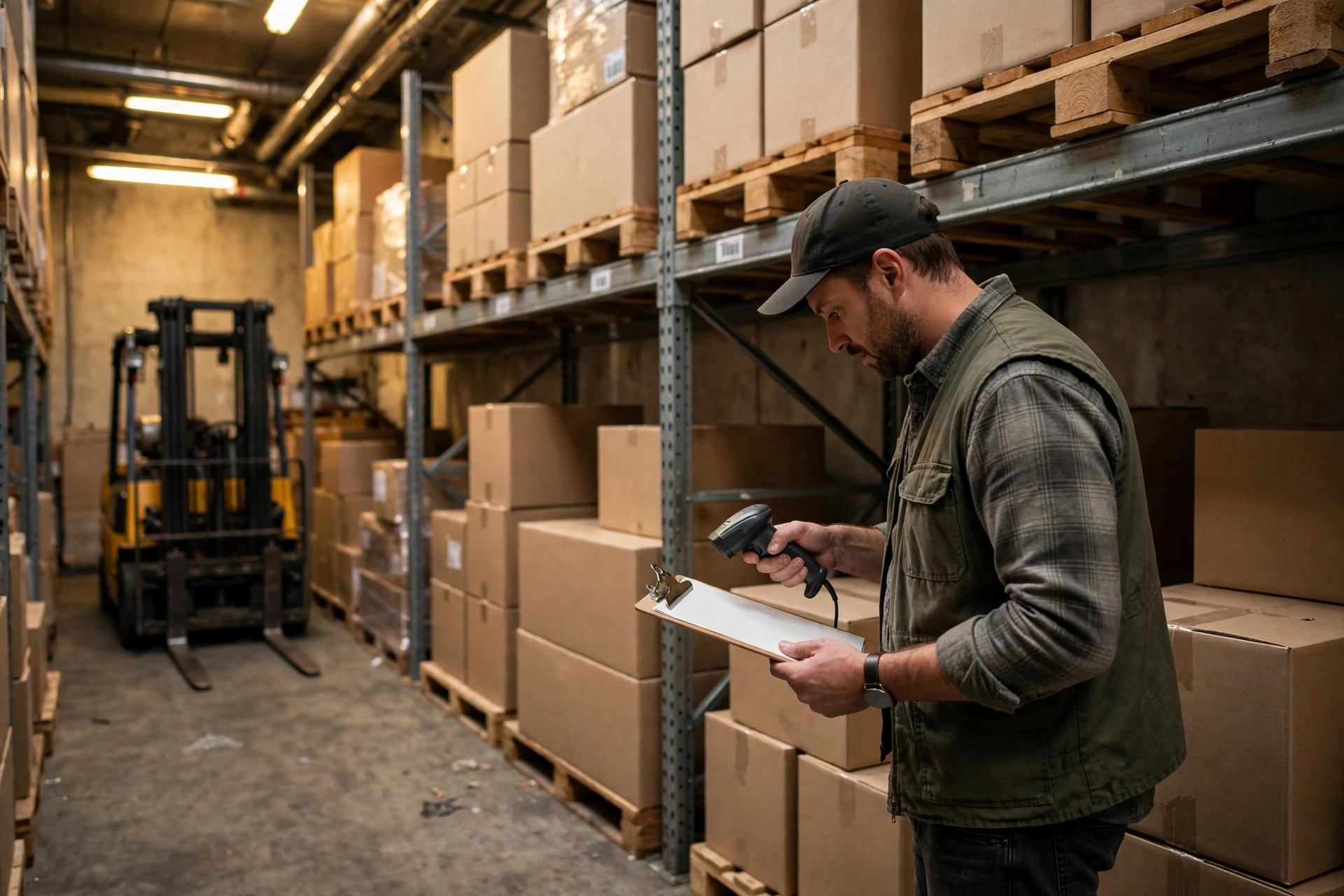
Our forklifts are used electrics: a 5,000-lb used electric counterbalance lists around $10,500–$28,500 (public dealer listings, October 2026); new starts around $35,000. Check three things: battery age, hour meter, mast condition. The battery is the whole game — a replacement pack alone costs enough to buy half a used truck, a lesson we learned from a quote sheet back then, for reference only. Our first truck cost $14,000 with a one-year-old battery. Still running today.
Racking: used. Pallets: used. Stretch-wrap machine: used. Where did the savings go? Into a WMS.
We ran on Excel for four months. At four customers and 200+ orders a day it started killing us: one customer's orders shipped wrong three times in a month — claims, refunds, nearly lost the account. We signed up for a basic WMS at a few hundred dollars a month. Inbound gets a receipt number, outbound gets a verification scan, and the mispick rate fell off a cliff. The math: Excel is free and quietly costs thousands a month in "surprises." The WMS costs hundreds and buys no-surprises. Broken equipment costs one repair; a broken system taxes you daily.

The first-year money: what it really costs to start a 3PL warehouse
This is what our little warehouse actually spent to open. Our numbers, for reference only — your rent and labor will differ, but the shape won't:
| Item | Cost (USD) | Notes |
|---|---|---|
| Lease deposit (3 months) | ~100,000 | Frozen on signing day |
| 2 used forklifts | ~30,000 | Includes first-year maintenance budget |
| Used racking + pallets | ~25,000 | ~2,000 pallet positions |
| Fire/electrical retrofit | 30,000–50,000 | Depends what the landlord left you |
| WMS first year + setup | 10,000–15,000 | Or monthly SaaS |
| Pack benches / supplies / office | ~10,000 | Used wrap machine |
| Licenses + insurance | ~10,000 | Cargo liability is the big one |
| Cash reserve (6 months payroll) | ~150,000 | Survival money, see below |
| Total | ~350,000–400,000 |
See that cash-reserve line? Six months of payroll and fixed costs. Why six? Because our first real collection landed in month five. The first half-year of a 3PL startup is almost guaranteed all-outflow. That reserve isn't a "just in case" — it's a "when." I've watched two fellow operators pour everything into buildout, miss payroll in month three, and close a warehouse that never got warm.
The breakeven math — ours was crude but it worked:
- Monthly fixed cost = rent (~33k) + five people (~35k) + insurance, utilities, software (~8k) ≈ $76,000/month (our numbers, for reference only)
- Revenue comes in two streams: storage (per pallet position per month — we charged $12–$18 back then) and handling (inbound, outbound, packing — per order or per unit)
- 2,000 pallet positions at 70% occupancy ≈ $20k/month in storage; the remaining $56k gap had to come from handling — at $4–$6 margin per order, that's 10,000–14,000 orders a month
So our breakeven: 70% occupancy + 10,000+ orders a month. Eight of the first twelve months underwater; first breakeven in month ten. Your numbers will differ; the formula won't: nail down monthly fixed cost first, then back into the occupancy and volume you need. If you can't do that math, don't sign.
Your first customer: don't chase the biggest — chase the steadiest
Second counterintuitive rule. Before we opened, several "friends of friends" promised big volume — at 30% below our rates, on net-60 terms. I almost said yes. When you have no customers, any customer looks like a life raft.
Our first real customer was a local auto-parts seller: 50–80 orders a day, shipping like clockwork every week, net-15, never late. Why him over the "big fish"? Three calculations:
- The big customer's price is poison. A 30%-discounted rate prices you below cost — you're paying for the privilege of being busy. A small warehouse has no scale; you'll never win a price war against the big sheds. You win on "zero mistakes and fast response," and that needs a normal price to survive.
- Payment terms are a noose on cash flow. Net 60 means you bankroll the customer for two months: payroll and rent go out daily, cash comes back two months later. In month seven we lived it — a net-30 customer slid to 60 days and payroll nearly bounced. Since then: unpaid past 45 days, outbound pauses. And our rate card prints three tiers: 5% off for prepay, standard at net 15, +3% at net 30. Want longer terms? Pay for them.
- Customer concentration is a sword overhead. Our red line: no single customer above 40% of revenue. In 2023 our biggest hit 55%; when he moved, three months of work evaporated. Now, past 40% is a warning; past 50% means hunting for new customers even if it takes discounting.
That seller later introduced two peers — same profile: small, steady. Three years on: eight to ten mid-size customers, no single departure fatal. The small-warehouse way: don't bet on the whale, bet on the structure.
Five years on, year one's three most expensive tuition payments: the sprinkler retrofit I never asked about, four months on Excel, and almost signing the net-60 whale. Each felt like saving money at the time. Each got repaid with interest.
If you're touring buildings and building a budget, one piece of advice: model cash flow before profit. Profit is a spreadsheet matter; cash flow is whether you sleep tonight. Every decision — lease, equipment, software, customer — starts with: after this money goes out, how many months can I survive? Survive twelve, and you've earned the right to negotiate with this industry.
Small warehouses have their own way of living: can't afford the prime location, take the one trucks can reach; can't afford new forklifts, buy used ones with fresh batteries; can't land the whale, serve small customers so well they can't leave. Big sheds compete on scale. We compete on one thing — outliving everyone.
By Xiao Ma, Small Warehouse Owner