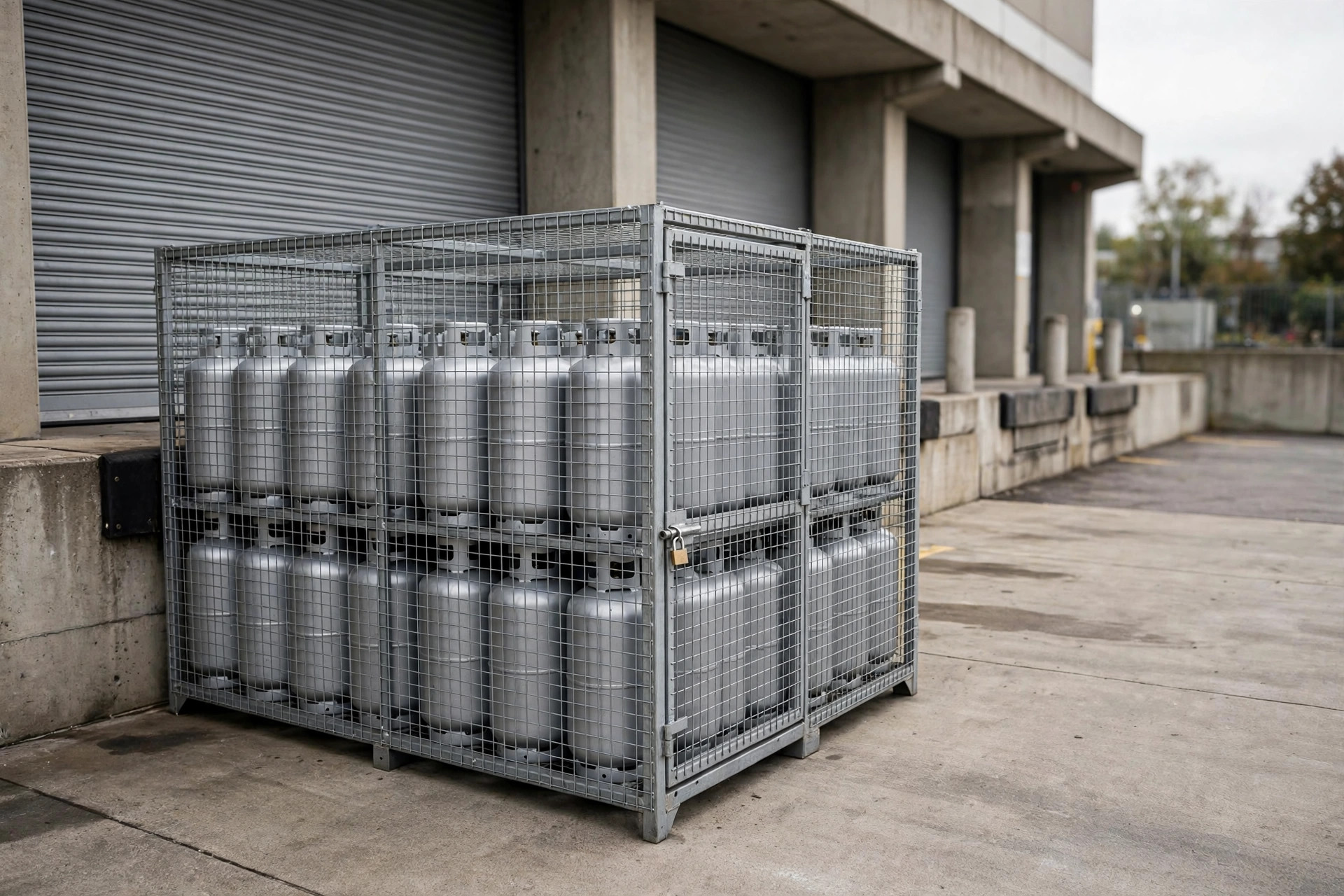
Think of it as drawing a minefield map for your warehouse.
That's what hazardous-area classification for explosion-proof electrical really is: you slice the whole building by "how likely is an ignitable concentration in the air here," put the heavy-duty explosion-proof gear where the likelihood is high, and use ordinary equipment where it isn't. Get the map right and every dollar lands where it matters. Get it wrong and you're either burning money or burying land mines. Let me walk through the whole logic in one pass.
The Principle: What the NEC Classification Language Actually Means
In the U.S., this is governed by NEC (NFPA 70) Article 500, plus OSHA 29 CFR 1910.307. It grades hazardous areas on two axes.
Axis one: Class — what form your material takes. Class I covers gases and vapors: solvents, alcohols, fuels. Class II covers combustible dusts: certain chemical powders, metal dusts. Class III covers fibers and flyings. This step is mechanical: pull the SDS (safety data sheet) for every chemical you store, check flash point and lower flammability limit, and the Class falls out. For example, under NFPA 30 and OSHA 1910.106, a liquid with a flash point below 100°F (37.8°C) counts as a flammable liquid — check the current official edition for exact thresholds, but "look up the SDS to set the Class" is non-negotiable.
Axis two: Division — how likely an ignitable concentration is. Division 1: it can show up under normal operations — filling nozzles, dispensing stations, anywhere material routinely escapes. Division 2: it won't appear under normal operations, only under abnormal ones like equipment failure or a leaking valve. You can roughly map the IEC Zone 0/1/2 system onto this — Zone 0 is "always present," Zone 1 lines up with Div 1, Zone 2 with Div 2 — roughly, don't take it to the bank; follow whichever system edition your project is designed to.
So a zone rating is really a three-variable equation: material properties (SDS) × release sources (where it can leak) × ventilation (whether a leak can dissipate) = the Division rating at that point. And ventilation is the most underrated variable in the equation — it can change the answer outright, as we'll see.
The Selection Boundary: How Much Money Sits Between Div 1 and Div 2
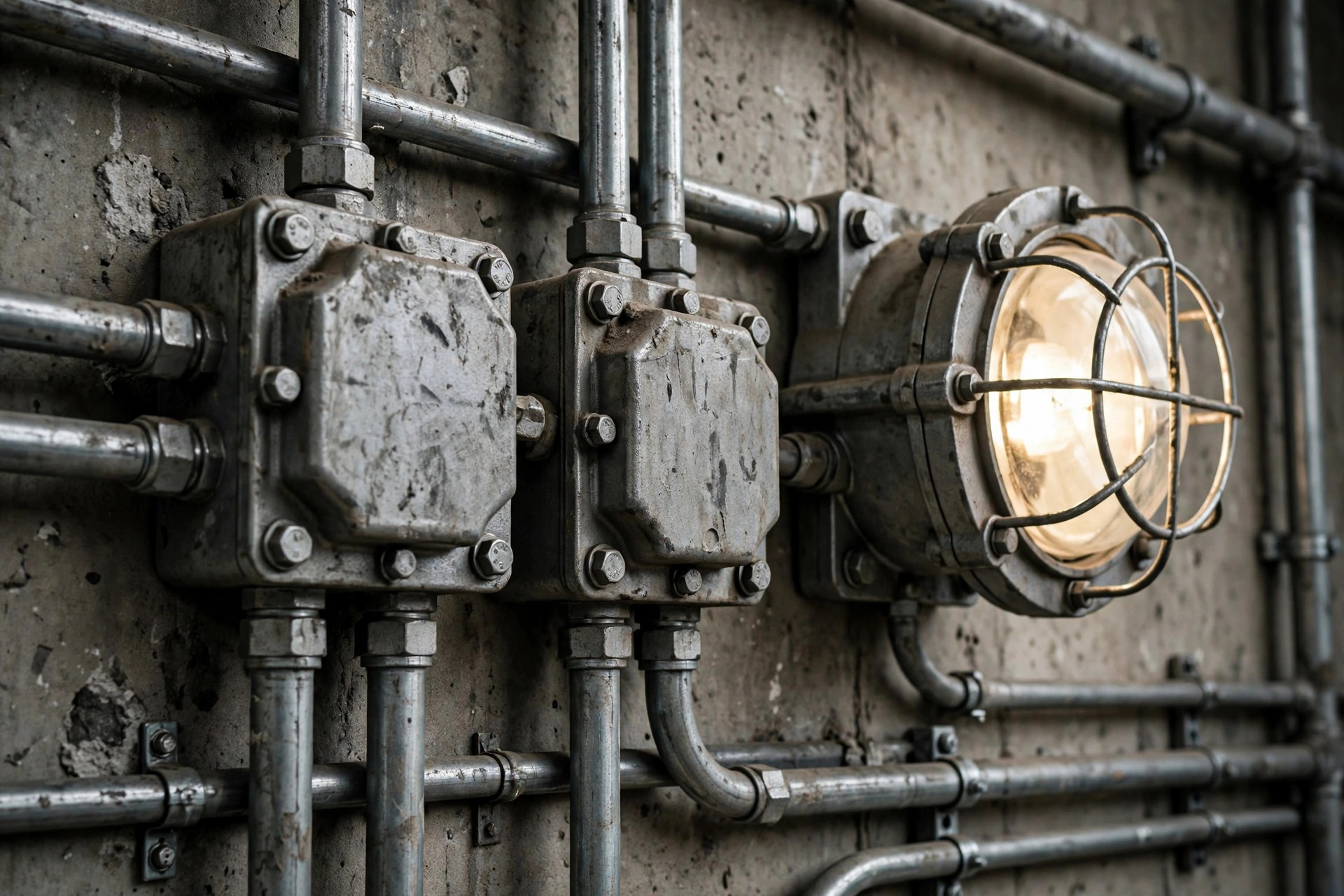
Div 1 and Div 2 equipment are not in the same price universe. A Div 1 luminaire — cast-aluminum housing, flame-path joints, tempered glass — costs multiples of an ordinary industrial light. Explosion-proof junction boxes, switches, conduit sealing fittings: wire up a whole workstation and the electrical cost can differ by an order of magnitude. So "where Div 1 ends and Div 2 begins" is the line that sets the project budget.
The boundary gets set in four steps, none optional:
- Read the SDS, set the Class. List flash points and flammability limits for every chemical in the building. This is the foundation. Change your materials and this step gets redone — case two below is what happens when it isn't.
- Find the release sources. Filling nozzles, valves, sampling points, pump seals — anywhere material can escape is a Div 1 candidate. Zones get drawn as radii around each source; the actual radii are calculated by a qualified engineer per the standard, not by gut feel.
- Do the ventilation math. This is the boundary that matters most. Natural or mechanical ventilation? Enough air changes to keep a leak below the lower flammability limit? NFPA 30 sets explicit ventilation requirements. Get ventilation right and large areas drop from Div 1 to Div 2, or out of classified territory entirely. Ventilation is a legitimate, code-compliant way to step down — not cutting corners.
- Draw the area classification map, and sign it. It has to come from a qualified engineer. The AHJ (authority having jurisdiction) recognizes the drawing, not your verbal explanation.
Now I need to fire at a pseudo-need: specifying the entire warehouse as Div 1 is the most expensive feel-good move I've seen. Some design firms spec high because they're afraid of liability; integrators won't object, since every extra Div 1 luminaire is margin. The owner pays multiples and walks away feeling "safety first." Safety first is right — but safety first doesn't mean maximum spec everywhere. A couple of years ago, a distribution warehouse near Houston stored drummed IPA (isopropyl alcohol) with the whole building wired Div 1. The owner later commissioned a proper area classification study and added mechanical ventilation. Result: only the filling and dispensing zone stayed Div 1; all storage dropped to Div 2. The savings would have covered a full-time safety hire for two years. Tell me that money wasn't wasted.
The Maintenance Trap: Explosion-Proof Has an Expiration Date
Most people think explosion-proof gear is install-and-forget. Wrong. The "proof" in explosion-proof lives in the flame path — the precisely machined metal joints between enclosure parts. If an internal spark ignites gas inside, the flame gets cooled and quenched as it travels through that joint, so it can't propagate outward. One missing bolt, a corroded face, a dented joint, and the protection is gone. It was explosion-proof the day it was installed. Five years later? Not necessarily.
Three traps I see constantly:
Trap one: the lazy relamp. A lamp dies in an explosion-proof fixture, and the electrician screws in whatever bulb is handy. Cover goes back on, nobody can tell. But an ordinary bulb's surface temperature and socket construction were never qualified for the rating — you've just cut a skylight in your explosion-proof fixture.
Trap two: the unsealed seal. Where conduit enters an explosion-proof box, you're supposed to install a sealing fitting packed with sealing compound, isolating the raceway from the enclosure. Some crews rush it — compound half-filled, or the fitting skipped entirely. That's a highway for an explosion: flame can travel down the conduit into the next room.
Trap three: five years, zero inspections. Corroded flame paths, rusted-shut bolts, cracked and aged sealing compound — all of it only gets caught by scheduled inspection. My rule: Div 1 areas get a visual plus spot-check at least once a year, with the checklist written into the equipment inspection routine — not "whenever someone remembers."
One counterintuitive rule to take home: higher rating is not better. Div 1 gear in a Div 2 area is wasted money; Div 2 gear in a Div 1 area is playing with fire. The engineering fee for a proper classification study feels expensive until you net it against the downgraded equipment bill across the whole building — run that math and the study is usually the highest-ROI line item in the project.
Whether the money is worth it comes down to one number: the share of your floor area rated Div 1. If it's over thirty percent, don't buy equipment yet — redo the classification study first. Nine times out of ten, the map was drawn conservatively, or ventilation never got factored in. Draw the minefield map right, and everything after that is execution.
By Da Liu, Automation Engineer