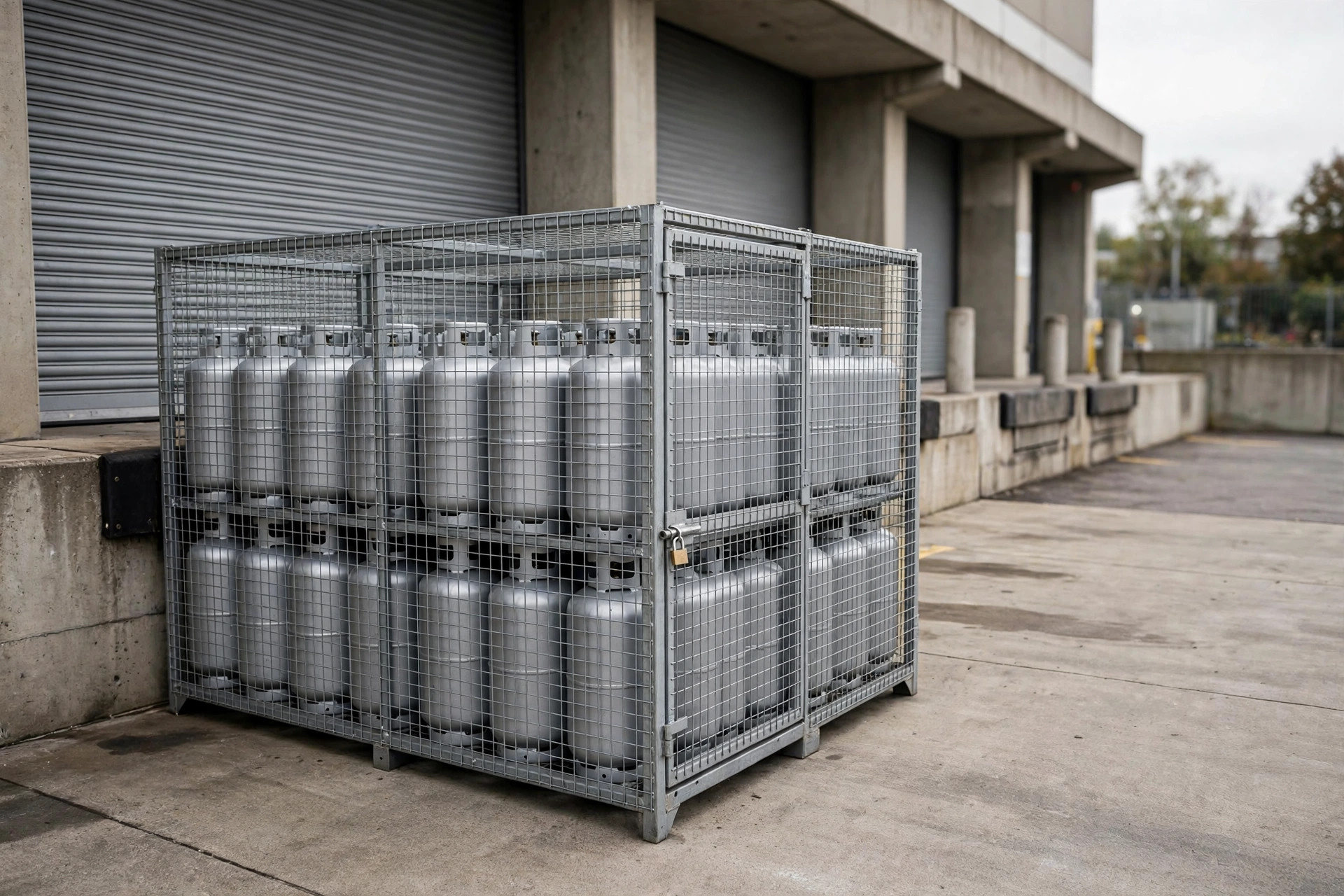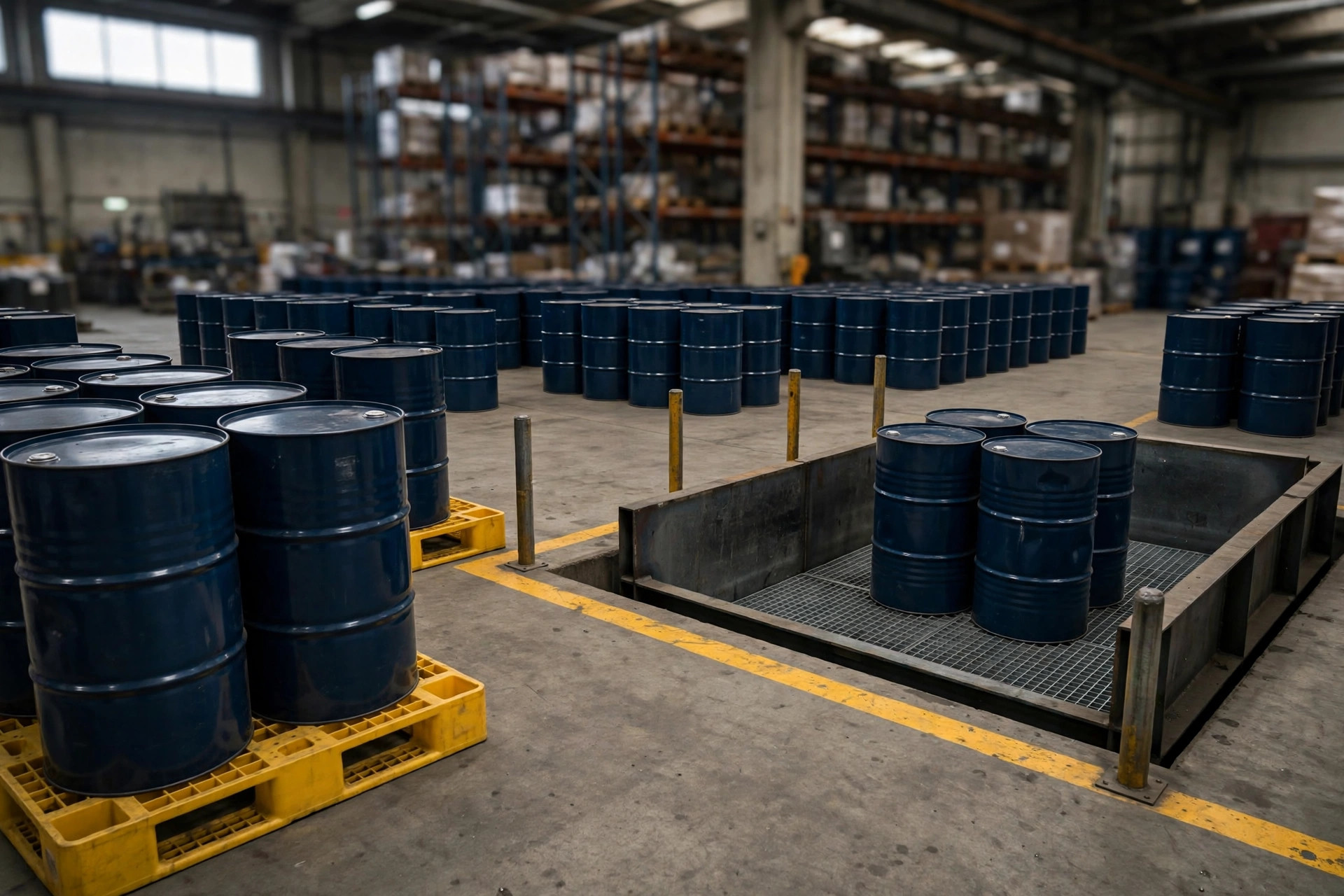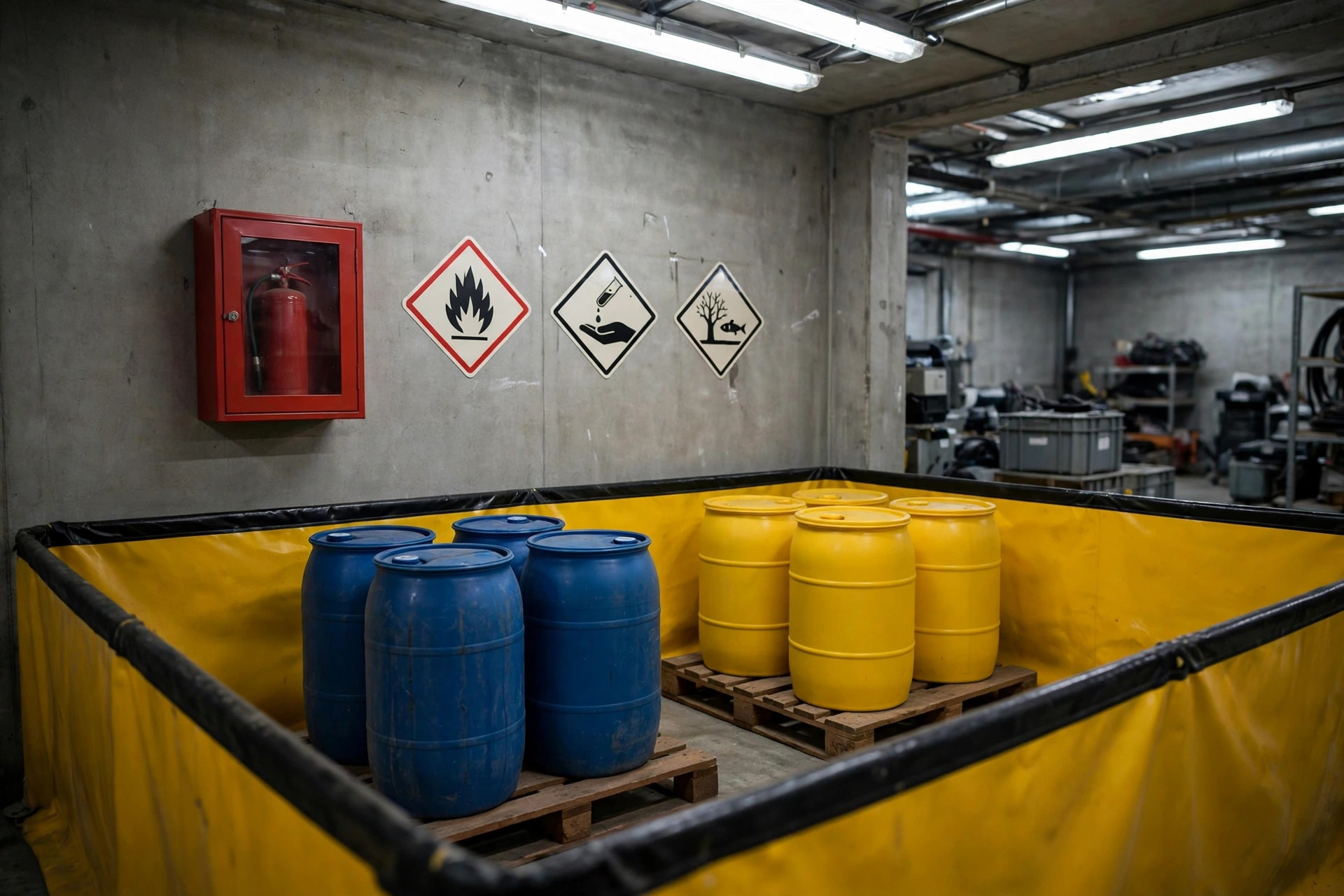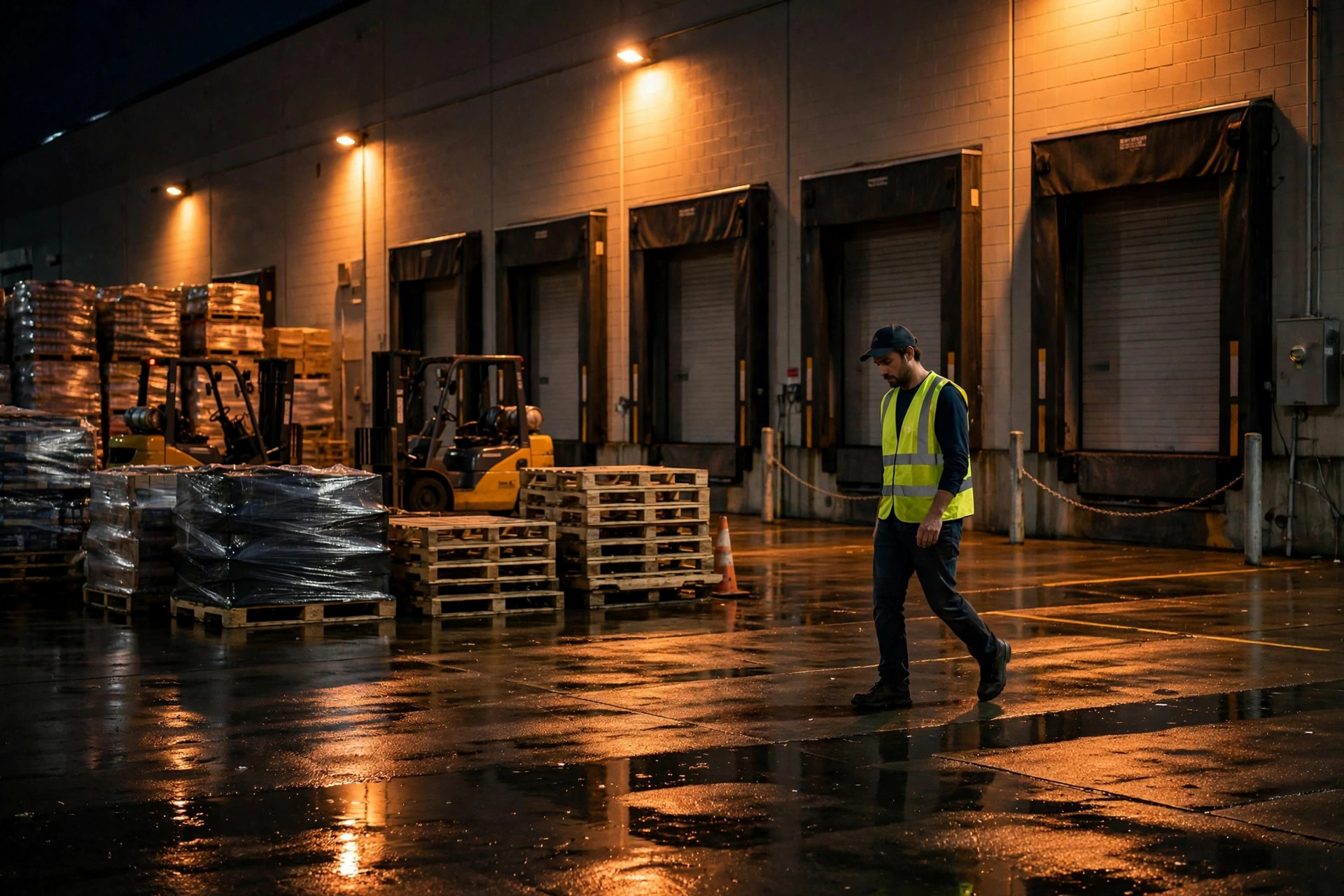
On the morning of September 29, 2024, an incompatible chemical storage failure hit Conyers, Georgia: a sprinkler component began leaking water onto trichloroisocyanuric acid. The chemical decomposes on contact with water, releasing heat. Within hours the building was engulfed, an orange-black plume of toxic smoke towering overhead. According to the U.S. Chemical Safety Board's final report, released in July 2026, the warehouse held nearly 14 million pounds of reactive chemicals at the time. Roughly 17,000 residents were evacuated, another 90,000 across the metro area were told to shelter in place, and property damage destroyed the entire warehouse. The owner permanently shut the plant in May 2025.
The failure was not that any single chemical was "too dangerous." It was that chemicals were stored alongside the wrong things — in this case, water.
A second data point, four years earlier and half a world away. On August 4, 2020, Warehouse 12 at the Port of Beirut held roughly 2,750 tons of ammonium nitrate stored six years, alongside fireworks. Welding work on a warehouse door started a fire; the fire reached the fireworks and then the ammonium nitrate. Ammonium nitrate does not burn on its own at ambient temperature — but confined with combustibles and heated, it is a different substance. Two incidents, different continents, the same management failure: things that must never sit together were never truly separated.
Incompatible chemical storage, seen through two warehouses
The Conyers investigation repays close reading. The CSB found the warehouse held more than twice the quantity of pool chemicals it had told local officials it would store. A December 2023 inspection had found more than 1,100 corroded sprinkler heads. Chlorine off-gassing from the chemicals had combined with ambient humidity since 2019, condensing as hydrochloric acid droplets that ate through metal components. The chain is unbroken: overstocking, chlorine off-gassing, acid corrosion of the sprinkler system, water leak, water-reactive decomposition, fire. Not one link was an "accident." All of it was compounded management debt.
Beirut's chain was shorter and uglier: 2,750 tons of ammonium nitrate, six years of inaction, fireworks in the same building, a welder's spark. A port worker later said he had personally seen dozens of bags of fireworks inside Warehouse 12. Segregation failures are rarely about not knowing. They are about knowing and not acting.
The incompatible chemical storage matrix
Incompatibility is not mysticism; it is chemistry. Fire codes define incompatible materials plainly: materials which, on contact with each other, can react to generate heat, fumes, gases, or byproducts hazardous to life or property. The matrix below is a warehouse starting point — the final authority is always Section 7 (handling and storage) and Section 10 (stability and reactivity) of each chemical's SDS.
| Oxidizers | Acids | Bases | Flammable liquids | Compressed gases | Water reactives | |
|---|---|---|---|---|---|---|
| Oxidizers | Compatible | ✕ Separate | Isolate | ✕ Separate | Isolate | ✕ Separate |
| Acids | ✕ Separate | Mineral vs organic apart | ✕ Separate | Isolate | Isolate | Isolate |
| Bases | Isolate | ✕ Separate | Compatible | Isolate | Isolate | Isolate |
| Flammables | ✕ Separate | Isolate | Isolate | Compatible (capacity limits) | ✕ O₂ vs fuel gas | ✕ Separate |
| Compressed gases | Isolate | Isolate | Isolate | ✕ O₂ vs fuel gas | O₂ vs fuel gas apart | Isolate |
| Water reactives | ✕ Separate | Isolate | Isolate | ✕ Separate | Isolate | Compatible (keep dry) |
Legend: ✕ = physical separation required, never in the same fire area; Isolate = separate by 20 feet, a noncombustible partition, or dedicated hazmat cabinets; Compatible = same hazard class generally coexists, still subject to capacity and cabinet limits.
Behind the matrix sit the "death pairs" every warehouse should post on the hazmat room wall: oxidizers with flammables (bleach and organics are a ready-made fire recipe); bleach with acids, which releases chlorine gas — the slow corrosion of Conyers' sprinklers was the same chemistry in chronic form; acids with bases, a violent exotherm; acids with cyanides, which releases hydrogen cyanide; water reactives with water — sodium, potassium, calcium carbide, and the trichloroisocyanuric acid that starred at Conyers; oxygen with acetylene or fuel gas, the classic pair; and mineral acids with organic acids — glacial acetic acid must not share a cabinet with nitric acid, an example OSHA has cited in an interpretation letter.
Three hard rules for hazmat segregation in US warehouses
Once you know who cannot sit with whom, the next question is how far apart counts as compliant. Three rule sets govern, in ascending order of coverage.
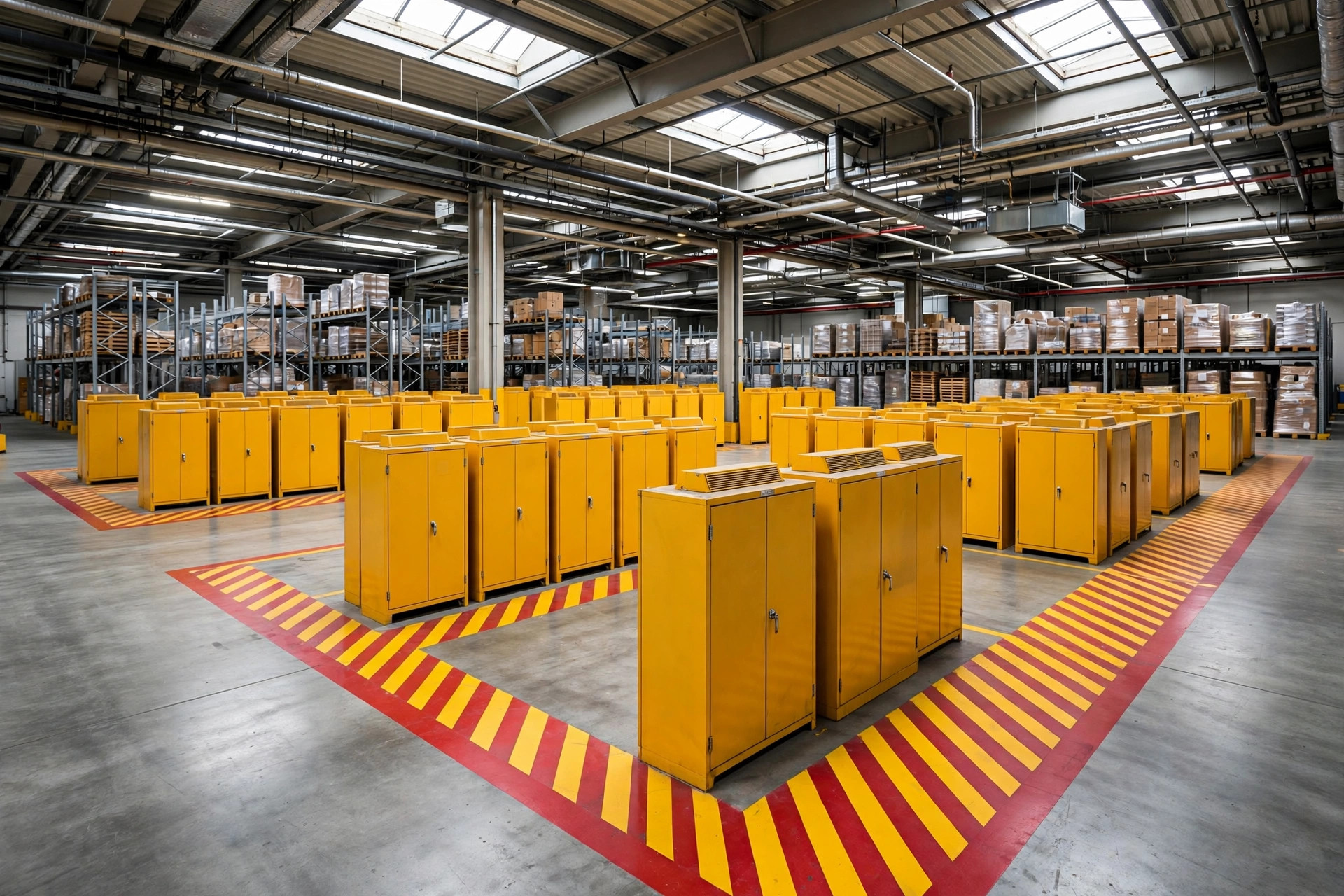
First: OSHA 1910.106 (flammable liquids). One of the most-cited standards in inspections. Four numbers to memorize: a single storage cabinet holds at most 60 gallons of Class I or II flammables, or 120 gallons of Class III combustibles; no more than three cabinets in one fire area, and beyond three, cabinets must be separated by at least 100 feet; cabinet vent openings must be sealed with the provided bungs unless the cabinet connects to an approved exhaust system. The widespread belief that "flammable cabinets must be ventilated" is wrong — the regulation says the opposite.
Second: OSHA 1910.253(b)(4)(iii) (compressed gases). Oxygen cylinders in storage must sit at least 20 feet (6.1 m) from fuel-gas cylinders or combustibles (especially oil and grease), or be divided by a noncombustible barrier at least 5 feet high with a fire-resistance rating of at least one-half hour. Two compliant paths, no third.
Third: the IFC/UFC incompatible-materials separation clause. The broadest of the three: incompatible materials in containers larger than 5 pounds or one-half gallon must be separated by at least 20 feet, isolated by a noncombustible partition extending at least 18 inches above and to the sides of the stored material, or stored in separate hazmat storage cabinets (incompatibles may not share a cabinet). Note the code's definition of "storage": material sitting in closed containers counts, including material connected to operations through closed piping. The "that doesn't count as storage" loophole barely exists.
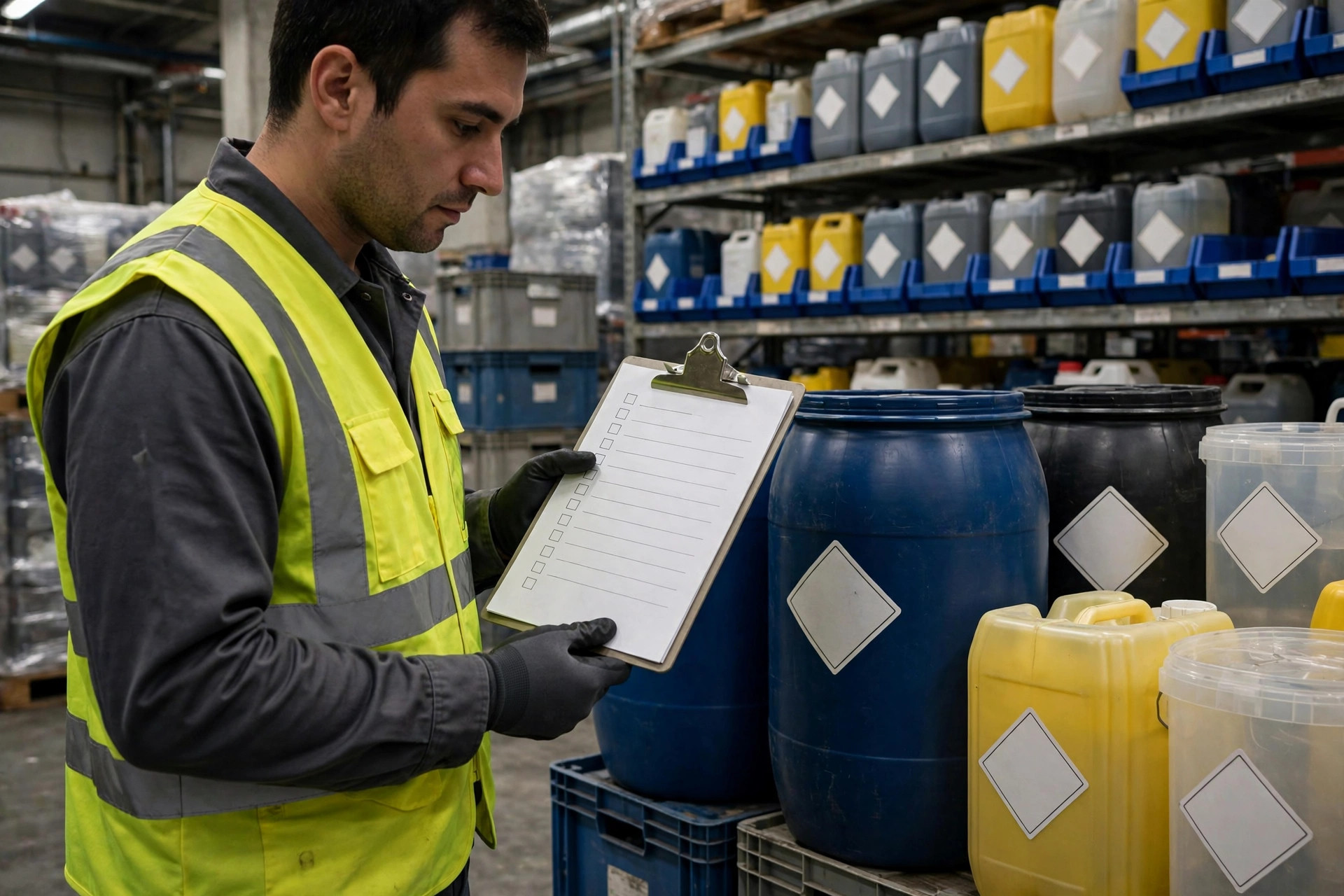
Above the floor: NFPA 400, the Hazardous Materials Code. This consensus standard covers detailed storage requirements for oxidizers, organic peroxides, water reactives, and corrosives. OSHA and the fire codes set the floor; NFPA 400 describes what "good" looks like. Any 3PL storing chemicals on a client's behalf should put it on the audit checklist. On penalties: OSHA fine amounts adjust annually, so I cite none here — check OSHA's current published schedule rather than a stale number.
The real cost of segregation: from the math to the floor plan
Here is the counterintuitive part: the true cost of segregation was never the cabinets. Cabinets are a visible one-time purchase. The real cost, charged every single day, is the pallet positions eaten by safety distance.
Run the numbers on a hypothetical 3PL holding four chemicals: bleach (oxidizing), hydrochloric acid (acid), sodium hydroxide (base), and isopropanol (flammable). From the matrix, bleach, acid, and isopropanol are mutually incompatible — a maximum clique of size three — which means at least three independent fire areas. Each area needs its own aisle, sprinkler coverage, and secondary containment. One 20-foot (6.1 m) separation lane in a distribution center permanently kills an entire row of pallet positions on both sides.
The trade-off is structural: segregation management exchanges safety redundancy against space utilization. Run it loose and you save positions while betting against a low-probability, catastrophic loss — Conyers' destroyed warehouse and Beirut's flattened port district are what that bet pays out. Run it tight and you buy certainty with hidden rent paid daily. The sharp warehouse manager does not ask about minimum cabinets to pass inspection. She asks for the largest incompatible clique in the SKU mix. Draw the matrix, and the minimum partition count follows; the maximum is set by rent and pick-path geometry. That minimum cannot be negotiated away by anyone.
Five steps, in this order, to put segregation on the warehouse floor. Pull the SDS files — Section 7 and Section 10 of every chemical's safety data sheet; the "incompatible materials" line is the official answer, and OSHA's Hazard Communication standard (29 CFR 1910.1200) requires suppliers to provide them. Build the matrix — classify every SKU into the six categories and mark every incompatible pair; classify before slotting, never after. Set the zones — the largest incompatible clique sets the minimum partition count, separated by 20 feet, a noncombustible partition, or dedicated cabinets; the zone map goes on the wall, not just in a PDF. Mark it physically — floor zone lines, cabinet labels, aisle warnings; separation a night-shift temp cannot read at a glance is separation that does not exist. Review quarterly — reformulations, new SKUs, and code updates invalidate old matrices; Conyers' sprinklers began corroding in 2019 and nothing in five years of reviews stopped them.
Incompatible chemical storage was never really about whether chemicals are "dangerous." It is about who maintains the incompatibility matrix in your warehouse, and how often it gets updated. When the seventh and eighth chemical SKUs arrive, does the first zone map still hold? Every answer should be written down and posted on the wall — not stored in some veteran employee's head. People quit, rotate, and forget. Chemicals do not.
By Dr. Chen, Supply Chain Researcher