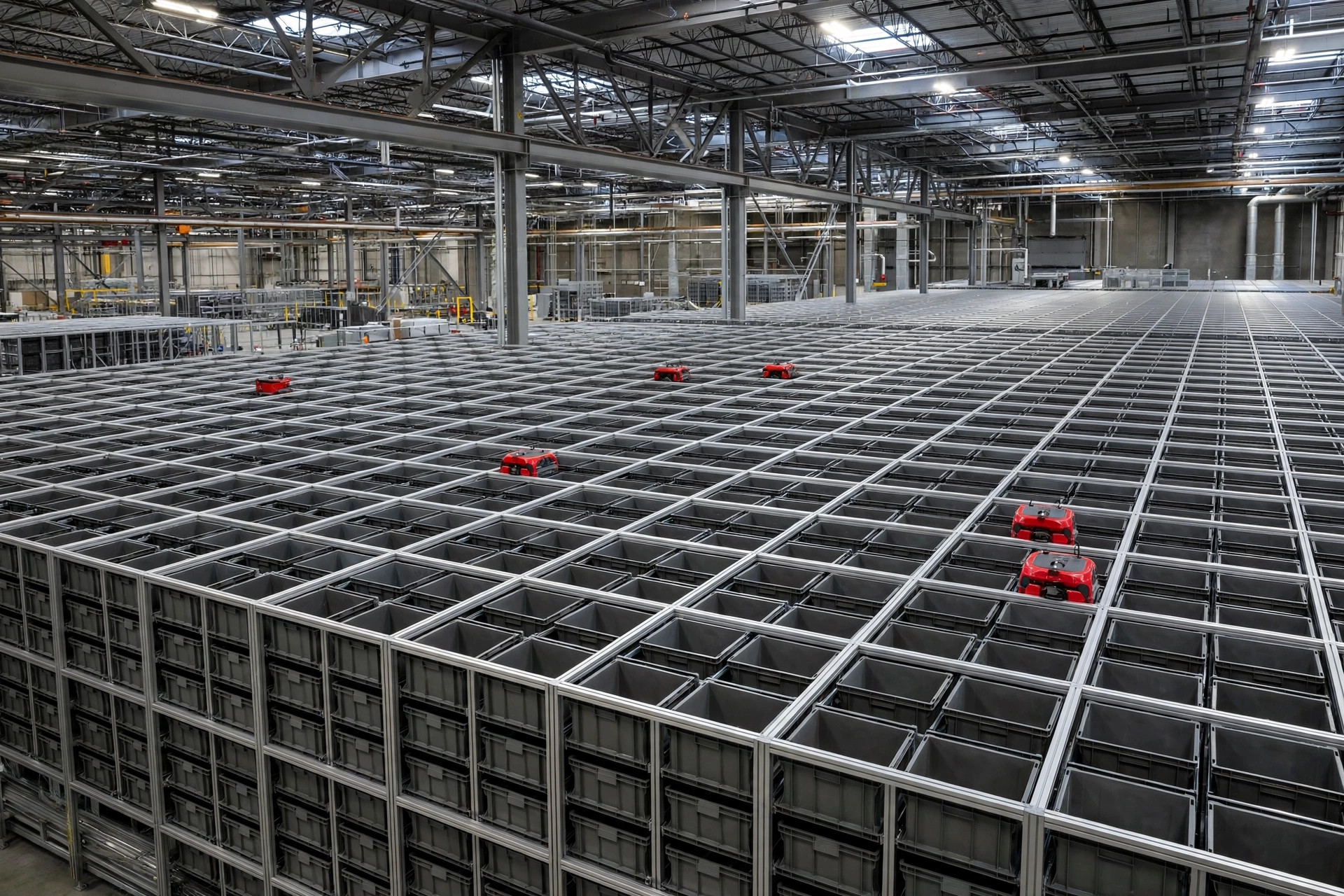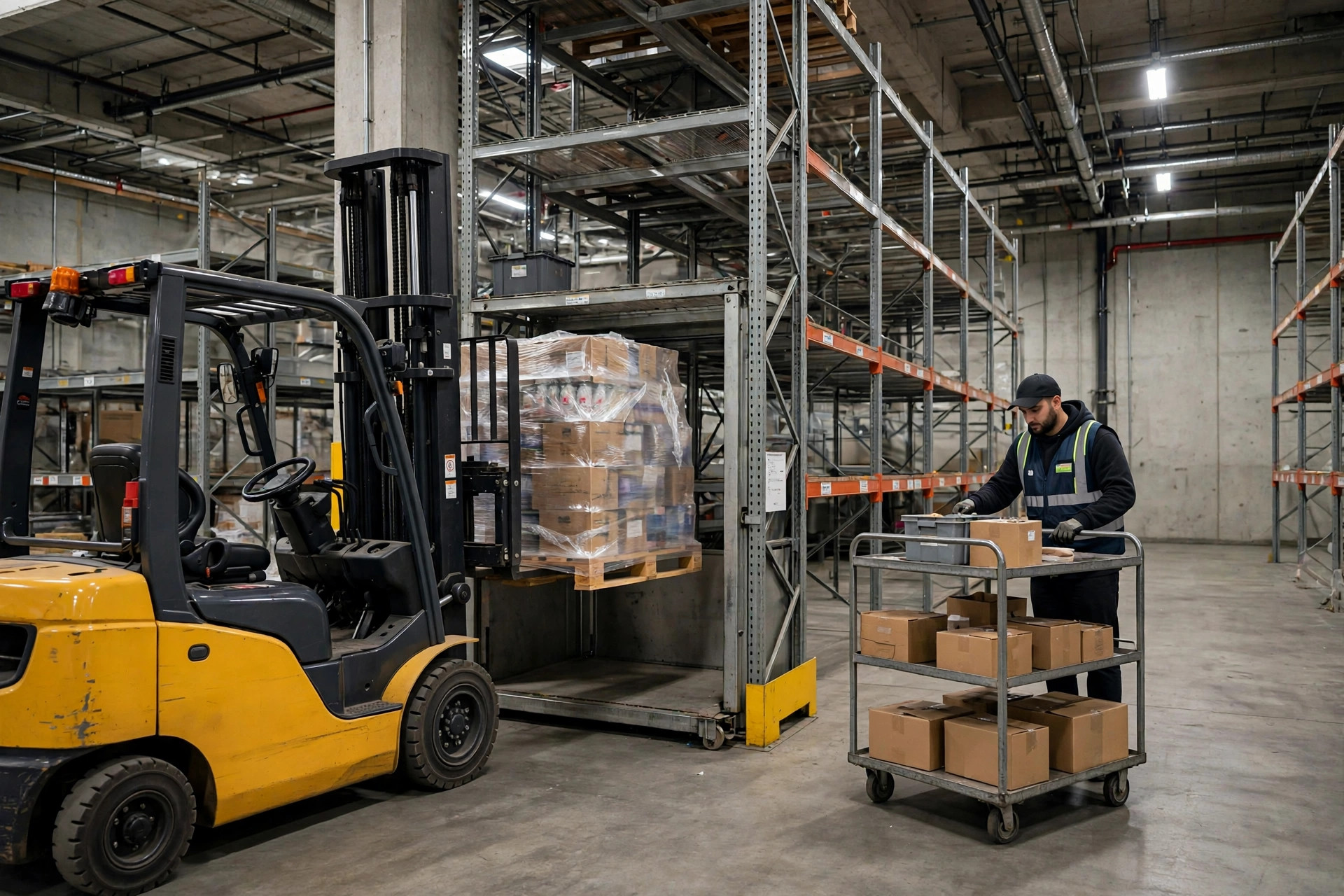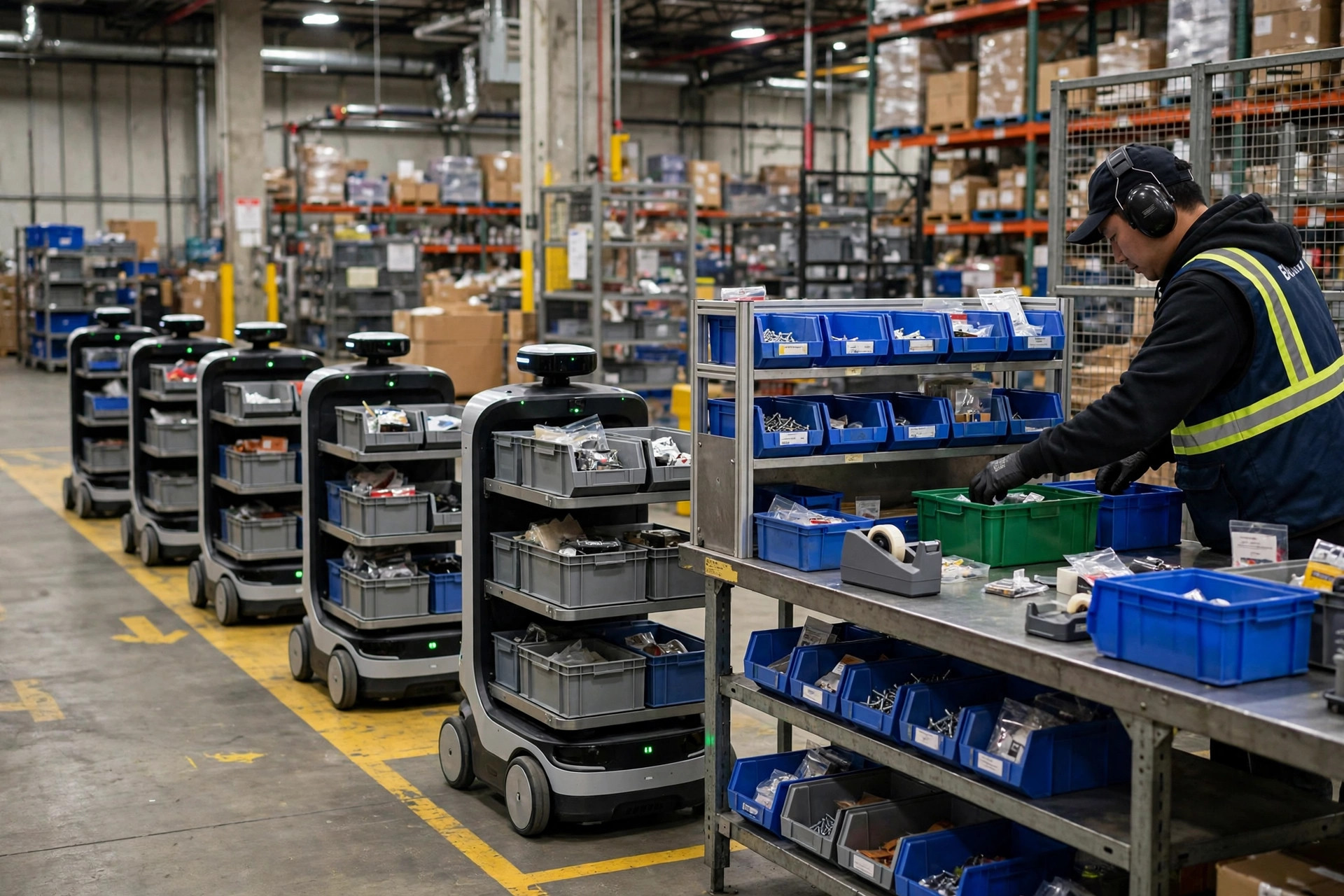
Verdict up front: in seven out of ten goods-to-person projects I have seen, the bottleneck is not the robot. It is the person standing at the picking station. Robots can deliver 40 to 60 totes per hour to a goods to person picking station; a human picks 150 to 250 units in that same hour, depending on SKU complexity. The two rates fall out of sync, robots queue up in front of the station, and you have built an expensive traffic jam.
A goods to person picking station is a serial production line where machine takt meets human takt — two gears meshing. The robot is the drive gear: steady, adjustable. The human is the driven gear: speed depends on stamina, SKU mix, and the mood of the shift. Spin the drive gear faster and the driven gear slips; output locks to the slower gear. And here is my first shot fired: many designs size the robot fleet to two decimal places with beautiful simulations, while the human pick rate gets one line — "assumed 200 UPH" — with nobody ever looking at the SKU profile. Designing a pick station as if human capacity were infinite is the most expensive fake requirement in goods-to-person projects.
Do the Math First: How Takt Mismatch Works
Station output follows a simple formula:
Effective station output = min(robot presentation capacity, picker rate x headcount)
In 2023 I worked on a 3PL project in Ontario, California: 8 pick stations, 6 tote robots per station. Measured: one robot cycle — fetch, deliver, return — averaged 75 seconds, about 48 presentations per station per hour. Each tote averaged 4.2 picks, so robot-side demand was roughly 200 picks per hour. Pickers averaged 18 seconds per pick including scan, verify, and place — 200 units per hour per person. On paper, perfectly balanced.
But that was the average. Peak season pushed per-pick time to 26 seconds — throughput per person dropped to about 140 units per hour, while robots kept delivering 48 totes an hour. Result: 3 to 4 robots queued at every station, fleet utilization fell from 82% to 55%, error rate jumped from 0.3% to 1.1%. The integrator said the robots performed well; the client said volume did not move. Both were right — nobody had modeled the floor of the human pick rate.
Robot takt is a design value, stable; human takt swings with SKU mix, shift, and season. Size on the average and the first swing breaks it.
Fix 1: Dual Positions and Buffer Slots — Stop Making Robots Wait
Fix one is decoupling: do not force the robot and the human into a hard mesh; put a buffer between them.
In practice, build the station "one picker, two presentation positions" — one active plus one or two buffer slots. The robot drops its tote at an empty position and leaves; it never waits for the picker. Changeover drops from 20 to 30 seconds to 3 to 5 seconds — a turn of the body.
A Houston apparel e-commerce warehouse did this in 2022. Six single-position stations, with robot queues as the daily norm. The retrofit: one parallel presentation position per station, about $4,000 each including racking, put-to-light, and a conveyor section (order of magnitude). After the change: output per station rose from 165 to 235 units per hour, and robot waiting time fell from 31% to 9% of total time. Not one robot added. Not one person replaced.
The dividing line: when robot waiting exceeds 20% of total time, add buffer positions before adding robots. Adding robots to a jammed station is another on-ramp to a gridlocked toll plaza — the cars still cannot get through. Too many projects do it backwards: queues at the station, first reaction is "not enough robots, buy two more," tens of thousands of dollars per unit, and the queue does not move an inch. That is a fake requirement if I ever saw one.
Fix 2: Task Pre-Assignment and Wave Takt Matching Inside the Goods to Person Picking Station
Fix one is a physical buffer; fix two is a planning buffer: make the totes arriving at the station totes a human can pick comfortably.
The WES decides which tote goes to which station and when. Its default logic — nearest plus balanced — cannot tell a 12-piece, 5-SKU mixed tote (three minutes of work) from a 2-piece single-SKU tote (twenty seconds). The picker's rhythm gets shredded by that randomness.
The fix is difficulty grading inside the WES: score each task by pieces × SKU count × size complexity, then balance difficulty when releasing waves — each station, each 15-minute window, gets a fixed ratio of hard and easy tasks. Think of a cafeteria line: the server cannot dish one portion in 3 seconds and another in 30 and keep the line moving. Alternate hard-to-serve dishes with easy ones.
That Ontario 3PL applied this: difficulty grading in the WES, with waves over 40% hard totes split into two releases. Per-pick time fell from 26 seconds back to 19 — the people did not get faster, the tasks got smoother. Station output stabilized around 210 units per hour with half the variance.
My takt matching worksheet — fill in your own measured numbers, do not copy mine:
| Item | How to fill | Example (order of magnitude) |
|---|---|---|
| Robot cycle time | Fetch, deliver, return — measured average | 75 sec |
| Presentations per station per hour | 3600 / cycle x parallelism factor | 48 |
| Average picks per tote | From order profile, weekly average | 4.2 |
| Robot-side demand rate | Presentations x picks per tote | 200 units/hr |
| Per-pick time by difficulty | Measure by difficulty tier, no lazy averages | Easy 12 sec / hard 30 sec |
| Effective picker output | 3600 / weighted average pick time | 150-200 units/hr |
| Takt gap | Demand rate minus picker output | Positive gap = robots will queue |
| Buffer slots needed | Gap / picker output, round up | Gap of 50 -> at least 1 buffer slot |
Use it in this order: fix two to bring pick time down, then fix one for buffer, add stations last. Reverse the order and you are burning money.
Fix 3: Ergonomics — Raising the Human Ceiling in the Goods to Person Picking Station
The first two fixes stop the machine from waiting; this one makes the human faster. Human takt has a clear ceiling, and most station designs never reach half of it.
Three levers, ranked by return on effort:
First, the golden zone. The reach envelope without bending or stretching: roughly 20 to 80 centimeters above the work surface, within a 60-centimeter radius in front of the body. Tote presentation height, carton placement, scanner holster — all of it belongs there. I have seen stations with totes at knee height, pickers bending 800 times a day. That is not an efficiency problem; that is a workers' comp claim in training. Raise the rack and per-pick time drops 2 to 4 seconds — at 2,000 picks a day, that is two hours.
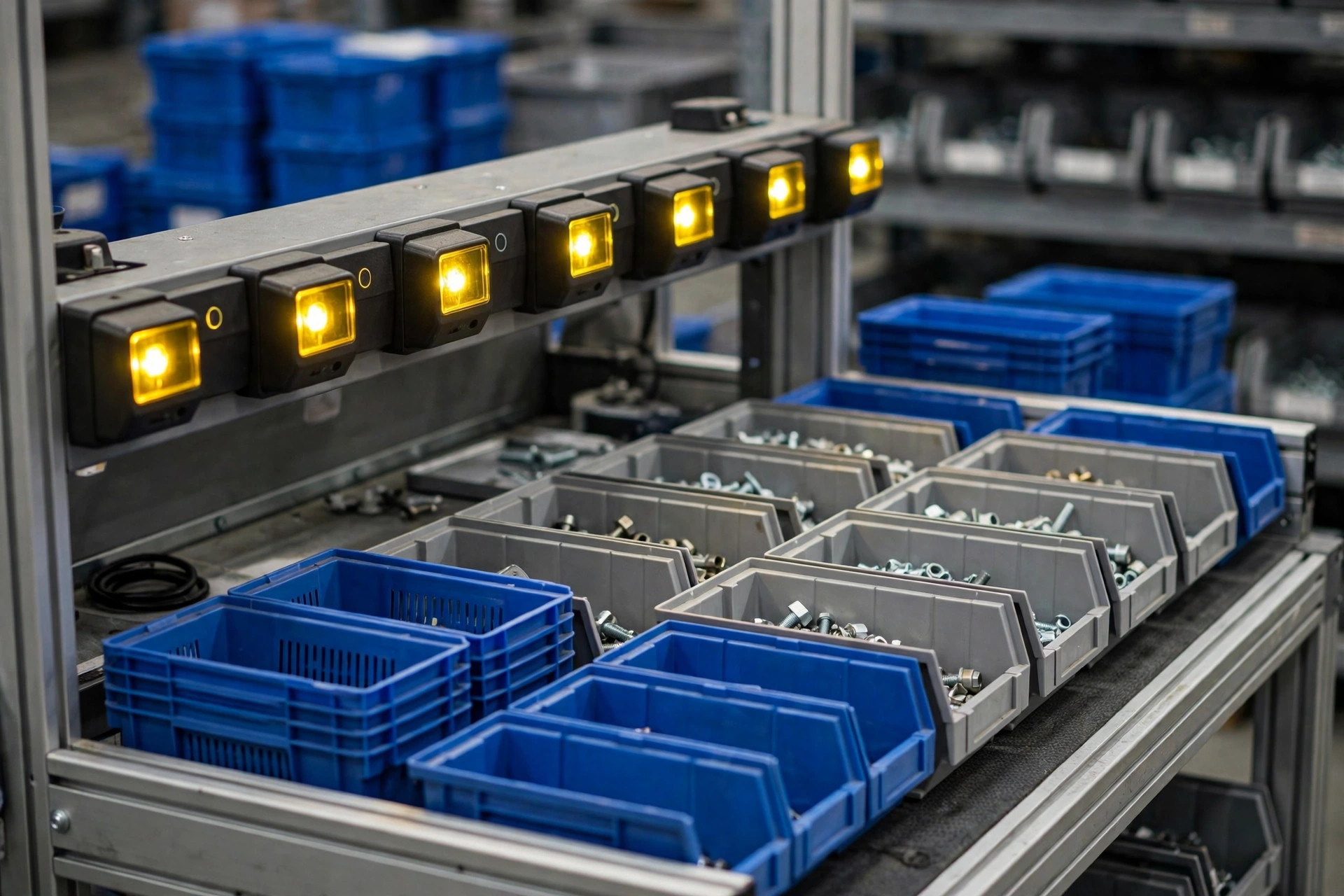
Second, put-to-light. In multi-order parallel picking, the biggest time sink is not the grab — it is the think: which carton does this piece go in? A row of light indicators turns "think" into "look," cutting per-piece decision time from 3 to 5 seconds to under one. A light module runs a few thousand dollars per station (order of magnitude), and it pays back on every order, every shift.
Third, information display. Large type, current step only — "grab this many, put it in that slot." Information overload slows people exactly like no information does.
The counterintuitive call: in a goods-to-person project, faster robots can lose money faster. Fleet size is configured for robots at full utilization. If the station can only absorb 60% of presentation capacity, the extra 40% of robots you bought are queuing and depreciating in front of the station. Before speeding anything up, ask: are more robots queuing at the station, or are pickers standing idle waiting for totes? If it is the former, the bottleneck is human, and adding robots is adding cars to a jammed road.
The Maintenance Trap: All Three Fixes Dead in Three Months
Going live is only halftime. All three fixes deployed, beautiful acceptance numbers — then back to square one six months later. The traps are always the same:
One: dead put-to-light lamps nobody replaces. The lights are consumables — when half a row is dark, pickers go back to "thinking." Spares and inspections belong in the SOP.
Two: the buffer slot becomes a junk pile. Returns and packing material land in position B "just temporarily," decoupling dies, and the queue comes right back. The shift lead clears every station at shift start. Hard rule.
Three: wave difficulty grading never recalibrated. SKU mix is alive; peak and off-peak profiles can differ by a factor of two. Recalibrate thresholds quarterly or the WES schedules by last year's definition of hard and easy.
So is the money worth it? Watch this one number: labor cost per station divided by effective station output — your labor cost per unit picked. After the three fixes, that number should move down 15 to 30 percent (order of magnitude, depending on your starting point). If it did not move, the money went to the wrong place — most likely, somebody bought more robots again.
By Da Liu, Automation Engineer