Let me tell you something. After all these years on the road, the people I respect most in this business are the ghana pineapple folks. Not because they grow the most fruit. Because they got kicked out of the market and climbed back in anyway. In 2004, Ghana's fresh pineapple exports peaked at about 71,000 tons, and back then Ghanaian fruit had a real name in Europe. Then, within a few years, the global market switched to a new variety grown mostly in Costa Rica, European buyers changed their taste overnight, and Ghana's exports slid to about 35,000 tons by 2008. More than half the business, gone. Most industries would have folded right there.
But the Ghanaians did not quit. What they had left looked unimpressive on paper: one old variety shipped by air, one fresh-cut factory, and a small share of the new variety shipped by sea. Three cards, and they are still shipping to Europe today on the strength of them. That tells you something about export cold chain. Sometimes it is not about who ships the most. It is about who figures out first what they are actually selling.
Ghana pineapple had its good years ended by one variety
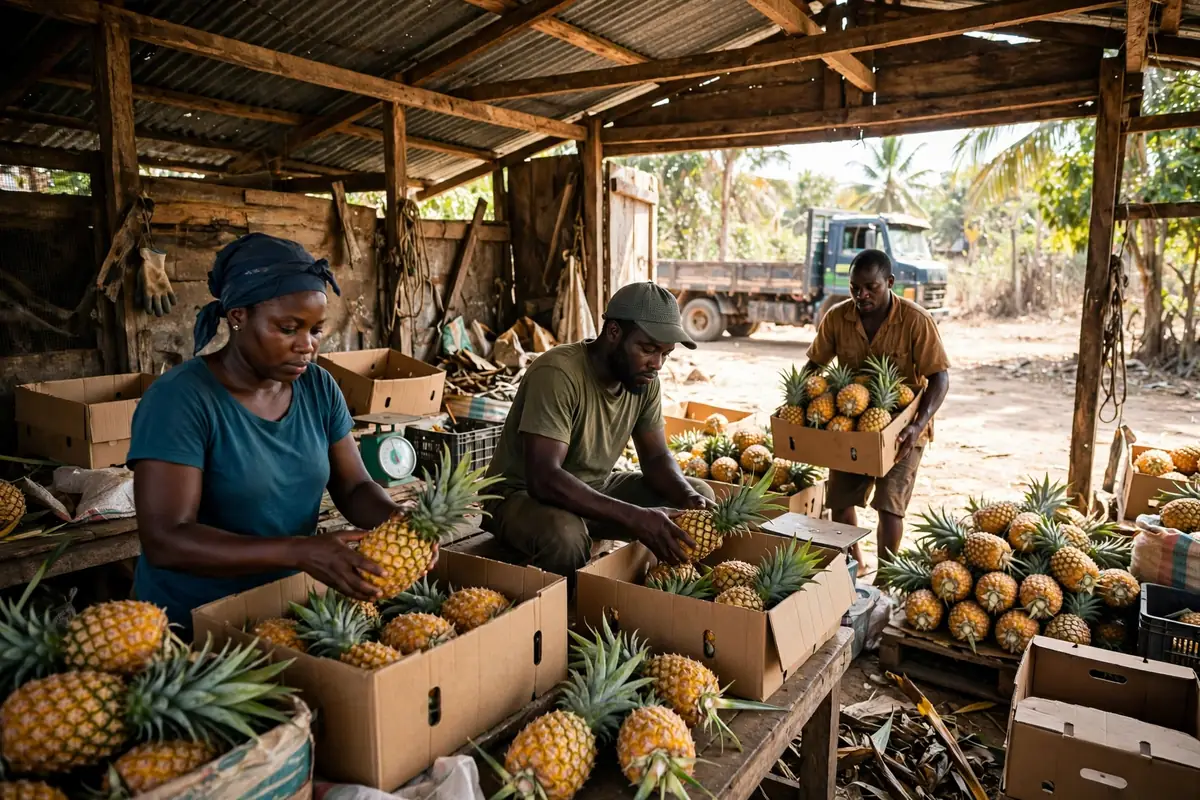
Let me settle the old account first. Ghana's traditional variety is Smooth Cayenne. It is rough-skinned, sweet, and tastes wonderful fresh off the plant. It has one fatal flaw: it does not travel. On a sea voyage of two weeks, the flesh browns, and when the box opens at destination and the color has gone dull, the supermarket says no. While European buyers still wanted that flavor, Smooth Cayenne could move by sea. Then the new variety arrived, sweet, golden, and able to sit through a long voyage, and buyers had no reason to keep buying yours. After 2006, sea shipments of Smooth Cayenne basically stopped, exporters shut down one after another, and smallholder farmers watched fruit rot in the fields with nobody to buy it.
I have seen this scene too many times from the cab of a truck. It is not that the goods were bad. The market changed the rules and you were still running by the old ones. One change of variety cut a country's export industry in half. The warehouses, the cold rooms, the packing lines were all still standing, but the fruit no longer matched the road, so the hardware was just a pile of metal.
That said, Smooth Cayenne was never worthless. It is fragrant and sweeter fresh than the new variety. The catch is that only air freight can protect that advantage. Ghana has been flying Smooth Cayenne to Europe since the mid-1980s: pick it, box it, put it on a plane, and it arrives in a few days tasting like it was just picked. Air freight is expensive, but expensive has its logic. You are selling freshness, not tonnage.
The air freight route is expensive for a reason
You have to do the air freight math honestly. One ocean container holds a dozen tons or more. One flight carries a fraction of that, so the freight cost per fruit looks frightening. But look at it from the other side. Air-freighted fruit sells at a premium: supermarkets sell it by the piece or by the box, and the buyer is paying for the taste of something picked days ago, not stock that sat in a warehouse for two weeks. Smooth Cayenne by air is a bet that European shoppers will pay extra for that flavor.
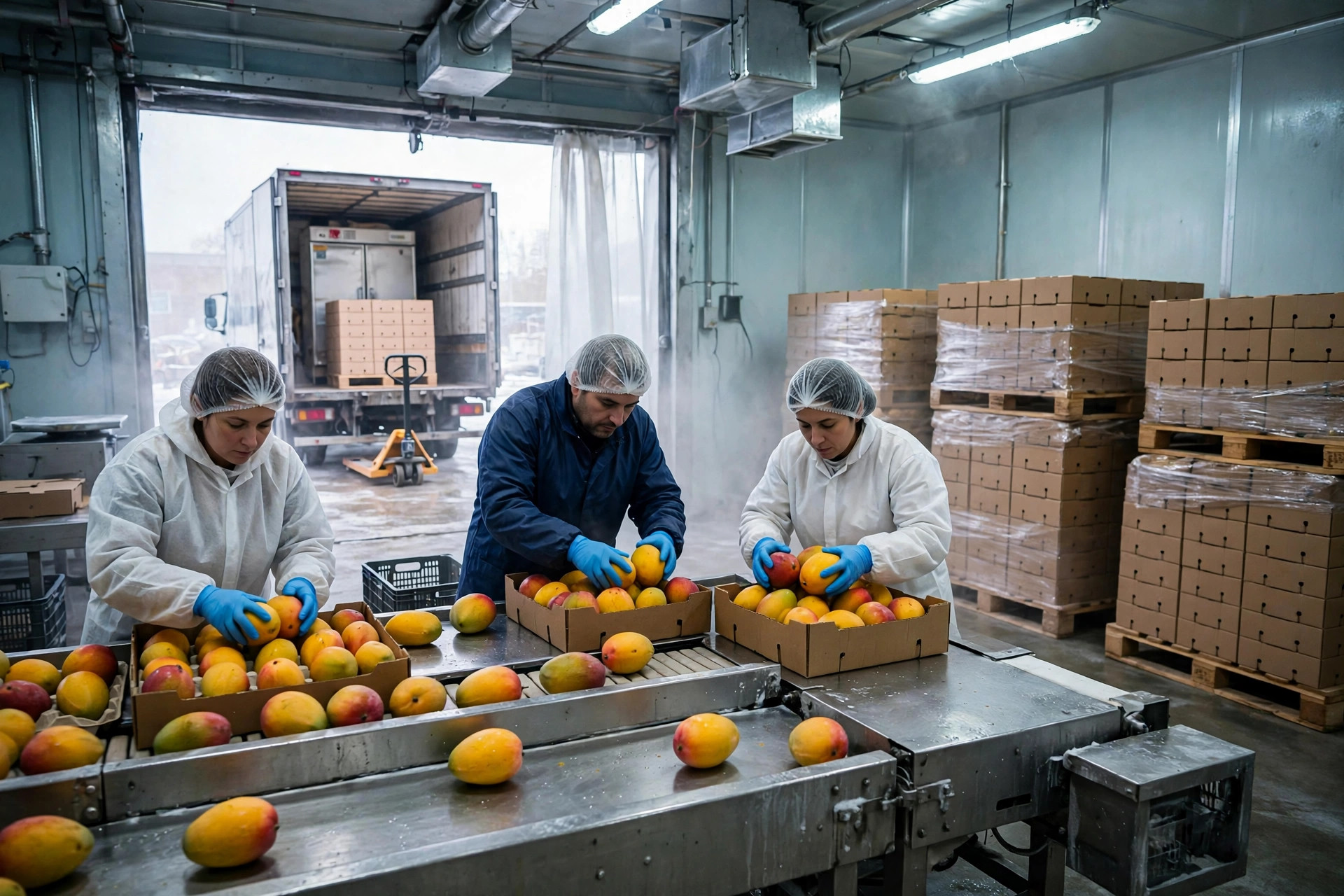
Here is a real example. In 1998, a fresh-cut company built a factory in Nsawam, in Ghana's Eastern Region, close to the pineapple and mango country. Their approach was completely different from everyone else's: do not cut in Europe, cut where the fruit grows. The fruit ripens, workers cut and pack it by hand, it goes into cold storage, onto a plane the same day, and onto European supermarket shelves within 48 hours of harvest. The skin and the core stay in Ghana and become compost. Only the edible part flies. Every kilo of peel left behind is money saved on the plane. That model is still running today, and in 2024 the President of Ghana visited their factory at Dobro. One company accounting for a large share of Ghana's fresh-cut fruit exports got there on the strength of those 48 hours.
Let me tell you, anyone who runs cold chain understands what sits behind the number 48. Picking has to happen in the early morning. Fruit entering the factory must be pre-cooled right away. The cutting rooms have to hold steady temperature and humidity. Packed boxes cannot wait at ambient temperature for a flight. At the airport they go straight into cold storage, and a delayed flight needs a backup plan. If any link drags by two or three hours, 48 becomes 60, and the shelf life shrinks by the same amount. In fresh-cut, time is shelf life, and shelf life is money.
Ghana pineapple still holds three cards
Today, the way Ghanaian pineapple survives comes down to three routes. I have laid them out below, and the table is an illustrative example, with round figures put together to show the structure rather than any single shipment's real quotation:
| Route | What it sells | How it moves | Where the money is | What it fears |
|---|---|---|---|---|
| Air, old variety | Flavor, picked fresh | Flown from Accra, direct to Europe | High unit price, small premium niche | Freight rises and the margin is gone |
| Fresh-cut | Ready-to-eat fruit boxes | Cut at origin, flown, on shelves in 48 hours | High added value, peel and core never fly | Many links, one break ruins the load |
| Sea, new variety | Hardy golden fruit | Out of Tema port, by ocean | Volume, low cost | Cannot beat Costa Rica on scale |
Here is the counterintuitive part, and most people get it wrong: Ghana should not bet everything on the sea-freighted new variety to win the volume back. The sea route belongs to Costa Rica, which has run it for twenty years, with scale, cost, and sailing schedules that press on you from every side. What do you beat them with on price? Ghana's way out runs in the opposite direction: do not fight on volume, fight on precision. Air-freighted Smooth Cayenne sells to European shoppers who still want that flavor. Fresh-cut sells 48-hour freshness. Costa Rica's big plantations cannot copy either, because their whole model is built on bulk and long voyages.
That does not mean the sea-freighted new variety is worthless. Farms in Ghana's Central Region already grow it, fly it out of Accra with Brussels as the transit hub, and a sea program is next. My judgment is that sea freight works as a supplement, not as the main business. The main business stays the two cards, air plus fresh-cut, with the small premium niche run properly, and sea freight picking up a little volume on the side.
One last piece of road wisdom for anyone thinking of entering this trade. The fruit export shed at Tema port, Shed 9, had cooling and cold storage installed years ago, so the port hardware is not the problem. The real problem is on land: is there a refrigerated truck for the run from the field to the packing shed? Does the shed pre-cool? How long does the fruit sit in the airport cold room before the flight? None of these links is glamorous. They are all common sense and a sense of responsibility. But cold chain works like that. You can buy hardware. You cannot buy responsibility.
So if you ask me what ghana pineapple lives on today, the answer is simple: knowing itself. It cannot win on volume, so it wins on freshness, on hand cutting, on 48 hours. That does not sound grand. Run the numbers, and it is exactly the reason it is still alive. By Shifu Zhao, Trucking Veteran (15 yrs)