
Picture this: it's 9:30 on a Tuesday morning, and a stranger in a polo shirt walks into your warehouse office, flashes a credential, and says he's with the FDA. He doesn't ask about your pest control logs. He doesn't ask about temperature records. His first question: "Can I see your food defense plan?"
If you run a food warehouse, you'd better have an answer ready. This isn't a suggestion — it's a regulation. Tucked inside the Food Safety Modernization Act is a rule aimed squarely at intentional adulteration: 21 CFR Part 121, "Mitigation Strategies to Protect Food Against Intentional Adulteration," finalized on May 27, 2016. It's not about spoilage or accidental contamination. It's about someone deliberately putting something harmful into food — and FDA takes that personally.
First, figure out whether the rule even covers you
Here's the part most warehouse operators miss: §121.5(b) exempts the mere holding of food — except holding in liquid storage tanks. In plain English, if your warehouse only stores sealed cases and pallets of dry goods, canned food, or packaged frozen product, this rule doesn't apply to you. FDA said so explicitly in the rule's preamble: holding retail-packaged food is out.
Three kinds of warehouses can't claim that exemption. Operations with liquid storage tanks — milk, juice, syrup, or edible oil sitting in bulk tanks are squarely in scope. Operations that open cases for picking, kitting, or bulk handling — once product is exposed, the risk profile changes completely. And repacking or relabeling where the food-contact packaging gets opened — note how fine the line is: repacking where the inner package stays intact is exempt under §121.5(c), but break that seal and you're in.
My blunt take: before writing a single page of a plan, spend half a day confirming applicability. I've seen both kinds of wasted money. The dry-goods 3PL that wrote a 40-page plan it never needed, because nobody read the exemption. And the juice warehouse with a tank farm outside Fresno that assumed "we're just a warehouse" and did nothing for years. Guess which one the inspector fines.
The clock ran out a long time ago, by the way. Large businesses had to comply by July 26, 2019. Small businesses — under 500 employees — by July 27, 2020. Very small businesses, under $10 million in annual food sales, had to have their exemption documentation ready by July 26, 2021. FDA started routine inspections for this rule back in March 2020. The question today isn't whether to comply. It's whether you can produce the paperwork when someone asks.
The vulnerability assessment is three questions, not a novel
Step one for covered facilities is a vulnerability assessment to identify "actionable process steps." FDA recognizes exactly three considerations under §121.130: how severe and widespread the public health impact would be if a contaminant were added; how physically accessible the product is; and how likely an attacker could successfully contaminate it.
Don't underestimate those three questions. Too many assessments read like essays — fifteen pages of "we take this very seriously." Inspectors don't grade enthusiasm. They grade whether you honestly scored each step of your operation and wrote down why. The spots that deserve your hardest look: the liquid tank farm — valves and sampling ports, where the fewest people go, which is precisely why the risk is highest. Open-case and bulk handling areas, where product sits exposed and foot traffic is heavy. The returns staging area, where packaging may already be compromised and which should be physically segregated from good stock. And nights and weekends, when staffing is thinnest and camera blind spots matter most — exactly when "accessibility" scores highest.
The assessment is allowed to conclude that you have no actionable process steps. But you have to document the reasoning, step by step. The inspector is buying your logic, not your conclusion. FDA publishes a free plan-builder tool on its website that can frame the work if you're starting from zero — useful scaffolding, but no template knows about your tank farm or your night shift.
Mitigation strategies that survive a real warehouse
Once you've identified vulnerable steps, you need mitigation strategies — written into SOPs, executed by real people, and actually checked. The rule also demands four companions: monitoring procedures, corrective action procedures, verification procedures, and training records (§121.126). I've watched too many plans die in a filing cabinet: beautiful on paper, invisible on the floor. The moment an inspector asks a forklift operator "do visitors have to sign in?" and gets a blank stare, the plan is worthless.
Three practical levers for a warehouse. Start with zoned access control. One badge for the whole building isn't enough — bulk areas, tank farms, and returns zones need separate permissions, and badge logs should show who entered which zone and when. Kill a departing employee's access the same day they leave. Small detail, and inspectors ask about it every single time.
Then visitor management. Sign in, wear a visitor badge, escorted at all times, restricted areas clearly marked. Delivery drivers stay in the dock area — they don't wander the aisles unescorted. Plenty of warehouses leave the dock doors wide open with drivers roaming the floor. That's a hard fail on food defense, and fixing it costs roughly one door policy and a sign-in book. The hard part isn't the fix; it's keeping it up six months later.
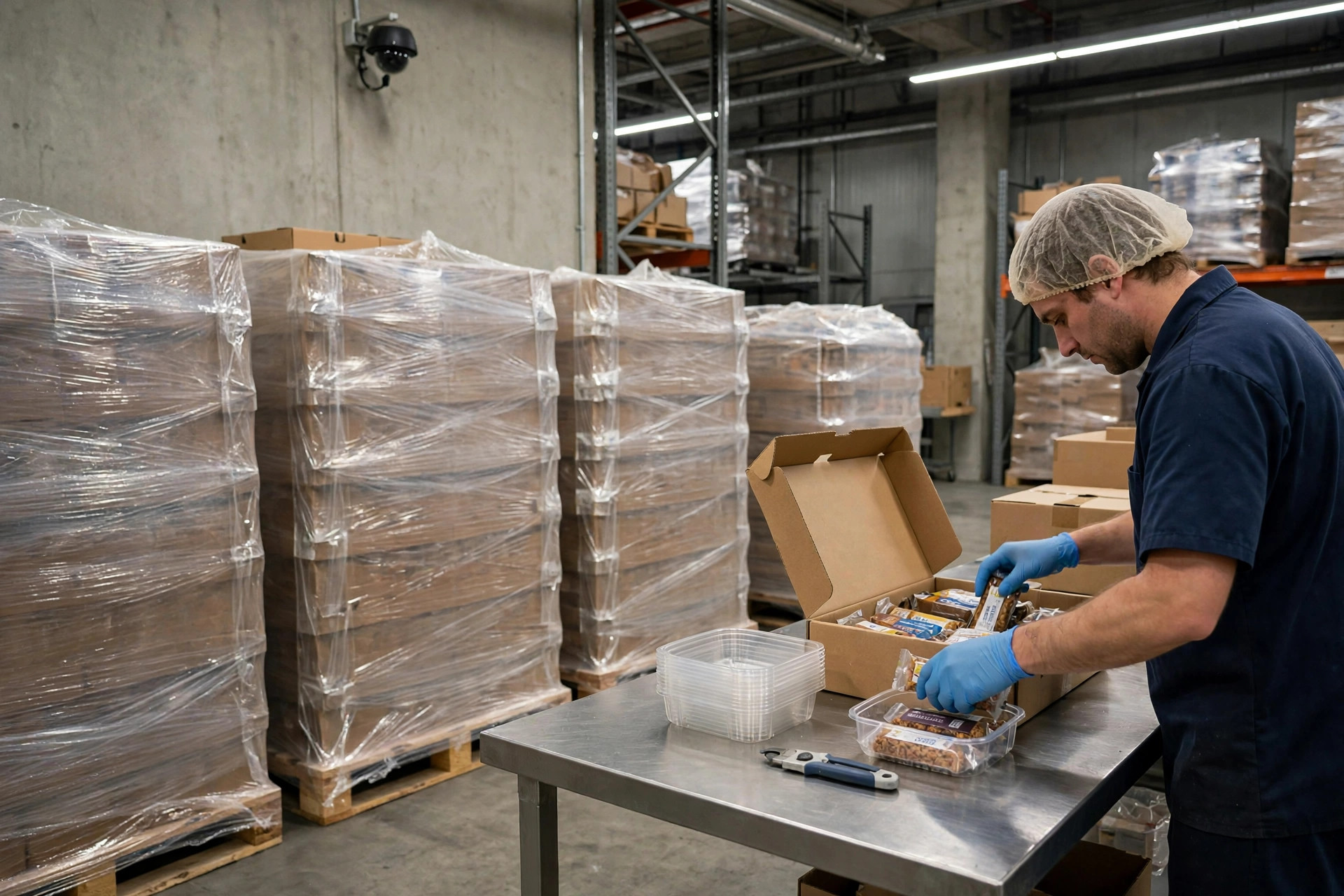
Then bulk area controls. Cameras over open-case work zones. Pallets wrapped with tamper-evident seals, seal numbers logged, any broken seal investigated on the spot. Tool cribs and key boxes locked. Chemicals — cleaners, pesticides — locked up far from any food area. Night-shift bulk work should be two-person whenever you can staff it.
One more piece almost everyone misses: the people doing this work must be "qualified individuals" — trained, with records showing the date, the content, and who attended. The training doesn't need to be elaborate. It needs to be provable. When an inspector reads your training log, what they're really reading is whether you took any of this seriously.
There's a cost argument that usually ends the debate in the room. Writing the plan, running the assessment, training the crew — that's a few weeks of work and some discipline. Failing an inspection, getting written up, and then doing it all anyway under a deadline with an inspector watching — that's the same work at triple the stress, plus the finding on your record. One of my clients put it well: the plan is cheap, the scramble is expensive.
Tomorrow morning, answer one question before anything else: does your warehouse have liquid storage tanks or open-case bulk operations? If yes, you're likely in scope — print the three assessment questions this week, get operations and QA in a room, and walk through every step of your operation on paper. If no, you likely qualify for the exemption — but have the documentation ready, because "we're exempt" only works when you can prove it. For the exact applicability boundary, check the rule text and talk to your legal counsel.