Another platform rule change, another seller scrambling. A friend of mine sells home storage sets, and last peak season a whole batch got rejected at inbound: one compliance label missing from a gift set. The shipment sat for a week while he re-shipped labels, and two of his best listings went out of stock in the meantime. That week cost him far more than the labels ever would have.
Here is the thing most sellers get wrong about kitting: it looks like simple work. Put a few items in a box, slap on a label, done. So they do it themselves. Then volume grows, and suddenly this "simple" job eats the most labor, produces the most errors, and one mistake costs more than all the labor they saved. This post is about how I actually run the numbers, and how I vet a co-packer before handing over my product.
Co-Packing vs In-House Kitting: Count the Full Cost First
Rant first: most sellers calculating in-house cost only count hourly wages and pretend everything else is free. I did that too, once. Peak season humbled me fast.
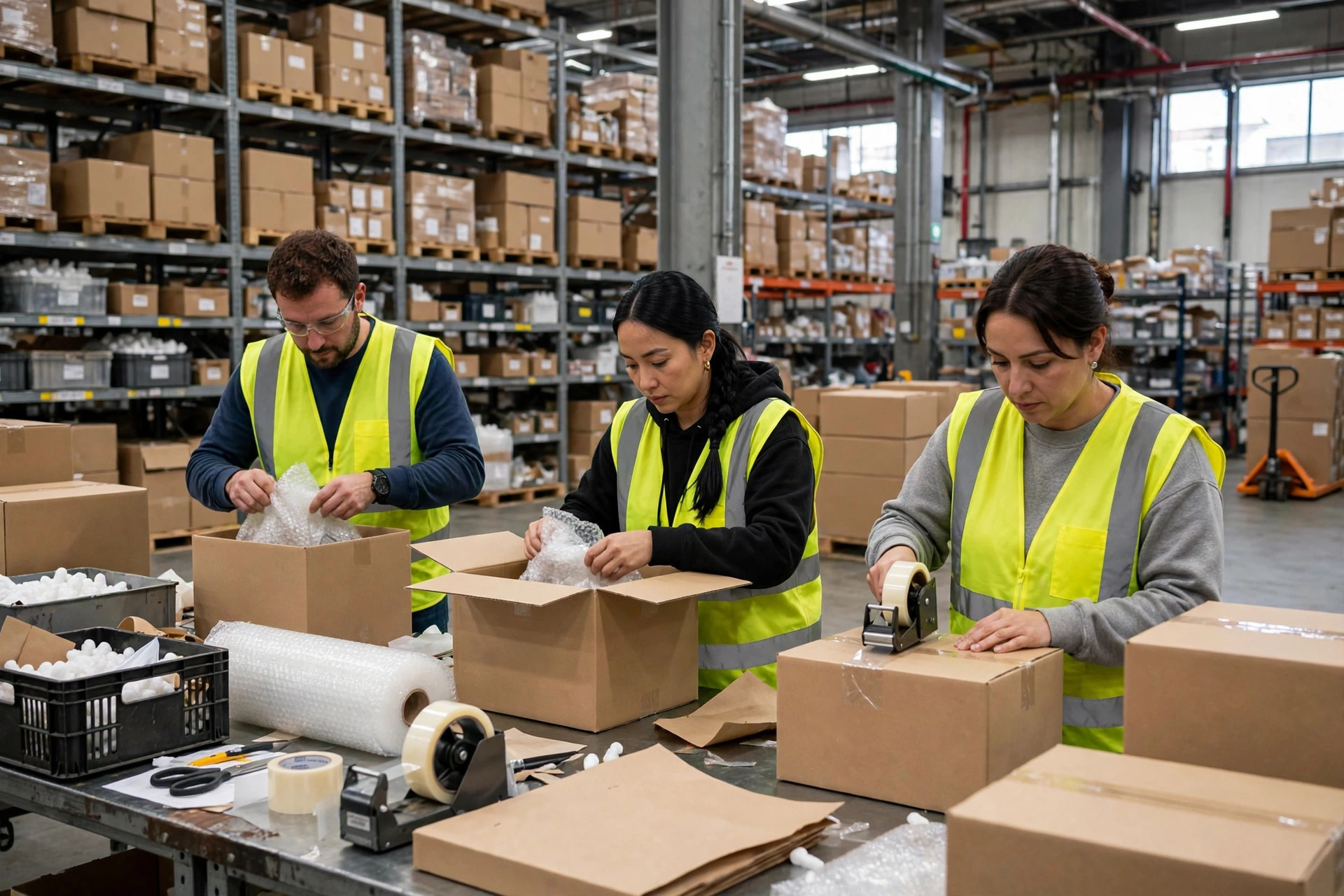
The real in-house cost has at least five pieces. First, direct labor: how many kits can one person actually assemble per hour? You have to measure this, not guess. In my own small team, an experienced hand could do forty to fifty simple three-piece gift sets an hour; a new hire did about half that. Second, space and consumables waste: boxes, fill, tape, label stock. The scrap rate looks trivial on a normal day and doubles when everyone is rushing. Third, quality checks and rework: wrong label, wrong item, missing insert. Every rework pass means the first pass was wasted. Fourth, management cost: scheduling, training, hiring temps. Temps in peak season spend their first two weeks basically learning on your product. Fifth, opportunity cost: every hour you and your core people spend at the packing table is an hour not spent on ads, suppliers, or new products.
I ran this math on my own holiday gift set one year, a few hundred sets a day for over a month. In-house looked cheaper per kit on paper. But once I added rework, temp training, and my own time, the gap against a co-packer's quote shrank to almost nothing. Worse, nobody was watching my ads during that stretch, and my ACoS quietly crept up. That hidden loss never shows up on any quote sheet.
So my rule is simple: calculate the full cost before comparing anything. If you only compare the per-unit price, you will choose wrong.
What a Co-Packing Quote Is Actually Charging You For
A co-packer quote usually breaks into several pieces: kitting labor per unit, packaging materials, labeling, quality inspection, storage and outbound handling, and sometimes a project setup fee or small-order surcharge. Minimum order quantity is the gate: too small and they will not take the job, or the per-unit price doubles, because line changeover, setup, and training all take time regardless of volume.
Here is the counterintuitive part: the cheapest co-packer is often the most expensive one. Cheap quotes frequently leave out inspection, double-checks, and exception handling. When something goes wrong, rework, return freight, and platform penalties are all yours. I have watched a fellow seller pick a tiny shop on price alone, get a batch of wrong barcodes, face an FBA rejection, and pay more in re-shipping and penalties than the cheap quote ever saved.
Peak season is the other trap. A shop that handles a few thousand kits a month comfortably can fall apart when volume triples. Capacity scheduling, temp quality, and lead times all wobble. Ask upfront: what is the peak capacity ceiling? How are overflows scheduled? What happens, in writing, when a deadline slips? If it is not in the contract, it is a wish.
Then there is retail compliance. Different channels have different rules for labels, barcode placement, and set-content markings, and different markets add language and warning requirements. Ask a co-packer which channels they have actually served, and how many inbound rejections they have had and why. Never ask "do you understand compliance." Ask for the rejection stories.
Five clauses must be written into the contract, not promised verbally. One: a defect-rate cap and who pays for rework and return freight when it is breached. Two: lead times and delay compensation. Three: confidentiality, so your packaging design and set combinations are not reused for competitors. Four: billing on actual qualified shipped units, with defective units excluded. Five: an exit plan for leftover materials and work in progress if the relationship ends. If a vendor will not agree to these five, I slow down no matter how low the quote is. Arguing during peak season costs far more than the packing fee.
The Co-Packing Audit Checklist: Eight Things to See On Site
No matter how good the quote looks, I do not hand over product without a site visit. This is my checklist, and you can steal it.
One, the line layout: are assembly tables arranged in flow, or is stuff piled everywhere with workers walking back and forth? Messy flow means high error rates. Two, inspection: is there an independent check station, or do assemblers check their own work? Self-checking is no checking. Three, barcode and labeling equipment: is it set up for batch work, and is there a backup when a printer dies? Four, lot traceability: can raw materials, work in progress, and finished goods be traced by lot, so a problem can be pinned to a specific batch? Five, storage conditions: does your product need dry, flat, or protected storage, and does the warehouse actually provide it? Six, staffing stability: what share of peak labor is temp, and how long is training? If peak season means day-one new hires touching your product, walk away. Seven, exception handling: what is the process for mislabels, missing items, and damage, and is it logged and reviewed or just shouted about? Eight, references: can they introduce two or three sellers in a similar category? A shop that will not is telling you something.
I used this list last year to reject a shop with a beautiful quote. On site, "quality control" was the team lead glancing at a few units, lot records were handwritten notebooks, and when I asked about peak capacity the answer was a vague "we will hire more people." Low price or not, I was not trusting them with my product.
How I Ended Up Deciding: A Hybrid Approach
Here is what I actually do now. Stable, steady-volume kits go to a vetted co-packer under a long-term agreement that locks in capacity and lead times. New products, small batches, and anything still being iterated stay in-house, where I can change fast. Keeping small batches in-house has a bonus: you spot packaging problems firsthand, like an oversized box or an insert in the wrong spot, and a co-packer will never volunteer that feedback.
One line I never cross: any step involving compliance labels, barcodes, or set-content markings gets a second-person check, whether in-house or outsourced. One labeling mistake costs far more than the labor of a second check. That, in the end, is what the co-packing vs in-house kitting decision really comes down to: not the cheapest hands, but the process least likely to break under peak pressure.
One last warning: before switching co-packers, run a small trial order. Never bet peak-season volume on an untested vendor. A trial tells you three things: are lead times real, what is the actual defect rate, and is communication smooth? Pass the trial, then scale. This one I tested myself, and it works.
Kitting is not a contest of fast hands. It is a contest of whose process does not break. Run the full cost math, audit the site, leave slack for peak season, and your sets will reach the shelf instead of surprising you at inbound.
By Ah K, E-commerce Seller (5 yrs)