Let me be blunt: the worst part of running a DTC store isn't getting traffic — it's chargebacks. The sale goes through, the package ships, the money lands in your account — and then two months later the card network yanks it back with a chargeback notice, plus a dispute fee on top. Marketplace sellers don't feel this as much; platforms have buyer protection and appeal channels. On a DTC store, a chargeback is the cardholder telling their bank "I never got it," and the bank sides with them first. You get to fight back with evidence.
I've lost these fights. I've also won them. Today's topic is the warehouse side of it — and yes, I'm going to be annoyingly detail-oriented, because chargeback disputes are never won by whoever argues loudest. They're won by whoever has the complete evidence chain.
Bottom line up front: if more than 1 out of every 100 orders on your DTC store gets charged back, the card networks (Visa and Mastercard each run their own monitoring programs) put you on a watchlist. Light consequence: reserves and higher rates. Heavy consequence: they shut down your merchant account entirely. The direct cost of one dispute is a $15–25 filing fee (check the latest card network policies), plus the product and shipping are gone. One chargeback costs you roughly two orders' worth of profit.
Case one: a $189 "never received it" that I won with a weight record
October 2025. An order came through my DTC store, $189, a portable coffee gear set. Shipping address in Texas. Carrier showed it signed for on day five. On day forty, the chargeback notice arrived — "not received."
What did I have? The weight record from ship day: parcel weighed 3.27 lbs, auto-snapped photo of the scale readout with the shipping label in frame. A pack-station screenshot: the sealed box with its label before it left. And the carrier's delivery scan (proof of delivery): "delivered, front door," with GPS coordinates.
I lined the three up as a timeline and submitted them: the weight photo proved I shipped something with real weight, the pack screenshot proved I sealed the box, the POD proved the carrier delivered it to the coordinates at their front door. Two weeks later the bank ruled in my favor. $189 came back, and the $15 fee was waived.
Honestly, I almost let that one go — the time cost of fighting felt too high. But after winning, I ran the numbers: with a full evidence chain, win rates on "not received" disputes are actually decent. The key is having the goods in hand.
Case two: a $320 lesson that address verification saved
March 2026. Another one, $320, two desktop fans. Shipping address in New York, but the cardholder's billing address was in California. Billing and shipping addresses not matching is a classic fraud signal. I ignored it. "Just ship it," I thought.
Three weeks later the chargeback arrived. Still "not received," but this time the cardholder added "I didn't place this order" — upgraded to a fraud dispute. These are the hardest, because the bank's default is to believe the cardholder.
What saved me were two actions taken before shipping. First, our system ran an AVS (Address Verification System) check, the billing ZIP didn't match, and the system auto-flagged the risk — I kept the screenshot. Second, per our process, high-ticket orders get signature confirmation; the carrier returned the signer's name, which matched the order's recipient.
I submitted the AVS anomaly screenshot, the signature record, and the weight photo together. The bank ruled against the cardholder: the recipient who signed matched the order, and the merchant had done its verification duty. $320 saved.
After that I made it a hard rule: any order where billing and shipping addresses differ goes through manual review. Don't be lazy. One fraud chargeback costs you ten orders of profit.
What chargebacks really cost: run the math
Most sellers think a chargeback is "losing one order's product." Wrong. Here's the full bill:
| Cost item | Amount / impact |
|---|---|
| Dispute fee | $15–25 per case (check latest card network policies; may not be refunded even if you win) |
| Product + shipping | Total loss; the goods are usually gone for good |
| Chargeback rate over 1% | Monitoring program enrollment, higher rates, reserves |
| Stay on the list too long | Merchant account terminated — game over for your DTC store |
| Time cost | Roughly 1–2 hours of evidence prep per dispute |
My own numbers: my store does about 800 orders a month. My chargeback rate once hit 1.4%, and dispute fees alone were burning nearly $300 a month — not counting product losses. After building the evidence chain, the rate dropped under 0.6%, and win rates on "not received" cases run above seventy percent.
Remember one number: 1%. That's the life-or-death line. Don't wait until you're on the list to fix it.
Four warehouse-side evidence moves you can start today
Ninety percent of dispute evidence comes from the warehouse. The prettiest customer-service script can't beat a timestamped weight photo. Here are the four moves, in priority order:
1. Weigh-and-photo every order
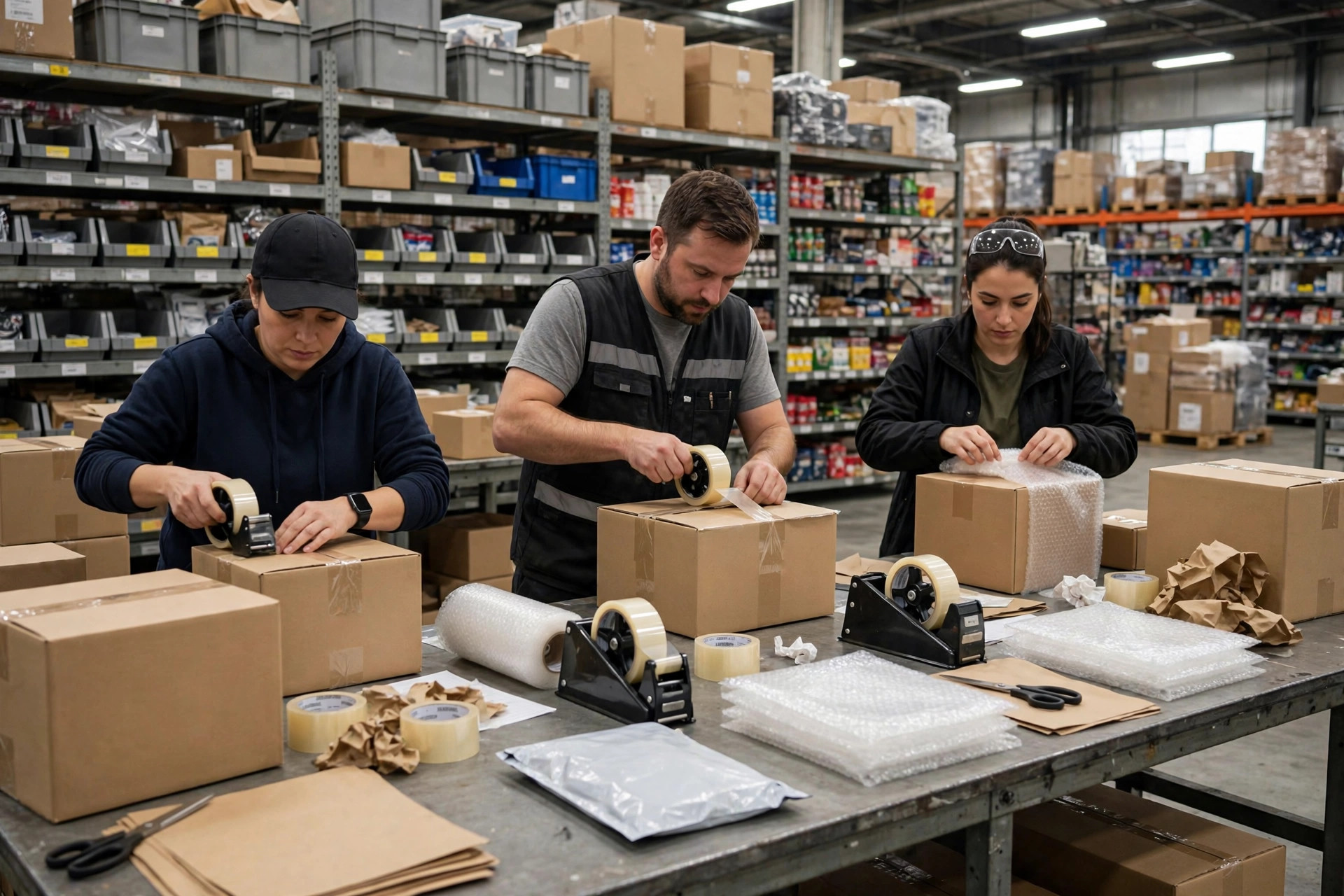
Weighing parcels isn't about freight cost — it's about evidence. Simple setup: a camera next to the scale (or a scale system with photo capture). Every order auto-snaps one photo: scale readout + parcel + shipping label in one frame, filename carries the order number, stored in the cloud.
What does this photo do in a dispute? It proves you actually shipped a parcel with real weight. The cardholder says "the merchant never shipped anything," you drop this photo, and you've already won half the fight. Cost is near zero: a cheap camera plus storage, a few dollars a month at most.

2. Double-check the label address: kills "wrong address" disputes
After printing the label and before sealing the box, run a check: does the label's address match the order in the system? Sounds silly, right? But at a few hundred orders a day in peak season, mislabeled and misaddressed parcels happen more than you'd think. For a "not received" chargeback caused by YOUR mislabeling, you don't even qualify to appeal — because you really did send it wrong.
Our process: after the packer applies the label, they scan its barcode, and the system auto-matches against the order address. Mismatch locks the order. Twenty extra minutes a day, and "wrong address" chargebacks went to zero.
3. Signature confirmation on high-ticket orders: $200 is the line
My line: any order over $200 ships with signature confirmation. It adds a few dollars in freight, but buys you the carrier-returned signer name and timestamp. That POD (proof of delivery) is the trump card in "not received" disputes.
How did I pick $200? Math: signature service costs roughly $3–5 per parcel (check your carrier's latest rates), while one $200+ chargeback costs $220+ in product and fees. Spending $5 to protect $220 doesn't need a second calculation.
4. Keep records 180 days: don't delete early
Card network dispute windows generally run about 120 days from the transaction (check the latest policies), plus bank processing time — so keep evidence at least 180 days. Our method: weight photos and pack screenshots named "order-number_date," stored in the cloud, auto-archived after 180 days. Storage costs are negligible, but the day a chargeback arrives and you can't find the evidence, you'll want to kick yourself.
The counterintuitive part: you can win the dispute and lose the customer
Unpopular opinion: the evidence chain only protects your floor. Pre-shipment fraud screening is your ceiling.
I've seen sellers with beautiful evidence chains, never losing a dispute, whose chargeback rate stays stubbornly high — because they do zero screening before shipping. Fraud orders have obvious tells: new customer, large ticket, billing address ≠ shipping address, late-night order, freight forwarder address. Your order system can catch all of these.
My setup is now two layers. Layer one: pre-shipment screening. Three red lines (new customer + high ticket + address anomaly) — trigger any two and the order goes to manual review. I'd rather lose one sale than lose two orders' profit on one fraud case. Layer two: the warehouse evidence chain. Screened orders ship with complete evidence, so if a dispute still comes, we win it.
Don't reverse the order. The evidence chain is damage control; screening is prevention. Doing only the evidence chain is like collecting bullet casings on a battlefield — very busy, but the bullets are still flying at you.
Final checklist, stick it on the warehouse wall:
- Weigh-and-photo every order, filename carries the order number, keep 180 days
- Double-check the label address after printing; lock mismatches
- Signature confirmation on orders over $200
- Manual review for any order where billing address ≠ shipping address
- Watch your chargeback rate weekly; investigate the moment it nears 1%
This one's battle-tested. From 1.4% down to 0.6%, seventy-plus percent win rate on "not received" cases — all from four warehouse-side moves. DTC folks, traffic is expensive and acquisition is hard. Don't let chargebacks steal another order.
By Ah K, E-commerce Seller (5 yrs)