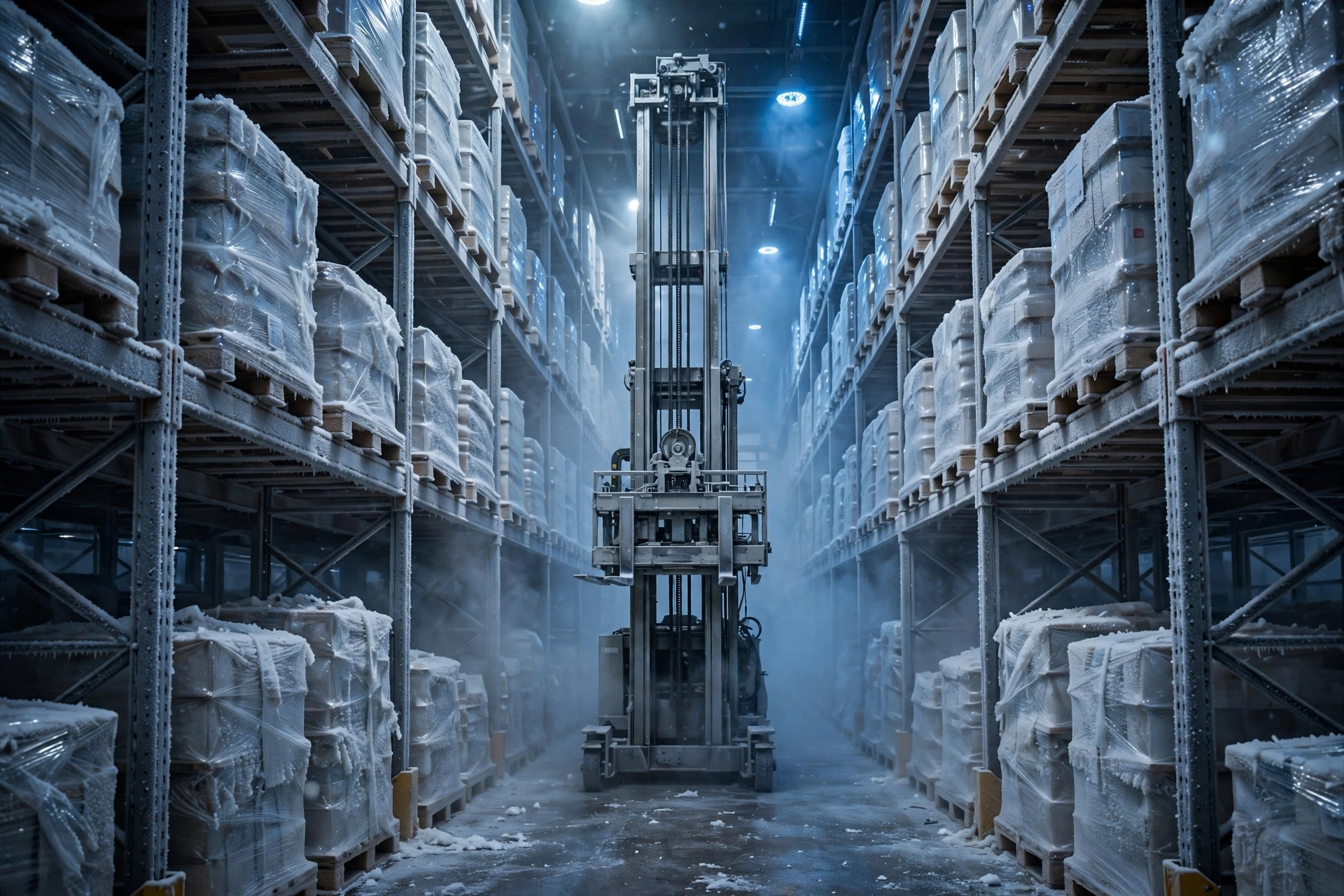
At minus 25 degrees, the first thing that gives up in a freezer warehouse isn't your people. It's the equipment — and the business case.
Back in the winter of 2019, I walked a retrofit assessment at a frozen-food 3PL in Indiana. The building had been sitting at minus 23 to minus 25 degrees for over a decade, still running narrow-aisle racking with manual picking. The owner asked me whether automated storage would work there. My answer: it can work — but don't price it against an ambient-temperature ASRS. A freezer ASRS is a different animal with a different set of economics.
Here's my verdict up front: in a sub-zero automated warehouse, the real enemy isn't the cold itself. It's the freeze-thaw cycling and the frost. Get that math wrong, and maintenance costs will eat every dollar you saved on labor.
Frost, Not Cold, Is What Kills You
Most people assume the big challenges at low temperature are brittle steel and frozen motors. That's textbook talk. In real projects, the first thing that bites is frost.
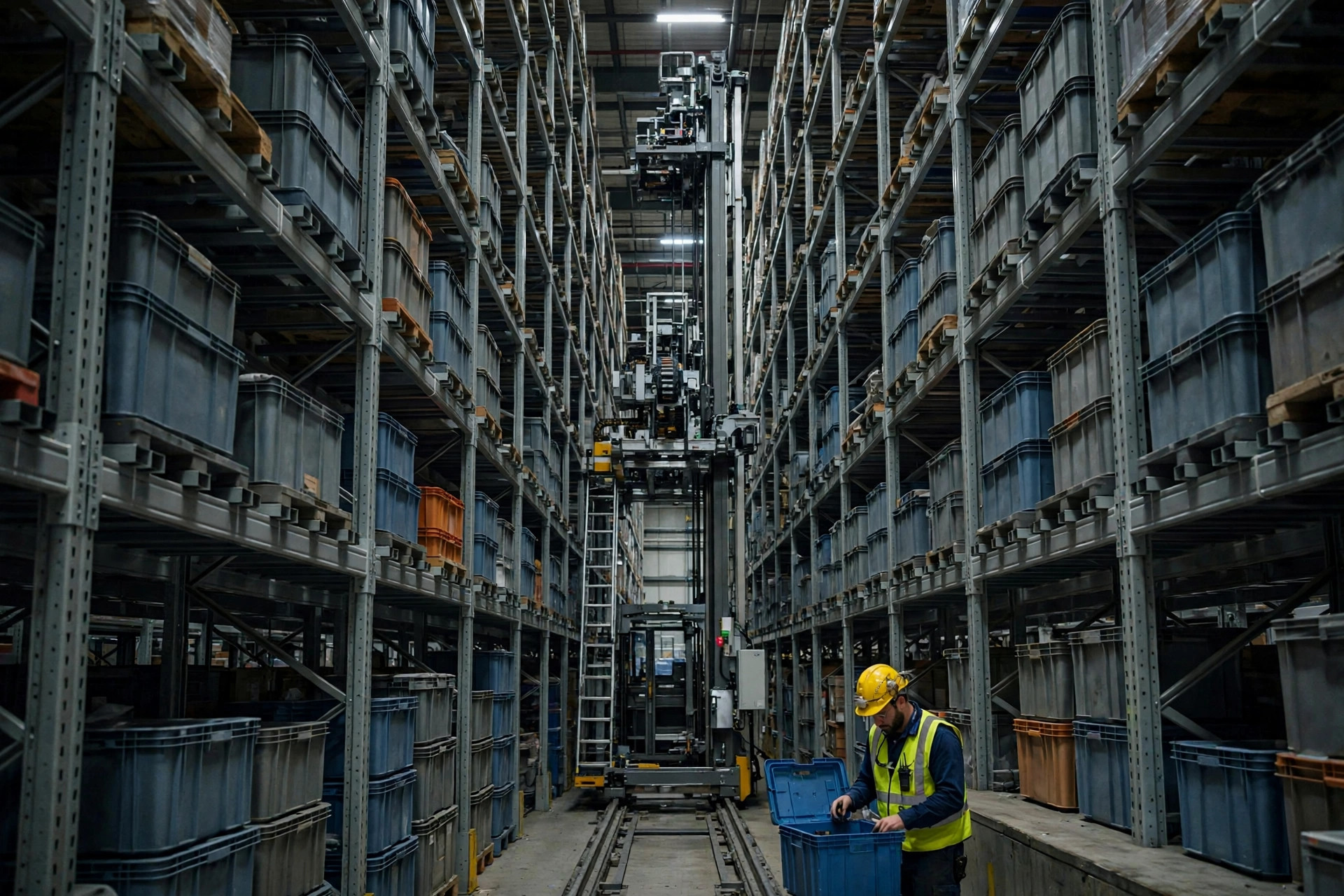
Every time a freezer door opens, warm humid air rushes in and lays a thin film of frost on racks, rails, and sensors. Layer by layer, that frost builds up until the stacker crane's travel wheels are rolling on a cushion of ice instead of bare rail. I've seen a project where a four-way shuttle stalled at the same curve twice in one shift. They tore the guide rail apart and found nearly half a centimeter of ice on its flank. The sensors were fine. The software was fine. Physics just said no. That stoppage cost half a shift, the room temperature climbed almost two degrees, and a batch of short-dated product had to be shipped early — the owner's loss to swallow.
So in a freezer ASRS, the de-icing and sealing design matters as much as the equipment selection. High-speed freezer doors plus air curtains. Strict rules on how often people and forklifts move in and out. Maintenance clearances around rails and critical sensors so crews can actually get at the frost. None of these line items exist in an ambient-temperature project, and every one of them decides whether the system runs continuously or limps along.
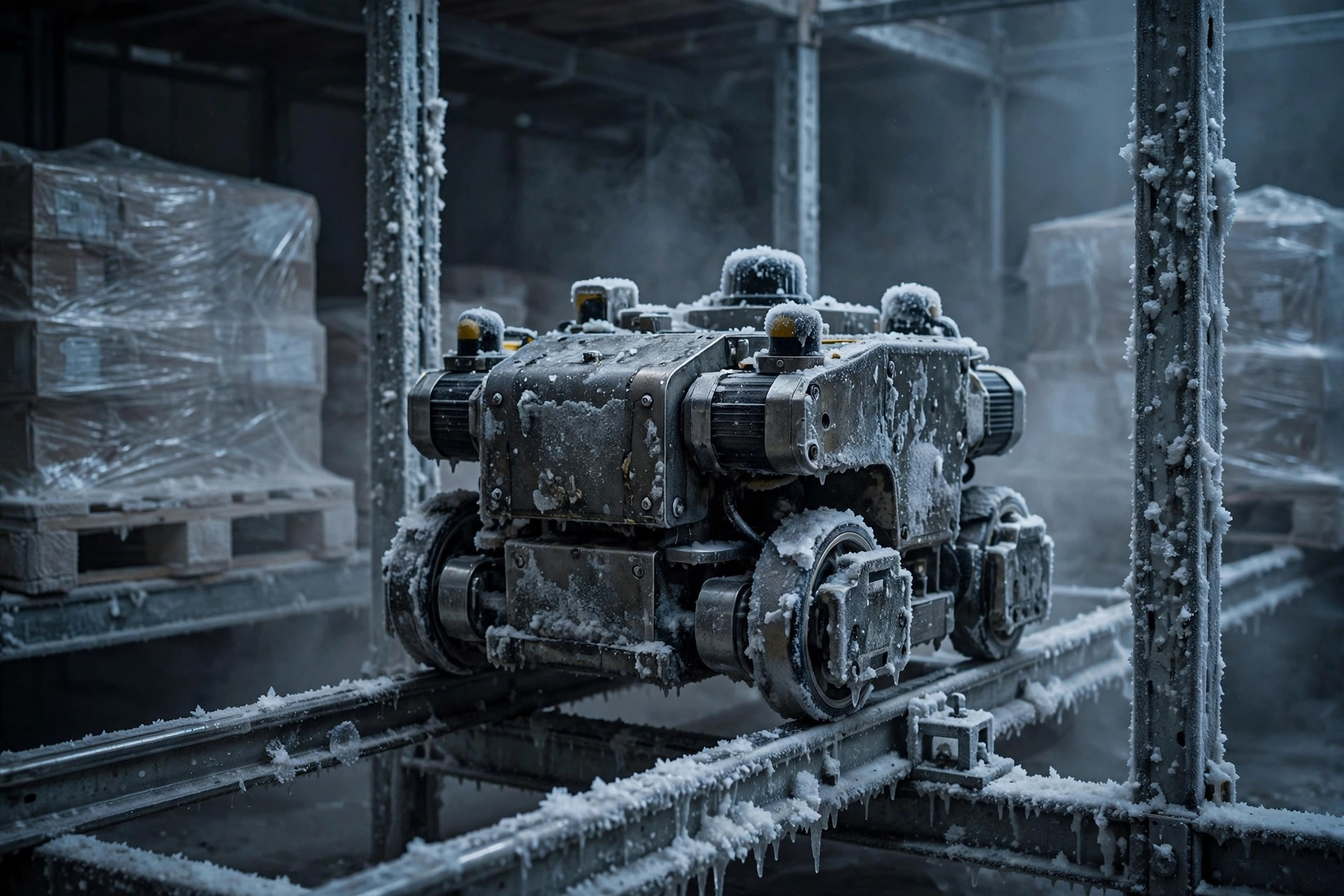
Some owners ask whether they can skip the sealing design and just "send someone in to de-ice periodically." My answer is always the same: have you priced the downtime per de-icing session, the temperature recovery time, and who carries the product-loss risk? Run those numbers and the upfront design money is almost always the cheaper option.
Batteries and Lubrication: The Two Hidden Cost Lines
Stacker cranes usually run on busbar power, so low temperature bothers them less. The trouble starts with battery-powered equipment — four-way shuttles, satellite carts. Lithium batteries lose charge and discharge capability noticeably below minus 20 degrees, and shorter runtime is simply the norm. That means the same workload needs either more spare shuttles rotating through charge cycles, or far more frequent charging. And the charging zone has its own trap: roll a minus-25-degree shuttle into a room-temperature charging room and it instantly beads with condensation. Electronics that get thermal-shocked like that every day fail at a visibly higher rate.
Lubrication is the other hidden line. Standard grease thickens and loses flowability at minus 25 degrees, which accelerates wear on bearings and chains. Freezer projects need purpose-made low-temperature grease, applied on a shorter cycle than ambient sites. That's not a "change the oil" footnote. Every lubrication point across the aisle has to be re-mapped, the maintenance manual becomes its own volume, and technicians entering the freezer in full cold-weather gear work at a fraction of normal pace. Maintenance windows in a freezer are narrow by nature — people can't stay long, and neither can the equipment wait.
So when you read a freezer ASRS quote, don't fixate on the equipment total. Read two lines closely: the low-temperature package in the options list, and the freezer-environment clauses in the maintenance contract. If an integrator quotes ambient pricing and promises a "cold-proof retrofit" later, I tell owners to walk away. A retrofit always costs more than getting it right the first time.
The Throughput Test: Who Actually Earns a Freezer ASRS
This is the dividing line that matters most. A freezer ASRS carries a real cost premium — low-temperature electrical components, low-temp lubricants, sealing and de-icing design, redundant shuttles. Every item adds money. For the same pallet positions, a freezer ASRS costs materially more than its ambient sibling. That's no secret in the industry.
My test is straightforward: look at daily pallet throughput and the velocity profile of your SKUs, not the size of the building. A frozen-food distribution center that runs near full occupancy, moves hundreds of pallets a day, and carries a concentrated SKU set can make the math work. The labor savings (freezer labor is expensive and hard to hire), near-continuous operation, and far fewer door openings than a manual freezer all pay back. The facilities that get hurt are the ones that bought the equipment for the building's size and then let it sit half-empty — the depreciation clock doesn't care about your utilization rate.
The flip side is the "stores a lot, moves a little" freezer — the seasonal frozen-goods trader who turns inventory twice a year. There, ASRS money is mostly burned. Equipment idles at minus 25 degrees while depreciation accrues, maintenance bills keep coming, and frost keeps forming. That operation is better served by a conventional freezer with manual labor, or by spending the money on door sealing and denser racking.
Then there's the in-between: volume is growing but not yet at the ASRS threshold. My advice is to make the building "ASRS-ready" now — clear height, column spacing, floor loading, all done right the first time. Reworking freezer construction costs far more than ambient construction, and money spent on preparation today saves serious money when the equipment decision finally arrives.
One question to take home: add up five years of freezer maintenance labor, spare parts, and downtime losses, then compare that against the premium for the cold package, redundancy, and maintenance on an ASRS proposal. If the difference doesn't cover the labor and product-loss savings, the system isn't worth building. And there's one more line item people forget — hiring. Fewer and fewer workers want to pick orders at minus 25 degrees for a living. When you can't staff the freezer, automation stops being about saving money and becomes about staying open. So ask yourself honestly — does your freezer's throughput justify the maintenance bill that comes with the system?