If you build warehouse equipment for the EU market, CE marking for material handling equipment is the toll booth you cannot drive around. Conveyors, stacker cranes, forklift attachments — no mark, no market. My verdict up front: nine out of ten Chinese equipment makers take the wrong first step, not because their engineering is bad, but because they confuse "sticking the label on" with "getting a certificate."
Kill Three Myths First
Myth 1: CE is a certificate. Think of it like a driver's license versus actually knowing how to drive — the card is the outcome, the skill is the substance. CE marking is fundamentally a manufacturer's EU Declaration of Conformity backed by a technical file. A Notified Body type-examination certificate is just one possible form of evidence, mandatory only for certain product categories. The phrase "CE certificate" appears nowhere in EU law. Any consultant who pitches you a "guaranteed CE certificate in seven days" is selling a pseudo-requirement — walk away. What they're really selling is peace of mind, not compliance.
Myth 2: once the mark is on, you're done. The EU runs on self-declaration plus market surveillance spot checks. Regulators in Germany, France, or Poland can pull your machine straight out of your distributor's warehouse. Fail, and it's delisting, public notification, sometimes the whole batch sent back. No technical file — or test data that doesn't add up — and the mark won't save you.
Myth 3: 20 January 2027 is far away. Underline this — it's the time anchor for the whole piece: Regulation (EU) 2023/1230 fully replaces Machinery Directive 2006/42/EC on 20 January 2027. Directive becomes Regulation: direct application in every member state, plus digital instructions and a two-tier high-risk list (Annex I, Part A / Part B). Any machine you design now lives across that switchover — build the file to the new Regulation or redo it later. Transitional rule: machines placed on the market under 2006/42/EC before 20 January 2027 keep circulating; anything new after that goes under the new rules.
CE Marking for Warehouse Equipment: Self-Declaration or Notified Body?
This is the dividing line. Three steps, like reading down a datasheet.
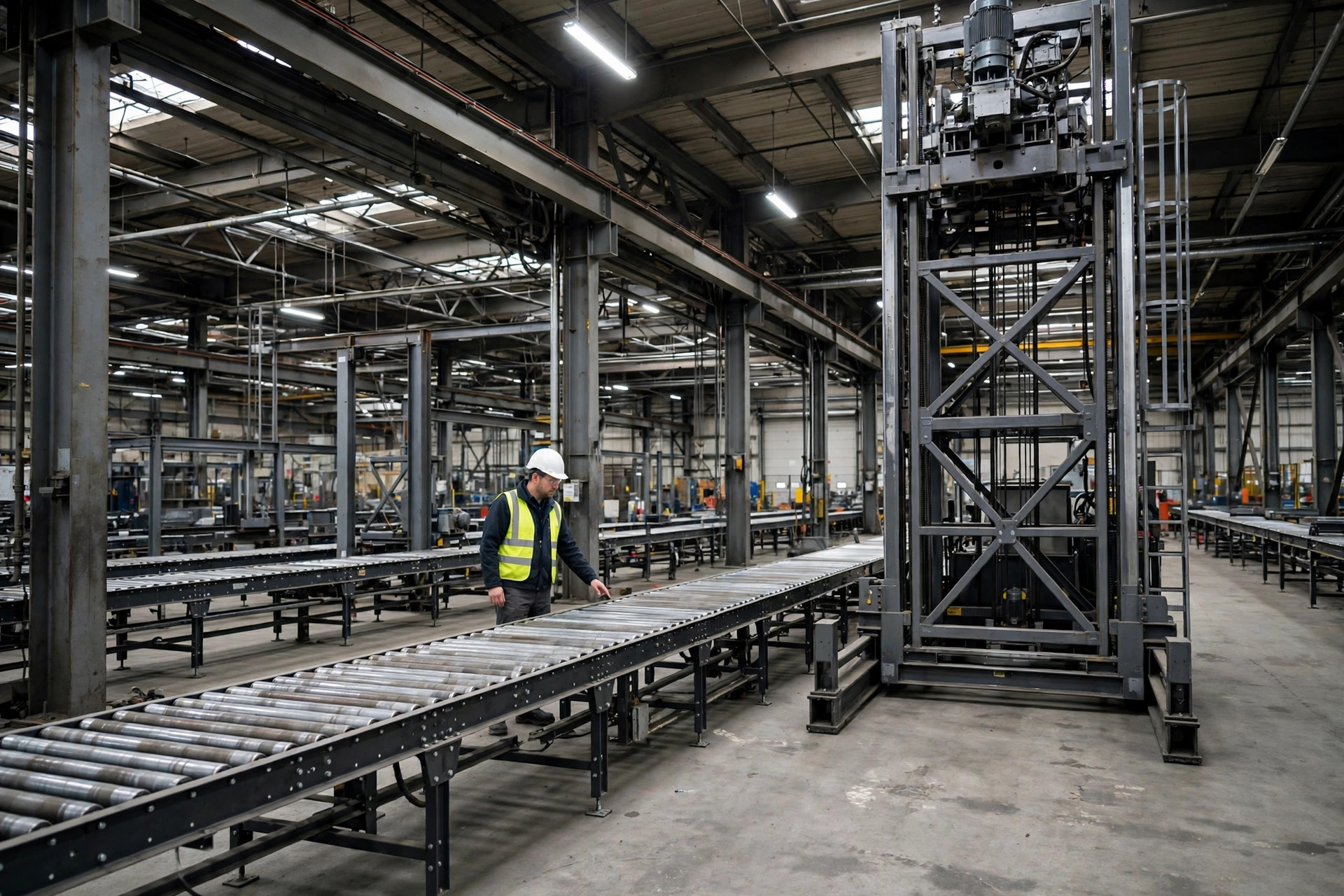
Step 1: is your product even "machinery"? Counter-intuitive first: racks, pallets, and plain bins have no moving parts — outside the machinery legislation entirely, no machinery CE mark needed. Plenty of factories open with "how do we CE-mark our racking" — answer: you don't. Scope check first, not a cent before it. Conveyors, stacker cranes, lift tables, AGVs/AMRs, attachments that change what a forklift does — those are machinery; they're in the game.
Step 2: check the high-risk list. Annex I has two tiers: Part A high-risk machinery must go through a Notified Body, no exceptions; Part B machinery built fully to harmonised standards can be self-declared (the old Directive's Annex IV worked the same way). On the list or not — that's the single most expensive dividing line in this whole CE marking process.
Step 3: pick your route. Self-declaration: your own risk assessment, your technical file, your signed Declaration, your mark — 100% on you. Notified Body route: EC type-examination or quality-system audit, after which the CE mark gains a four-digit body number. Four digits after a CE mark means that maker went the institutional route.
| Equipment | Typical route | Core harmonised standards |
|---|---|---|
| Roller/belt conveyors | Self-declaration (common) | EN ISO 12100, EN 60204-1, EN 619 |
| Stacker cranes (ASRS) | Depends on risk; Notified Body often required | EN ISO 12100, EN ISO 13849-1, EN 60204-1, EN 528 |
| Lift tables / vertical lifts | Often on the high-risk list; Notified Body | EN ISO 12100, EN ISO 13849-1 |
| Forklift attachments | Self-declaration (common) | EN ISO 12100 (add EN 60204-1 if powered) |
| AGVs/AMRs | Self-declaration (full standards coverage) | EN ISO 12100, EN ISO 13849-1, EN ISO 3691-4 |
Three standards you must know cold: EN ISO 12100 is the machinery safety design bible and the risk-assessment method — the foundation of every technical file. EN ISO 13849-1 covers safety-related control systems, performance levels PLa through PLe — your e-stop, guard-door, and light-curtain circuits get their grade from it. EN 60204-1 covers electrical safety of machinery — cabinet build, wiring, grounding, e-stop device selection.
A real story: in 2023, a stacker-crane integrator's machine lifted over 3 metres with a falling-object risk — squarely high-risk, so Notified Body type-examination was mandatory. Their safety PLC e-stop loop was single-channel PLc; the risk assessment demanded at least PLd. Failed type-examination twice, rebuilt as dual-channel — two extra months, delivery slipped. The dividing line isn't "big versus small machine." It's two numbers: risk level and circuit performance level.
CE Marking Rejection Hotspots: Four Traps Built for Warehouse Equipment
Trap 1: the manual isn't in the destination country's language. The law requires instructions in an official language of the member state where the machine will be used. In 2024, a Suzhou conveyor builder shipped to Poland with a 47-page English-only manual. Market surveillance held it: no Polish version, no release. Three weeks in a supervised warehouse, storage by the day, the customer's commissioning slipped wholesale. Translation isn't an add-on — it's a release condition. The new Regulation allows digital instructions; the language requirement hasn't budged an inch.
Trap 2: the risk assessment is missing — or theatre. The EN ISO 12100 risk assessment is the soul of the technical file; plenty of factories fake it with one table and a few lines, and assessors see through it in seconds. A real one covers the full lifecycle — transport, installation, commissioning, operation, maintenance, decommissioning, no skipping. Miss maintenance (an unguarded service platform on a stacker crane) and you're rejected just the same.
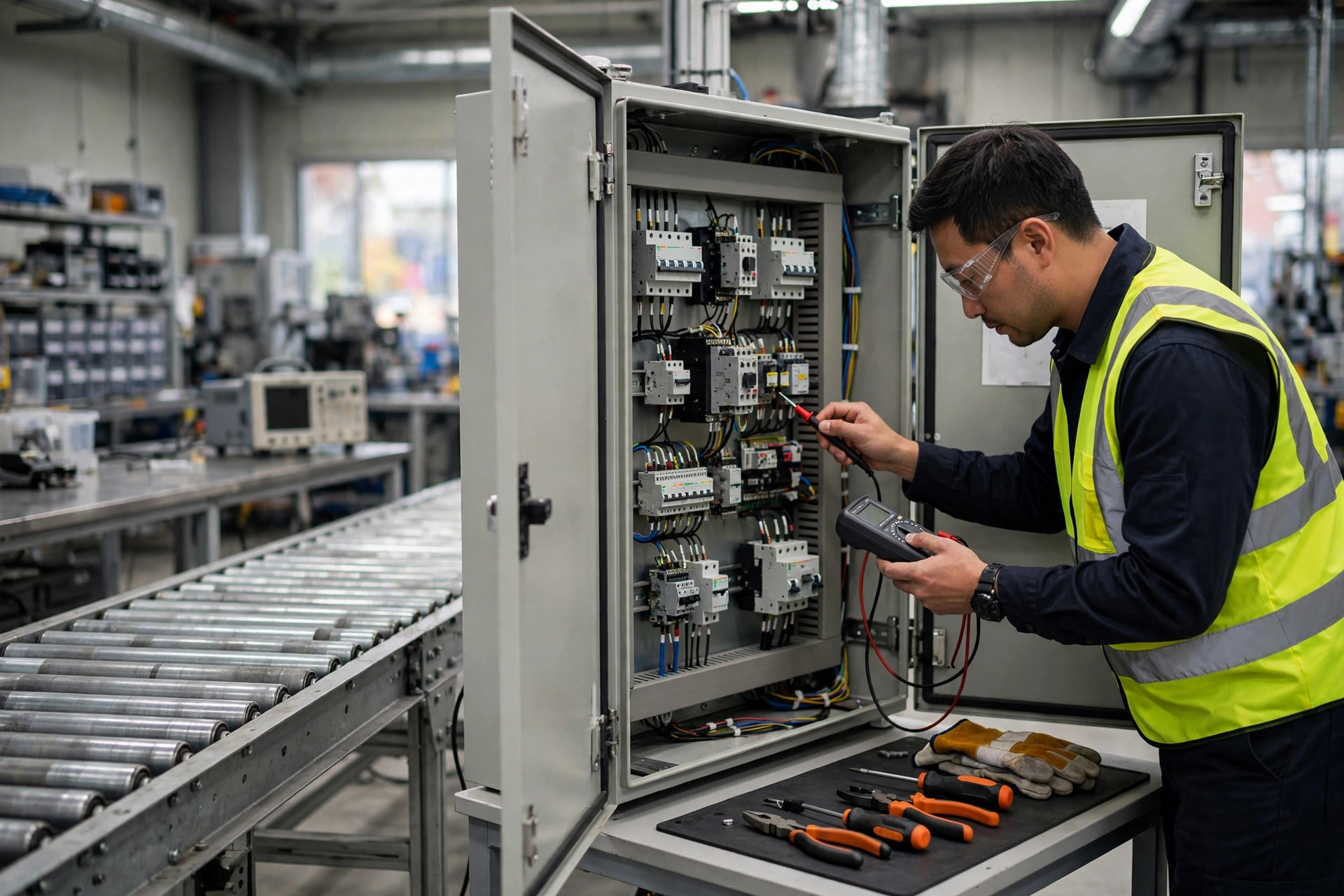
Trap 3: electrical safety. EN 60204-1 inspectors check three things: grounding continuity, insulation, and e-stop devices. The classic failure in Chinese-built cabinets is a standard pushbutton masquerading as a safety-rated e-stop device, or an e-stop loop with no performance-level verification per EN ISO 13849-1. It's like fitting a car with a fake seatbelt buckle — looks right, useless in a crash.
Trap 4: the e-stop circuit's PL grade falls short. E-stop, guard interlocking, and zone guarding are safety functions: the risk assessment sets the required performance level (PLr), then you verify the actual circuit achieves it. A PLc circuit guarding a PLd risk cannot be saved by paperwork. For stacker cranes and lifts, PLd is the starting line, not the ceiling.
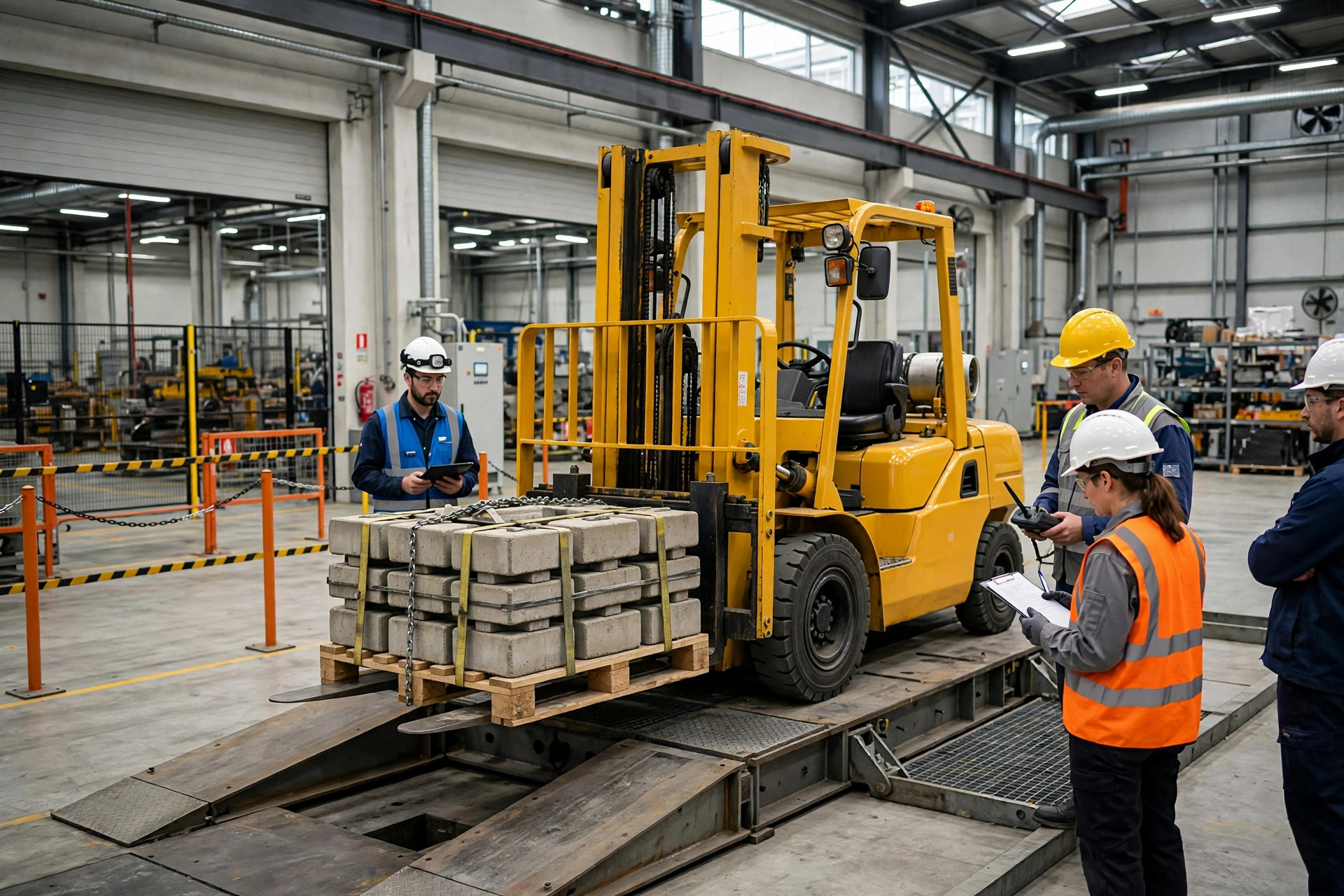
One more short one. A forklift-attachment maker in Ningbo sold through a German distributor — who, under the law, became the "importer," with duties to check the Declaration of Conformity and keep the technical file available. If something goes wrong, he answers first. So he audited the factory harder than any Notified Body: load-test reports, safety-factor calculations, every document accounted for. Counter-intuitive conclusion: however pretty your CE mark, if you can't get past your own importer, the goods never leave his warehouse. Treat a distributor's compliance muscle as a selection criterion.
The Money: Both Routes on the Table
| Route | External spend (order of magnitude) | Timeline (if smooth) | The catch |
|---|---|---|---|
| Self-declaration | Low thousands of euros: lab testing billed per item, manual translation, optional third-party risk assessment | 1–3 months | You own 100% of the liability |
| Notified Body type-examination | Tens of thousands of euros and up, varies widely by machine complexity and test scope | 3–6 months including rework | Mandatory for high-risk list items — no choice |
Magnitudes only — get real quotes from real bodies. Any consultant offering a flat "pass guaranteed" price gets the Myth-1 treatment: walk away.
And the trade-off. Self-declaration is cheaper, but you carry all the liability — and your EU importer (your distributor) will force you to complete the file anyway. The certification money you think you saved comes back as his audit cost, folded into your pricing. The Notified Body route is expensive, but for high-risk machines it's compulsory, and for the rest it's a third-party endorsement that plays as hard currency in distributor negotiations.
Whether the money is worth it comes down to one number: total certification spend divided by projected EU sales over three years. Above 5%, your order book can't carry that compliance cost — probe with small orders via self-declaration, don't open with a Notified Body engagement. Below 5%, it's a ticket, not a cost: do it right once, reuse the file, every order after is pure margin. CE marking isn't a business cost in the EU — it's the toll. The question was never whether to pay, but how to avoid paying twice.
By Da Liu, Automation Engineer