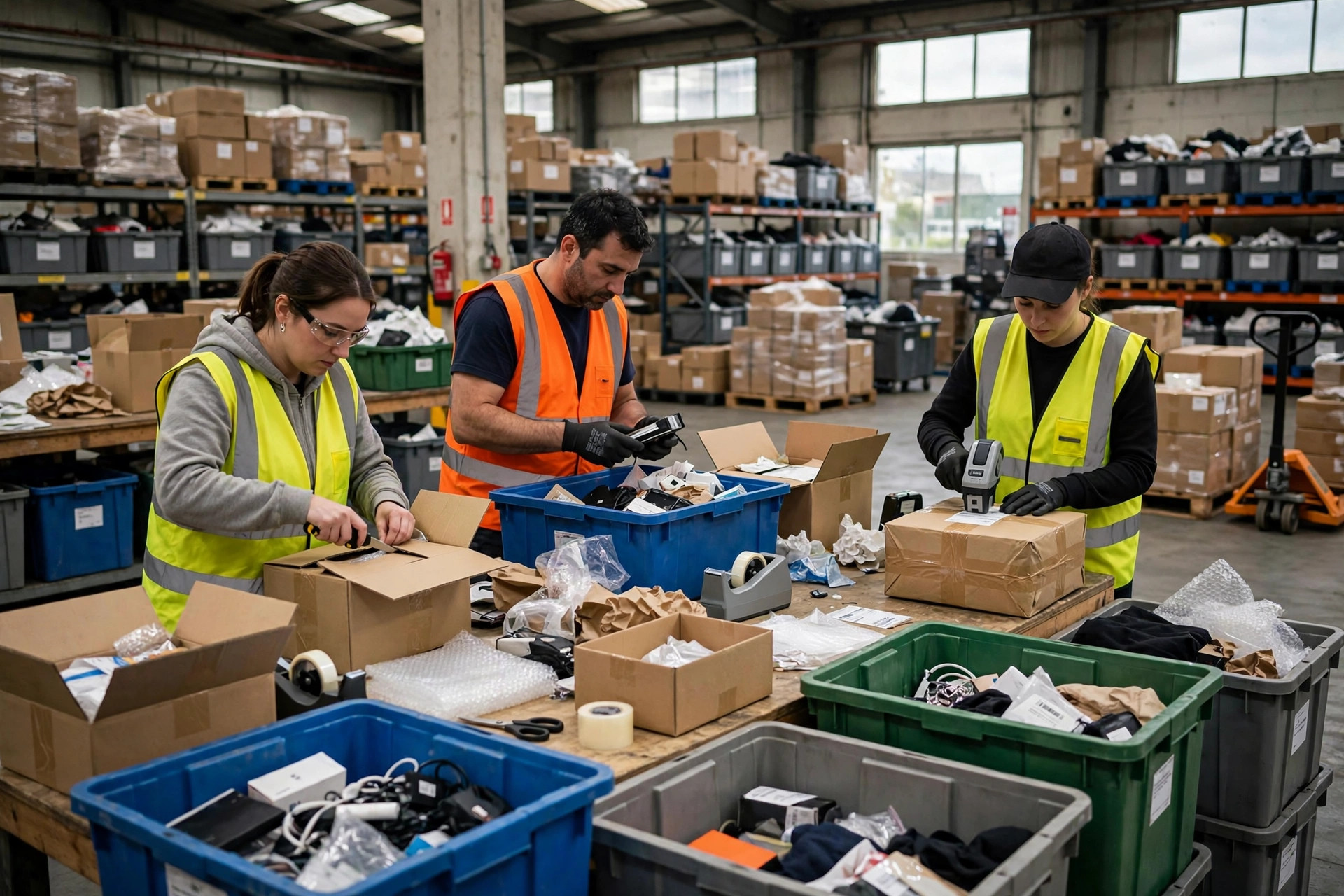
Amazon changed its rules on me again last year — ad costs up, inbound stuck for a week — so I went looking for a second channel and landed on cdiscount france marketplace fulfillment. France is not a side market you dabble in with leftover stock. Cdiscount is France's homegrown generalist marketplace, around 17 million unique visitors a month and roughly 10,000 sellers, backed by the Casino group and rooted in Bordeaux since 1998. French shoppers buy big-ticket home goods there the way other countries buy them on Amazon. My first test was deliberately small: 200 units of a kitchen gadget. Half sold in three weeks, and nine orders came back. That is when I learned the real game here is not listing speed. It is warehousing and returns.
Do the Money Math Before You List on Cdiscount France
Cdiscount charges about €39.99 a month, plus a category commission. The default rate for new products is 15%, used and refurbished goods run 17%, and categories swing widely: phones sit near 7%, small appliances near 10%, jewellery can hit 20%. The commission base is the tax-inclusive selling price plus shipping, multiplied by the category rate, and French VAT at 20% adds a 1.2 multiplier on top of the commission. Payouts land every 10 days, not in real time, so plan cash flow around that cycle. Exact rates change by category and promotion, so treat the official site as the final word.
Here is a worked example, labelled as a hypothetical: a small appliance sells for €49.99 with €5.99 shipping at a 10% commission rate. Commission works out to (€49.99 + €5.99) × 10% × 1.2, roughly €6.72. Add inbound freight, storage, and last-mile delivery, and the margin gets thin fast. I run every listing through that formula before it goes live. High-commission categories need price headroom; the volume-at-any-cost playbook dies here.
French shoppers also love paying in four interest-free instalments, and the platform puts the instalment handling fee on the order. Read that line on your statement. I log instalment orders separately and reconcile commission and fees at month-end, because a fee you never noticed is a fee you never priced in.
Self-Fulfil or Hand It to Octopia: My Cdiscount France Call
For cdiscount france marketplace fulfillment, you get two paths: ship it yourself, or use Octopia Fulfillment, the platform's own service, badged "Expédié par Cdiscount" — the local equivalent of FBA. I have run both, and my rule is simple: self-fulfil while daily volume is low and flexible; move the winners into the platform warehouse once volume stabilises, because French buyers trust that badge and it shows up in conversion.
Self-fulfilment taught me the hard lesson first. My stock sat in a German warehouse, promising 3–5 day delivery into France. One strike plus one peak-season backlog later, six orders arrived late and my seller rating dropped 0.3 points. French buyers do not forgive late delivery the way I expected — two days late earns a bad review, and bad reviews drag ad conversion down with them. After that I split French orders out, kept only bestsellers in the local warehouse, and set a hard 3 p.m. cut-off. An order I cannot ship on time is an order I would rather not take.
Octopia Fulfillment works differently. Small items under 30 kg with a combined three-side measurement under 2 metres generally go to Cestas near Bordeaux; bulky goods go to Andrézieux-Bouthéon and Saint-Mard. Standard delivery runs about 3–5 days, express can hit next day, and the service reaches metropolitan France plus more than 20 European countries. Fees split into storage and shipping, invoiced every 10 days alongside sales payouts, with no minimum volume. Exact storage and shipping rates depend on size, weight, and destination — check the official pricing page rather than trusting a number in any blog post, including this one.
My trigger to switch was concrete. In October 2025, one kitchen gadget hit 40 orders a day on Cdiscount France. My packers were working until 11 p.m. and the mis-ship rate hit 3%. I moved 800 units of that bestseller into Octopia Fulfillment and left 200 slow movers in my own warehouse. Conversion rose from 4.1% to 5.6% in the first week, returns were processed faster, and support tickets fell by about a third. That move worked — I tested it myself — but only because the winner was concentrated. If your catalogue is 200 SKUs that each sell a handful of units, platform storage fees will eat you alive.
| Fulfilment path | Best for | Cost shape | Delivery | My call | | Self-fulfilment | Under 30 orders a day, scattered SKUs | Rent + labour + parcel, per order | Depends on warehouse location, often 3–5 days | Start here, find your winners first | | Octopia Fulfillment | Concentrated bestsellers, steady volume | Storage + shipping, settled every 10 days | Standard 3–5 days, express next day | Move the winners over, leave slow movers behind | | French third-party warehouse | Sellers running several French channels from one stock pool | Storage + handling + last mile | Depends on location and carrier | Worth it when one stock pool serves multiple channels |
Do not pick a path from a webinar. Pick it from your order curve. Unstable volume plus locked-in platform stock hurts more than a slightly higher parcel rate.
Returns on Cdiscount France: French Law Is Stricter Than Platform Rules
Returns are where cdiscount france marketplace fulfillment quietly eats your margin. Under French distance-selling law, consumers get a 14-day cooling-off period after receiving the goods, and sellers must refund within 14 days of being notified. How return shipping is handled depends on what your shop policy actually says — and a vague policy costs more in back-and-forth messages than the return itself.
I grade every return into three buckets, written into the shop policy and onto the warehouse handling card. Bucket one, resellable: check appearance and accessories, photograph it, put it back on sale. Bucket two, light defect: clearance pricing or a bundle deal, and never let it occupy a prime pick face. Bucket three, damaged or incomplete: write it off. Do not burn two rounds of freight to save a few euros. In January 2026 I processed 120 returns: 71 resellable, 33 light-defect, 16 written off. The recovered resale value was roughly €2,100 in that hypothetical-style worked tally — treat the ratio as the lesson, not the euro figure as a promise.
You need a French return address. The three options are a French return address, a prepaid return label, or paying for an international return yourself. I chose the first: a French warehouse receives returns, grades them, and decides the next step locally. Cross-border returns sound cheaper until the buyer waits two weeks, leaves a bad review first, and you still pay the refund.
Here is the counter-intuitive part: a high return rate is not always a bad product. One storage box priced at €29.99 had an 11% return rate, double my shop average, and I nearly delisted it. Digging into the data, about 60% of returns were wrong-size purchases. I moved the dimensions onto the first listing image, and within a month the return rate fell to 6.5% while conversion rose 0.8 points. Returns data is free customer feedback. Treat it as a cost line only and you throw the feedback away.
One more detail new sellers skip: French-language customer service. Cdiscount expects sellers to answer buyers in French by email. I started with machine translation and paid for it — one dispute escalated to a bad review because my French reply read like a refusal to accept the return. Now a part-time French-speaking agent handles messages for two hours a day, response time dropped from a day to about three hours, and bad reviews fell noticeably. Do not skip this to save money; French buyers judge you on whether the conversation flows, not on how good your English is.
If you are about to enter Cdiscount France, here is my short list: run the commission formula before you list, move concentrated winners into platform fulfilment and keep scattered SKUs self-fulfilled, and write your returns process on day one — that 14-day French cooling-off period is not decoration. This approach worked for me, tested with real orders and real returns. The channel pays, but only if you play by French rules.
By Ah K, E-commerce Seller (5 yrs)