10:30 PM, last October, peak season. I walked over to inbound and found old Carlos still on the pallet jack, scanning labels.
"You eat yet?" I asked.
He didn't look up. "Soon as this trailer's done. Almost."
I looked at the clock on the wall: 11:40. He'd clocked in at 6:30. Fifty minutes to the end of his fifth hour, and that trailer still had two hours of freight in it.
Here's the honest truth, folks. If you run a warehouse in California, premium pay is the easiest stupid money you'll ever spend. Your guy misses a meal break on time, the state makes you pay him an extra hour of wages. Two hours a day, max — one for a missed meal, one for a missed rest.
How Premium Pay Works: The Cost of a Missed California Warehouse Meal Break
Let me nail the rules down, because California Labor Code 512 and 226.7 don't leave room for negotiation:
First, any shift over 5 hours gets a 30-minute meal break, and that break has to start before the end of the 5th hour. Clock in at 6:30, your meal starts no later than 11:30. 11:31? That's late. Violation.
Second, any shift over 10 hours gets a second 30-minute meal break, starting before the end of the 10th hour.
Third, if you don't provide it — late, interrupted, or missed entirely — you owe one hour of pay at the employee's regular rate for that day. That's premium pay.
Fourth, rest breaks are separate: 10 minutes of paid rest for every 4 hours worked, nothing owed for shifts under 3.5 hours. Miss a rest break, that's another hour of penalty pay for the day. So two hours max per person per day.
Here's a trap a lot of managers fall into: a 5-to-6-hour shift can have the meal break waived by mutual agreement. And on a 10-to-12-hour shift, the second meal can be waived too — but only if the first one wasn't. Waive the first, and the second is untouchable.
One more thing, from the California Supreme Court's 2021 Donohue decision: no rounding meal punches. Your time clock rounds 11:31 to 11:30 and pretends nothing happened? Doesn't fly. The records are what they are.
How We Found Out: That Trailer During Peak
Back to Carlos. Peak-season inbound, 38 trailers in the yard, not enough forklift drivers. By the time he finished that trailer, it was past 1 AM. His first meal didn't start until his 7th hour.
Next morning, Lisa from HR dropped a report on my desk. "Look at this month's penalties. Thirty-eight hundred bucks."
We dug in: the real problem wasn't the yelling — it was that the yelling didn't work. Night shift, inbound buried, nobody can walk away. The lead won't go first. "Let me finish this trailer" — the whole warehouse thinks that way, and the 5th-hour line slides right past.
The second discovery hurt more: a few veteran guys told us "I'm not hungry," and we just went along with it. HR told us later: that's not a voluntary waiver. A real waiver needs mutual agreement, and ideally it's in writing. Somebody's casual "I'm not hungry" turns into "I was pressured" the day there's a dispute, and you've got nothing to prove otherwise.
The California Supreme Court gave employers an out in Brinker (2012): your duty is to provide the break, not to make sure the employee takes it. Relieve them of all duty, let them use the time however they want, and you've met your obligation — even if they keep working. But here's the catch: you can't undermine it. If your schedule makes it impossible to eat, or your leads never eat themselves, is that really "providing" a break?
Doing the Math: What a 200-Person Warehouse Can Bleed in a Month
At peak, we run about 200 people. Here's the most conservative math I can give you:
| Item | Number |
|---|---|
| Headcount (peak) | ≈200 |
| Average regular rate | $22/hour |
| Missed/late meals per person per week | 1 |
| Monthly penalty pay | 200 × $22 × 4.3 ≈ $18,900 |
Almost nineteen grand a month. That's before rest-break premiums and second meals on 12-hour shifts. Over a year, that's two used forklifts.
Here's the counterintuitive part, folks: a lot of managers think paying the premium settles it. It doesn't. Under California law, premium pay is wages, not a penalty — that came out of Murphy v. Kenneth Cole. Wages means it goes on the pay stub, into taxes, into the final paycheck. Short someone on it when they separate, and you've got a whole second fight on your hands. This isn't "paying for peace of mind." You're paying, and the liability stays on the books.
And there's a trade-off you need to think through: some folks tell me, "just have everyone sign a waiver." Dream on. First, waivers only cover 5-to-6-hour shifts and the second meal on 10-to-12-hour shifts — the first meal on an 8, 10, or 12-hour shift can never be waived. Second, the waiver has to be genuinely voluntary; if you're holding good shifts hostage over it, it's worthless paper. Third, waive the first and you lose the right to waive the second. Waivers are not an escape hatch.

Scheduling That Actually Works: Our Playbook for On-Time California Warehouse Meal Breaks
We tried three versions. The first two crashed. The third has held for almost a year. This is what we do now:
Version one: verbal reminders. The lead gets on the radio at lunchtime and yells. Why it failed: when it's busy, nobody hears it, and even if they do, they can't leave. The penalties kept flowing.
Version two: eat when you're free. Why it failed: somebody is always "not done yet," somebody is always last. The honest guys lose, the slick ones eat first, and morale takes a hit.
Version three — the current system. Four pieces, all required.
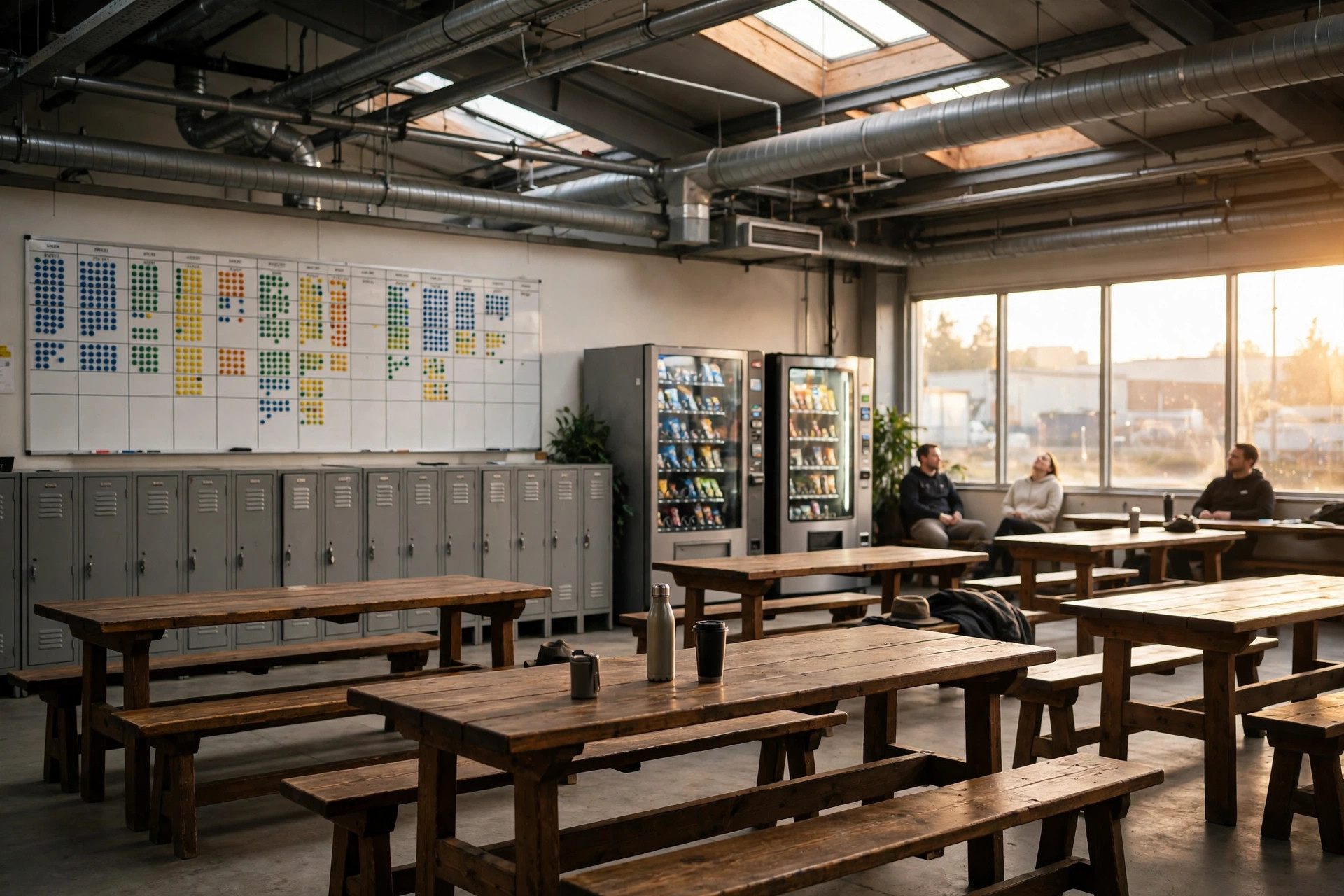
First, meal times are written into the schedule itself. Not "around 11-ish." It's "Carlos 11:00–11:30, Maria 11:30–12:00." Staggered, so every time block has coverage. The schedule is posted on the break-room wall, and everyone gets a copy. HR and the lead both sign it.
Second, coverage is assigned by name. When someone goes to eat, exactly who covers their line is written down. We pay the coverage folks a small bump — honest truth, that bump costs way less than the one-hour penalty.
Third, the time system has a red line. At 4 hours 45 minutes into a shift, the lead's handheld buzzes: this person has 15 minutes left before the 5th hour. The lead goes to the floor and confirms the person actually leaves to eat.
Fourth, waivers for short shifts go through a written process. Five-to-six-hour shift, employee genuinely wants to skip it — sign the written waiver, HR files it. For a 10-to-12-hour shift where someone wants to waive the second meal, we check the records: was the first one waived? If yes, no second waiver.
One note for anyone running nights: nights are where this breaks. HR is gone, it's one lead, fewer people, more freight. Our fix: night-shift meal times go on the schedule 30 minutes earlier than day shift, as a buffer. When inbound explodes at peak, we'd rather call in two temps for coverage than let meal times slide.
A Reminder for My Fellow Managers
Honest truth, folks: preventing this has always been cheaper than paying for it. Our monthly penalty pay is down to a few hundred bucks now, and it wasn't employee discipline that did it — it was the schedule, the coverage list, and the red-line alerts.
Three things I want you to take away, all paid for with our own money:
First, don't trust "I'm not hungry." Either they eat on time, or there's a signed waiver, or you're paying the penalty. Three options. There is no fourth.
Second, the second meal on a 12-hour shift is the one that gets missed. Everyone remembers the first. The second one lands before the 10th hour — 2, 3 in the morning, who's tracking that? It has to be on the schedule.
Third, don't hide behind Brinker. Yes, the court said employers provide, they don't police. But if your schedule makes eating impossible, or your leads never eat themselves, that's pressuring people to skip. When it goes to a judge, they look at what you actually did — not what your break policy says on the wall.
That's how we run it in our warehouse. If you're running one in California too, go pull last month's penalty report — that number is your scheduling health check, right there.
By Chen Feng, Warehouse Operations Manager