It was 6:45 on an October morning, two weeks before peak season. I had just walked into my office when Linda from HR blocked the doorway, a stack of papers in her hand.
"Chen, we still haven't done the harassment training this year. Two hours for supervisors, one hour for everyone else. Every California company with five or more people has to do it."
I knew the law — SB 1343. But here's the honest truth: the statute is one thing, a warehouse is another. We run three shifts, 200-plus people on a normal day, and another 80 temps when peak hits. Somebody tell me: how do you actually schedule those two hours? Keep production running, don't make the crew hate you, and have the records ready whenever the state comes knocking. Nail all three, and you've actually done it.
Headcount: temps count, every single one
First, that "five or more." A lot of managers think it means full-time headcount. Wrong. The law counts temporary and seasonal workers too. We run 200-plus most of the year and push toward 280 in October. Every one of those 280 is covered. No exceptions.
The temp rule is the real killer: anyone hired for less than six months has to finish training within 30 days of hire or 100 hours worked — whichever comes first. Our peak temps work 12-hour days, six days a week. That's 72 hours a week. They blow past 100 hours before the end of week two. The new guy barely knows where the bathroom is and he's already overdue for training. Plan around "30 days" and your schedule falls apart every single time.
Then there's agency labor. The law says the staffing agency is responsible for training its own people, not us. I laughed when I read that. Sure — it's their responsibility on paper, but when the records are missing, the state comes after me, the one running the floor. Counting on somebody else for this is the same as doing nothing.
Two realities: shifts and language
Three shifts make classroom training a nightmare. Day shift you can gather. Night shift? Pull people off the line at 2 a.m. for a two-hour lecture and watch morale crater. We tried it — hired an outside trainer, one session for days, one for nights. Seventeen people showed up to the night session. Five fell asleep. The trainer was half asleep by the end too. Money spent, nothing learned.
Language is the second reality. More than 30% of our crew is Latino. Play them an English course and you might as well have played nothing. California has a 10% rule most people don't know about: if 10% or more of your workforce prefers a language other than English, your policy has to be translated into that language. We're way past 10% on Spanish. Our policy exists in Spanish, or we're exposed.
Three rounds of training before we got it right
Round one: outside trainer, classroom style. A few thousand dollars per session with materials. Result described above — the night shift slept through it.
Round two: I found out the California Civil Rights Department (CRD) offers free online courses — one-hour and two-hour versions, in Spanish and other languages. Free is free. We had people take it on the break-room computers. Then HR checked the logs: one guy "finished" the one-hour course in eight minutes. He'd left the video running while he scrolled his phone. Coverage hit 100%. Actual learning, maybe half that.
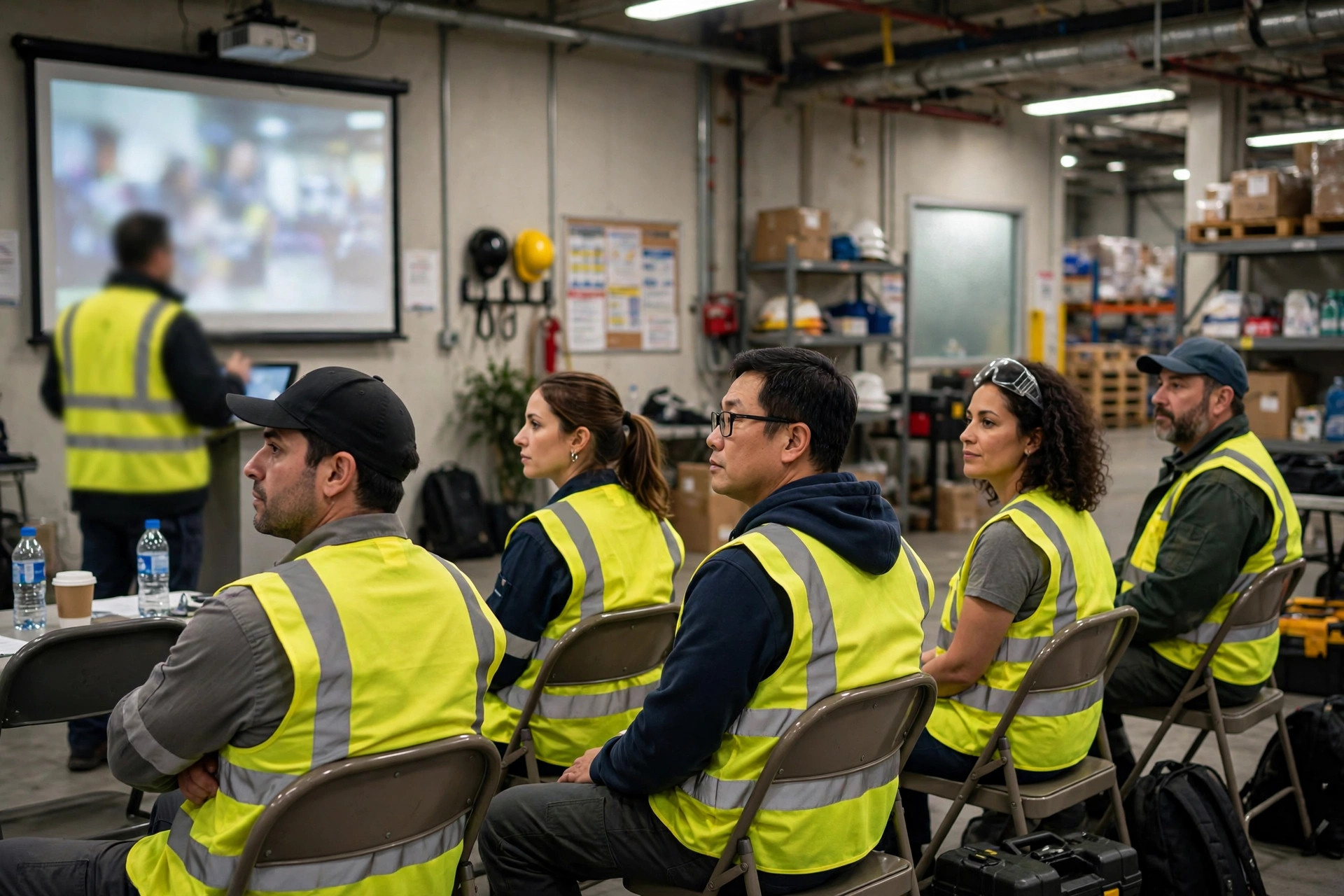
Round three is where it clicked: hybrid. Online course as the foundation, plus 15 minutes in person. At the daily pre-shift huddle, the supervisor walks through a one-page sheet of real cases from our industry, everyone signs in, done. Fifteen minutes. Production doesn't stop. Nobody resents it.
Put the three options side by side and the math is obvious:
| Approach | Direct cost | Labor cost | Coverage | What actually happens |
|---|---|---|---|---|
| Outside trainer, classroom | A few thousand $ per session | 2 hrs × everyone's wages | Night shift never fully shows | People sleep through it |
| Online self-study only | $0 (free CRD course) | 1–2 hrs × everyone's wages | 100% | People game the video |
| Hybrid (what we do now) | $0 | Online 1–2 hrs + 15-min huddle | 100% | Signed, supervised, done |
Here's the honest truth about the math: people keep asking me what the course cost. It cost nothing. The real cost is wages — mandatory training time is paid time. Two hundred-plus people at one to two hours each, that's the real number. Anyone obsessing over "how much is the course" is doing the wrong math.
Three things most managers get backwards
First: the training is free; the wages are the expensive part. Covered above.
Second: the agency is legally responsible for temp training, but when records are missing, the state audits you. So we wrote it into the contract: the agency hands over training certificates before its people set foot in our building. No certificate, no entry. They grumbled at first. Now it's routine.
Third, and this one surprises people: you can split the training up. The law allows shorter segments as long as the hourly total is met. Our supervisors' two hours became four 30-minute sessions on Friday afternoons in the slow season. Nobody says it has to be two hours in one sitting. And never schedule supervisor training during peak — your supervisors are drowning in peak, and they'll remember who made them sit still for two hours.

Our training playbook: what we do now, every time
One more trick: those 15 minutes at the huddle shouldn't come from HR — they should come from each shift's supervisor. Policy from HR goes in one ear and out the other. The same words from your own supervisor land differently. Our veteran lead, Old Qiang, can get the young guys nodding along — because his cases are real, and they happened at the warehouse next door.
- Day one, 15 minutes at the pre-shift huddle. The supervisor covers the policy highlights, hands out the printed policy (English and Spanish), employee signs. Those 15 minutes live inside onboarding — no extra line downtime.
- Online course done within 7 days of hire. We picked 7 days — way inside the legal 30-day/100-hour line, because peak temps cross 100 hours in week two. HR pulls the completion list every Friday. Not done? You finish the course before your next scheduled shift.
- Agency workers: certificates before entry. Written into the contract exhibit. No certificate, no entry.
- Supervisor two hours, split into four sessions, slow-season Friday afternoons. Never during peak.
- HR keeps everything in one shared folder: sign-in sheets, certificates, course materials. Two years minimum. If the Civil Rights Department walks in, we produce it in ten minutes. That's what "done" looks like.
- Retrain every two years, with a calendar reminder. Don't trust anyone's memory — trust the system.
One heads-up for fellow ops managers: don't sit on this. Memorizing the statute is worthless. It comes down to three things — production keeps running, the crew doesn't hate it, and the records are ready any day. The state won't call ahead before an audit. By the time you're backfilling sign-in sheets, it's already too late.
By Chen Feng, Warehouse Operations Manager