California's indoor heat illness prevention standard for warehouses has quietly entered its third year of enforcement.
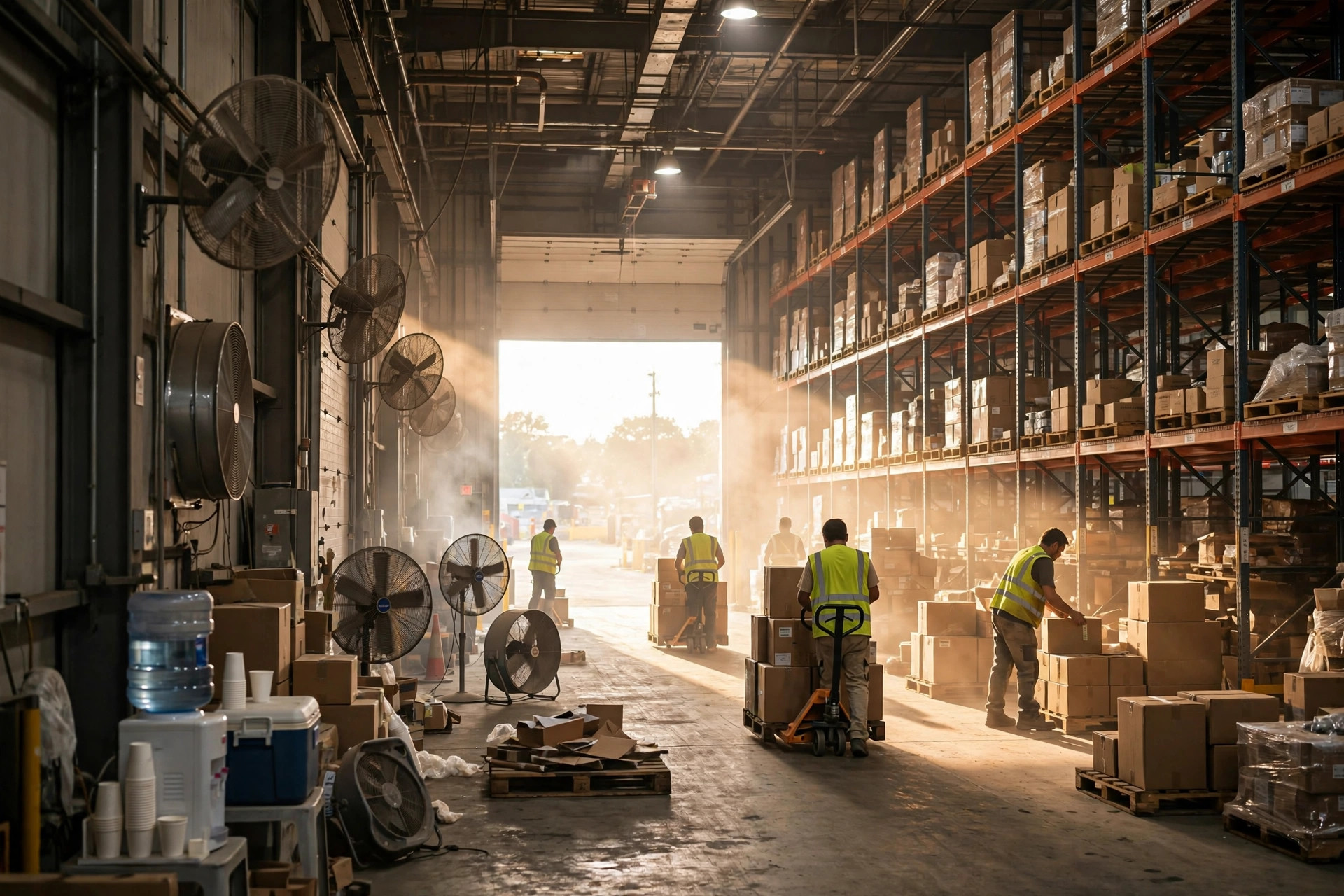
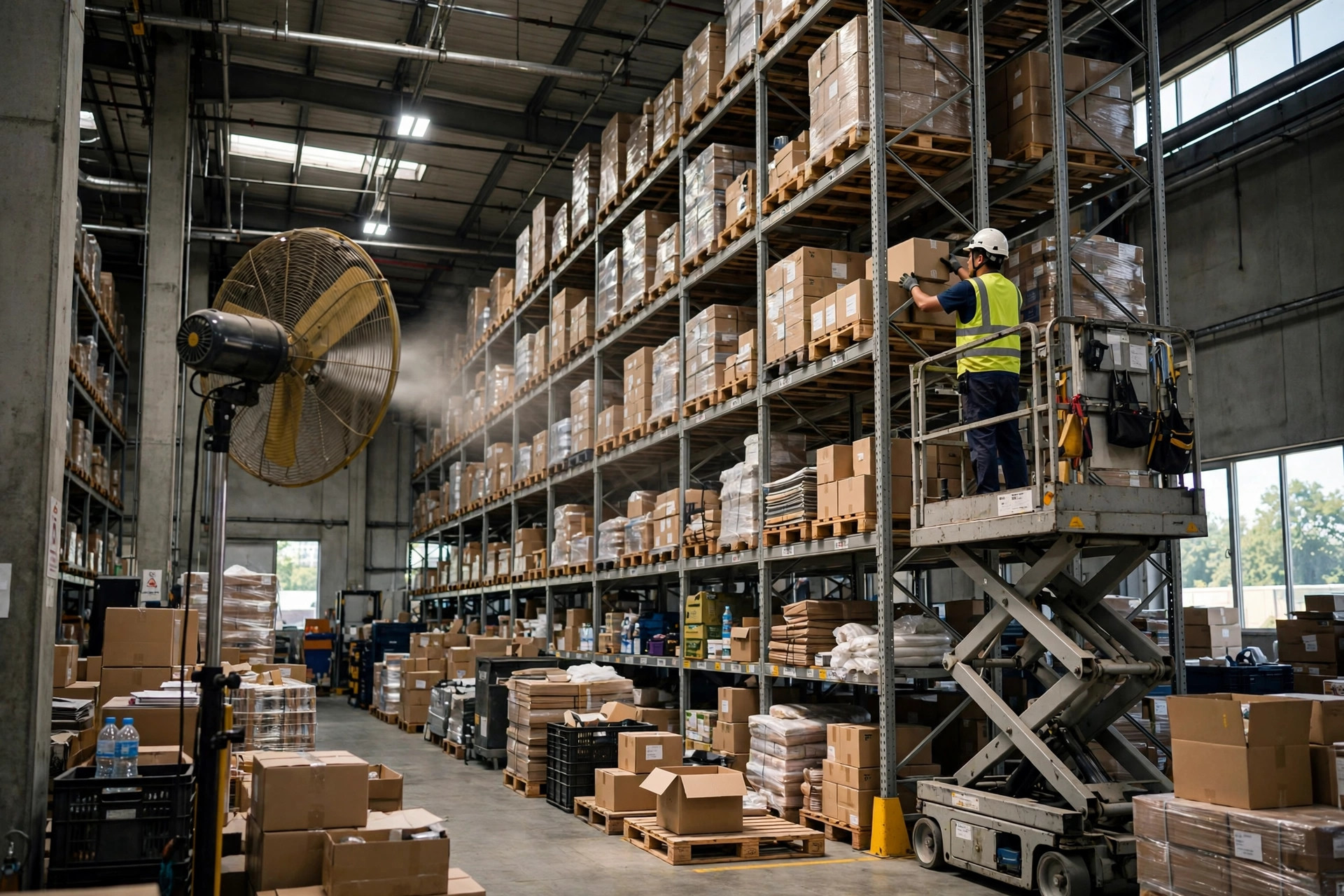
On a September afternoon in 2026, the thermometer inside a 120,000-square-foot distribution center in California's Inland Empire read 91°F. Dock doors stood open, hot air rolled in, and a newly installed industrial fan pushed air across the sort line — bought to satisfy a regulation already two years on the books: California's indoor heat illness prevention standard, Title 8, Section 3396.
According to Cal/OSHA's public materials, the Standards Board adopted Section 3396 on June 20, 2024, and the Office of Administrative Law approved it effective July 23, 2024. The rule writes a single sentence into law: whenever employees are present and the indoor temperature reaches 82°F, the employer owes a full set of heat-illness protections. Warehouses, distribution centers, and food processing plants — big boxes with no air conditioning, high ceilings, and dock doors for ventilation — are first in line.
This article is about implementation, not press releases. The rule is in force and enforcement is active, yet most of what I see published stops at "California has a new rule." What warehouse operators actually need is operational: how to measure the threshold, how to lay out cool-down areas, what goes in the written plan, what training records to keep.
The data: why California warehouses got targeted first
A few numbers frame the picture. Public occupational-safety statistics attribute roughly 40 worker deaths a year in the U.S. to environmental heat exposure, with heat-related workplace injuries running into the hundreds of thousands annually. The California numbers explain the enforcement logic better: a peer-reviewed study published in Health Affairs found that after the state strengthened enforcement of its outdoor heat standard between 2010 and 2014, heat-related outdoor worker deaths fell 33%, with a further 51% decline following the standard's 2015 revision. Enforcement works — which is precisely why Cal/OSHA is replicating the same playbook indoors.
Enforcement density is rising. Industry reporting on Cal/OSHA's enforcement record notes that an Amazon regional air freight hub in San Bernardino received three heat-related citations in January 2024, totaling $14,625 in penalties. No single citation is frightening in size; the signal is. Large logistics facilities are on the inspection list.
The rule itself: what the indoor heat illness prevention standard actually requires
Strip Section 3396 down and a warehouse manager needs to hold onto two thresholds and one document.
The first line: 82°F. When employees are present and the indoor temperature reaches or exceeds 82°F, the baseline obligations kick in: provide sufficient drinking water that is fresh, suitably cool, free of charge, and located as close as practicable to the cool-down area; maintain cool-down areas and encourage workers to use them; monitor employees for symptoms and provide first aid and emergency response; closely observe new employees during their first 14 days as they acclimatize; and train employees and supervisors on heat risk factors, illness symptoms, water consumption, and emergency procedures — before they are exposed. And the most important item: establish and implement a written Indoor Heat Illness Prevention Plan covering water, cool-down areas, acclimatization, and emergency response procedures.
The second line: 87°F. When the indoor temperature or heat index reaches 87°F — or when it is 82°F but employees wear clothing that restricts heat removal or work in high radiant heat areas — additional duties trigger: measure and record the temperature and heat index, and implement control measures where feasible. In short, 82°F is the plan-and-provision line; 87°F is the measure-and-control line.
Exceptions: Brief or incidental exposure — less than 15 minutes in any 60-minute period at temperatures from 82°F up to (but not including) 95°F — generally falls outside the rule, though this exception does not apply to vehicles without effective air conditioning. For boundary cases, check the current text on Cal/OSHA's official site; regulatory details should always be verified against the latest official version.
One common misunderstanding deserves its own paragraph: the standard does not care whether you are a "hot industry." It cares what the thermometer says. An office with a broken air conditioner or a sweltering equipment room could theoretically be covered. Warehouses are the enforcement focus not because the rule names them, but because warehouses are the buildings most likely to exceed 82°F.
Implementation: an indoor heat illness prevention checklist for warehouses
The Inland Empire 3PL's 2025 heat-season retrofit is representative. Their approach abstracts into a checklist, organized here as action, basis, and timeline. This is a synthesis of the public regulatory text and observed industry practice; verify specifics against Cal/OSHA's current official guidance.
| # | Item | Action | Regulatory basis | Suggested timeline |
|---|---|---|---|---|
| 1 | Temperature monitoring | Place thermometers or loggers in work zones, docks, and high-bay areas; log daily during heat season | 82°F trigger; 87°F measurement-and-record duty | Deployed by April each year |
| 2 | Written plan | Draft the written indoor heat illness prevention plan covering water, cool-down, acclimatization, emergency procedures | Plan is mandatory at 82°F | Complete and communicated before heat season |
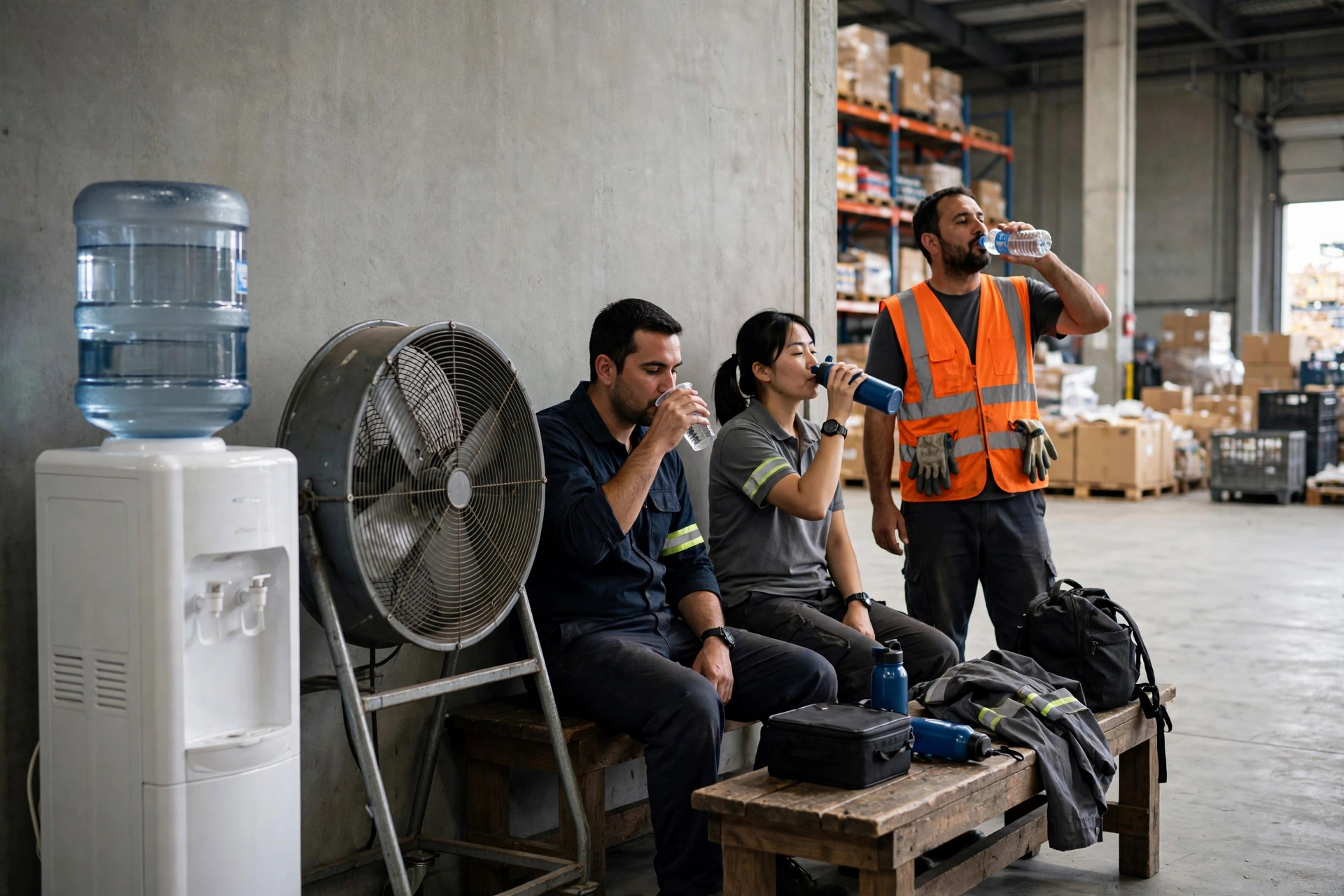
| 3 | Cool-down area | Designate a separate rest zone with fans or cooling, away from heat sources, with enough seating | Cool-down areas are a baseline duty | Ready by May |
| 4 | Drinking water | Stations near the cool-down area; fresh, cool, free, easy to reach | Rule requires water as close as practicable to cool-down | Maintained year-round |
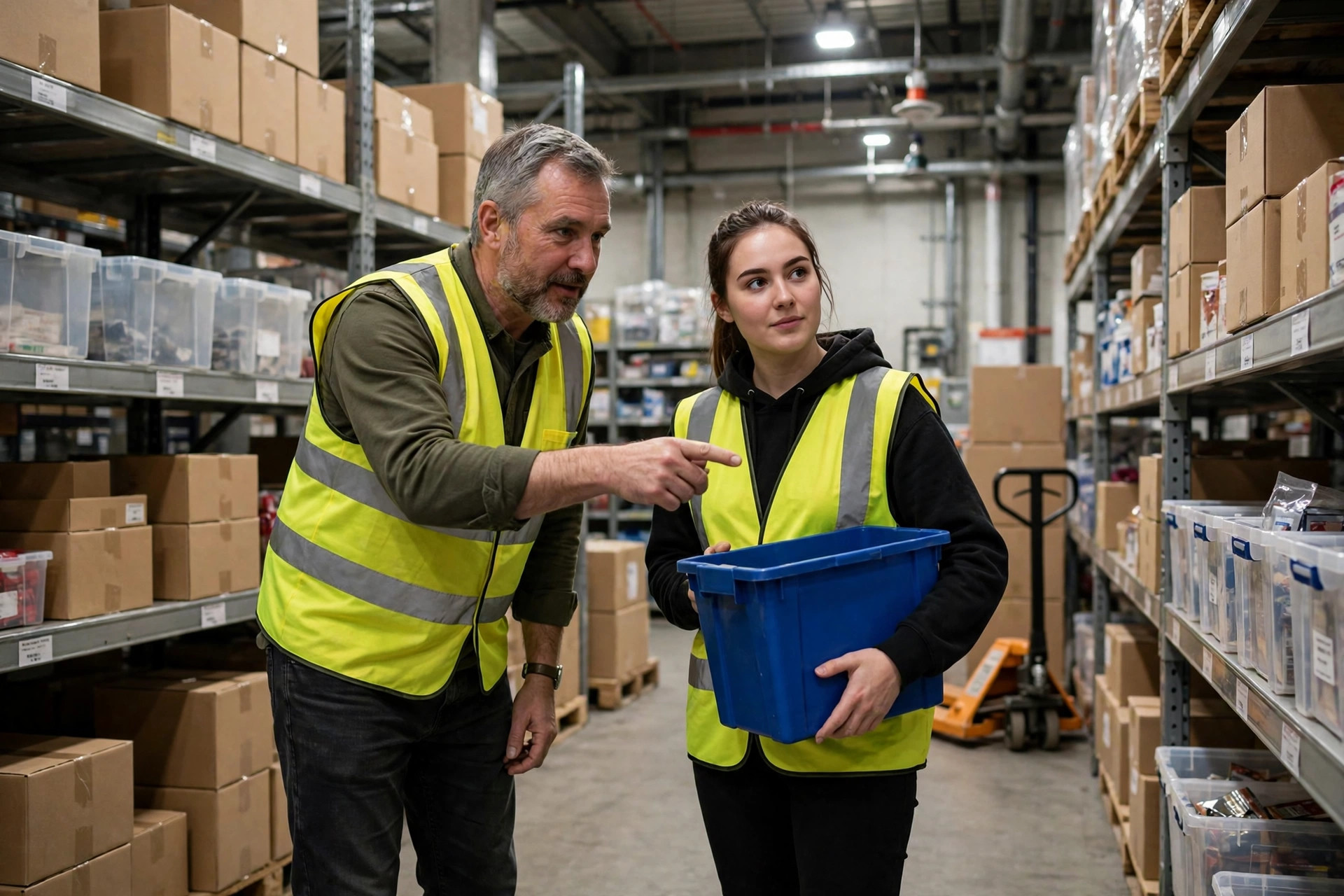
| 5 | New-hire acclimatization | Closely observe new hires for the first 14 days; ramp up heat-exposed work gradually | 14-day observation requirement | Built into onboarding |
| 6 | Training records | Complete all-employee and supervisor training before heat season; keep sign-in sheets and materials | Training must precede exposure | Done by May annually |
| 7 | Emergency procedures | Define illness recognition, on-site first aid, 911 protocols, hospital routes, and named responsible persons | Emergency response is a required plan element | Drill once a year |
| 8 | Control measures | When approaching 87°F, evaluate engineering controls (exhaust, insulation, staggered shifts) | 87°F triggers measurement and feasible controls | Assessed dynamically in season |
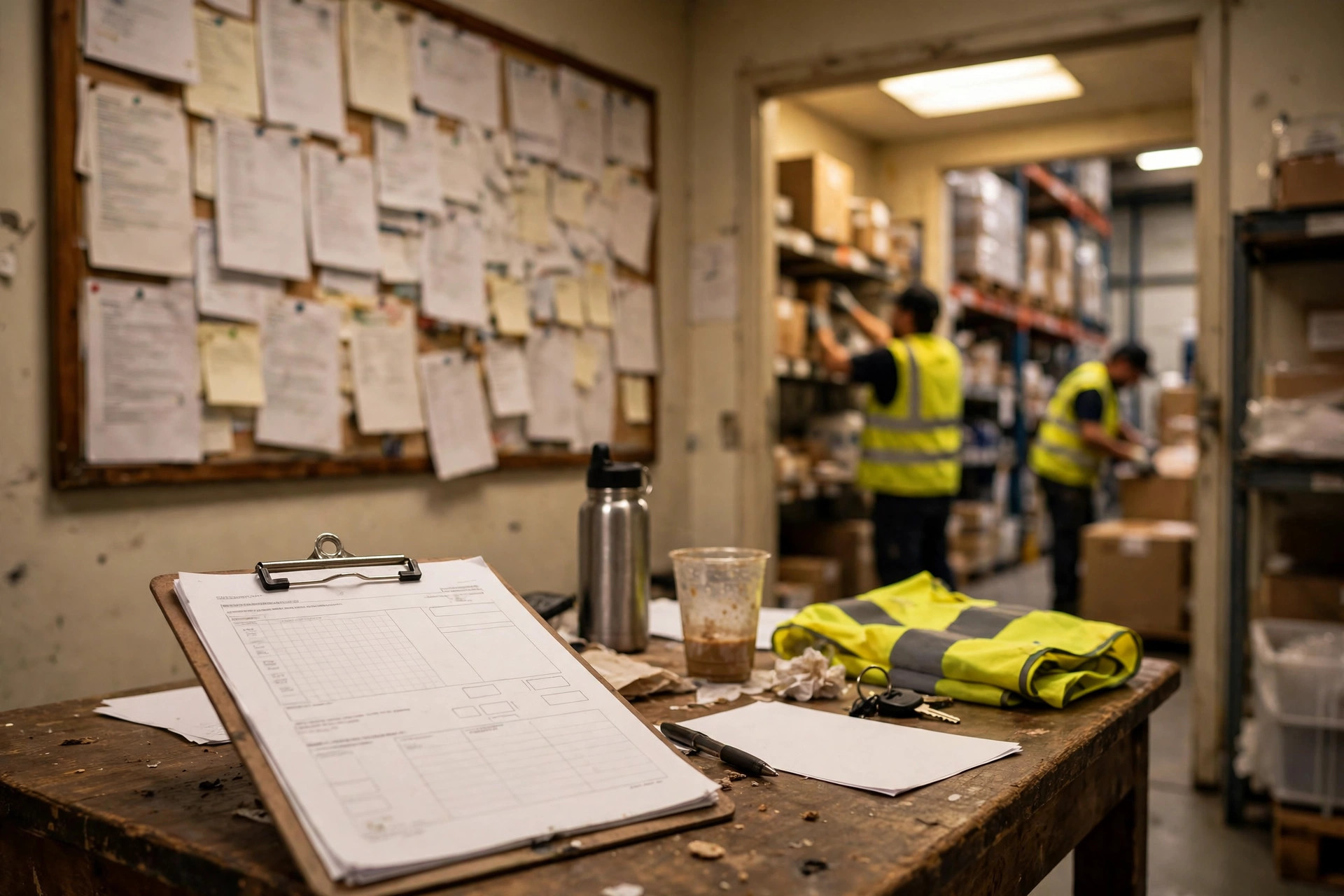
On this list, inspectors gravitate toward items 1, 2, and 6: temperature logs, the written plan, and training sign-in sheets. These are direct evidence of whether the work was done. Water stations and cool-down areas are visible on a walk-through. Emergency procedures become the liability document after an incident — and the absence of a plan typically draws a heavier citation than the absence of a fan.
A counterintuitive judgment: many warehouses' first instinct is air conditioning, but AC is the worst compliance investment per dollar. The rule asks for a plan, water, cool-down areas, training, and records. Industrial fans plus shading, insulation, and staggered scheduling can keep most work zones within a comfortable margin of the line.
The trend: does this line keep tightening
My judgment is yes, and it already is. Three lines of evidence.
First, California enforcement has a clear "outdoor first, indoor second" path dependency. The outdoor standard took effect in 2006 (Section 3395); the indoor standard did not land until 2024 — an 18-year gap, even though the legislature's SB 1167 had ordered an indoor standard by January 1, 2019. Path dependency means this: since the outdoor enforcement data (the 33% and 51% death reductions) already proved the playbook works, indoor enforcement intensity will climb along the same curve, not reverse.
Second, the federal layer is catching up. Federal OSHA's nationwide heat rule proposal has completed its comment phases; as of October 2026 it was not yet a final rule, but once finalized it will be a uniform baseline for employers nationwide. What California employers build today for Section 3396 — temperature monitoring, written plans, training systems — will very likely transfer directly. This money gets spent sooner or later; spending it early amortizes the future compliance cost.
Third, other states are following. Oregon adopted its own indoor heat rule back in 2022, and states including Washington and Colorado have heat-protection requirements of varying scope in motion. California is not an island; it is a bellwether.
So return to that 3PL's $40,000 fan. Viewed in a single year, it was a forced expense. Viewed on a three-to-five-year timeline, it bought three things: inspection pass rates, a reusable compliance system, and a work environment that retains people through peak season. The essence of heat compliance was never just "avoid the fine." It is "avoid the incident." Fines have caps. Incidents do not.
An open question for the reader: once 82°F becomes "heat" in the legal sense, should warehouse climate design be redefined from a comfort exercise into a compliance exercise? If so, the formulas for HVAC selection in new builds and retrofit budgets may all need rewriting.
By Dr. Chen, Supply Chain Researcher