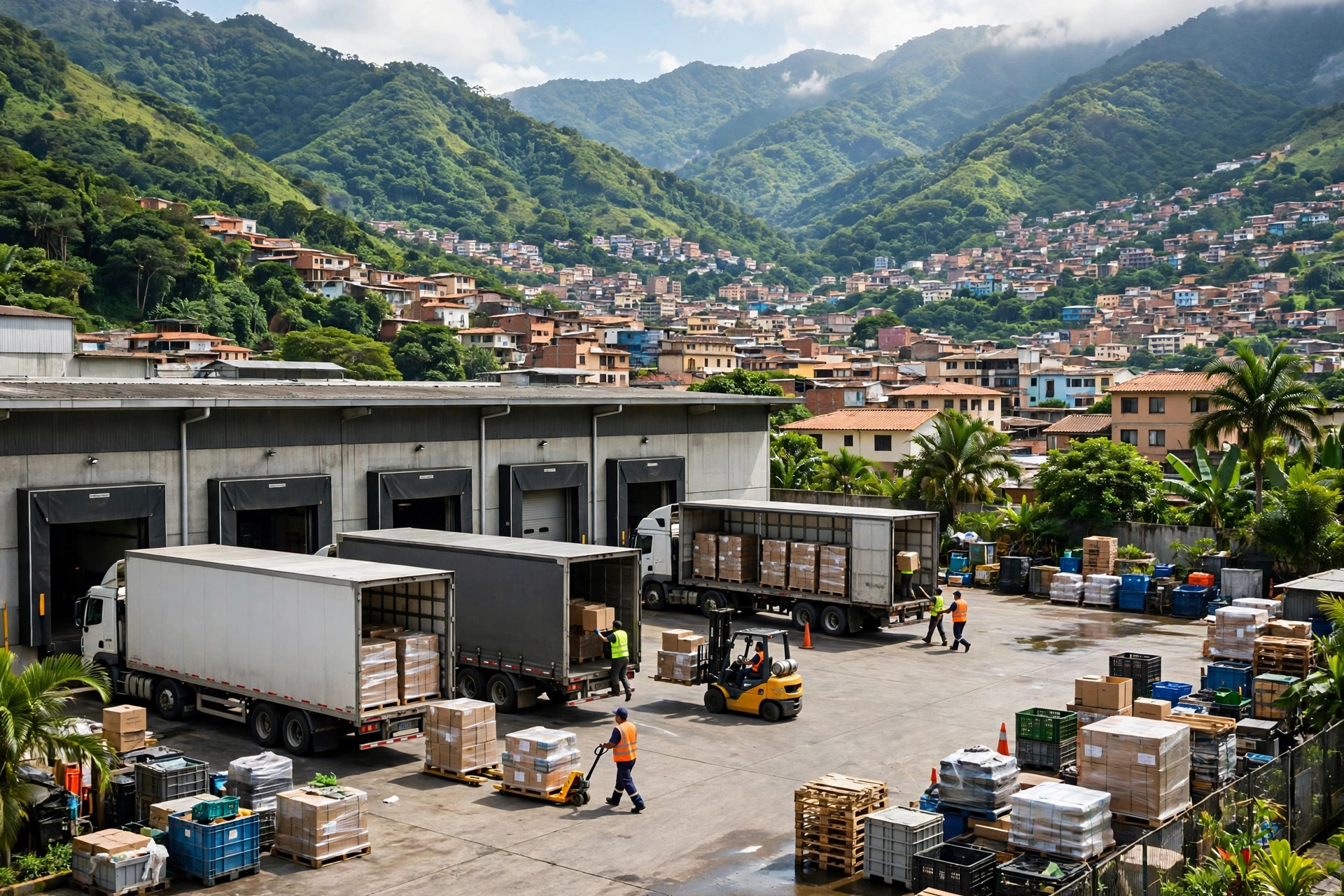
Morning in Cali arrives wrapped in mountain mist. A truck rolls down the valley road, brakes still warm, and the driver nurses a coffee by the dock while waiting for the warehouse doors to open. The first time I watched that scene, one thought stuck with me: in a valley city, freight is genuinely awkward to handle. Cali does not sprawl the way a flatland city does. The roads are few, the directions are few, and if you put your warehouse in the wrong spot, you spend every day after that paying for the mistake. We small warehouses cannot afford that kind of tuition, so let me walk you through this bill line by line.
Here is the uncomfortable starting point most guides skip: people look at Cali, note its name, note its closeness to the Pacific port corridor through Buenaventura, and assume proximity equals advantage. Proximity is one thing. Getting freight smoothly off the coast, into the Cauca Valley, and then back out to a scatter of regional cities is quite another. Cali sits in a valley ringed by mountains, with the city, its suburbs, and its farm belt squeezed into the same corridor. Pick the city and you are near your customers. Pick the suburbs and you are near the road network. Pick the farm belt and you are near your supply. The catch, and it is a big one, is that those three advantages never share the same address.
Why Valley Freight Is Hard to Hold
Let me give you two headaches I have watched up close, both the kind that keep a small warehouse owner awake.
The first involved a friend handling farm produce for regional distribution. When harvest season hit, goods poured toward Cali from both sides of the valley: mixed categories, mixed batch sizes, arrivals that never lined up neatly. His warehouse was an old yard inside the city, with a narrow gate and no room for a large truck to turn. Big vehicles could not get in, so everything had to be broken down outside and shuttled in piecemeal. For days his whole crew was consumed by shuttling and waiting, and every extra night goods spent sitting on a truck brought more damage and more complaints. He told me later that the real problem with a city warehouse was not floor space at all. It was freedom of movement. A truck's schedule always had to negotiate with city traffic, gate hours, and local restrictions.
The second headache belonged to a peer doing city delivery. His customers were spread across Cali and the surrounding towns, orders were small and urgent, and he wanted his warehouse practically next door to them. He took a well-located city site and discovered that large trucks struggled to move during the day, so inbound work piled into the night and driver rosters fell apart. Worse, when peak season arrived, orders from outlying towns also had to flow through that same city point, and the warehouse that was supposed to be close to everyone became the bottleneck instead. Close, but unable to ship. Both stories point to the same lesson: in a valley city, location is not about who you are near. It is about whether freight flows in the right direction without friction.
Three Locations, Three Ways to Burn Money
Roughly speaking, Cali offers three kinds of site, and their bills must be compared separately rather than lumped together.
| Location | Best for | The upside | The trap |
|---|---|---|---|
| City | Urban delivery, time-sensitive customers | Close to buyers, fast response | Truck access constrained, expansion difficult, operations hemmed in |
| Suburbs | Regional distribution, cross-docking | Near the road network, free truck movement, room to grow | Longer delivery radius, last-mile cost must be calculated order by order |
| Farm belt | Origin consolidation, grading and basic processing | Close to supply, less handling before storage | Seasonal swings, road conditions in the rainy season, idle space in the quiet months |
A city warehouse looks cheap on delivery distance and then quietly charges you in access and time. A suburban warehouse is the mirror image: the building itself is easy to run and trucks come and go happily, but every order's final leg has to be recalculated, and once your customer base spreads, the rent you saved can drift straight back into transport spending. A farm-belt warehouse lives and dies by the season. Harvest time is frantic; the quiet months can leave half the building empty while fixed costs keep rolling in. None of the three is simply cheapest. The right question is which bill matches your freight.
There is also a labour bill that newcomers underestimate. Hiring is usually easier in the city. In the suburbs and the farm belt, you have to think about commuting and whether workers can realistically stay through a season. A warehouse that cannot staff its peak is a warehouse that cannot turn, however good its location looks on paper. If you choose a remote site, budget for recruitment and rostering early, not after opening day.
Now the contrarian judgment, and I know it will annoy the big operators: a prestigious address is a luxury, not a strategy. Large companies can afford to plant a flag somewhere impressive because brand and scale absorb the cost. A small warehouse cannot copy that playbook. Our edge is not a good-sounding address. It is a bill we can actually read. If a location makes you pay daily for access, shuttling, and idle space, then no matter how handsome the postcode, it is a losing site.
Our Homegrown Method: Start Small, Survive First
Our method is unglamorous, but it works, and it boils down to three questions asked before any lease is signed.
First, where does your freight come from and where is it going? Supply-heavy freight leans toward the farm belt. City-order-heavy freight leans toward the city. Freight that must fan out to regional cities leans toward the suburban road network. Get the direction wrong and everything after that is damage control.
Second, can your quiet season carry this warehouse? Do not just model the busy months. Model the empty ones. Farm-belt sites demand this discipline most, because a busy harvest can hide a bleak off-season right up until the bills arrive.
Third, can your trucks actually get in and out? Visit the site at morning and evening peaks before you trust any map. Gate width, turning room, and whether night operations are workable decide your true daily cost far more than a brochure ever will.
Run those three questions over every candidate and many apparently cheap sites eliminate themselves. We have no budget for trial and error, so we would rather start smaller, slightly off-center, but pointed in the right direction, than lock ourselves into an address we cannot escape. Once volumes steady and customers stick, you can move to a better site with cash flow behind you and far more negotiating power.
What I Would Tell a Peer Looking at Cali
Think of Cali as a valley market first and a city market second. Freight travels along the valley, so warehouses should follow freight, not the other way around. The Pacific port corridor matters, but it is one link in a chain: coastal freight must enter the valley, valley freight must reach regional cities, and somebody has to catch it at every step. For policy, tax, and regulatory specifics, conditions change and local enforcement varies, so always go by the latest official guidance — do not sign a contract on the strength of a broker's sales pitch.
My practical advice is simple. Judge a site by its roads first, its gates second, and its price third. Put the busy-season bill and the quiet-season bill side by side before you commit. Never pay for an impressive address beyond what your volume can support. In a valley city, the right site feels like swimming downstream and the wrong one feels like swimming upstream every single day. We small operators do not have grand advantages, just careful arithmetic and small steps. A small warehouse has its own way of making a living: survive first, and the future gets a chance to arrive.
By Xiao Ma, Small Warehouse Owner