An AS/RS has a funny temperament. Year one, you brag about it. Year two, you take it for granted. Year three, it starts acting up — slower, jammier, occasionally "playing dead" for half an hour. The boss asks if it's time to replace it, the vendor says just add another aisle, and maintenance says it can hold on two more years. Everyone's confident, and nobody has data.
After twenty years in warehousing, I've watched too many automated systems die of "feels fine." From the day a stacker crane passes acceptance testing, its performance rides a slow downward curve. The only question is whether you know where on that curve you are right now. Year three is the inflection point: mechanical wear starts showing, the original slotting plan no longer matches your SKU mix, and the control system is still tuned for opening-day volumes. My advice is blunt: at the three-year mark, run a retest. Get the data first, then decide whether to tune, repair, or plan a retrofit.
Start With the Acceptance Report, Not the Aisle
The first step of the health check isn't walking the aisle — it's opening the filing cabinet. Pull the acceptance test report from three years ago and copy down three numbers: single-cycle throughput (cycles/hour), dual-cycle throughput (cycles/hour), and average task response time. That's your factory health record, and the retest measures against it.
How to retest without shutting down? Don't. Instead, pull 30 days of WCS task logs and calculate actual throughput per shift, taking the 30-day median for inbound singles and dual cycles, then compare against the acceptance numbers. I did this for a double-deep crane commissioned in 2021 at a Columbus, Ohio e-commerce DC: acceptance dual-cycle was 95 cycles per hour; three years later the median was 78 — down nearly 20%. Management had always felt things were "running fine." The numbers ended that conversation.
Here's my rule of thumb for reading the results: within 10% of acceptance, that's normal aging — tune parameters and keep up maintenance. Down 10 to 20%, it's time to act — check rail wear, fork chains, motor current. Down more than 20%, stop debating and bring in the OEM for a full mechanical inspection; something structural is usually wrong. One trap to avoid: don't compare peak-season single-day spikes against acceptance figures. Acceptance was measured under standard conditions, so compare with a 30-day median. Apples to apples.
Aisle Utilization Isn't About How Full the Racks Are
Most health checks look at machine speed and stop there. They skip slotting — and three years is plenty of time for your SKU mix to outgrow the original ABC plan. I've seen a DC where half the "A" SKUs occupying 40% of the golden aisles had been discontinued, while new bestsellers were buried at the far end of the rack. The machine was innocent; the slotting plan had simply expired.
The recheck is straightforward: rank SKUs by pick frequency over the last 12 months. The top 20% must live in the aisles closest to the I/O station and at lower levels. If more than 30% of your A movers are living in the suburbs, your system is spending 80% of its energy doing 50% of the work. While you're at it, hunt dead stock — pallets untouched for 180 days should be cleared or moved to manual storage, not squatting in your most expensive real estate.
Here's the one people miss: task queue time in the aisle. Your WCS log records how long each task waits between being issued and the crane starting it. Take the median during peak hours. If that number has doubled versus three years ago, the problem isn't a slow crane — it's scheduling that can't keep up with volume. Maybe wave strategies were never retuned, maybe the conveyor at the I/O station is the bottleneck. Fixing the schedule beats adding an aisle, and it costs a fraction.
Failure Data Doesn't Lie
Step three: failures. Take 12 months of fault tickets and categorize them by component — forks, travel motors, hoist motors, positioning systems, communications, safety light curtains. Plot a monthly trend and watch for two things.
First, whether the interval between failures on the same component is shrinking. Fork chains replaced once in year one, twice in year two, three times already this year? That's not bad luck; it's wear entering its acceleration phase. In my experience, major mechanical components on a stacker crane last roughly 8 to 12 years, but years three to four are the watershed — consumable replacement frequency visibly steps up. Budgeting next year's spares against that trend is far cheaper than a 2 a.m. emergency repair.
Second, watch the share of "soft" faults — stoppages with no clear cause that clear on restart. More than five of those in three months almost always points to the control layer: a dirty positioning strip, aging comms cable, a PLC timer parameter that no longer matches current cycle times. Soft faults are the silent killers: 10 to 20 minutes each, adding up over a year to more lost capacity than one major breakdown.
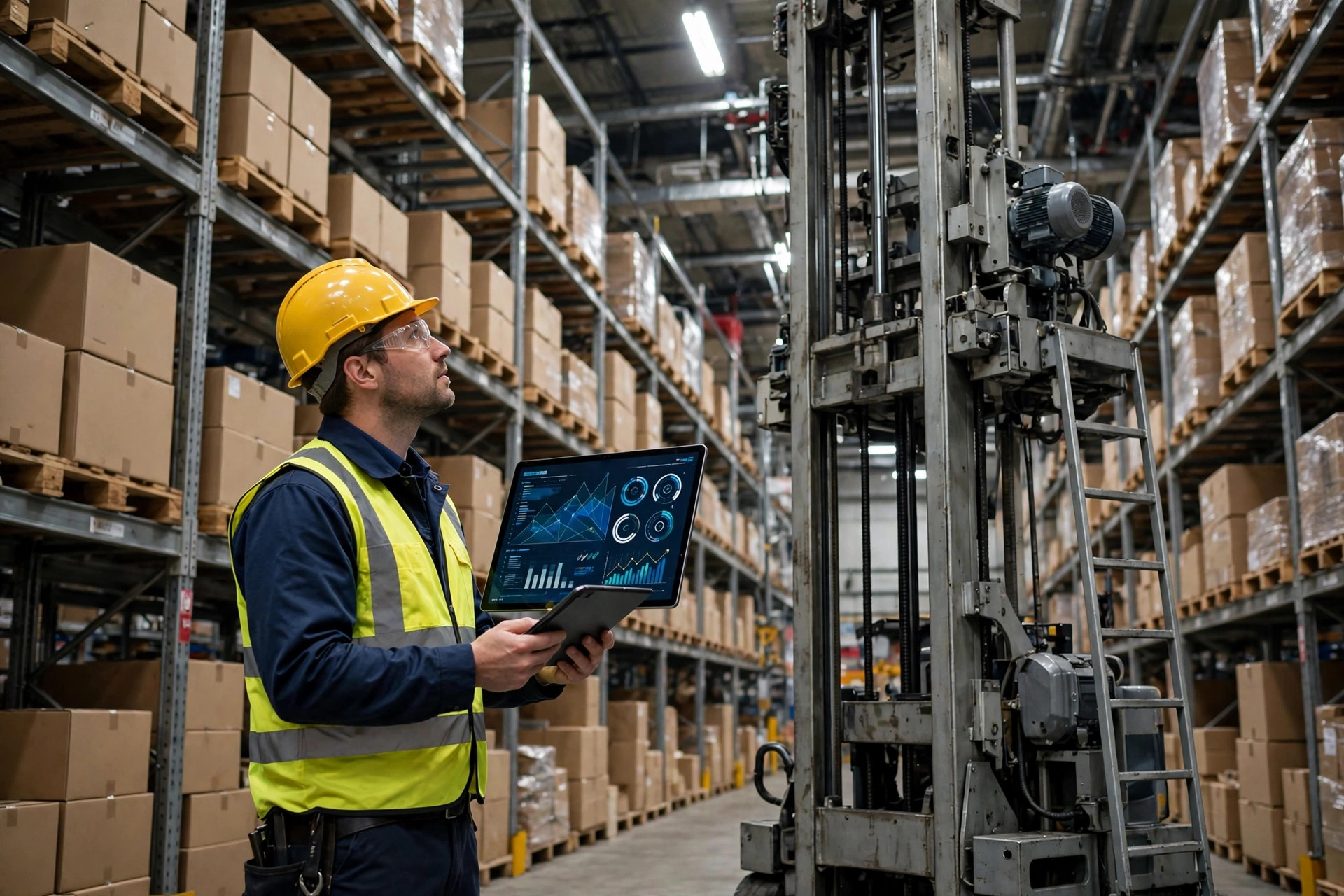
A real lesson from 2023: a food distribution DC in New Jersey, three years post go-live, management insisting everything was fine "except the occasional jam." We pulled the data: dual-cycle down 17%, 35% of A movers slotted in remote aisles, fork chains replaced four times in a year. The conclusion wrote itself: re-slot first (two weeks, zero hardware spend), then a full inspection of chains and rails with replacements where needed. Post-fix dual-cycle came back to 88 per hour, and the boss shelved a $400,000-plus budget line that had been earmarked for "adding an aisle."
So the health check usually ends in one of three places. One: healthy machine, expired slotting — re-slot, cheapest fix there is. Two: accelerating wear, decent slotting — plan a preventive overhaul and put it in next year's budget. Three: both failing — only then do you talk retrofit or expansion. Don't get the order backwards. Leading with "add an aisle" makes the vendor happiest and you poorest.
This weekend, spend two hours categorizing the last three months of fault tickets by component. The result will tell you exactly where next year's maintenance budget should go — more reliably than any vendor slide deck.