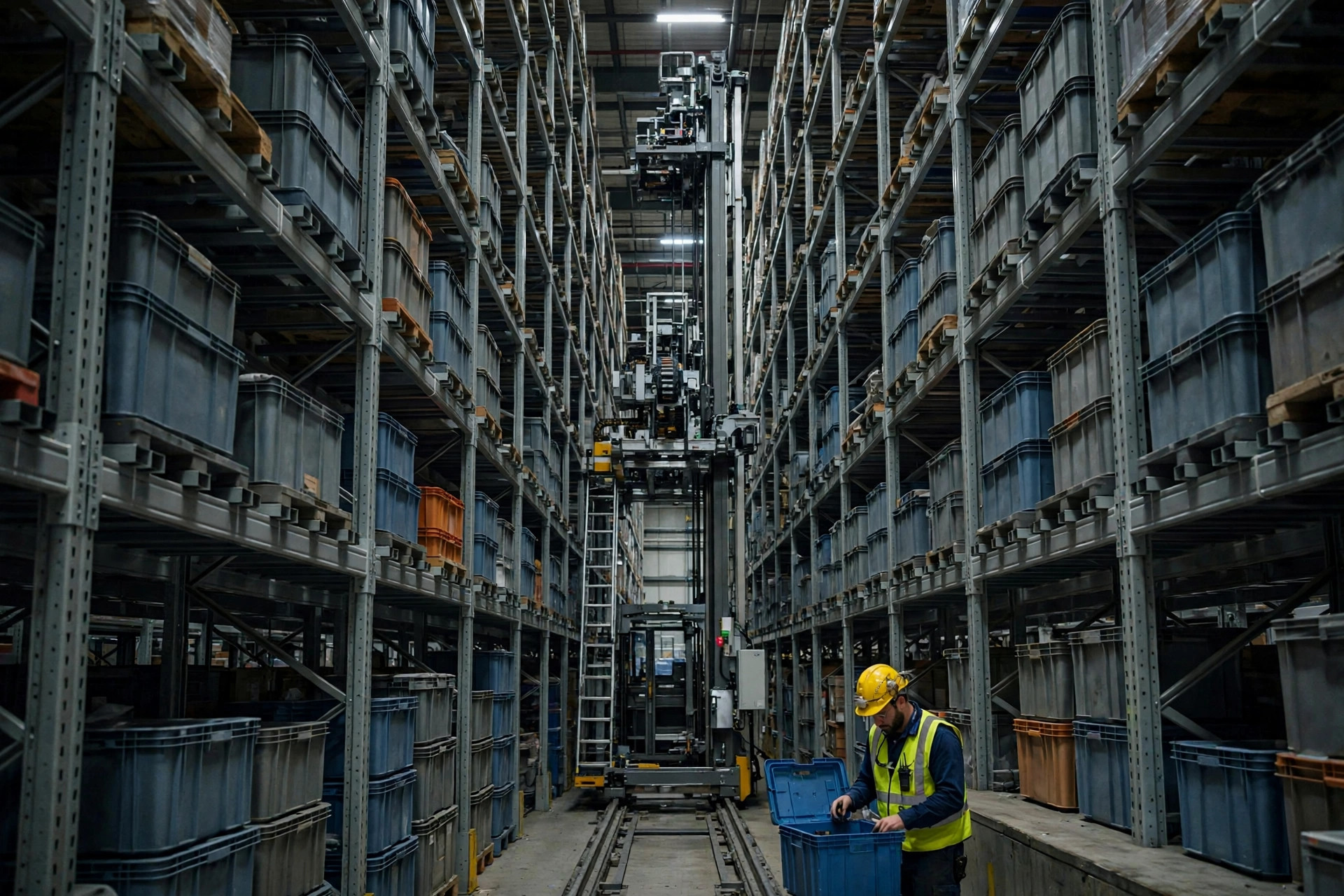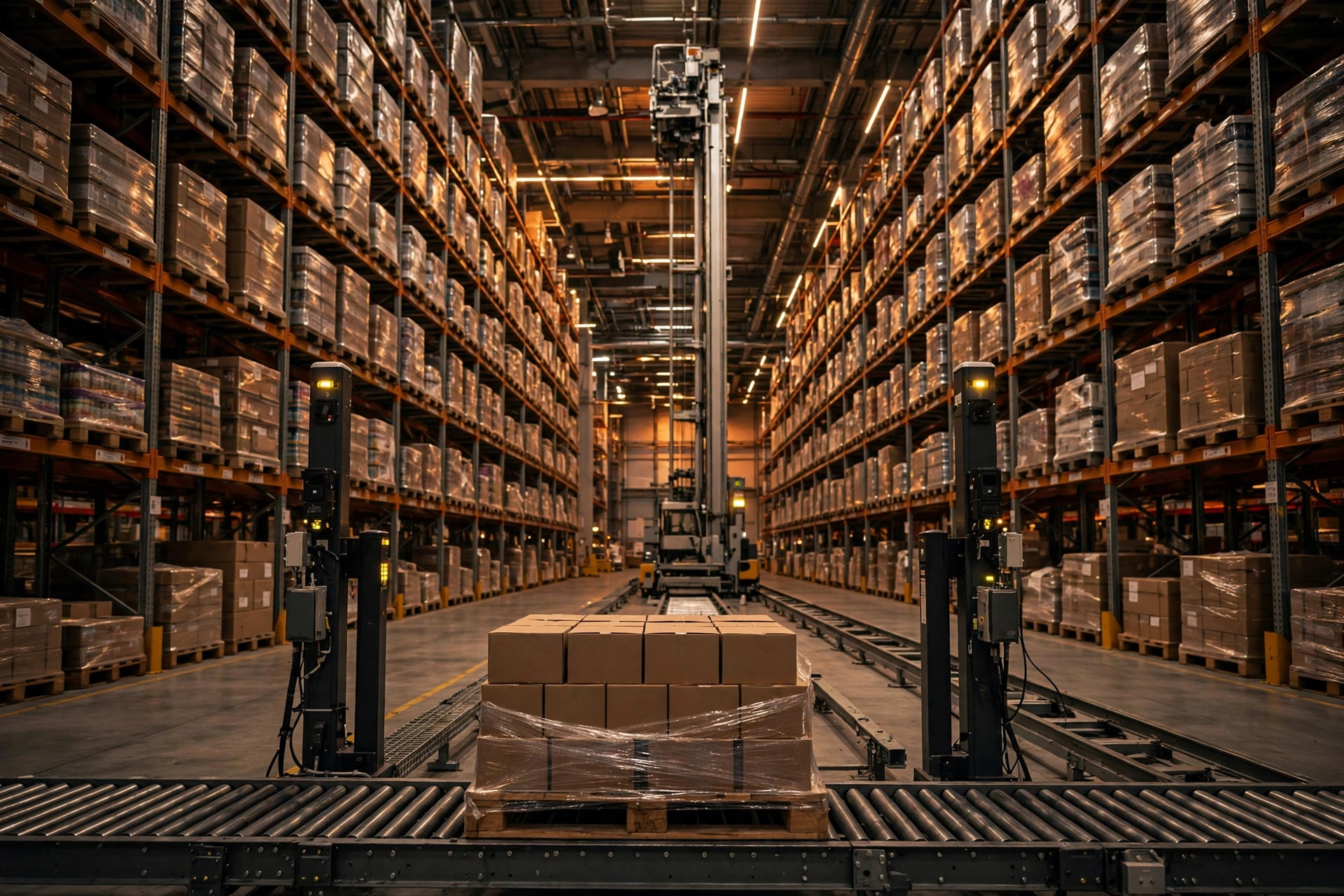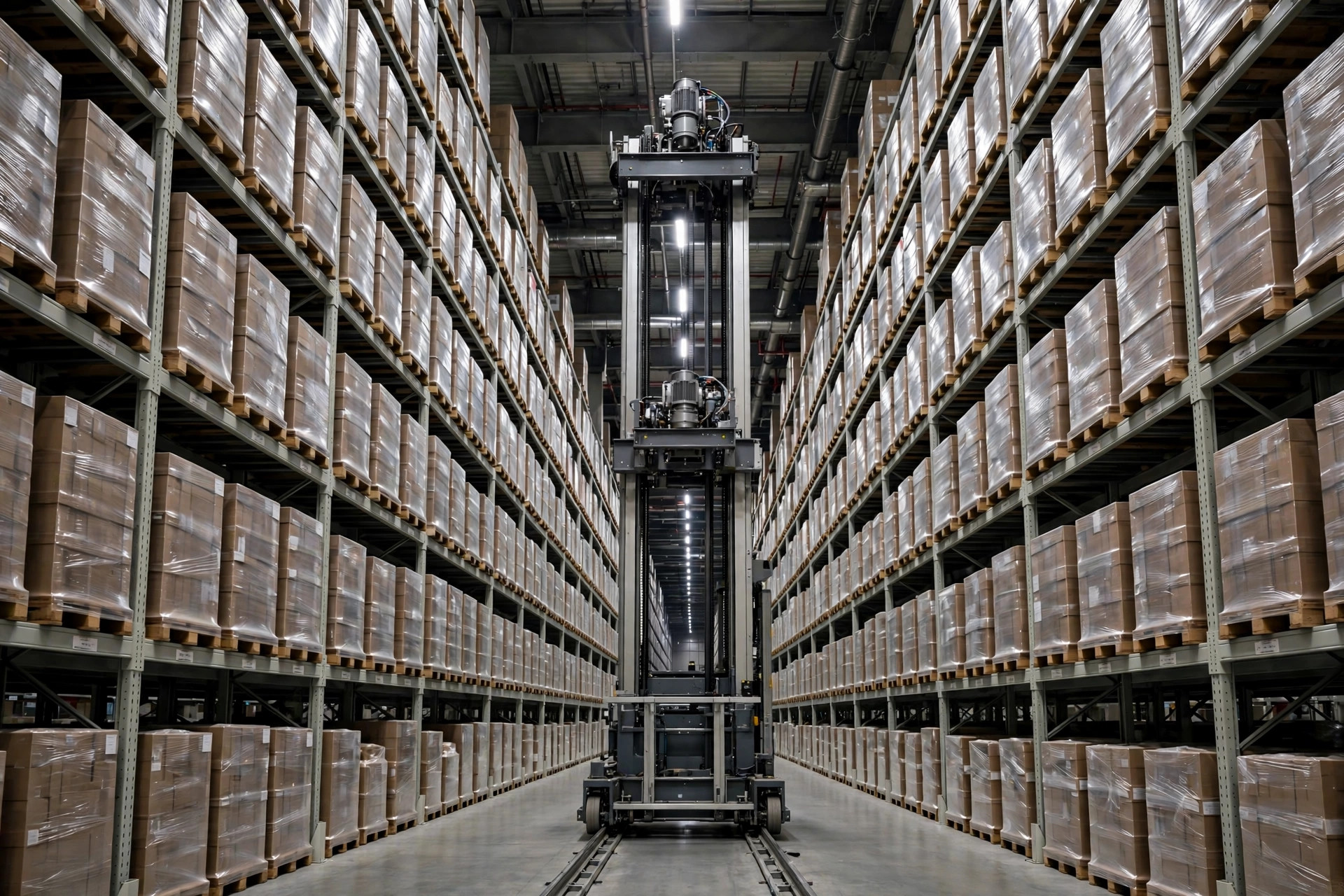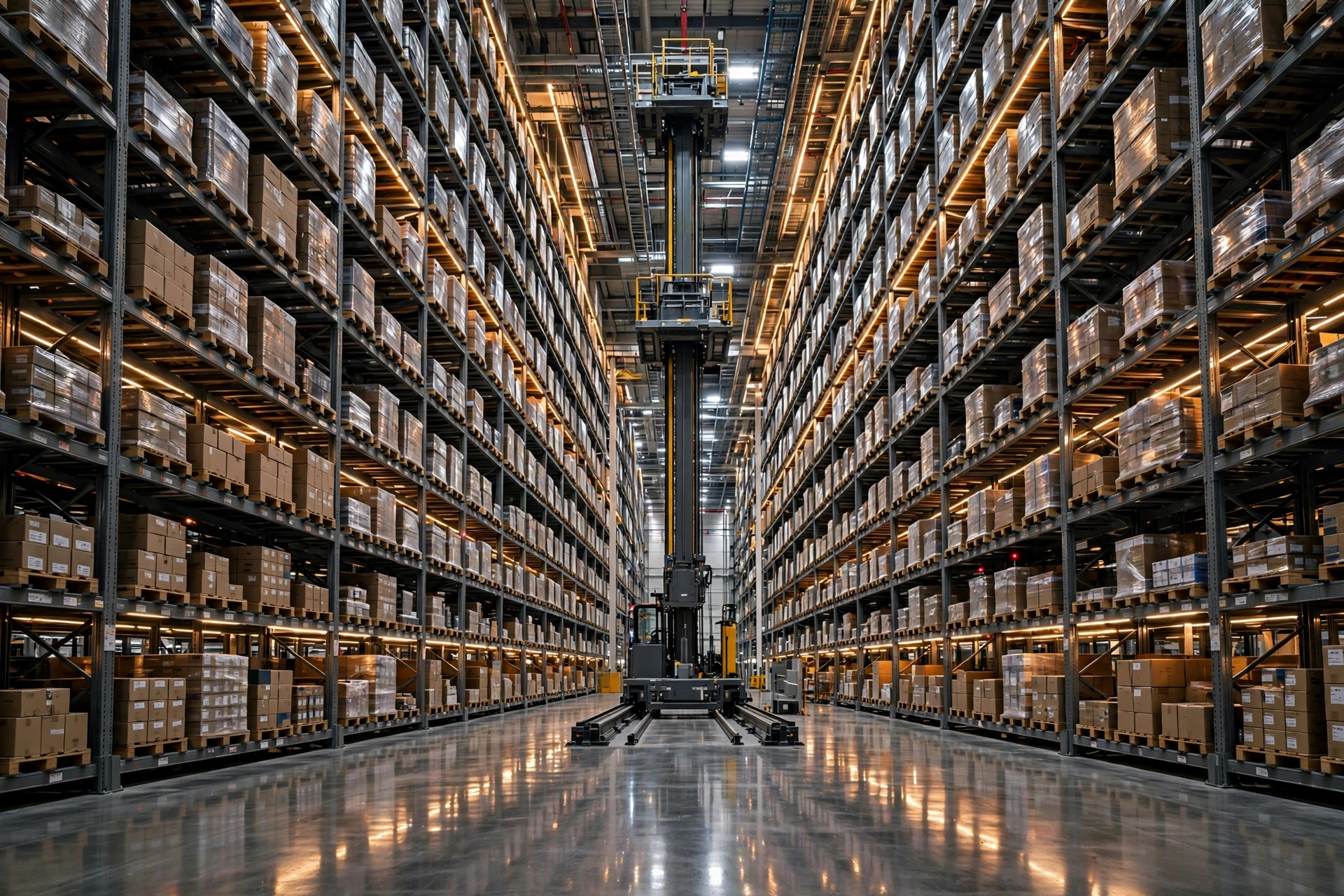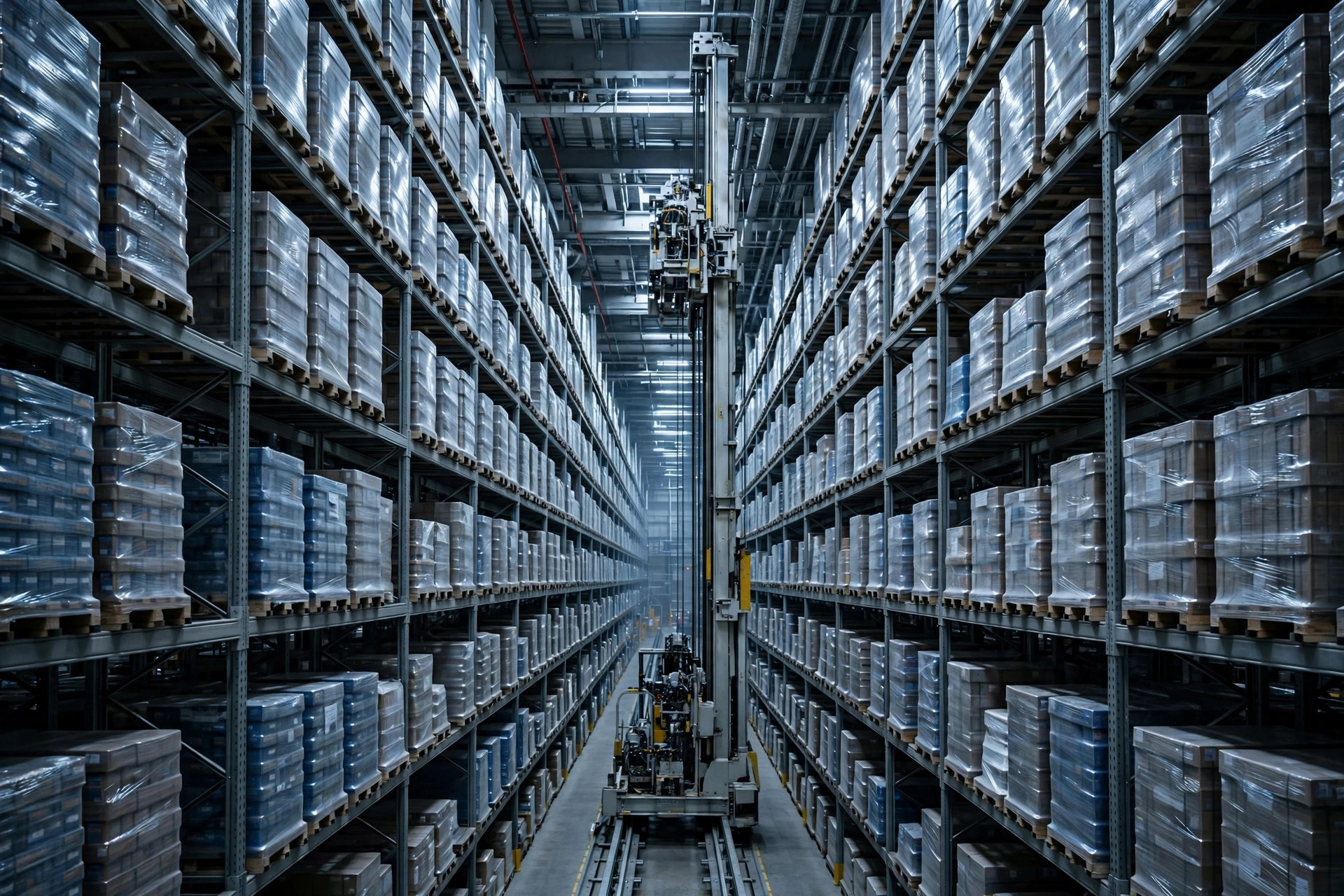
Walk into two identical 100,000-square-foot warehouses. One runs single-deep selective racking: 5,000 pallet positions. The other runs double-deep: around 6,500. Same building, same product, fifteen hundred extra pallets — that is the pitch, and the math is real.
What the pitch leaves out is the price tag attached to those fifteen hundred positions. I get asked about double-deep versus single-deep every year, usually during automated warehouse evaluations, and the glossy renderings always show the same thing: half the aisles, a mountain of pallets. What they never show is a half-empty lane with one lonely pallet sitting in front and nothing behind it. That picture is the whole story.
Where the extra pallets come from
The mechanism is simple. In single-deep racking, each aisle serves one row of rack on each side. In double-deep, each aisle serves two rows deep on each side, so you need roughly half as many aisles. The floor space you free up becomes pallet positions. Industry sources commonly cite around 30% more storage density than selective racking, with some vendors claiming 40% to 50% under ideal conditions.
Read that last phrase again: under ideal conditions. The headline number assumes every lane holds two pallets, front and back, all the time. In a real warehouse, lanes are half empty constantly. Every lane holding a single pallet wastes its rear position, and your realized density lands well below the brochure number.
So when you review a proposal, ignore total pallet positions and ask for effective positions — modeled against your SKU profile and inventory turns, not a template. Templates are always full. Your warehouse is not.
Run the math one level deeper with me. That 100,000-square-foot building: 5,000 positions single-deep, 6,500 double-deep on paper. But if your SKU mix leaves a meaningful share of lanes half full, your usable number might be 5,800. The celebrated "thirty percent" just shrank to sixteen. Always carry the calculation to this step. Stop at 6,500 and you are buying a rendering, not a warehouse.
The honeycomb tax
The core trade-off has a name: selectivity. Single-deep gives you 100% — every pallet directly accessible, any pallet retrievable without touching another. Double-deep cuts that to 50%. Each lane holds two pallets in last-in-first-out order, and reaching the rear pallet means moving the front one first.
This creates three concrete problems. First, SKU count. Each lane should ideally hold a single SKU, because mixing two SKUs front-to-back means shuffling pallets every time you need the rear one. My rule: if you run more than about 500 SKUs in a fully double-deep building, your warehouse team will hate you. Second, lot and expiry control. Food and pharma operations running strict first-in-first-out have to fight the equipment's natural LIFO behavior with careful system-directed slotting. Third, honeycombing — the industry term for lanes holding one pallet with the rear slot empty. The more SKUs you carry and the smaller your batch sizes, the worse it gets.
I saw this play out in a food distribution warehouse in Fontana in 2021 — 80,000 square feet, all double-deep. Six months after go-live, a review showed effective utilization barely twenty percent above the old single-deep layout, nowhere near the thirty percent in the proposal. The cause was SKU count: under three pallets per SKU on average, so a huge share of lanes sat half full with the rear positions collecting dust.
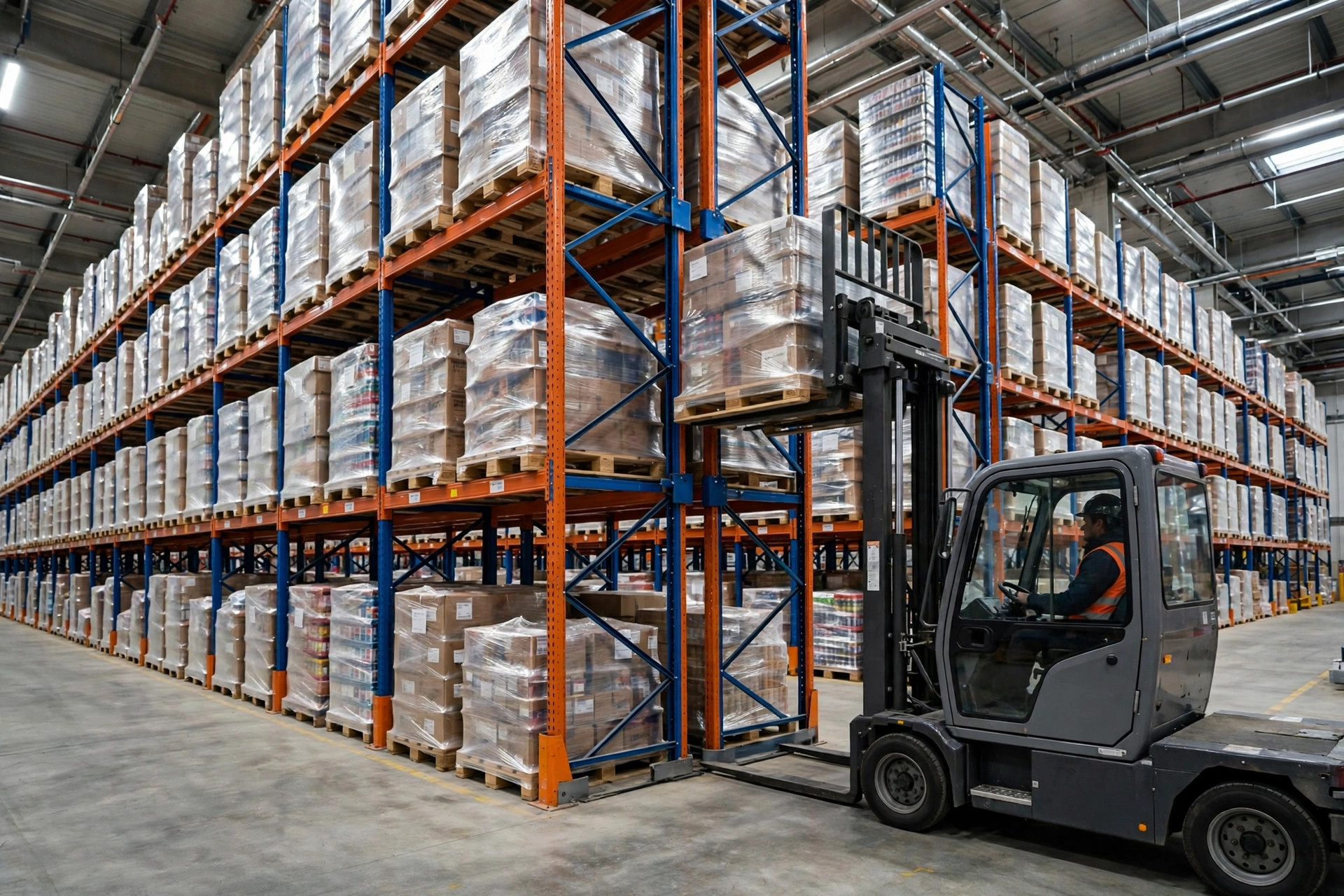
Then there is the equipment bill. Standard forklifts cannot reach the rear position. You need double-deep reach trucks with telescopic or pantograph forks — more expensive to buy, fussier to maintain, and demanding on operators, because the forks extend several feet into the rack where the driver is working half blind. Rack damage runs higher too; every double-deep site I have seen replaces column protectors more often than its single-deep peers. Budget for it.
One more thing vendors blur: double-deep does not meaningfully narrow individual aisles. It cuts the number of aisles, not their width — the truck still needs room to turn and extend its forks. "Lower aisle-area ratio" is not "narrower aisles." Do not let the phrasing do the convincing.
And ask for references with your SKU profile, not theirs. A vendor case study from a beverage distributor running 40 SKUs tells you nothing about your 1,200-SKU 3PL operation. I always ask for two references: one with a similar SKU count, one in the same industry. If both report effective density within a few points of the proposal, the number is real.
My rule of thumb
Double-deep is a good tool that only rewards the right building. It shines where SKUs are few and batches are large: beverages, paper products, building materials, frozen-food raw storage. Freezer warehouses are the classic fit — every square foot of freezer costs a fortune to build and power, so density is money, and frozen product tends to move in big slow batches where double-deep's weaknesses barely show.
Keep it away from e-commerce, 3PL, and grocery distribution with thousands of SKUs. High SKU counts, small batches, fast turns — the 50% selectivity will strangle picking productivity. My cutoff for clients is simple: under 4 pallets per SKU on average, double-deep probably loses money; over 10, it deserves serious consideration; between 4 and 10, model it carefully.
There is also a middle path I like: hybrid layout. Put slow, bulky SKUs in a double-deep zone and fast, small-batch SKUs in single-deep. I designed one for a 3PL in Riverside in 2023 — 60,000 square feet, half and half — and it landed about twenty percent more positions than full single-deep with picking productivity essentially intact. The cost is complexity: your WMS needs two sets of slotting rules. For warehouses with a split SKU profile, it is the best deal on the table.
Four questions for your next selection meeting. One: show me effective positions modeled on my SKU mix, not the brochure total. Two: can my current trucks do double-deep, and if not, is the equipment swap in the budget? Three: where do we sit against the 4-and-10 pallets-per-SKU lines? Four: show me your honeycombing estimate — if the vendor cannot answer, discount the whole proposal. Double-deep is not good or bad. It is a tool, and tools only pay off in the right hands.