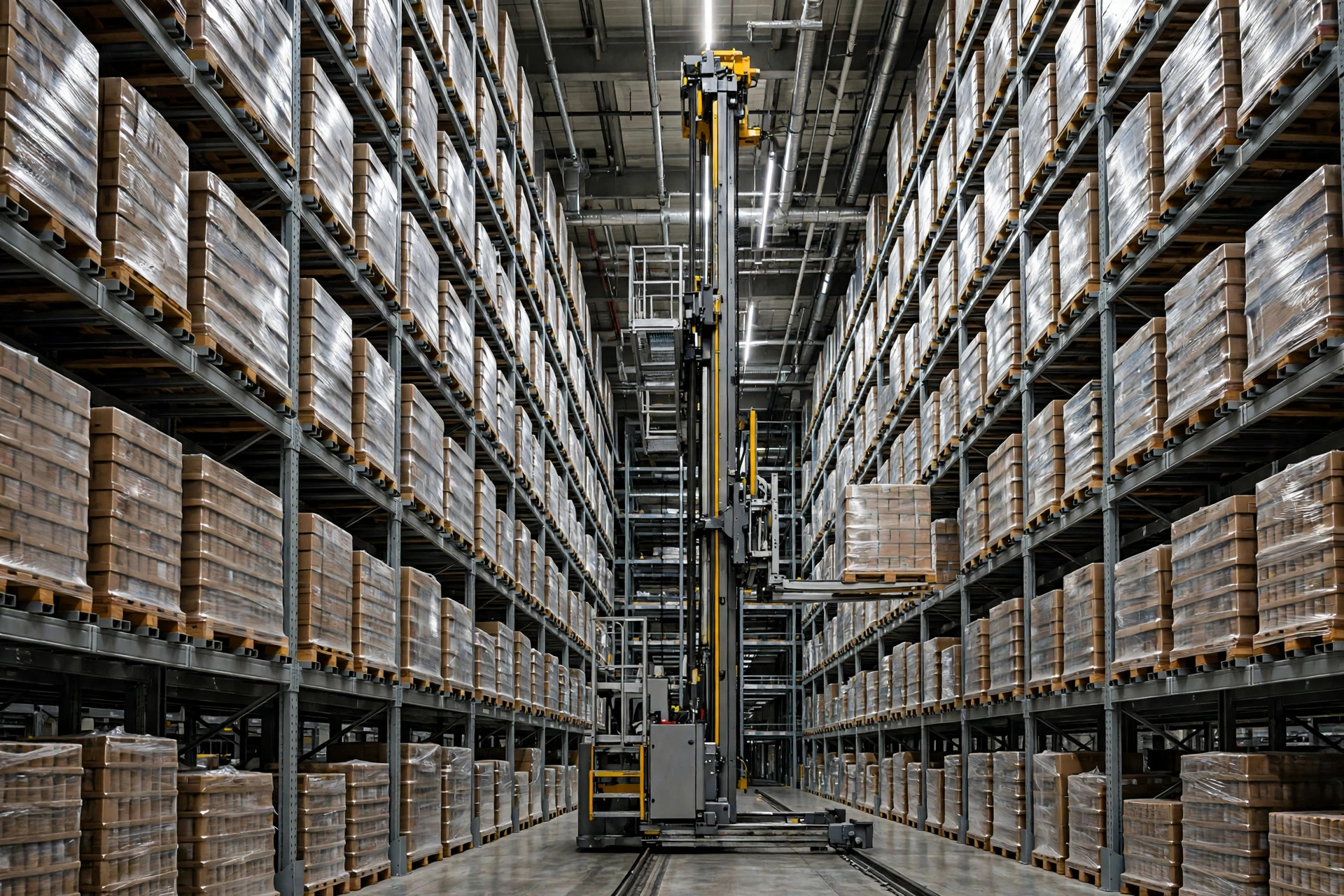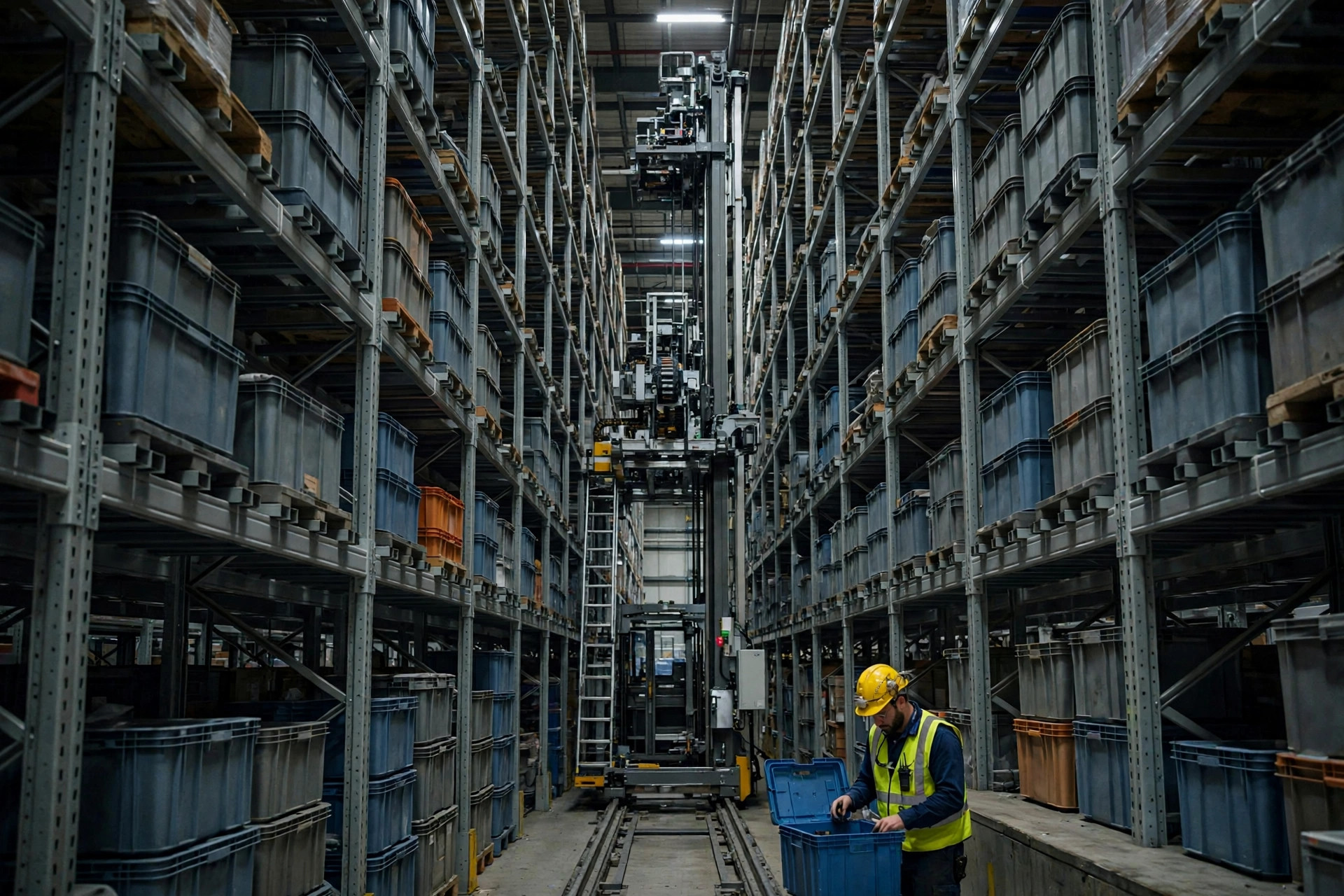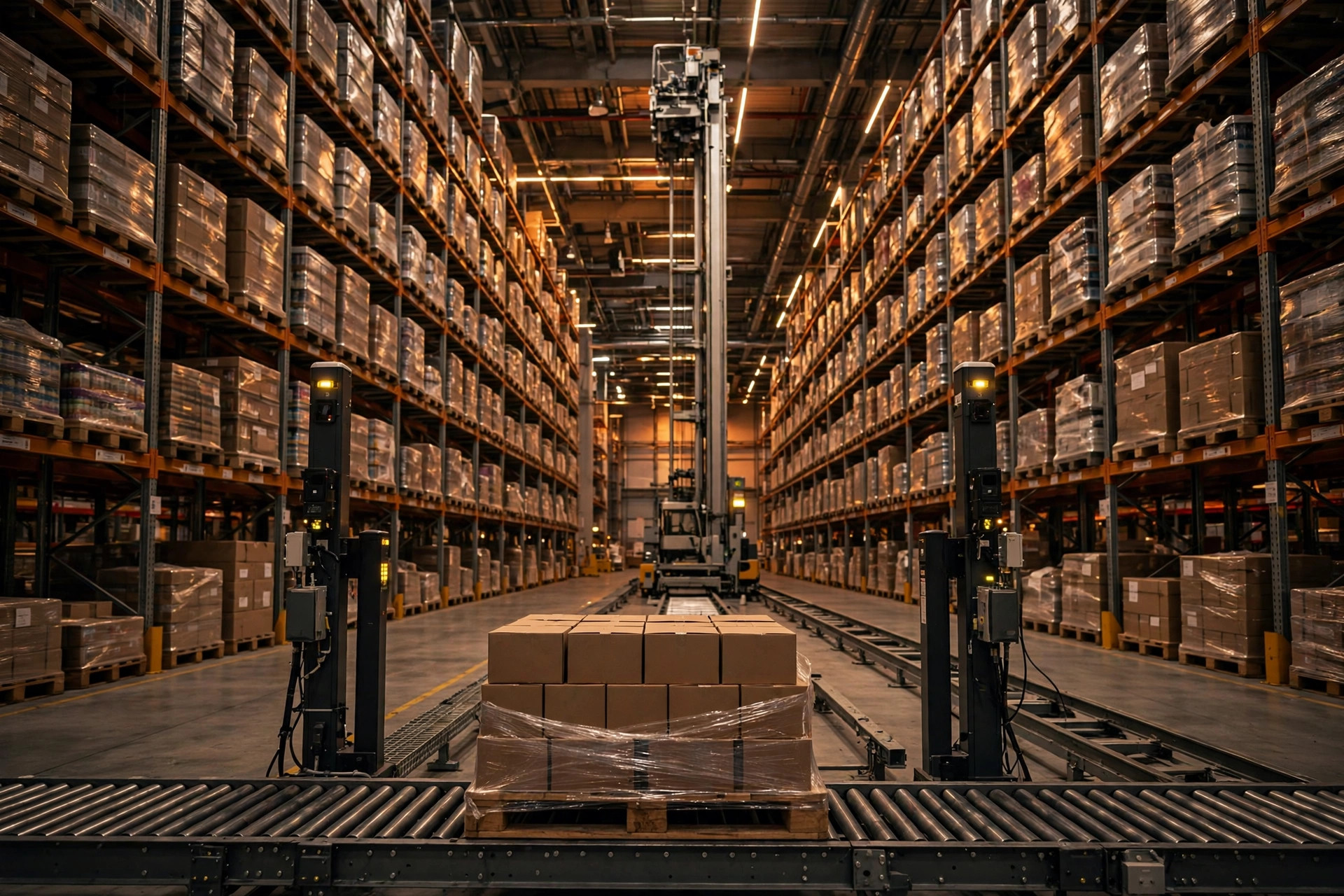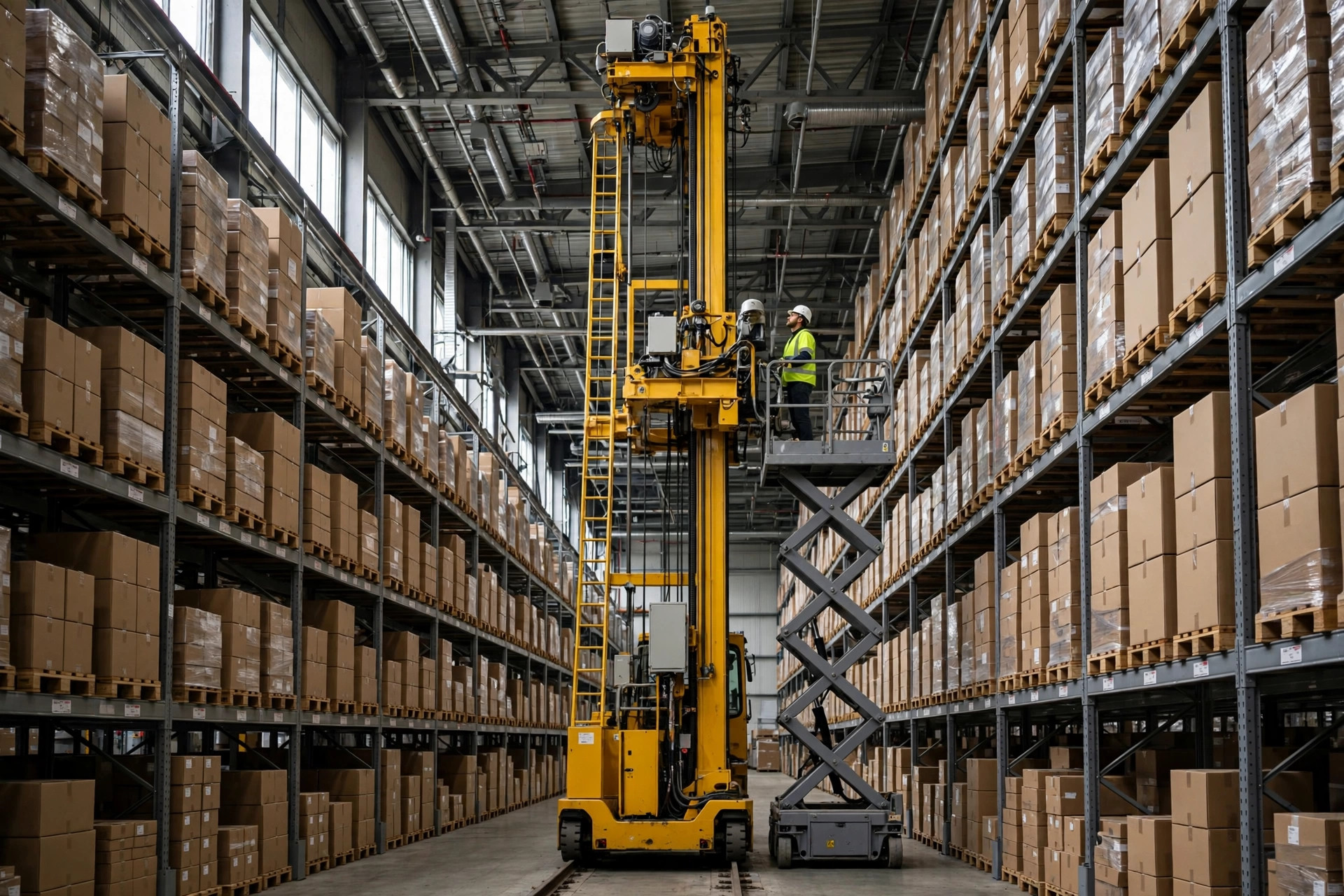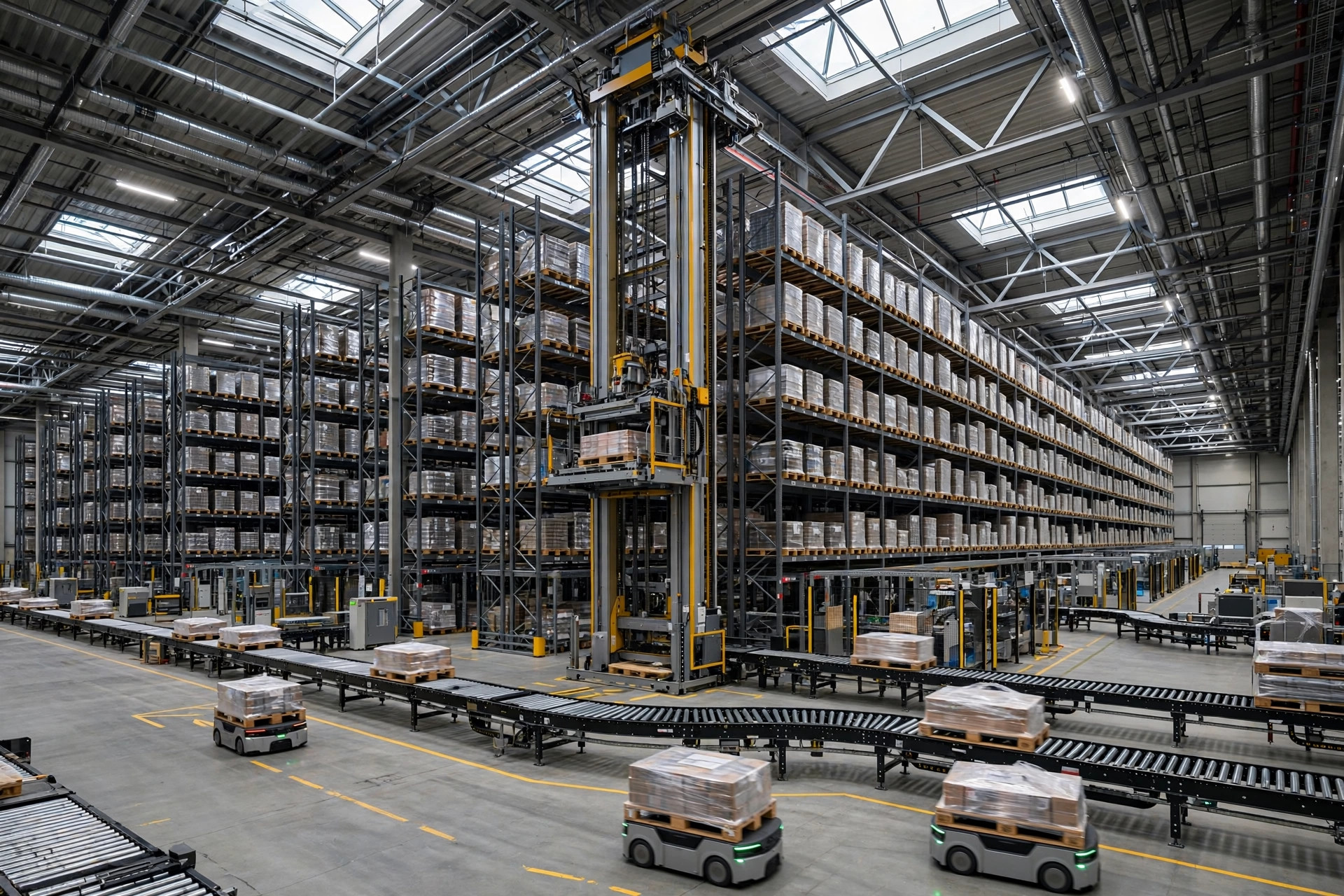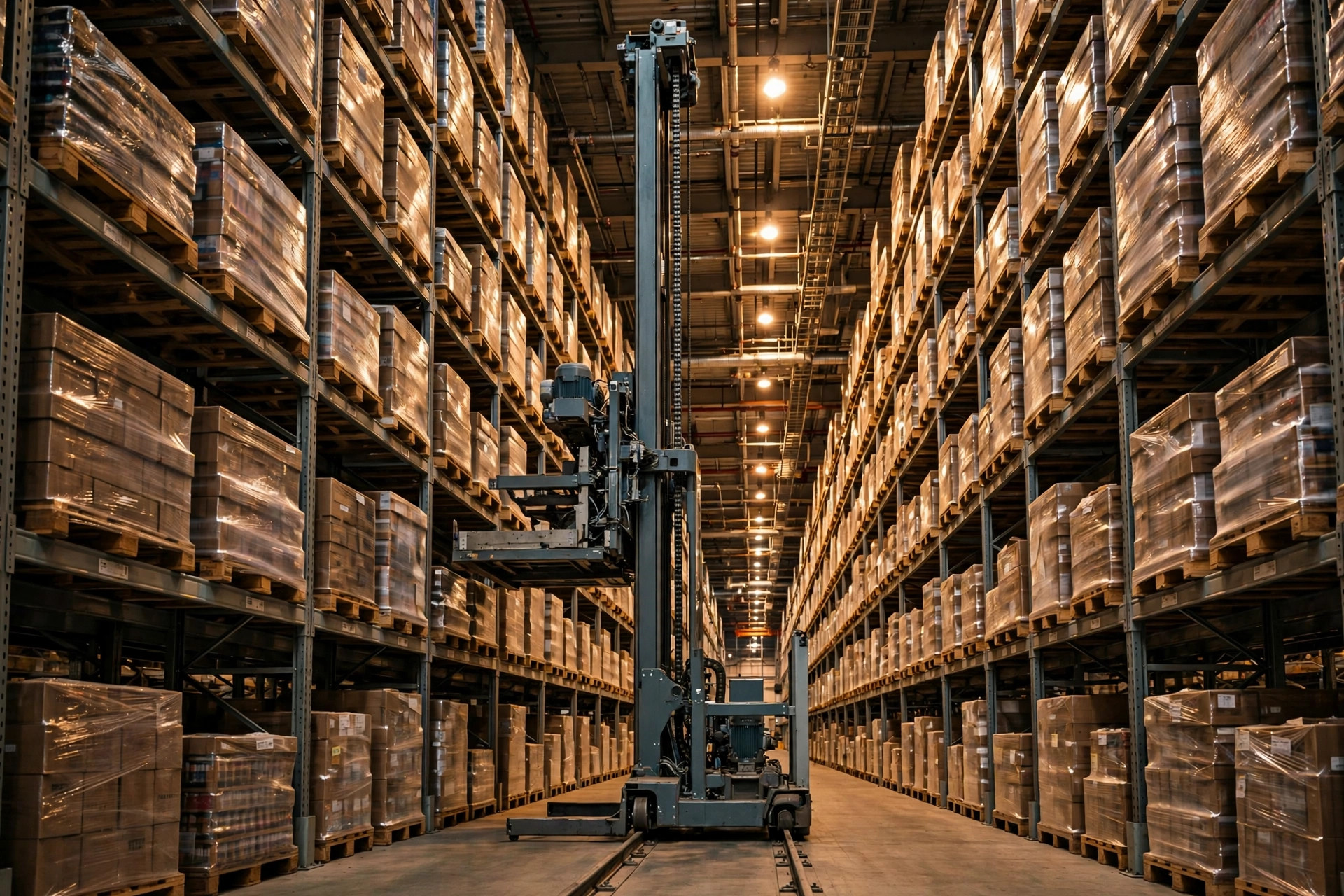
Crane addressing sounds boring until a fork punches through a pallet. In an ASRS aisle, the stacker crane has to know its exact position — horizontal travel and vertical lift — at all times. Miss by a centimeter and the fork either stabs the pallet or kisses the rack beam. I have seen the second one happen twice, and each repair bill had six digits. So before a salesperson dazzles you with "±0.5 mm accuracy," let us look at how the two mainstream approaches — laser positioning and barcode positioning — actually work.
How laser positioning works: one beam, one distance
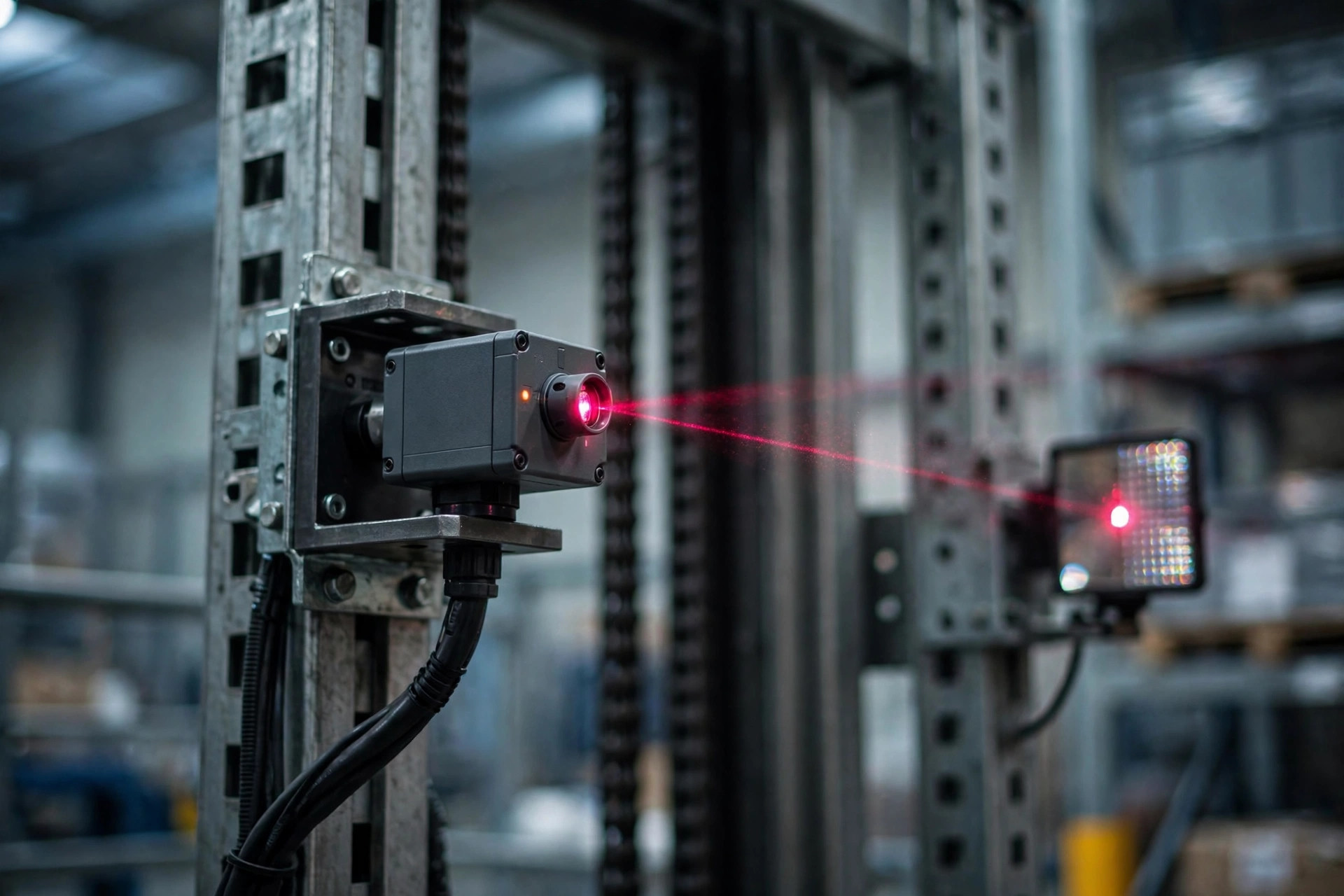
A laser distance sensor rides on the crane and fires at a reflector at the end of the aisle. Time of flight gives the distance. Think of shouting in a canyon and timing the echo, except light is six orders of magnitude faster than sound, and the sensor measures hundreds of times per second — fast enough to keep up with any crane speed.
Range covers hundreds of meters easily; a 30-meter-high bay is no problem. Repeatability is in the millimeter class — vendors typically quote ±1 to ±3 mm, so check the latest datasheets for the exact figure. One set for horizontal travel, one for vertical lift, independent of each other. Overall, laser positioning is the simple-honest route: straightforward physics, genuine precision, at the price of needing someone to look after it.
What does it fear? Dirt and drift. A film of dust on the sensor lens or the reflector kills reflectivity, and the controller starts throwing "position lost" alarms. Loaded rack uprights creep over the years, floors settle, and the moment the reflector drifts out of the beam, addressing starts to wander.
In 2022, a 3PL high-bay warehouse in Suzhou — 24 meters tall, double-deep stacker cranes running 240 m/min. When winter heating kicked in, dust levels rose, and two weeks without wiping the reflectors was enough for "position lost" alarms to start popping. Once, a crane emergency-stopped at full travel speed and the fork tip grazed a pallet bottom — one full pallet written off. The fix was embarrassingly simple: one new line on the maintenance checklist, "wipe reflectors every Wednesday." Three years, zero repeats. Laser addressing precision is real precision — but it demands housekeeping. That is its Achilles' heel.
How barcode positioning works: a 100-meter tape measure on the wall
A coded barcode tape — some systems use 2D-style codes — runs the full length of the aisle, and a reading head on the crane scans it like a barcode gun on the move. Every code carries absolute position data: wherever you read, you know where you are. Think of it as gluing a 100-meter tape measure to the wall, with the reader as the eye that reads it — it keeps reading even at 4 m/s.
Scale accuracy is likewise in the millimeter class, with repeatability around ±1 mm — again, check the latest datasheets. Dust and lighting changes barely bother it, because it reads codes, not reflected light. On this route, installation quality decides everything.
What does it fear? Installation, and physical damage. Over tens or hundreds of meters, the tape must go on dead straight with tight joints — 2 mm of crooked tape means a systematic 2 mm addressing error. Installation is labor-heavy: a 120-meter aisle takes two people two to three days of sticking and aligning. Aging tape, a chunk scraped off by a pallet, and the reader starts "skipping" over it, forcing the crane to slow down.
In 2024, a pharma cold store in Chengdu at -25°C. Frost formed on the barcode tape, read rates slid down from 99.9%, and the crane crawled at reduced speed through frosted zones — line throughput dropped 15%. The fix was a stream of dry air blown across the reader head. It cost next to nothing, but nobody thought of it during design. Barcode addressing does not fear dirt; it fears cold. The mirror image of laser.
Head to head: laser vs barcode positioning, three ledgers
| Dimension | Laser positioning | Barcode positioning |
|---|---|---|
| Principle | Laser distance, time of flight | Reading absolute-position barcode tape |
| Repeatability | Millimeter class (±1 to ±3) | Millimeter class (around ±1) |
| Hardware cost | High: sensor plus reflector is pricey | Low: reader plus tape is cheap |
| Installation cost | Low: mount two heads, align the beam, done in half a day | High: tape the whole aisle and align it, labor is the big line item |
| Maintenance focus | Wipe lenses and reflectors, fight dust | Check tape aging and joints, fight frost |
| Environmental weakness | Dust, reflector drift | Deep-freeze frosting, physical tape damage |
| Failure mode | Position lost, emergency stop | Skipped reads, slow crawl |
The trade-off in one sentence: laser is "expensive hardware, cheap installation, fussy maintenance"; barcode is "cheap hardware, expensive installation, maintenance that depends on luck." Over five years, total cost often lands in the same ballpark — which is why both camps of salespeople are still alive today, and neither has eaten the other.
Now for the rant. Plenty of buyers walk in demanding "±0.5 mm addressing accuracy." Sounds impressive, right? But rack uprights install at ±5 to ±10 mm tolerance, and a pallet sitting on the beams adds another ±10 mm of placement slop. However precisely you address, the fork is aiming at a slot that is already a centimeter off. Every millimeter of accuracy beyond the rack tolerance is money thrown away. The correct order: measure the rack tolerance first, then set the addressing spec, then talk price. Reverse it and you are just donating to the sales rep — I call out this kind of fake requirement every time I see it.
The dividing lines: which warehouse gets which, and who sleeps better in year five
There is no standard answer for crane addressing, only fit:
- Dusty warehouses (building materials, paper, grain): barcode. You will never wipe laser lenses often enough, no matter how detailed the checklist.
- Deep-freeze stores (below -20°C): laser with a heated housing, or barcode with air purge — put that small cost into the total before comparing.
- Very long aisles (hundred-meter class): laser. Laying barcode tape over 100 meters accumulates joint error you will regret.
- Tight budget, tight schedule: laser goes live fast — half a day to align and walk away. Got your own maintenance crew and cheap labor: barcode's long-term holding cost is lower.
- One-line rule: the longer the aisle, the more laser; the dirtier the environment, the more barcode; cold stores get their own math.
Now, maintenance in year five. Laser's trap is invisible dirt: the reflector sits at the end of the aisle where nobody goes. Half a year without wiping and reflectivity halves. The controller reports occasional losses, then frequent losses, then refuses to move. This belongs in the SOP checklist with a name attached. Barcode's trap is visible damage: tape scraped by pallets or gouged by forklifts. The reader skips right over it. Keep a spare length of tape in stores and use the proper splice joints — never patch with clear tape, because that section of code becomes unreadable. Run either route for five years and MTBF looks about the same. What differs is the maintenance motion: laser is "wipe often," barcode is "inspect often." Whether uptime holds depends entirely on whether someone actually does it.
So is the money worth it? Watch this one number: the rack installation tolerance, in millimeters. Tolerance of 10 mm and you are buying ±1 mm addressing — that is waste. Tolerance of 3 mm and you have earned the right to talk high precision. Measure the tolerance first, pick the approach second, do the math last. Get the order right, and the money is well spent.
By Da Liu, Automation Engineer